
Items related to Becoming Yellow: A Short History of Racial Thinking
Synopsis
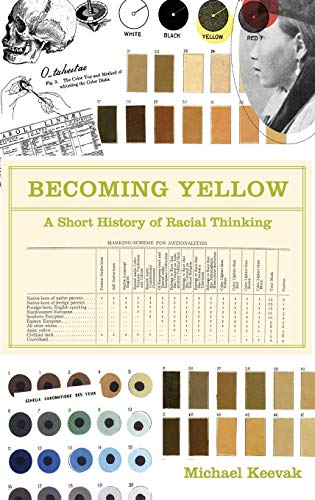
The story of how East Asians became "yellow" in the Western imagination―and what it reveals about the problematic history of racial thinking
In their earliest encounters with Asia, Europeans almost uniformly characterized the people of China and Japan as white. This was a means of describing their wealth and sophistication, their willingness to trade with the West, and their presumed capacity to become Christianized. But by the end of the seventeenth century the category of whiteness was reserved for Europeans only. When and how did Asians become "yellow" in the Western imagination? Looking at the history of racial thinking, Becoming Yellow explores the notion of yellowness and shows that this label originated not in early travel texts or objective descriptions, but in the eighteenth- and nineteenth-century scientific discourses on race.
From the walls of an ancient Egyptian tomb, which depicted people of varying skin tones including yellow, to the phrase "yellow peril" at the beginning of the twentieth century in Europe and America, Michael Keevak follows the development of perceptions about race and human difference. He indicates that the conceptual relationship between East Asians and yellow skin did not begin in Chinese culture or Western readings of East Asian cultural symbols, but in anthropological and medical records that described variations in skin color. Eighteenth-century taxonomers such as Carl Linnaeus, as well as Victorian scientists and early anthropologists, assigned colors to all racial groups, and once East Asians were lumped with members of the Mongolian race, they began to be considered yellow.
Demonstrating how a racial distinction took root in Europe and traveled internationally, Becoming Yellow weaves together multiple narratives to tell the complex history of a problematic term.
"synopsis" may belong to another edition of this title.
About the Author
Michael Keevak is a professor in the Department of Foreign Languages at National Taiwan University. His books include Sexual Shakespeare, The Pretended Asian, and The Story of a Stele.
From the Back Cover
"All racial categories are constructed, but none so laboriously as the 'yellow' of East Asians. This learned and stimulating book ranges across a half-dozen centuries of writing to tell the story of East Asians' transformation from 'white' to 'yellow' (and many hues in between) and their homogenization as members of a 'Mongolian' race. Drawing on travelogues, medical texts, and works of geography, anthropology, and natural history, Keevak unveils the complex and surprising history of an idea that remains deeply ingrained in our image of Asia and Asians today. Becoming Yellow is a marvelous contribution to the history of racialist thinking."--David L. Howell, Harvard University
"Becoming Yellow is an absorbing tale of how science was manipulated in quest of assigning a less-than-becoming shade to Asian peoples. Poring over several centuries of European accounts, Michael Keevak documents how the jaundiced views of the literati were by no means evenly applied and how scientific justifications of racial theory were colored more by contingent events than physical truths."--Michael Laffan, Princeton University
"This book will make an indelible and enlightening mark in the fields of post-colonial, race, and cultural studies, and will attract an uncommonly diverse audience. It has a rightful place as part of the literary and historical scholarship that comprises the greater contemporary postcolonial project."--Don J. Wyatt, Middlebury College
"Well-organized and engaging, this very interesting and singular work is a solid contribution to various fields and innovative in both its focus and approach. I cannot think of any other book that addresses the same subject that this one does."--Larissa Heinrich, University of California, San Diego
Excerpt. © Reprinted by permission. All rights reserved.
Becoming Yellow
A Short History of Racial ThinkingBy Michael KeevakPRINCETON UNIVERSITY PRESS
Copyright © 2011 Princeton University PressAll right reserved.
ISBN: 978-0-691-14031-5
Contents
List of Illustrations....................................................................................................................viiAcknowledgments..........................................................................................................................ixIntroduction No Longer White: The Nineteenth-Century Invention of Yellowness.............................................................1Chapter 1 Before They Were Yellow: East Asians in Early Travel and Missionary Reports....................................................23Chapter 2 Taxonomies of Yellow: Linnaeus, Blumenbach, and the Making of a "Mongolian" Race in the Eighteenth Century.....................43Chapter 3 Nineteenth-Century Anthropology and the Measurement of "Mongolian" Skin Color..................................................70Chapter 4 East Asian Bodies in Nineteenth-Century Medicine: The Mongolian Eye, the Mongolian Spot, and "Mongolism".......................101Chapter 5 Yellow Peril: The Threat of a "Mongolian" Far East, 1895–1920............................................................124Notes....................................................................................................................................145Works Cited..............................................................................................................................175Index....................................................................................................................................211
Chapter One
Before They Were Yellow East Asians in Early Travel and Missionary Reports
When premodern European authors attempted to describe the residents of other lands there was often little agreement about precisely what color they were, partly because before the end of the eighteenth century there was no systematic desire to classify people according to what we now call race. Western thinking had long differentiated between the peoples of the known world in a variety of ways, including often vague notions about skin tone. But markers such as religion, language, clothing, and social customs were seen as far more important and meaningful than the relative lightness or darkness of the inhabitants, which, in any case, was usually attributed to some combination of climate, gender, and social rank. Human "blackness" was a conceptual marker of difference that from an early date could be associated with dirt or evil (Satan was perceived as the only truly black individual), but in a broader sense it was also an adjective that was constantly utilized to suggest sin, idolatry, and cultures that lay outside the Christian community. Anyone beyond (or on the fringes of) Europe could be coded as "dark" or "black." Yet this, too, was not a racial distinction in the modern sense of the term. Even earlier, in the Greco- Roman world, skin color seemed to have held much less significance, although the lands to the east, known collectively as India, were always associated with marvels, fabulous wealth, and various forms of both human and nonhuman monsters.
It is against this background that we must understand a certain level of surprise when the earliest medieval travel narrators, such as Marco Polo at the end of the twelfth century, referred both to the leader of Cathay and the people of Japan as "white" (bianca). This description was extended to all Chinese when a version of Polo's text (and there were many) was edited for G. B. Ramusio's pioneering travel compendium in 1559. Other travelers to China such as Friar Odoric in the 1330s remarked that the people of the region were good looking (di corpo belli), although here the southern Chinese were described as pallid (pallidi) rather than white—and this, too, would become an important nuance in later accounts.
Beginning at the end of the fifteenth century, when (at first Iberian) travelers sailed around the tip of Africa and into the Indian Ocean, they were pleased and gratified to find that the people of Asia were not uniformly dark. It was another medieval stereotype (as in Isidore of Seville's Etymologies) that the inhabitants of the Indies were generally "tinged with color" (tincti coloris) owing to the burning heat of the region. This notion had become linked to another old legend that somewhere on the other side of the Arab world there existed a "lost" Christian (and perhaps "white") community led by the figure known as Prester John. He had been the subject of a fictional letter to the pope in 1164, asking for assistance in resisting the Arab enemy. Early modern Asian exploration as a whole might even be viewed as an attempt to fulfill a long-term obsession with finding Prester John, whose location constantly shifted as each new area became better known to Western travelers.
In 1511 the Portuguese were able to establish a permanent outpost for East Asian trade at Malacca, which for some time had already been a site of thriving international commerce. Persistent rumors of "white" people in the Far East had suddenly become a reality, as both Chinese and Japanese (as well as Arabs and other East Asians) were a common sight. The "whiteness" of these people was constantly highlighted, not only in contrast to the Indians but as a term that described their presumed level of civilization. A revealing case in point is one of the earliest accounts of the arrival of the Europeans by Girolamo Sernigi, a Florentine merchant who had been in the employ of the Portuguese during the first voyage of Vasco de Gama in 1497–99. Before sailing into the Indian Ocean the Portuguese had arrived at Calicut on the southwest coast of India, where they were told about a visit some eighty years previously of "certain vessels of white [bianchi] Christians, who wore their hair long like Germans, and had no beards except around the mouth, such as are worn at Constantinople by cavaliers and courtiers." Sernigi added that if these sailors had really been Germans the Portuguese would have known about them, so he wondered whether they were Russians instead.
We have no idea what was really said to de Gama and his party, and one must assume that the comparison to Germans was merely part of the way in which the rumor was received or retold from a Western perspective. Second, one suspects that the identification of these men as Christian was also a European assumption, since for centuries they had already fashioned an equation between human whiteness and Christianity. Moreover, the whole story was related at second- or thirdhand at best, and it was not published until 1507, long after Sernigi had returned to Lisbon. It has been plausibly argued, however, that these "white Christians" were in fact Chinese, members of an enormous seagoing operation headed by the eunuch Zheng He (or Chung Ho), who before he died in 1435 had established the Chinese as the leading international trading presence in the entire Indian Ocean region, a position they held for many decades before circumstances led to their almost complete (official) withdrawal by the time the Portuguese arrived. It has even been suggested that initially the Indians of Calicut may have welcomed the Portuguese precisely because they thought they were Chinese.
Whatever the case, Sernigi's anecdote was later canonized in Luis de Camões's sixteenth-century national epic, The Lusiads, where it was integrated into a glorified narrative of Portuguese trade and the triumph of Christian civilization. The entire tone of the story has been altered, too, as Camões transformed Sernigi's puzzlement and suspicion into a good omen for the joyous prospect of future profit in an already well- formed system of multinational trade. When the Portuguese met dark- skinned Arabic- speaking men, Camões described them as "Ethiopians" who "had communicated with better people," and when the Portuguese also learned that "from the East" there were other ships as large as their own and manned by white men—"people much like us, of the color of day" (Gente, assi como nós, da côr do dia)—the implication seemed to be that these were Arab traders rather than European competitors.
While the Indian informants at Calicut were unable or uninterested in distinguishing one light-colored skin from another, Sernigi and Camões both presumptuously supposed that the Europeans were the only truly "white" people in the world, which is to say the only civilized Christian nations. Darker-skinned peoples might have learned to speak Arabic and have mastered the art of overseas navigation, but it was also assumed that if there really were white men in the East they must have been Europeans like themselves, and if they were northern Africans they might also have relatively fair skin but they were certainly not "white." The European reception of this new body of information, in other words, was immediately read according to presuppositions about human culture as it was related to skin color, and while we are unable to say with any certainty whether the earlier white visitors were indeed Chinese (and the evidence seems to be based mainly on the kind of weapons they are described as carrying), this is a perfect example of Westerners' misunderstanding of their own presumed superiority.
In the version of Sernigi's letter published by Ramusio the visitors' whiteness and their imagined nationality went unmentioned, and yet the structure of European self-interest remained the same, as the desire to "find" white Christians in the East, or to Christianize them if they were of another religion, were central features of Western encounters with native peoples. King Manuel I of Portugal's oft-quoted instructions to Diogo Lopes de Sequeira in 1508, three years before the Portuguese had established their position at Malacca, was intensely concerned about the religion of (in this case) China. "Are they Christian or heathen; do any Moors live among them or others who are not of their faith; what do they believe in if they are not Christians?"
WHITE EAST ASIANS
In the beginning of the European "age of exploration," in short, East Asian peoples were almost uniformly described as white, never as yellow. The surviving literature is full of references to the whiteness of both Chinese and Japanese natives, as merchants and (later) missionaries were able to penetrate into the mysterious lands of the marvelous East. A few examples should suffice. One of the very first accounts was by Tomé Pires, a Portuguese apothecary who stayed in Malacca between 1512 and 1515 and who compiled a long report known as the Suma oriental, addressed to King Manuel I. Like all such information his notes were a closely guarded secret, since the Portuguese hoped to retain a monopoly on the enormously profitable trade to the region. A part of the text was published (also by Ramusio) when that monopoly was no longer secure, including information that the Chinese were "white like us [bianchi, si come siamo noi], the greater part of them dressing in cotton cloth and silk." The full text compared them to Germans (something of a cliché in this period), and the women, who were also described as being "of our whiteness" (da nosa alvura), looked like Spanish ladies.
A contemporaneous report by Duarte Barbosa, a Portuguese official in India for many years, was also published in abridged form by Ramusio. Here, too, the people of China were fair-skinned: "great merchants, white men and well-made [huomini bianchi, grandi & ben disposti]; their women are very beautiful but both the men and women have small eyes, and the men's beards contain only three or four hairs and no more." Once again the appearance of the people was measured according to thoroughly European standards; they were praised for wearing shoes and stockings and were compared to Germans, this time in terms of their language, as if it were an equally outlandish tongue to Iberian ears. Another (unpublished) description by Giovanni da Empoli in 1514 agreed that the Chinese were "white men [uomini bianchi], dressed after our fashion like Germans, with French boots and shoes." The earliest reports of the Japanese took much the same form, although at first information was available about Ryukyu islanders only. Pires had noted that they were "white men, well dressed" (homees bramquos bem vestidos), but they were also said to be even better than the Chinese, "more dignified." This is because they were perceived to be wealthier, and in 1517 an order was sent out to find the location of these people of "Lequia."
My review of these early accounts is both cursory and oversimplified, but it should be clear immediately that the whiteness or reputed whiteness of these people was not a racial designator and indeed not really even a description of their color. If the Chinese or Okinawans were described as white, it was a function of their affluence and their power and their apparent level of cultural sophistication. White, like all color terms, was evaluative rather than descriptive. Perhaps East Asian pigmentation was seen to differ from that of Africans or Indians or Malaysians, but this was not why they were called "white." Before long it was also a function of their perceived capacity to become truly "civilized," which is to say converted to European Christianity. It is partly for this reason that the Japanese started out much whiter than their Chinese neighbors, since by the end of the sixteenth century hundreds of thousands of people had already been converted. The published version of the first European visit to Japanese territory in 1543, when a group of Portuguese had landed by mistake on the island of Tanegashima, noted that the boats sent out to meet them contained men whiter than the Chinese (mais alvos que os Chins), with small eyes and short beards. Other early reports, such as that of Portuguese captain Jorge Alvares in 1547, agreed that these were a white people (gemte bramqua), and the same phrase was used much more famously in the 1552 "Letter to Europe" of St. Francis Xavier, the pioneer missionary who had arrived in 1549.
Henceforth, Japanese whiteness would be constantly reiterated in the missionary literature, but this, too, was always connected to the (potential) Christianity of the people. Xavier notoriously described them as "the best people yet discovered" ("among the infidels," that is), but this was a verdict thoroughly based on local codes of honor, honesty, and virtue that were perceived as being amenable to Western Christianity. As fellow missionary Balthasar Gago put it in 1555, despite the fact that the Japanese were a handsome, polite, and cultured white people (gente branca), it was no marvel to see them fall into misery, as they lacked the true religion. Or as another (anonymous) missionary wrote in 1581, the Japanese might well be white (colore candidi) and even superior to many Europeans, but it was precisely those qualities that made them "especially fit for taking up the religion of Christ."
Not everyone would share this sort of enthusiasm, however, and many insisted that the Japanese were colors other than white. Alessandro Valignano, for instance, the Jesuit Visitor to Japan and chief architect of the program for conversions, disgustedly noted how many Portuguese continued to refer to the Japanese (and the Chinese as well) as negros. Other nonmissionary eyewitness travelers, such as Olivier van Noort and Dirck Pomp, found the Japanese brown (bruyn) and black (swart) instead. And when four Japanese teenagers made a papal visit to Rome in 1585, a public relations event carefully orchestrated by Valignano as well, they were variously described as olive (olivastro), brown (bruna), pale and deathly (pallida e smorticcia), the color of Africans (di colore Affricano), and the color of lead (di color di piombo). And this was despite the fact that they had already been converted. One commentator puzzled over the fact that as they lived in a cold climate, they "should be white" (suol esser bianca), and he tried to explain this fact by appealing to the idea that perhaps their olive (olivastro) skin was simply a result of their long and arduous journey.
Soon enough, however, Japanese Christians would become the object of increasingly frequent and often horrific persecutions. In 1614 the religion was officially banned, and in 1639 the last of the remaining Westerners had been summarily expelled. The tone of all European reports, as one might imagine, grew steadily more subdued along with the complexion of the natives. When an actual Japanese ambassador showed up in Rome in 1614, he was judged to be pallid (palles), tanned (basannéz), yellow tending to olive (giallo, tirante quasi all'ollivastro), and greasy black (di color nero grasso). In 1660 even the official Jesuit history now called them olive (ulivigno). Another Jesuit text from 1715 continued to assert that the Japanese were at least less olive (moins olivâtre) than other East Asians, but this view was revised twenty years later when the same author proclaimed that their color was just as olive (olivâtre) as the Chinese. In the meantime Engelbert Kaempfer's History of Japan had been published in 1727, which remained Europe's standard account until well into the nineteenth century. Here the Japanese were no longer white but brown (braune) instead, and this was rendered into English as tawny and into French as bazanez, which along with olivastro were perhaps the most common terms for describing native peoples who were not exactly black but not white either.
(Continues...)
Excerpted from Becoming Yellowby Michael Keevak Copyright © 2011 by Princeton University Press. Excerpted by permission of PRINCETON UNIVERSITY PRESS. All rights reserved. No part of this excerpt may be reproduced or reprinted without permission in writing from the publisher.
Excerpts are provided by Dial-A-Book Inc. solely for the personal use of visitors to this web site.
"About this title" may belong to another edition of this title.
Search results for Becoming Yellow: A Short History of Racial Thinking

Stock Image
Becoming Yellow: A Short History of Racial Thinking
Published by
Princeton University Press, 2011
ISBN 10: 0691140316
ISBN 13: 9780691140315
Used
Hardcover
First Edition
Seller: Textbooks_Source, Columbia, MO, U.S.A.
Seller rating 5 out of 5 stars

hardcover. Condition: Good. 1st Edition. Ships in a BOX from Central Missouri! May not include working access code. Will not include dust jacket. Has used sticker(s) and some writing or highlighting. UPS shipping for most packages, (Priority Mail for AK/HI/APO/PO Boxes). Seller Inventory # 001462865U
Seller Image
Becoming Yellow : A Short History of Racial Thinking
Published by
Princeton University Press, 2011
ISBN 10: 0691140316
ISBN 13: 9780691140315
Used
Hardcover
Seller: GreatBookPrices, Columbia, MD, U.S.A.
Seller rating 5 out of 5 stars
Condition: good. May show signs of wear, highlighting, writing, and previous use. This item may be a former library book with typical markings. No guarantee on products that contain supplements Your satisfaction is 100% guaranteed. Twenty-five year bookseller with shipments to over fifty million happy customers. Seller Inventory # 5695085-5
Seller Image
Becoming Yellow
Published by
White Lotus Press, Princeton, 2011
ISBN 10: 0691140316
ISBN 13: 9780691140315
Used
Paperback
Seller: SEATE BOOKS, APO, AP, U.S.A.
Seller rating 4 out of 5 stars

Paperback. Condition: Good. Dust Jacket Condition: no dj. Becoming Yellow. Book. Seller Inventory # N5004
Seller Image
Becoming Yellow : A Short History of Racial Thinking
Published by
Princeton University Press, 2011
ISBN 10: 0691140316
ISBN 13: 9780691140315
New
Hardcover
Seller: GreatBookPrices, Columbia, MD, U.S.A.
Seller rating 5 out of 5 stars
Condition: New. Seller Inventory # 5695085-n
Seller Image
Becoming Yellow
Published by
Princeton University Press, US, 2011
ISBN 10: 0691140316
ISBN 13: 9780691140315
New
Hardcover
Seller: Rarewaves USA, HEBRON, KY, U.S.A.
Seller rating 5 out of 5 stars
Hardback. Condition: New. In their earliest encounters with Asia, Europeans almost uniformly characterized the people of China and Japan as white. This was a means of describing their wealth and sophistication, their willingness to trade with the West, and their presumed capacity to become Christianized. But by the end of the seventeenth century the category of whiteness was reserved for Europeans only. When and how did Asians become "yellow" in the Western imagination? Looking at the history of racial thinking, Becoming Yellow explores the notion of yellowness and shows that this label originated not in early travel texts or objective descriptions, but in the eighteenth- and nineteenth-century scientific discourses on race. From the walls of an ancient Egyptian tomb, which depicted people of varying skin tones including yellow, to the phrase "yellow peril" at the beginning of the twentieth century in Europe and America, Michael Keevak follows the development of perceptions about race and human difference.He indicates that the conceptual relationship between East Asians and yellow skin did not begin in Chinese culture or Western readings of East Asian cultural symbols, but in anthropological and medical records that described variations in skin color. Eighteenth-century taxonomers such as Carl Linnaeus, as well as Victorian scientists and early anthropologists, assigned colors to all racial groups, and once East Asians were lumped with members of the Mongolian race, they began to be considered yellow. Demonstrating how a racial distinction took root in Europe and traveled internationally, Becoming Yellow weaves together multiple narratives to tell the complex history of a problematic term. Seller Inventory # LU-9780691140315
Seller Image
Becoming Yellow : A Short History of Racial Thinking
Published by
Princeton University Press, 2011
ISBN 10: 0691140316
ISBN 13: 9780691140315
Used
Hardcover
Seller: GreatBookPrices, Columbia, MD, U.S.A.
Seller rating 5 out of 5 stars
Condition: As New. Unread book in perfect condition. Seller Inventory # 5695085
Seller Image
Becoming Yellow : A Short History of Racial Thinking
Published by
Princeton University Press, 2011
ISBN 10: 0691140316
ISBN 13: 9780691140315
Used
Hardcover
Seller: GreatBookPricesUK, Woodford Green, United Kingdom
Seller rating 5 out of 5 stars
Condition: good. May show signs of wear, highlighting, writing, and previous use. This item may be a former library book with typical markings. No guarantee on products that contain supplements Your satisfaction is 100% guaranteed. Twenty-five year bookseller with shipments to over fifty million happy customers. Seller Inventory # 5695085-5
Buy Used
£ 53.98
£ 15 shipping
Ships from United Kingdom to U.S.A.
Ships from United Kingdom to U.S.A.
Quantity: 3 available
Seller Image
Becoming Yellow : A Short History of Racial Thinking
Published by
Princeton University Press, 2011
ISBN 10: 0691140316
ISBN 13: 9780691140315
Used
Hardcover
Seller: GreatBookPricesUK, Woodford Green, United Kingdom
Seller rating 5 out of 5 stars
Condition: As New. Unread book in perfect condition. Seller Inventory # 5695085
Buy Used
£ 80.52
£ 15 shipping
Ships from United Kingdom to U.S.A.
Ships from United Kingdom to U.S.A.
Quantity: 3 available
Seller Image
Becoming Yellow : A Short History of Racial Thinking
Published by
Princeton University Press, 2011
ISBN 10: 0691140316
ISBN 13: 9780691140315
New
Hardcover
Seller: GreatBookPricesUK, Woodford Green, United Kingdom
Seller rating 5 out of 5 stars
Condition: New. Seller Inventory # 5695085-n
Buy New
£ 86.98
£ 15 shipping
Ships from United Kingdom to U.S.A.
Ships from United Kingdom to U.S.A.
Quantity: 3 available
Seller Image
Becoming Yellow
Published by
Princeton University Press, US, 2011
ISBN 10: 0691140316
ISBN 13: 9780691140315
New
Hardcover
Seller: Rarewaves USA United, HEBRON, KY, U.S.A.
Seller rating 5 out of 5 stars
Hardback. Condition: New. In their earliest encounters with Asia, Europeans almost uniformly characterized the people of China and Japan as white. This was a means of describing their wealth and sophistication, their willingness to trade with the West, and their presumed capacity to become Christianized. But by the end of the seventeenth century the category of whiteness was reserved for Europeans only. When and how did Asians become "yellow" in the Western imagination? Looking at the history of racial thinking, Becoming Yellow explores the notion of yellowness and shows that this label originated not in early travel texts or objective descriptions, but in the eighteenth- and nineteenth-century scientific discourses on race. From the walls of an ancient Egyptian tomb, which depicted people of varying skin tones including yellow, to the phrase "yellow peril" at the beginning of the twentieth century in Europe and America, Michael Keevak follows the development of perceptions about race and human difference.He indicates that the conceptual relationship between East Asians and yellow skin did not begin in Chinese culture or Western readings of East Asian cultural symbols, but in anthropological and medical records that described variations in skin color. Eighteenth-century taxonomers such as Carl Linnaeus, as well as Victorian scientists and early anthropologists, assigned colors to all racial groups, and once East Asians were lumped with members of the Mongolian race, they began to be considered yellow. Demonstrating how a racial distinction took root in Europe and traveled internationally, Becoming Yellow weaves together multiple narratives to tell the complex history of a problematic term. Seller Inventory # LU-9780691140315