
Items related to How Round Is Your Circle?: Where Engineering and Mathematics...
Synopsis
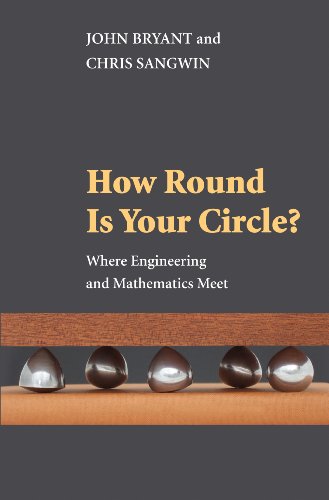
How do you draw a straight line? How do you determine if a circle is really round? These may sound like simple or even trivial mathematical problems, but to an engineer the answers can mean the difference between success and failure. How Round Is Your Circle? invites readers to explore many of the same fundamental questions that working engineers deal with every day--it's challenging, hands-on, and fun.
John Bryant and Chris Sangwin illustrate how physical models are created from abstract mathematical ones. Using elementary geometry and trigonometry, they guide readers through paper-and-pencil reconstructions of mathematical problems and show them how to construct actual physical models themselves--directions included. It's an effective and entertaining way to explain how applied mathematics and engineering work together to solve problems, everything from keeping a piston aligned in its cylinder to ensuring that automotive driveshafts rotate smoothly. Intriguingly, checking the roundness of a manufactured object is trickier than one might think. When does the width of a saw blade affect an engineer's calculations--or, for that matter, the width of a physical line? When does a measurement need to be exact and when will an approximation suffice? Bryant and Sangwin tackle questions like these and enliven their discussions with many fascinating highlights from engineering history. Generously illustrated, How Round Is Your Circle? reveals some of the hidden complexities in everyday things.
"synopsis" may belong to another edition of this title.
About the Author
John Bryant is a retired chemical engineer. He was lecturer in engineering at the University of Exeter until 1994. Chris Sangwin is lecturer in mathematics at the University of Birmingham. He is the coauthor of Mathematics Galore!
From the Back Cover
"This book is a mine of exploration and information. I would recommend it to anyone with an interest in how things work and in how mathematics can help make sense of the world. Budding engineers and mathematicians will find it an inspiration."--John Mason, The Open University
"Truly impressive. This book builds a bridge across the ordinarily huge chasm separating how engineers and mathematicians view the world. Its innovative approach will be refreshing to readers with an engineering bent, and an eye-opener for many mathematicians. The audience for this book includes just about anyone who has any curiosity at all about how mathematics helps in explaining the world."--Paul J. Nahin, author ofAn Imaginary Tale
"I learned a lot from this book. I think it will have wide appeal, including with those readers who are interested in mathematics and those who are interested in building models. I was up until midnight the other night making a hatchet planimeter out of a coat hanger and washers!"--David Richeson, Dickinson College
From the Inside Flap
"This book is a mine of exploration and information. I would recommend it to anyone with an interest in how things work and in how mathematics can help make sense of the world. Budding engineers and mathematicians will find it an inspiration."--John Mason, The Open University
"Truly impressive. This book builds a bridge across the ordinarily huge chasm separating how engineers and mathematicians view the world. Its innovative approach will be refreshing to readers with an engineering bent, and an eye-opener for many mathematicians. The audience for this book includes just about anyone who has any curiosity at all about how mathematics helps in explaining the world."--Paul J. Nahin, author of An Imaginary Tale
"I learned a lot from this book. I think it will have wide appeal, including with those readers who are interested in mathematics and those who are interested in building models. I was up until midnight the other night making a hatchet planimeter out of a coat hanger and washers!"--David Richeson, Dickinson College
"About this title" may belong to another edition of this title.
Search results for How Round Is Your Circle?: Where Engineering and Mathematics...

Stock Image
How Round Is Your Circle?: Where Engineering and Mathematics Meet
Published by
Princeton University Press, 2008
ISBN 10: 069113118X
ISBN 13: 9780691131184
Used
Hardcover
Seller: World of Books (was SecondSale), Montgomery, IL, U.S.A.
Seller rating 5 out of 5 stars

Condition: Good. Item in good condition. Textbooks may not include supplemental items i.e. CDs, access codes etc. Seller Inventory # 00108864859
Stock Image
How Round Is Your Circle?: Where Engineering and Mathematics Meet
Published by
Princeton University Press, 2008
ISBN 10: 069113118X
ISBN 13: 9780691131184
Used
Hardcover
Seller: World of Books (was SecondSale), Montgomery, IL, U.S.A.
Seller rating 5 out of 5 stars
Condition: Acceptable. Item in acceptable condition! Textbooks may not include supplemental items i.e. CDs, access codes etc. Seller Inventory # 00110282750
Stock Image
How Round Is Your Circle?: Where Engineering and Mathematics Meet
Published by
Princeton University Press (edition First Edition), 2008
ISBN 10: 069113118X
ISBN 13: 9780691131184
Used
Hardcover
First Edition
Seller: BooksRun, Philadelphia, PA, U.S.A.
Seller rating 5 out of 5 stars
Hardcover. Condition: Fair. First Edition. With dust jacket. The item might be beaten up but readable. May contain markings or highlighting, as well as stains, bent corners, or any other major defect, but the text is not obscured in any way. Seller Inventory # 069113118X-7-1-29
Stock Image
How Round Is Your Circle?: Where Engineering and Mathematics Meet
Published by
Princeton University Press, 2008
ISBN 10: 069113118X
ISBN 13: 9780691131184
Used
Hardcover
Seller: World of Books Inc, Montgomery, IL, U.S.A.
Seller rating 4 out of 5 stars

Hardback. Condition: Good. How do you draw a straight line? How do you determine if a circle is really round? These may sound like simple or even trivial mathematical problems, but to an engineer the answers can mean the difference between success and failure. This work invites you to explore many of the same fundamental questions that working engineers deal with every day. Seller Inventory # CIN069113118XG
Seller Image
How Round Is Your Circle?: Where Engineering and Mathematics Meet
Published by
Princeton University Press, 2008
ISBN 10: 069113118X
ISBN 13: 9780691131184
Used
Hardcover
Seller: Goodwill of Colorado, COLORADO SPRINGS, CO, U.S.A.
Seller rating 5 out of 5 stars
Condition: good. All pages and cover are intact. Dust jacket included if applicable, though it may be missing on hardcover editions. Spine and cover may show minor signs of wear including scuff marks, curls or bends to corners as well as cosmetic blemishes including stickers. Pages may contain limited notes or highlighting. "From the library of" labels may be present. Shrink wrap, dust covers, or boxed set packaging may be missing. Bundled media e.g., CDs, DVDs, access codes may not be included. Seller Inventory # COLV.069113118X.G
Stock Image
How Round Is Your Circle? : Where Engineering and Mathematics Meet
Published by
Princeton University Press, 2008
ISBN 10: 069113118X
ISBN 13: 9780691131184
Used
Hardcover
Seller: Better World Books, Mishawaka, IN, U.S.A.
Seller rating 5 out of 5 stars
Condition: Good. Former library copy. Pages intact with minimal writing/highlighting. The binding may be loose and creased. Dust jackets/supplements are not included. Includes library markings. Stock photo provided. Product includes identifying sticker. Better World Books: Buy Books. Do Good. Seller Inventory # 4783600-6
Stock Image
How Round Is Your Circle? : Where Engineering and Mathematics Meet
Published by
Princeton University Press, 2008
ISBN 10: 069113118X
ISBN 13: 9780691131184
Used
Hardcover
Seller: Better World Books: West, Reno, NV, U.S.A.
Seller rating 5 out of 5 stars
Condition: Very Good. Former library copy. Pages intact with possible writing/highlighting. Binding strong with minor wear. Dust jackets/supplements may not be included. Includes library markings. Stock photo provided. Product includes identifying sticker. Better World Books: Buy Books. Do Good. Seller Inventory # 6002365-6
Stock Image
How Round Is Your Circle?: Where Engineering and Mathematics Meet
Published by
Princeton University Press, 2008
ISBN 10: 069113118X
ISBN 13: 9780691131184
Used
Hardcover
Seller: HPB-Diamond, Dallas, TX, U.S.A.
Seller rating 5 out of 5 stars
Hardcover. Condition: Very Good. Connecting readers with great books since 1972! Used books may not include companion materials, and may have some shelf wear or limited writing. We ship orders daily and Customer Service is our top priority! Seller Inventory # S_468095454
Stock Image
How Round Is Your Circle?: Where Engineering and Mathematics Meet
Published by
Princeton University Press, 2008
ISBN 10: 069113118X
ISBN 13: 9780691131184
Used
Hardcover
Seller: Half Price Books Inc., Dallas, TX, U.S.A.
Seller rating 5 out of 5 stars
hardcover. Condition: Very Good. Connecting readers with great books since 1972! Used books may not include companion materials, and may have some shelf wear or limited writing. We ship orders daily and Customer Service is our top priority! Seller Inventory # S_479586214
Stock Image
How Round Is Your Circle?: Where Engineering and Mathematics Meet
Published by
Princeton University Press, 2008
ISBN 10: 069113118X
ISBN 13: 9780691131184
Used
Hardcover
Seller: Lexington Books Inc, Idaho Falls, ID, U.S.A.
Seller rating 5 out of 5 stars
Hardcover. Condition: Good. Contents are tight; Small amount of highlighting. Seller Inventory # 137706