
Items related to Simple Algebras, Base Change, and the Advanced Theory...
Simple Algebras, Base Change, and the Advanced Theory of the Trace Formula: 120 (Annals of Mathematics Studies, 120) - Softcover
Book 104 of 202: Annals of Mathematics Studies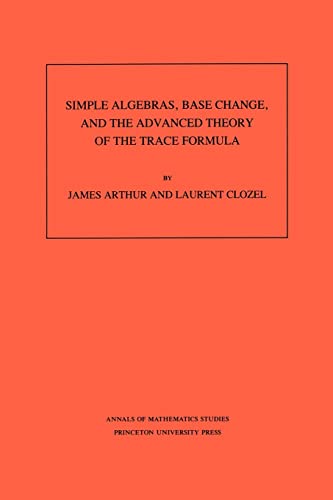
Synopsis
A general principle, discovered by Robert Langlands and named by him the "functoriality principle," predicts relations between automorphic forms on arithmetic subgroups of different reductive groups. Langlands functoriality relates the eigenvalues of Hecke operators acting on the automorphic forms on two groups (or the local factors of the "automorphic representations" generated by them). In the few instances where such relations have been probed, they have led to deep arithmetic consequences.
This book studies one of the simplest general problems in the theory, that of relating automorphic forms on arithmetic subgroups of GL(n,E) and GL(n,F) when E/F is a cyclic extension of number fields. (This is known as the base change problem for GL(n).) The problem is attacked and solved by means of the trace formula. The book relies on deep and technical results obtained by several authors during the last twenty years. It could not serve as an introduction to them, but, by giving complete references to the published literature, the authors have made the work useful to a reader who does not know all the aspects of the theory of automorphic forms.
"synopsis" may belong to another edition of this title.
Search results for Simple Algebras, Base Change, and the Advanced Theory...

Stock Image
Simple Algebras, Base Change, and the Advanced Theory of the Trace Formula. (AM-120), Volume 120 (Annals of Mathematics Studies, 120)
Published by
Princeton University Press, 1989
ISBN 10: 0691085188
ISBN 13: 9780691085180
New
Softcover
Seller: Labyrinth Books, Princeton, NJ, U.S.A.
Seller rating 5 out of 5 stars

Condition: New. Seller Inventory # 001965
Stock Image
Annals of Mathematics Studies: Simple Algebras, Base Change, and the Advanced Theory of the Trace Formula. (Volume 120)
Published by
Princeton University Press, 1989
ISBN 10: 0691085188
ISBN 13: 9780691085180
Used
Softcover
Seller: Anybook.com, Lincoln, United Kingdom
Seller rating 5 out of 5 stars
Condition: Good. Volume 120. This is an ex-library book and may have the usual library/used-book markings inside.This book has soft covers. In good all round condition. Please note the Image in this listing is a stock photo and may not match the covers of the actual item,450grams, ISBN:0691085188. Seller Inventory # 5764554
Buy Used
£ 31.15
£ 13.04 shipping
Ships from United Kingdom to U.S.A.
Ships from United Kingdom to U.S.A.
Quantity: 1 available
Stock Image
Simple Algebras, Base Change, and the Advanced Theory of the Trace Formula
Published by
Princeton University Press, 1989
ISBN 10: 0691085188
ISBN 13: 9780691085180
New
Softcover
Seller: GreatBookPrices, Columbia, MD, U.S.A.
Seller rating 5 out of 5 stars
Condition: New. Seller Inventory # 400330-n
Seller Image
Simple Algebras, Base Change, and the Advanced Theory of the Trace Formula
Published by
Princeton University Press, US, 1989
ISBN 10: 0691085188
ISBN 13: 9780691085180
New
Paperback
Seller: Rarewaves USA, HEBRON, KY, U.S.A.
Seller rating 5 out of 5 stars
Paperback. Condition: New. A general principle, discovered by Robert Langlands and named by him the "functoriality principle," predicts relations between automorphic forms on arithmetic subgroups of different reductive groups. Langlands functoriality relates the eigenvalues of Hecke operators acting on the automorphic forms on two groups (or the local factors of the "automorphic representations" generated by them). In the few instances where such relations have been probed, they have led to deep arithmetic consequences. This book studies one of the simplest general problems in the theory, that of relating automorphic forms on arithmetic subgroups of GL(n,E) and GL(n,F) when E/F is a cyclic extension of number fields. (This is known as the base change problem for GL(n).) The problem is attacked and solved by means of the trace formula. The book relies on deep and technical results obtained by several authors during the last twenty years. It could not serve as an introduction to them, but, by giving complete references to the published literature, the authors have made the work useful to a reader who does not know all the aspects of the theory of automorphic forms. Seller Inventory # LU-9780691085180
Seller Image
Simple Algebras, Base Change, and the Advanced Theory of the Trace Formula
Published by
Princeton University Press, 1989
ISBN 10: 0691085188
ISBN 13: 9780691085180
New
Softcover
Seller: GreatBookPricesUK, Woodford Green, United Kingdom
Seller rating 5 out of 5 stars
Condition: New. Seller Inventory # 400330-n
Buy New
£ 85.79
£ 15 shipping
Ships from United Kingdom to U.S.A.
Ships from United Kingdom to U.S.A.
Quantity: 1 available
Stock Image
Simple Algebras, Base Change, and the Advanced Theory of the Trace Formula
Published by
Princeton University Press, 1989
ISBN 10: 0691085188
ISBN 13: 9780691085180
Used
Softcover
Seller: GreatBookPrices, Columbia, MD, U.S.A.
Seller rating 5 out of 5 stars
Condition: As New. Unread book in perfect condition. Seller Inventory # 400330
Seller Image
Simple Algebras, Base Change, and the Advanced Theory of the Trace Formula
Published by
Princeton University Press, 1989
ISBN 10: 0691085188
ISBN 13: 9780691085180
Used
Softcover
Seller: GreatBookPricesUK, Woodford Green, United Kingdom
Seller rating 5 out of 5 stars
Condition: As New. Unread book in perfect condition. Seller Inventory # 400330
Buy Used
£ 101.40
£ 15 shipping
Ships from United Kingdom to U.S.A.
Ships from United Kingdom to U.S.A.
Quantity: 1 available
Seller Image
Simple Algebras, Base Change, and the Advanced Theory of the Trace Formula
Published by
Princeton University Press, US, 1989
ISBN 10: 0691085188
ISBN 13: 9780691085180
New
Paperback
Seller: Rarewaves USA United, HEBRON, KY, U.S.A.
Seller rating 5 out of 5 stars
Paperback. Condition: New. A general principle, discovered by Robert Langlands and named by him the "functoriality principle," predicts relations between automorphic forms on arithmetic subgroups of different reductive groups. Langlands functoriality relates the eigenvalues of Hecke operators acting on the automorphic forms on two groups (or the local factors of the "automorphic representations" generated by them). In the few instances where such relations have been probed, they have led to deep arithmetic consequences. This book studies one of the simplest general problems in the theory, that of relating automorphic forms on arithmetic subgroups of GL(n,E) and GL(n,F) when E/F is a cyclic extension of number fields. (This is known as the base change problem for GL(n).) The problem is attacked and solved by means of the trace formula. The book relies on deep and technical results obtained by several authors during the last twenty years. It could not serve as an introduction to them, but, by giving complete references to the published literature, the authors have made the work useful to a reader who does not know all the aspects of the theory of automorphic forms. Seller Inventory # LU-9780691085180
Seller Image
Simple Algebras, Base Change, and the Advanced Theory of the Trace Formula. (AM-120), Volume 120
Published by
Princeton University Press, 1992
ISBN 10: 0691085188
ISBN 13: 9780691085180
New
Softcover
Seller: moluna, Greven, Germany
Seller rating 5 out of 5 stars
Condition: New. Dieser Artikel ist ein Print on Demand Artikel und wird nach Ihrer Bestellung fuer Sie gedruckt. Studies one of the simplest general problems in the theory, that of relating automorphic forms on arithmetic subgroups of GL(n,E) and GL(n,F) when E/F is a cyclic extension of number fields. (This is known as the base change problem for GL(n).) The problem . Seller Inventory # 447029972
Buy New
£ 89.17
£ 41.39 shipping
Ships from Germany to U.S.A.
Ships from Germany to U.S.A.
Quantity: Over 20 available
Stock Image
Simple Algebras, Base Change, and the Advanced Theory of the Trace Formula (Annals of Mathematics Studies)
Seller: Revaluation Books, Exeter, United Kingdom
Seller rating 5 out of 5 stars
Paperback. Condition: Brand New. 230 pages. 9.00x6.00x0.75 inches. In Stock. Seller Inventory # x-0691085188
Buy New
£ 123.26
£ 10 shipping
Ships from United Kingdom to U.S.A.
Ships from United Kingdom to U.S.A.
Quantity: 2 available