
Items related to The Garden in the Machine: The Emerging Science of...
The Garden in the Machine: The Emerging Science of Artificial Life: 17 (Princeton Science Library) - Softcover
Book 48 of 61: Princeton Science Library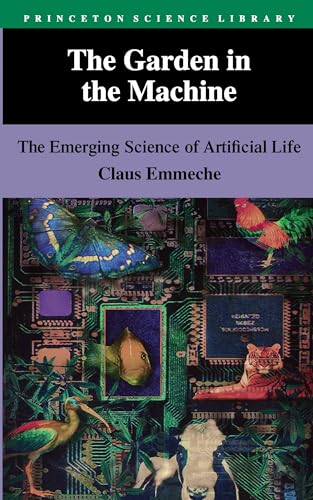
Synopsis
What is life? Is it just the biologically familiar-birds, trees, snails, people-or is it an infinitely complex set of patterns that a computer could simulate? What role does intelligence play in separating the organic from the inorganic, the living from the inert? Does life evolve along a predestined path, or does it suddenly emerge from what appeared lifeless and programmatic? In this easily accessible and wide-ranging survey, Claus Emmeche outlines many of the challenges and controversies involved in the dynamic and curious science of artificial life. Emmeche describes the work being done by an international network of biologists, computer scientists, and physicists who are using computers to study life as it could be, or as it might evolve under conditions different from those on earth. Many artificial-life researchers believe that they can create new life in the computer by simulating the processes observed in traditional, biological life-forms. The flight of a flock of birds, for example, can be reproduced faithfully and in all its complexity by a relatively simple computer program that is designed to generate electronic "boids" Are these "boids" then alive? The central problem, Emmeche notes, lies in defining the salient differences between biological life and computer simulations of its processes. And yet, if we can breathe life into a computer, what might this mean for our other assumptions about what it means to be alive? The Garden in the Machine touches on every aspect of this complex and rapidly developing discipline, including its connections to artificial intelligence, chaos theory, computational theory, and studies of emergence. Drawing on the most current work in the field, this book is a major overview of artificial life. Professionals and nonscientists alike will find it an invaluable guide to concepts and technologies that may forever change our definition of life.
"synopsis" may belong to another edition of this title.
About the Author
Claus Emmeche, a Danish theoretical biologist, is a Research Fellow at the Center of Cognitive Science, University of Roskilde. He is also Guest Scientist and a reader at the Niels Bohr Institute, University of Copenhagen, and is the author of several books on biology.
"About this title" may belong to another edition of this title.
Search results for The Garden in the Machine: The Emerging Science of...

Seller Image
The Garden in the Machine
Published by
Princeton University Press, 1996
ISBN 10: 0691029032
ISBN 13: 9780691029030
Used
Softcover
Seller: Zoom Books East, Glendale Heights, IL, U.S.A.
Seller rating 5 out of 5 stars

Condition: good. Book is in good condition and may include underlining highlighting and minimal wear. The book can also include "From the library of" labels. May not contain miscellaneous items toys, dvds, etc. . We offer 100% money back guarantee and 24 7 customer service. Seller Inventory # ZEV.0691029032.G
Stock Image
The Garden in the Machine: The Emerging Science of Artificial Life
Published by
Princeton University Press, 1996
ISBN 10: 0691029032
ISBN 13: 9780691029030
Used
Paperback
Seller: ThriftBooks-Atlanta, AUSTELL, GA, U.S.A.
Seller rating 5 out of 5 stars
Paperback. Condition: Very Good. No Jacket. May have limited writing in cover pages. Pages are unmarked. ~ ThriftBooks: Read More, Spend Less. Seller Inventory # G0691029032I4N00
Stock Image
The Garden in the Machine
Published by
Princeton University Press, 1996
ISBN 10: 0691029032
ISBN 13: 9780691029030
Used
paperback
Seller: HPB Inc., Dallas, TX, U.S.A.
Seller rating 5 out of 5 stars
paperback. Condition: Very Good. Connecting readers with great books since 1972! Used books may not include companion materials, and may have some shelf wear or limited writing. We ship orders daily and Customer Service is our top priority! Seller Inventory # S_462265842
Stock Image
The Garden in the Machine : The Emerging Science of Artificial Life
Published by
Princeton University Press, 1996
ISBN 10: 0691029032
ISBN 13: 9780691029030
Used
Softcover
Seller: Better World Books, Mishawaka, IN, U.S.A.
Seller rating 5 out of 5 stars
Condition: Good. Reprint. Pages intact with minimal writing/highlighting. The binding may be loose and creased. Dust jackets/supplements are not included. Stock photo provided. Product includes identifying sticker. Better World Books: Buy Books. Do Good. Seller Inventory # 2426010-6
Stock Image
Garden in the Machine the Emerging Science of Artifical Life
Published by
Princeton University Press, Princeton NJ, 1994
ISBN 10: 0691029032
ISBN 13: 9780691029030
Used
Paperback
Seller: Chequamegon Books, Washburn, WI, U.S.A.
Seller rating 5 out of 5 stars
Paperback. Condition: As New. translated from the Danish by Steven Sampson. part of the Princeton Science Library. "What is life? Is it just the biologically familiar-birds, trees, snails, people--or is it an infinitely complex set of patterns that a computer could simulate? What role odes intelligence play in separating the organic from the inorganic, the living from the inert? In this accessibel and wide-ranging survey, Claus Emmeche outlines many of the challenges and controversies involved in the dynamic and curious science of artificial life." 199 pages; 5 1/2 x 8 1/2 ". Seller Inventory # 15331
Stock Image
The Garden in the Machine: The Emerging Science of Artificial Life
Published by
Princeton University Press, Princeton, NJ, 1996
ISBN 10: 0691029032
ISBN 13: 9780691029030
Used
Soft cover
Seller: G.J. Askins Bookseller, New Lebanon, NY, U.S.A.
Seller rating 5 out of 5 stars
Soft cover. Condition: Very Good. 2nd Printing. 200 page softcover with figure illustrations. No flaws - unmarked, tight and clean. Seller Inventory # 526770
Seller Image
The Garden in the Machine : The Emerging Science of Artificial Life
Published by
Princeton University Press, Princeton, NJ, U.S.A., 1996
ISBN 10: 0691029032
ISBN 13: 9780691029030
Used
Trade Paperback
First Edition
Seller: Rose's Books IOBA, Harwich Port, MA, U.S.A.
Seller rating 1 out of 5 stars

Trade Paperback. Condition: As New. First Edition. First edition. 199 pp. What is life? Is it just the biologically familiar?birds, trees, snails, people?or is it an infinitely complex set of patterns that a computer could simulate? What role does intelligence play in separating the organic from the inorganic, the living from the inert? Danish biologist Claus Emmeche wryly outlines many of the challenges and controversies involved in the dynamic and curious science of artificial life, touching on its connections to artificial intelligence, chaos theory, and computational theory. Rather than define answers, Emmeche seeks to ask the right questions. Seller Inventory # 004541
Stock Image
The Garden in the Machine - the Emerging Science of Artificial Life
Published by
Princeton University Press, Princeton, New Jersey, 1996
ISBN 10: 0691029032
ISBN 13: 9780691029030
Used
Soft cover
Seller: Church Street Books, Lutterworth, LEICS, United Kingdom
Seller rating 5 out of 5 stars
Soft cover. Condition: VG++. Third Printing. In the Princeton Science Library, translated from Danish by Steven Sampson. Card covers, 199pp inc index, plus 3pp list of series, b/w illustrations. Apart from several production creases in front cover laminate, the book looks unread. Seller Inventory # 002433
Buy Used
£ 4.87
£ 14.55 shipping
Ships from United Kingdom to U.S.A.
Ships from United Kingdom to U.S.A.
Quantity: 1 available
Stock Image
The Garden in the Machine: The Emerging Science of Artificial Life
Published by
Princeton University Press, 1994
ISBN 10: 0691029032
ISBN 13: 9780691029030
Used
Softcover
Seller: Anybook.com, Lincoln, United Kingdom
Seller rating 5 out of 5 stars
Condition: Good. This is an ex-library book and may have the usual library/used-book markings inside.This book has soft covers. In good all round condition. Please note the Image in this listing is a stock photo and may not match the covers of the actual item,350grams, ISBN:9780691029030. Seller Inventory # 2938673
Buy Used
£ 7
£ 13.04 shipping
Ships from United Kingdom to U.S.A.
Ships from United Kingdom to U.S.A.
Quantity: 1 available
Stock Image
The Garden in the Machine - The Emerging Science of Artificial Life -
Seller: Martin Preuß / Akademische Buchhandlung Woetzel, Kerzenheim, Germany
Seller rating 5 out of 5 stars
03. Condition: Wie neu. 1996. 199 S., zahlr. Abb. What is life? Is it just the biologically familiar - birds, trees, people - or is it an infinitely complex set of patterns that a computer could simulate? What role does intelligence play in separating the organic from the inorganic, the living from the Sprache: Deutsch. Seller Inventory # 16837