
Items related to Preaching Paul: xi
Synopsis
Helpful and insightful strategies for preaching from the writings of Paul. Few biblical figures are more compelling to preachers than the apostle Paul. The story of his dramatic conversion on the road to Damascus is a favorite example of the way that God turns lives around. His writings contain the earliest witness we have to the Christian gospel. His message of God's offer of grace in the life, death, and resurrection of Jesus Christ is deeply appealing. So why is it that when it comes time to choose a text for this Sunday's sermon, preachers so often choose something other than Paul? When Brad Braxton asked himself that question, he realized that preachers are often daunted by the size and complexity of the Pauline corpus. Drawing on his expertise as a New Testament scholar and homiletics professor, as well as on his experience as a pastor, Braxton offers the reader tools with which to wrestle more effectively with the complex, yet essential, message of Paul. Eschewing either a solely historical approach or a completely spiritual one, the author brings the two together to explore the meaning of Paul's message in its original context, as well as its contemporary application. Written with imagination and depth of understanding, this book is for anyone who wishes to know Paul better and to preach from his letters more effectively.
"synopsis" may belong to another edition of this title.
About the Author
Brad R. Braxton is Associate Professor of Homiletics and New Testament at Vanderbilt Divinity School in Nashville, Tennessee.
Excerpt. © Reprinted by permission. All rights reserved.
Preaching Paul
By Brad R. BraxtonAbingdon Press
Copyright © 2004 Abingdon Press
All rights reserved.
ISBN: 978-0-687-02144-4All rights reserved.
Contents
Acknowledgments,
Introduction,
Truth in Advertising: Is This Book for You?,
A Book About Preaching: A Pragmatic Approach,
A Book About Paul: A Pragmatic Person,
Preaching Paul: Paul as a Messenger of the Gospel,
Preaching Paul: Paul's Letters in Service of the Gospel,
A Twenty-second Time-out: Why Preach from Paul?,
The Opportunities,
The Obstacles,
A Word on Biblical Authority and Accountability,
1. What Is Preaching? God's News We Can Use,
Insights from Romans 10,
God's News We Can Use,
The Faithfulness of Preaching: Cross-shaped Proclamation,
The Passion of Preaching: No Homiletical Half-stepping,
The Usefulness of Preaching: Portable Proclamation,
2. Who Was Paul? Exploring Paul's Convictions and Communities,
Paul's Identity and Religious Experience,
The Pharisees and Paul,
Paul's Central Convictions,
The Empire: Paul's Social and Political Context,
The Ekklesia: Paul's Alternative Community,
3. Preaching Paul: Paul as a Messenger of the Gospel,
Devotional Interpretation: Exploring the Ancient for the Modern,
Devotional Interpretations of Why We Preach,
Why Do We Preach? We Preach Because We Must!,
Why Do We Preach? We Preach Because We Can!,
4. Preaching Paul: Interpreting Paul's Letters for Proclamation,
Preaching and the Bible,
Selecting a Pauline Text for Preaching,
An Interpretive Approach,
From the Good Book to the Good News,
5. Preaching Paul: Proclaiming the News from Paul's Letters,
A Pauline Sermon on Romans 8,
Second Wind,
Theological and Rhetorical Analysis of the Sermon,
More Pauline Preaching,
Dead and Alive,
Hanging Loose in an Uptight World,
6. A Bibliographic Guide for Preaching Paul,
A Selected Pauline Bibliography for Busy Ministers,
A Selected Annotated Bibliography of Significant Studies on Paul,
Epilogue,
Notes,
Index,
CHAPTER 1
WHAT IS PREACHING? GOD'S NEWS WE CAN USE
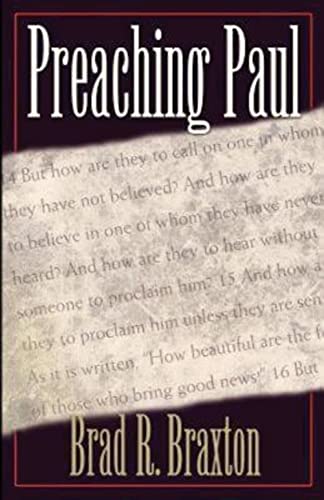
But how are they to call on one in whom they have not believed? And how are they to believe in one of whom they have never heard? And how are they to hear without someone to proclaim him? And how are they to proclaim him unless they are sent? As it is written, "How beautiful are the feet of those who bring good news!" (Rom. 10:14-15)
This chapter aims to answer the question, "What is preaching?" A complex, demanding activity such as preaching requires a multidimensional description. Examining the authentic and inauthentic Pauline Letters for their homiletical wisdom, I offer three characteristics of effective preaching.
In spite of its multiple parts, my understanding of preaching could still be considered minimal. Effective preaching might entail more than I present. I wonder if effective preaching can contain less than I discuss and still claim to be an earnest witness to the gospel.
Insights from Romans 10
According to Olin Moyd, preachers "are just town heralds bringing the news from another source. They do not make the news but are the news reporters." The image of the preacher as a herald or heavenly reporter is rooted in the biblical tradition of prophetic proclamation. Furthermore, this image has considerable popularity in the African American churches that have formed me. Having preached in a variety of African American churches, I have discovered that Paul's declaration about the preacher in Romans 10:1415 is frequently uttered prior to the sermon. Paul, quoting from his Jewish predecessor Isaiah, exclaims in Romans 10:15, "As it is written, 'How beautiful are the feet of those who bring good news.'" Paul's words function almost like a liturgical affirmation in many African American churches.
Some churches regularly recite liturgical affirmations. For example, after the reading of scripture a worship leader will declare, "This is the word of God for the people of God," and the congregants will respond, "Thanks be to God!" In many African American contexts Paul's words in Romans 10:14-15 are often employed as a liturgical prelude to preaching. In the churches of my youth, right before the sermon I regularly heard this odd biblical affirmation about a preacher's feet being beautiful. Though the imagery seemed strange, those who uttered this scripture made it clear that the arrival of the preacher was a moment of great awe and joy.
Closer investigation of Romans 10:15 has clarified the strange imagery of "beautiful feet." The Greek word in this verse often translated "beautiful" (h?raios) can also be rendered "timely," as in the sense of arriving at the appropriate moment. Thus, one could render Paul's statement: "How timely are the feet (that is, the arrival) of those proclaiming good news!" In other words, the arrival of the preacher, God's reporter, is always a welcome event because the preacher has the late-breaking story of God's salvation.
God's News We Can Use
In the twenty-first century, information has become the "god" of many people. Or, information and its retrieval in cyberspace have become "god-like." Tom Beaudoin suggests that the expansiveness of the information in cyberspace causes many people to imagine the World Wide Web "as a metaphor—however imperfect—for God." He further observes, "Cyberspace highlights our own finitude, reminding us that we can never be fully cognizant of all that is happening.... In this way, cyberspace illuminates our human limits. Yet it also mirrors our desire for the infinite, the divine."
A fascinating development of the Information Age has been the insatiable desire for news. Large corporations have based their economic futures and their claims to fame on providing news around the clock. CNN, C-Span, MSNBC, and the Weather Channel are attempting to satisfy our craving for twenty-four-hour news.
Not enough people are raising this question: Does more information necessarily mean better information? Just because we have more information and more news does not mean it is useful news. In a world where reports about homicides take precedence over stories about heroes, we are hard-pressed to discover news that is beneficial and spiritually uplifting. Thus the primary responsibility of the preacher is to provide God's news that people can use. As mentioned, the Greek word for "gospel," euangelion, means "good news." Early Christians used the word euangelion to make a counterclaim against Roman imperial culture. Throughout the first-century Mediterranean world, persons referred to the imperial benefaction of the caesars in Rome as "good news."
But, in defiance of the belief that ancient or contemporary "caesars" have had any good news, Christians have always declared that good news is not found in caesar but instead in Christ. God's action in Christ is the true good news, and it is news that we can use.
Before we can talk profitably about preaching from Paul's Letters we need to determine what constitutes preaching in the first place. What is preaching? Preaching is the faithful, passionate reporting of God's useful news. Let us examine more closely three defining characteristics of this gospel reporting.
The Faithfulness of Preaching: Cross-shaped Proclamation
Effective preaching seeks to be faithful to time-tested, theological criteria. One criterion that might especially regulate the preacher's work is the theology of the cross, which is a conception of reality that permeates Paul's Letters. The voluminous scholarship on the theology of the cross attests to its centrality to Christian identity and practice. Without becoming mired in that scholarship, I will briefly present what I do not mean and what I do mean by a theology of the cross.
Contrary to classical articulations of atonement doctrines, I do not believe that the violence (that is, the blood) of Jesus' crucifixion satisfies or atones for humanity's sins against God, as if God required "blood satisfaction." Moreover, a theology of the cross is not the uncritical sanctification of suffering and violence as mechanisms for establishing a right relationship with God. Many scholars, especially feminist and womanist thinkers, have sensitized us to the horrific violence, exploitation, and imperialism that Christians have propagated under the "sign of the cross."
JoAnne Terrell urges Christians to reject the "hermeneutics of sacrifice," which is "the understanding that personal sacrifice in the imitation of Christ" is the defining feature of Christian identity. As it developed, Christianity began to glorify Jesus' violent sacrifice, no longer simply considering it a "once and for all" redemptive act. Instead, sometimes violent sacrifice became a reality to be replicated in the lives of Christians. This call to (violent) sacrifice has often manifested itself either externally or internally.
Externally, dominant groups exhorted oppressed groups to embrace suffering as an example of "bearing the cross." Ironically this suffering was often inflicted upon the socially oppressed groups by the dominant groups. As an example, Terrell observes that the Christian glorification of sacrifice provided an ideological foundation for slavery in Europe, the Americas, and the Caribbean. Additionally, this obsession with sacrifice has enslaved countless women (especially those of color) in a demoralizing cult of surrogacy—a ceaseless cycle of living one's life simply for the benefit of others. In these instances, the cross (or its abusive interpretation) has not atoned for sin but propelled persons into the "sin of servanthood."
In its internal manifestation, the call to sacrifice has led many Christians to visit upon themselves all manner of suffering in an effort to replicate the suffering of Christ. Julie Hopkins cites chilling examples of women in Christian history enduring unspeakable, self-inflicted violence as a means to atone for their sins in a manner akin to Christ's death. This self-inflicted suffering has often extended beyond the physical realm to include the psychological realm. Some scholars assert that the Western fixation on guilt also has roots in a malformed theology of the cross. According to Hopkins, such a malformed theology supposes that "only punishment through suffering will redress the balance so that if we are not punished by others we punish ourselves." A ceaselessly tormenting guilt has often been the instrument of that self-punishment.
This discussion demonstrates how easily persons can distort a legitimate theology of the cross. Preaching that supports such distortions should be avoided and denounced. Nevertheless, preaching that evades meaningful engagement with the cross and its implications cannot legitimately claim to be Christian. Briefly, I will discuss my understanding of the cross and its ramifications for preaching. The apostle Paul's influence on my thinking will be evident.
I agree with Paul that fundamentally the cross is an apocalyptic reality. This means that the saving dimensions of the cross are located in its life-altering revelations and not in its gory details (for example, "the blood of Jesus"). Assessed without the wisdom of the Holy Spirit, the cross is nothing more than a violent spectacle. According to Paul the Holy Spirit provides believers a framework for properly evaluating the proclamation of "Jesus Christ crucified" (1 Cor. 2:1-10). A theology of the cross offers at least two revelations. First, it reveals the mistake of equating appearances with reality. With God apparent displays of strength can in reality be exhibitions of weakness, and apparent displays of weakness can in reality be exhibitions of strength.
Could there be a more impressive demonstration of Rome's bone-crushing strength than the crosses that constantly dotted the landscape of colonized Judea? Jesus' prophetic ministry— especially his temple rabble-rousing and enthusiastic proclamation about an inclusive reign of God—must have appeared to the religious and political leaders as messianic mania. On that Friday the crosses upon which Rome impaled Jesus and two bandits were the cure for such mania.
Christians claim that Jesus' prophetic ministry was in reality an authentic manifestation of God's intentions. Therefore, since Jesus' obedience to God had landed him in the execution chamber, God stood in solidarity with Jesus during that execution.
God was present in Jesus' weakness and death as a symbol of divine empathy for the violence visited upon people who justly challenge injustice. The cross is not God's demand for suffering. The cross is God's identification with people who suffer, and especially those who suffer in the service of liberation.
Thus, in the cross God invests weakness with the divine strength of God's presence. Tyron Inbody remarks, "Jesus' death is more than simply a heroic act; it is, also, the self-identification of God with and for the world in all its frailty, vulnerability, suffering, and death."
The cross does not tarnish God's strength but instead provides a new model of strength. Weakness and vulnerability can be God's instruments for transformation. If this is a legitimate theology of the cross, it offers a sobering message to a world infatuated with "image management." Cross-shaped preaching declares that preoccupation with our apparent images of strength causes us to ignore our real fountains of power.
Economic images and metaphors of strength are predominant in secular and ecclesial American life. Consequently church leaders and congregations have placed an inordinate emphasis upon numerical indicators of preaching's effectiveness. Many church folk would never worship idol gods like those "misguided" persons in the Bible. But have not some of us constructed shrines to church polls, percentages, and PowerPoint® pie charts? Though ever mindful of the concerns of persons in the pew, cross-shaped preaching ultimately never takes its "cues from the pews." It refuses to capitulate to what apparently is palatable and popular. Faithful preaching remembers that in Jesus' parable of the types of soil in Mark 4 only one of the four seeds fell upon good soil and produced a harvest. Statistically, the preacher in that parable yields only a 25 percent "rate of return." In the reign of God preachers who contribute to the genuine spiritual transformation of one out of four people should be considered "successful." God's perspective on the necessary percentage to constitute "success" differs greatly from many of our cultural standards. Faithful preaching welcomes large crowds but does not judge its effectiveness by crowds or their responses.
Preaching that is true to the cross remains keenly aware of the difference between a delirious crowd and a disciplined congregation. The Gospel narratives of the last week of Jesus' life indicate how quickly the dispositions of crowds can change. Certain ones who hailed Jesus on Sunday would participate indirectly in his execution on Friday.
Second, a theology of the cross reveals God's involvement in politics. Those who interpret a theology of the cross as a preoccupation with political passivity, victimization, and violence have ignored the actions of Jesus and God. Death did not rush upon Jesus as an unanticipated tragedy. Jesus must have been aware of the lethal potential of his actions and message. Nevertheless, he willingly embraced the consequences. Furthermore, when judged before various political rulers, he forfeited any chance to avoid his fate.
Paul's words in 1 Corinthians 1:27-28 address God's involvement in politics. "But God chose what is foolish in the world to shame the wise; God chose what is weak in the world to shame the strong; God chose what is low and despised in the world, things that are not, to reduce to nothing things that are." As suggested, in Jesus' crucifixion—a form of execution reserved for the lowest social classes—God demonstrated solidarity with those who suffer. Through the resurrection of that crucified man, God also has promised the eventual exaltation of those who are oppressed, as well as the judgment of the oppressors.
Jürgen Moltmann amplifies this point:
Now the death of Christ was the death of a political offender. According to the scale of social values of the time, crucifixion was dishonour and shame. If this crucified man has been raised from the dead and exalted to be the Christ of God, then what public opinion holds to be lowliest, what the state has determined to be disgraceful, is changed into what is supreme. In that case, the glory of God does not shine on the crowns of the mighty, but on the face of the crucified Christ. The authority of God is then no longer represented directly by those in high positions, the powerful and the rich.
(Continues...)
Excerpted from Preaching Paul by Brad R. Braxton. Copyright © 2004 Abingdon Press. Excerpted by permission of Abingdon Press.
All rights reserved. No part of this excerpt may be reproduced or reprinted without permission in writing from the publisher.
Excerpts are provided by Dial-A-Book Inc. solely for the personal use of visitors to this web site.
"About this title" may belong to another edition of this title.
Search results for Preaching Paul: xi

Stock Image
Preaching Paul
Seller: World of Books (was SecondSale), Montgomery, IL, U.S.A.
Seller rating 5 out of 5 stars

Paperback. Condition: Good. Helpful and insightful strategies for preaching from the writings of Paul. Few biblical figures are more compelling to preachers than the apostle Paul. The story of his dramatic conversion on the road to Damascus is a favorite example of the way that God turns lives around. His writings contain the earliest witness we have to the Christian gospel. His message of God's offer of grace in the life, death, and resurrection of Jesus Christ is deeply appealing. So why is it that when it comes time to choose a text for this Sunday's sermon, preachers so often choose something other than Paul? When Brad Braxton asked himself that question, he realized that preachers are often daunted by the size and complexity of the Pauline corpus. Drawing on his expertise as a New Testament scholar and homiletics professor, as well as on his experience as a pastor, Braxton offers the reader tools with which to wrestle more effectively with the complex, yet essential, message of Paul. Eschewing either a solely historical approach or a completely spiritual one, the author brings the two together to explore the meaning of Paul's message in its original context, as well as its contemporary application. Written with imagination and depth of understanding, this book is for anyone who wishes to know Paul better and to preach from his letters more effectively. Seller Inventory # 00102706302
Stock Image
Preaching Paul
Published by
Abingdon Press (edition ), 2004
ISBN 10: 0687021448
ISBN 13: 9780687021444
Used
Paperback
Seller: BooksRun, Philadelphia, PA, U.S.A.
Seller rating 5 out of 5 stars
Paperback. Condition: Very Good. It's a well-cared-for item that has seen limited use. The item may show minor signs of wear. All the text is legible, with all pages included. It may have slight markings and/or highlighting. Seller Inventory # 0687021448-11-1
Seller Image
Preaching Paul
Seller: Bay State Book Company, North Smithfield, RI, U.S.A.
Seller rating 5 out of 5 stars
Condition: very_good. Seller Inventory # BSM.1AL6G
Stock Image
Preaching Paul
Seller: Wonder Book, Frederick, MD, U.S.A.
Seller rating 5 out of 5 stars
Condition: Good. Good condition. A copy that has been read but remains intact. May contain markings such as bookplates, stamps, limited notes and highlighting, or a few light stains. Seller Inventory # G14Q-00616
Stock Image
Preaching Paul
Seller: Better World Books, Mishawaka, IN, U.S.A.
Seller rating 5 out of 5 stars
Condition: Very Good. Pages intact with possible writing/highlighting. Binding strong with minor wear. Dust jackets/supplements may not be included. Stock photo provided. Product includes identifying sticker. Better World Books: Buy Books. Do Good. Seller Inventory # 740747-6
Stock Image
Preaching Paul
Seller: Better World Books, Mishawaka, IN, U.S.A.
Seller rating 5 out of 5 stars
Condition: Good. Pages intact with minimal writing/highlighting. The binding may be loose and creased. Dust jackets/supplements are not included. Stock photo provided. Product includes identifying sticker. Better World Books: Buy Books. Do Good. Seller Inventory # 18379815-6
Stock Image
Preaching Paul
Seller: World of Books Inc, Montgomery, IL, U.S.A.
Seller rating 4 out of 5 stars

Paperback. Condition: Good. Helpful and insightful strategies for preaching from the writings of Paul. Few biblical figures are more compelling to preachers than the apostle Paul. The story of his dramatic conversion on the road to Damascus is a favorite example of the way that God turns lives around. His writings contain the earliest witness we have to the Christian gospel. His message of God's offer of grace in the life, death, and resurrection of Jesus Christ is deeply appealing. So why is it that when it comes time to choose a text for this Sunday's sermon, preachers so often choose something other than Paul? When Brad Braxton asked himself that question, he realized that preachers are often daunted by the size and complexity of the Pauline corpus. Drawing on his expertise as a New Testament scholar and homiletics professor, as well as on his experience as a pastor, Braxton offers the reader tools with which to wrestle more effectively with the complex, yet essential, message of Paul. Eschewing either a solely historical approach or a completely spiritual one, the author brings the two together to explore the meaning of Paul's message in its original context, as well as its contemporary application. Written with imagination and depth of understanding, this book is for anyone who wishes to know Paul better and to preach from his letters more effectively. Seller Inventory # CIN0687021448G
Stock Image
Preaching Paul
Seller: Pink Casa Antiques, Frankfort, KY, U.S.A.
Seller rating 5 out of 5 stars
Paperback. Condition: Very Good. signed and inscribed by author, tight, uncreased spine, pages clear and bright, shelf and edge wear, corners bumped, packaged in cardboard box for shipment, tracking on U.S. orders. Seller Inventory # 88532
Stock Image
Preaching Paul
Seller: Lakeside Books, Benton Harbor, MI, U.S.A.
Seller rating 5 out of 5 stars
Condition: New. Brand New! Not Overstocks or Low Quality Book Club Editions! Direct From the Publisher! We're not a giant, faceless warehouse organization! We're a small town bookstore that loves books and loves it's customers! Buy from Lakeside Books! Seller Inventory # OTF-Y-9780687021444
Seller Image
Preaching Paul (Paperback or Softback)
Published by
Abingdon Press 12/1/2004, 2004
ISBN 10: 0687021448
ISBN 13: 9780687021444
New
Paperback or Softback
Seller: BargainBookStores, Grand Rapids, MI, U.S.A.
Seller rating 5 out of 5 stars
Paperback or Softback. Condition: New. Preaching Paul. Book. Seller Inventory # BBS-9780687021444