
Items related to My Life as a Fake
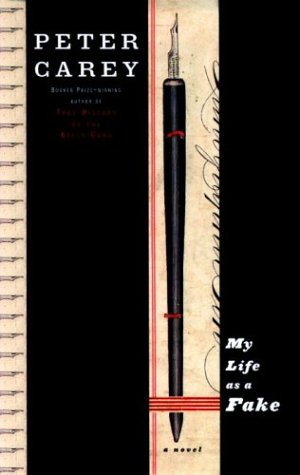
Synopsis
Following the triumph of his Booker Prize–winning True History of the Kelly Gang, Peter Carey ventures into the Far East with a novel shot through with mysteries at once historical, literary, and personal.
Sarah Wode-Douglass, the editor of a London poetry magazine, had grown up knowing the famous and infamous John Slater. And because he figured prominently in the disaster that was her parents’ marriage, when Slater proposes that she accompany him to Malaysia, Sarah embarks out of curiosity on a journey that becomes, instead, a lifelong obsession. Her discoveries spiral outward from Christopher Chubb, a destitute Australian she meets by chance in the steamy, fetid city of Kuala Lumpur. He is mad, Slater warns her, explaining the ruinous hoax Chubb had committed decades earlier. But lurking behind the man’s peculiarity and arrogance, Sarah senses, is artistic genius, in the form of a manuscript he teases her with and which she soon would do anything to acquire. The provenance of this work, she gradually learns, is marked by kidnapping, exile, and death—a relentless saga that reaches from Melbourne to Bali, Sumatra, and Java, and that more than once compels her back to Malaysia without ever disclosing all of its secrets, only the power of the imagination and the price it can exact from those who would wield it.
Astonishing, mesmerizing, and ultimately shocking, My Life as a Fake is the most audacious novel yet in Peter Carey’s extraordinary career.
"synopsis" may belong to another edition of this title.
About the Author
Peter Carey received the Booker Prize for Oscar and Lucinda, and again for True History of the Kelly Gang. His other honors include the Commonwealth Prize and the Miles Franklin Award. The author of seven previous novels and a collection of stories, he was born in Australia in 1943 and now lives in New York City.
Excerpt. © Reprinted by permission. All rights reserved.
The Old Rectory, Thornton, Berkshire. August 1985
I have known John Slater all my life. Perhaps you remember the public brawl with Dylan Thomas, or even have a copy of his famous book of 'dirty' poems. If it's an American edition you'll discover, on the inside flap, a photograph of the handsome, fair-haired author in cricket whites. Dewsong was published in 1930. Slater was twenty at the time, very nearly a prodigy.
That same year I was born Sarah Elizabeth Jane to a beautiful, impatient Australian mother and a no less handsome but rather posh English father, Lord William Wode-Douglass, generally known as Boofy.
Slater's own class background was rather ambiguous, though my mother, a dreadful snob, had a tin ear, and I know she thought Slater very grand and therefore permitted him excesses she would not have tolerated from the Chester grammar-school boy he really was.
It was Slater who carved my father's thirtieth birthday cake with his bare hands, who rode a horse into the kitchen, who brought Unity Mitford to dinner during the period she was stealing stationery from Buckingham Palace and carrying that nasty little ferret around in her handbag.
I cannot say that I understood his role in my parents' marriage, and only when my mother killed herself -- in a spectacularly awful style -- did I suspect anything was amiss. In the last minutes of her life I saw John Slater put his arms around her and finally I understood, or thought I did.
From that moment I hated everything about him: his self-absorption, his intense angry good looks, but most of all those electric blue eyes which inhabited my imagination as the incarnation of deceit.
When my mother died, poor Boofy fell apart completely. He drank and wept and roared, and after falling down the stairs the second time he packed me off to St Mary's Wantage in Berkshire, which I did not like at all. I ran away, was returned in a post-office van, fought with the headmistress, and adopted the perverse strategy of writing with my left hand, thus making almost all my schoolwork illegible. I was so busy being a bad girl that no-one noticed that I also had a brain. But even while I was receiving D's in English I somehow managed to see that Slater's celebrated verses were nothing so much as bowers constructed by a male in order to procure sex. This was far from being my only insight and I was not reluctant to let the Great Man know exactly what I thought. Somewhere in his papers there may still be evidence of my close reading of 'Eastern Oriental,' with its impertinent corrections, its queries about his heavily enjambed lines, all of which I archly hoped might be 'helpful to him.'
I was, in short, a precocious horror and you will not be at all astonished that John Slater and I did not become friends. But, London being London, I did keep on running into him over the years, and as he continued to write poetry and I had ended up as the editor of The Modern Review, we knew many of the same people and had reason to sit at the same table more than once.
Time did not make the association easier. Indeed, as I grew older his physical presence became more and more disturbing. I will not say that I was obsessed with him, but I could not be in the same room without looking at him continually; I was drawn to him and repulsed by him all at once. He was an appallingly unapologetic narcissist and so full of iconoclastic opinion and territorial enthusiasms that there was not a dinner party, be it ever so packed with the Great and the Good, where one could escape his increasingly bardic presence. Of course I could not look at him without thinking of my poor unhappy mother.
In spite of the fact that we were so very intimately connected, it took all of thirty years for us to speak with more than superficial politeness. He was then sixty-two and while perhaps better known for his novels -- The Amersham Satyricon had been a huge bestseller -- he was still generally referred to as 'the poet John Slater.' Which was exactly how he looked: rather wild and windburned, as if he'd recently returned from tramping over the moors or following Basho's path all the way to Ogaki.
Slater does seem to have worked very hard at the social side of literature, and there was scarcely a British poet or novelist whom he could not call his friend, or for whom he had not, at some time, done a favour. The Faber crowd he cultivated particularly and it was at a Faber dinner party, at the home of Charles Monteith, where we finally came to talk to each other. Our conversation aside, I don't recall a great deal about the evening except that Robert Lowell -- the guest of honour -- had inadvertently revealed that he didn't know who Slater was. This, one could hypothesise, is why Slater chose to turn and talk to me so urgently, calling me 'Micks,' a name belonging to my family and all that lost time at Allenhurst at High Wycombe.
What he had to say was not in the least personal, but his use of the nickname had already touched me and his voice, perhaps as a result of the famous American's careless judgement of his life, took on a wistful, elegiac tone which I found unexpectedly moving. For the first time in years I looked at him closely: his face was puffy, its colour, uncharacteristically, a little grey. When he began to talk about revisiting Malaysia, a country where so much of Dewsong and its successors had their roots, it was hard not to wonder if he might be tidying up his affairs.
Come with me, he said suddenly.
I laughed sharply. He grasped my hand and held me with those damned eyes and of course he was such a Famous Crumpeteer that I looked away, embarrassed.
We should go, he said. Don't you think?
It was impossible to guess what he meant by 'we' and 'should.'
We must talk, he insisted. It is very bad that we never have.
This sudden intimacy was as off-putting as it was wished for.
I have no money, I said.
I have tons of it.
He watched me closely as I poured more wine.
You've got a boyfriend, he suggested.
I have a very jealous cat.
I adore cats, he said. I will come and talk to her.
And suddenly his cab arrived and he had to go on to a very glamorous party where he was expecting to meet John Lennon and as he rose there was a general clamour of farewells and it was my understanding that our conversation had been of no great moment -- merely a cover for his embarrassment at the hands of Robert Lowell.
But he telephoned me, at home in Old Church Street, at eight o'clock the next morning and it was very quickly clear that this journey was not at all impulsive. He had already arranged for the British Council to pay for one ticket, while two thousand words for Nova would fund another. He would be delighted to foot all of my expenses.
My father had died just the year before in circumstances that were not at all happy -- a sulky sort of estrangement on my part -- and it was not in the least dotty for me to think that John Slater was offering this trip as an opportunity for us to talk, for me to understand my own unhappy family a little better. Of course he never said so, and even now, all these years later, I cannot be sure what his intention was at the beginning. Certainly it was not sex. Let me dispense with that immediately. It was well known that I had no interest in it.
John, I said, I am an awful tourist. I have no intention of slogging through the bloody jungle with binoculars. I am an editor. It's all I do. I read. I have no other life.
You love to eat, he said. I saw you polish off that curry.
Well, it was very good curry.
Then Kuala Lumpur will be paradise for you. Darling, I've known K.L. for almost as long as I've known you.
Of course he did not 'know' me at all.
What's the worst thing that can happen? I'll make a pass at you? Micks, for God's sake -- it's a bloody week of your life. We'll all be mouldering in the ground soon enough. Do come.
That did it -- the mouldering. After lunch I burgled our safe and took the last of the magazine's petty cash. In the King's Road I purchased forty-five pounds in travellers' cheques, a pair of sandals, and a summer frock. So prepared, I entered that maze from which, thirteen years later, I have yet to escape.
In those days it was a thirty-hour flight from London to Kuala Lumpur, but we suffered a long delay in Tehran due to fog in Dubai, and then an interminable wait in Singapore. You would think that forty-two hours would be a sufficient opportunity for the two of us to begin our conversation, but it seemed that Slater liked to sleep on aeroplanes and he was so drugged with Phenobarb and whisky when we landed in Singapore that the air hostesses thought he was dead.
He passed through Malaysian Immigration in a wheelchair and so my very first memory of Kuala Lumpur involves the difficulties of transporting a large and meaty man into a taxi and from there into the extraordinarily kitsch foyer of the Merlin Hotel, and there his fame preceded him, thank God.
Apart from the awful gold and tartan decor of the Merlin, my only impressions of this foreign capital were heat and smells, sewage, floral scents, rotting fruit, and a general mustiness which seeped into my skin and permeated my large plain room where someone had written 'Fuck Little Duck' in grey pencil beside the toilet bowl.
The next day Slater did not answer his telephone and I became concerned that he really might have died. Then, on the off-chance, I checked with the desk and discovered he and his luggage had departed the hotel. No message. Just gone.
I immediately felt like someone who has been passionately seduced, fucked, and abandoned. This is not a pleasant feeling at the best of times and all my old animus against Slater came surging back. I was far too angry to read and far too agitated to sleep, and this was how I came to be inspecting the Indian haberdashers on Batu Road. I like to buy fabrics, but nothing pleased me her...
"About this title" may belong to another edition of this title.
Search results for My Life as a Fake

Stock Image
My Life As a Fake: A Novel
Published by
Random House Canada, Toronto, Ontario, 2003
ISBN 10: 0679312811
ISBN 13: 9780679312819
Used
Hardcover
Seller: Hourglass Books, Vancouver, BC, Canada
Seller rating 4 out of 5 stars

Hardcover. Condition: Very Good. Dust Jacket Condition: Very Good, Not Price Clipped. Canadian First. Complete number line from 1 to 10; some edge wear to boards and dust jacket; otherwise a solid, clean copy with no marking or underlining; collectible condition. Book. Seller Inventory # 012897
Stock Image
My Life as a Fake
Published by
Random House, Toronto, 2003
ISBN 10: 0679312811
ISBN 13: 9780679312819
Used
Hardcover
First Edition
Seller: A Good Read, Toronto, ON, Canada
Seller rating 4 out of 5 stars
Hardcover. Condition: Near Fine. Dust Jacket Condition: Good. First Canadian Edition. A Good Read ships from Toronto and Niagara Falls, NY - customers outside of North America please allow two to three weeks for delivery. Bruising and wear to upper corners of d/j.; 8vo - over 7¾" - 9¾" Tall. Seller Inventory # 22153
Stock Image
My Life As a Fake
Seller: Heroes Bookshop, Paris, ON, Canada
Seller rating 4 out of 5 stars
Hardcover. Condition: Very Good. Dust Jacket Condition: Very Good. 1st edition /1st Printing. First Canadian Edition.clean crisp pages with a tight binding and a mylar protected dust cover. Seller Inventory # T140
Seller Image
My Life as a Fake
Published by
Random House of Canada, Limited, Mississauga, ON, Canada, 2003
ISBN 10: 0679312811
ISBN 13: 9780679312819
Used
Hardcover
First Edition
Signed
Seller: THE BOOK BROTHERS, CHATHAM, ON, Canada
Seller rating 4 out of 5 stars
Hardcover. Condition: As New. Dust Jacket Condition: As New. 1st Edition. As new copy. (see picture) 266 pages. Cover is in BrodartSigned and dated 24/10/03 by the author. Signed by Author(s). Seller Inventory # 006170
Stock Image
My Life As a Fake
Published by
Random House, New York, 2003
ISBN 10: 0679312811
ISBN 13: 9780679312819
Used
Hardcover
First Edition
Seller: B-Line Books, Amherst, NS, Canada
Seller rating 5 out of 5 stars

Hardcover. Condition: Fine. Dust Jacket Condition: Fine+. First American Edition; First Printing. About new book in barely rubbed DJ.; 1.07 x 9.54 x 5.94 Inches; 304 pages. Seller Inventory # 24616
Stock Image
My Life as a Fake
Published by
Random House Canada October 2003, 2003
ISBN 10: 0679312811
ISBN 13: 9780679312819
Used
Hardcover
Seller: Old Goat Books, Waterloo, ON, Canada
Seller rating 3 out of 5 stars

Hardcover. Condition: Near Fine. Dust Jacket Condition: NF. Jacket Condition: 'NF' Condition: 'NF' Notes: By the Booker Prize-winning author. Seller Inventory # 1052368
Stock Image
My Life As a Fake (SIGNED COPY)
Published by
Random House Canada, 2003
ISBN 10: 0679312811
ISBN 13: 9780679312819
Used
Hardcover
First Edition
Signed
Seller: Samuel S Lin, Etobicoke, ON, Canada
Seller rating 5 out of 5 stars
Hardcover. Condition: Near Fine. Dust Jacket Included. 1st Edition. 274 pages. Quarter black cloth with red board. Head and tail of spine slightly bumped. Appears unread or only lightly read. Near fine Dust Jacket intact and no price clipped or tear and only a hint of crease at top edge. A fine copy signed by Carey on the title page. Size: Approx. 5 3/4" x 9 1/2"tall. Signed by Author(s). Seller Inventory # 002410
Stock Image
My Life as a Fake {Uncorrected Proof}
Published by
Random House Canada, Toronto, 2003
ISBN 10: 0679312811
ISBN 13: 9780679312819
Used
Soft cover
First Edition
Signed
Seller: Summerhill Books, Toronto, ON, Canada
Seller rating 5 out of 5 stars
Soft cover. Condition: Very Good. First Edition. 8vo. 273 pp. First Canadian edition. Signed (no inscription) on title page. Black and white illustrated wraps show creasing to front cover. Signed by Author(s). Seller Inventory # 001339
Stock Image
My Life as a Fake
Published by
Random House, Toronto, 2003
ISBN 10: 0679312811
ISBN 13: 9780679312819
Used
Hardcover
First Edition
Signed
Seller: A Good Read, Toronto, ON, Canada
Seller rating 4 out of 5 stars
Hardcover. Condition: Fine. Dust Jacket Condition: Near Fine. First Edition; First Printing. A Good Read ships from Toronto and Niagara Falls, NY - customers outside of North America please allow two to three weeks for delivery. Minor rubbing to d/j. Flat-signed by author on title page. First Canadian edition.; 8vo - over 7¾" - 9¾" tall; Signed by Author. Seller Inventory # 12380
Stock Image
My Life As A Fake (Signed First Edition; First Printing)
Published by
Random House Canada, Toronto, ON, 2003
ISBN 10: 0679312811
ISBN 13: 9780679312819
Used
Hardcover
First Edition
Signed
Seller: West End Editions, Burlington, ON, Canada
Seller rating 5 out of 5 stars
Hardcover. Condition: Fine. Dust Jacket Condition: Fine. 1st Edition. A fine first edition and first printing copy, flat signed on the title page by Peter Carey. A very collectible copy; not price clipped, no remainder mark. Canadian first edition and first printing. Signed by Author(s). Seller Inventory # 002962