
Items related to Metaphysics, Volume I: Books 1–9 (Loeb Classical...
Metaphysics, Volume I: Books 1–9 (Loeb Classical Library) - Hardcover
Book 2 of 23: Loeb Classical Library: Aristotle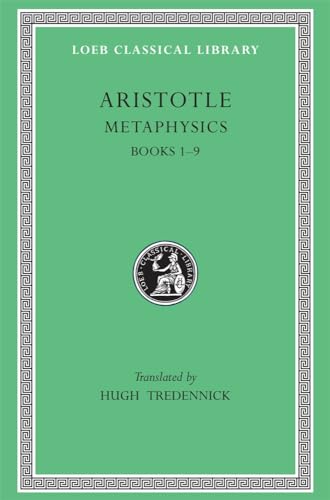
Synopsis
First things.
Aristotle, great Greek philosopher, researcher, reasoner, and writer, born at Stagirus in 384 BC, was the son of a physician. He studied under Plato at Athens and taught there (367–347); subsequently he spent three years at the court of a former pupil in Asia Minor. After some time at Mitylene, in 343–342 he was appointed by King Philip of Macedon to be tutor of his teen-aged son Alexander. After Philip’s death in 336, Aristotle became head of his own school (of “Peripatetics”), the Lyceum at Athens. Because of anti-Macedonian feeling there after Alexander’s death in 323, he withdrew to Chalcis in Euboea, where he died in 322.
Nearly all the works Aristotle prepared for publication are lost; the priceless ones extant are lecture-materials, notes, and memoranda (some are spurious). They can be categorized as follows:
I Practical: Nicomachean Ethics; Great Ethics (Magna Moralia); Eudemian Ethics; Politics; Economics (on the good of the family); On Virtues and Vices.
II Logical: Categories; Analytics (Prior and Posterior); Interpretation; Refutations used by Sophists; Topica.
III Physical: Twenty-six works (some suspect) including astronomy, generation and destruction, the senses, memory, sleep, dreams, life, facts about animals, etc.
IV Metaphysics: on being as being.
V Art: Rhetoric and Poetics.
VI Other works including the Constitution of Athens; more works also of doubtful authorship.
VII Fragments of various works such as dialogues on philosophy and literature; and of treatises on rhetoric, politics, and metaphysics.
The Loeb Classical Library edition of Aristotle is in twenty-three volumes.
"synopsis" may belong to another edition of this title.
About the Author
Hugh Tredennick (1899–1982) was Professor of Classics at Royal Holloway College and Dean of the Faculty of Arts at London University.
"About this title" may belong to another edition of this title.
Search results for Metaphysics, Volume I: Books 1–9 (Loeb Classical...

Stock Image
Metaphysics, Volume I: Books 1â"9
Published by
Harvard University Press (edition Illustrated), 1933
ISBN 10: 0674992997
ISBN 13: 9780674992993
Used
Hardcover
Seller: BooksRun, Philadelphia, PA, U.S.A.
Seller rating 5 out of 5 stars

Hardcover. Condition: Very Good. Illustrated. With dust jacket. It's a well-cared-for item that has seen limited use. The item may show minor signs of wear. All the text is legible, with all pages included. It may have slight markings and/or highlighting. Seller Inventory # 0674992997-11-1-29
Stock Image
Metaphysics, Volume I
Seller: Open Books, Chicago, IL, U.S.A.
Seller rating 5 out of 5 stars
Hardcover. Condition: Acceptable. 1989 printing. Contains pencil notes and underlining. Jacket wear. Previous owner's name written inside book. Open Books is a nonprofit social venture that provides literacy experiences for thousands of readers each year through inspiring programs and creative capitalization of books. Seller Inventory # mon0000846610
Stock Image
Aristotle: Metaphysics, Books I-IX (Loeb Classical Library No. 271) (Volume I)
Published by
Harvard University Press, 1933
ISBN 10: 0674992997
ISBN 13: 9780674992993
Used
Hardcover
Seller: Textbooks_Source, Columbia, MO, U.S.A.
Seller rating 5 out of 5 stars
Hardcover. Condition: Good. Illustrated. Ships in a BOX from Central Missouri! May not include working access code. Will not include dust jacket. Has used sticker(s) and some writing or highlighting. UPS shipping for most packages, (Priority Mail for AK/HI/APO/PO Boxes). Seller Inventory # 000332392U
Stock Image
Aristotle: Metaphysics, Books I-IX (Loeb Classical Library No. 271)
Published by
Harvard University Press, 1933
ISBN 10: 0674992997
ISBN 13: 9780674992993
Used
Hardcover
Seller: Books From California, Simi Valley, CA, U.S.A.
Seller rating 4 out of 5 stars

Hardcover. Condition: Very Good. Cover and edges may have some wear. Seller Inventory # mon0004154112
Stock Image
ARISTOTLE: METAPHYICS, BOOKS I-IX
Published by
William Heinemann & G. P. Putnam's Sons, 1933
ISBN 10: 0674992997
ISBN 13: 9780674992993
Used
Hardcover
Seller: Ancient World Books, Toronto, ON, Canada
Seller rating 5 out of 5 stars
Hardcover. Condition: Very Good. Dust Jacket Condition: No Dust Jacket. Scholar's name to ffep (A. R. Littlewood) with additional name. Bookprize plate to inner cover. Top edges gilt.; Loeb Classical Library No. 271; 704 pages. Seller Inventory # 45121
Stock Image
Metaphysics, Volume I: Books 1-9
Published by
Harvard University Press, 1996
ISBN 10: 0674992997
ISBN 13: 9780674992993
Used
Hardcover
Seller: 3rd St. Books, Lees Summit, MO, U.S.A.
Seller rating 5 out of 5 stars
Hardcover. Condition: Very Good. Dust Jacket Condition: Very Good. Very good, clean, tight condition. Greek/English text. Text free of marks. Professional book dealer since 1999. All orders are processed promptly and carefully packaged with tracking. Seller Inventory # 098316
Seller Image
Aristotle : Metaphysics, Books I-IX
Published by
Harvard University Press, 1933
ISBN 10: 0674992997
ISBN 13: 9780674992993
New
Hardcover
Seller: GreatBookPrices, Columbia, MD, U.S.A.
Seller rating 5 out of 5 stars
Condition: New. Seller Inventory # 414470-n
Seller Image
Metaphysics, Volume I
Published by
Harvard University Press, US, 1933
ISBN 10: 0674992997
ISBN 13: 9780674992993
New
Hardcover
Seller: Rarewaves.com USA, London, LONDO, United Kingdom
Seller rating 5 out of 5 stars
Hardback. Condition: New. First things.Aristotle, great Greek philosopher, researcher, reasoner, and writer, born at Stagirus in 384 BC, was the son of a physician. He studied under Plato at Athens and taught there (367-347); subsequently he spent three years at the court of a former pupil in Asia Minor. After some time at Mitylene, in 343-342 he was appointed by King Philip of Macedon to be tutor of his teen-aged son Alexander. After Philip's death in 336, Aristotle became head of his own school (of "Peripatetics"), the Lyceum at Athens. Because of anti-Macedonian feeling there after Alexander's death in 323, he withdrew to Chalcis in Euboea, where he died in 322.Nearly all the works Aristotle prepared for publication are lost; the priceless ones extant are lecture-materials, notes, and memoranda (some are spurious). They can be categorized as follows:I Practical: Nicomachean Ethics; Great Ethics (Magna Moralia); Eudemian Ethics; Politics; Economics (on the good of the family); On Virtues and Vices.II Logical: Categories; Analytics (Prior and Posterior); Interpretation; Refutations used by Sophists; Topica.III Physical: Twenty-six works (some suspect) including astronomy, generation and destruction, the senses, memory, sleep, dreams, life, facts about animals, etc.IV Metaphysics: on being as being.V Art: Rhetoric and Poetics.VI Other works including the Constitution of Athens; more works also of doubtful authorship.VII Fragments of various works such as dialogues on philosophy and literature; and of treatises on rhetoric, politics, and metaphysics.The Loeb Classical Library edition of Aristotle is in twenty-three volumes. Seller Inventory # LU-9780674992993
Buy New
£ 27.81
Free Shipping
Ships from United Kingdom to U.S.A.
Ships from United Kingdom to U.S.A.
Quantity: 8 available
Stock Image
Metaphysics, Volume I: Books 19
Seller: Time-Honored Books, Franklin, IN, U.S.A.
Seller rating 4 out of 5 stars
Hardcover. Condition: Fine. Dust Jacket Condition: Near Fine. 5th or later Edition. ex libris stamp only. Greek-English. Aristotle, great Greek philosopher, researcher, reasoner, and writer, born at Stagirus in 384 BC, was the son of a physician. He studied under Plato at Athens and taught there (367347); subsequently he spent three years at the court of a former pupil in Asia Minor. After some time at Mitylene, in 343342 he was appointed by King Philip of Macedon to be tutor of his teen-aged son Alexander. After Philip's death in 336, Aristotle became head of his own school (of "Peripatetics"), the Lyceum at Athens. Because of anti-Macedonian feeling there after Alexander's death in 323, he withdrew to Chalcis in Euboea, where he died in 322. Nearly all the works Aristotle prepared for publication are lost; the priceless ones extant are lecture-materials, notes, and memoranda (some are spurious). They can be categorized as follows: I Practical: Nicomachean Ethics; Great Ethics (Magna Moralia); Eudemian Ethics; Politics; Economics (on the good of the family); On Virtues and Vices. II Logical: Categories; Analytics (Prior and Posterior); Interpretation; Refutations used by Sophists; Topica. III Physical: Twenty-six works (some suspect) including astronomy, generation and destruction, the senses, memory, sleep, dreams, life, facts about animals, etc. IV Metaphysics: on being as being. V Art: Rhetoric and Poetics. VI Other works including the Constitution of Athens; more works also of doubtful authorship. VII Fragments of various works such as dialogues on philosophy and literature; and of treatises on rhetoric, politics, and metaphysics. Seller Inventory # ABE-1771939391885
Stock Image
Metaphysics, Volume I
Seller: PBShop.store UK, Fairford, GLOS, United Kingdom
Seller rating 5 out of 5 stars
HRD. Condition: New. New Book. Shipped from UK. Established seller since 2000. Seller Inventory # WL-9780674992993
Buy New
£ 24.80
£ 4.16 shipping
Ships from United Kingdom to U.S.A.
Ships from United Kingdom to U.S.A.
Quantity: 15 available