
Items related to On the Nature of Things (Loeb Classical Library 181)
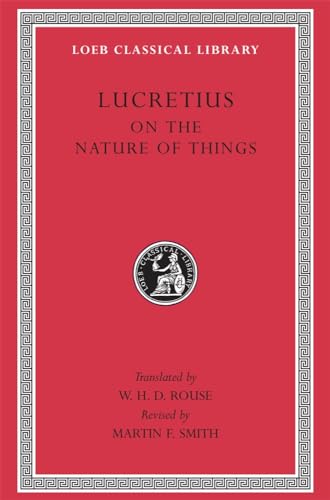
Synopsis
Atomic atheism in verse.
Lucretius (Titus Lucretius Carus) lived ca. 99–ca. 55 BC, but the details of his career are unknown. He is the author of the great didactic poem in hexameters, De Rerum Natura (On the Nature of Things). In six books compounded of solid reasoning, brilliant imagination, and noble poetry, he expounds the scientific theories of the Greek philosopher Epicurus, with the aim of dispelling fear of the gods and fear of death and so enabling man to attain peace of mind and happiness.
In Book 1 he establishes the general principles of the atomic system, refutes the views of rival physicists, and proves the infinity of the universe and of its two ultimate constituents, matter and void. In Book 2 he explains atomic movement, the variety of atomic shapes, and argues that the atoms lack color, sensation, and other secondary qualities. In Book 3 he expounds the nature and composition of mind and spirit, proves their mortality, and argues that there is nothing to fear in death. Book 4 explains the nature of sensation and thought, and ends with an impressive account of sexual love. Book 5 describes the nature and formation of our world, astronomical phenomena, the beginnings of life on earth, and the development of civilization. In Book 6 the poet explains various atmospheric and terrestrial phenomena, including thunder, lightning, earthquakes, volcanoes, the magnet, and plagues.
The work is distinguished by the fervor and poetry of the author.
"synopsis" may belong to another edition of this title.
About the Authors
William Henry Denham Rouse (1863–1950) was Headmaster of the Perse School and a founding editor of the Loeb Classical Library.
Martin Ferguson Smith is Emeritus Professor of Classics, Durham University, UK.
"About this title" may belong to another edition of this title.
Search results for On the Nature of Things (Loeb Classical Library 181)

Stock Image
On the Nature of Things [Loeb Classical Library, 181]
Published by
Harvard University Press, 1992
ISBN 10: 0674992008
ISBN 13: 9780674992009
Used
Hardcover
Seller: Windows Booksellers, Eugene, OR, U.S.A.
Seller rating 5 out of 5 stars

Hardcover, no dust jacket. Limited pencil underlining. Wear on all edges of text. Dust jacket worn on facing, corners, and along spine with wrapper torn away along lower spine. Else good. 602 pp. Seller Inventory # 761563
Stock Image
On the Nature of Things
Published by
Harvard University Press, 1924
ISBN 10: 0674992008
ISBN 13: 9780674992009
Used
Hardcover
Seller: World of Books (was SecondSale), Montgomery, IL, U.S.A.
Seller rating 5 out of 5 stars
Hardback. Condition: Good. Atomic atheism in verse. Lucretius (Titus Lucretius Carus) lived ca. 99?ca. 55 BC, but the details of his career are unknown. He is the author of the great didactic poem in hexameters, De Rerum Natura (On the Nature of Things). In six books compounded of solid reasoning, brilliant imagination, and noble poetry, he expounds the scientific theories of the Greek philosopher Epicurus, with the aim of dispelling fear of the gods and fear of death and so enabling man to attain peace of mind and happiness. In Book 1 he establishes the general principles of the atomic system, refutes the views of rival physicists, and proves the infinity of the universe and of its two ultimate constituents, matter and void. In Book 2 he explains atomic movement, the variety of atomic shapes, and argues that the atoms lack color, sensation, and other secondary qualities. In Book 3 he expounds the nature and composition of mind and spirit, proves their mortality, and argues that there is nothing to fear in death. Book 4 explains the nature of sensation and thought, and ends with an impressive account of sexual love. Book 5 describes the nature and formation of our world, astronomical phenomena, the beginnings of life on earth, and the development of civilization. In Book 6 the poet explains various atmospheric and terrestrial phenomena, including thunder, lightning, earthquakes, volcanoes, the magnet, and plagues. The work is distinguished by the fervor and poetry of the author. Seller Inventory # CIN0674992008G
Stock Image
On the Nature of Things
Seller: Borden's Book Shoppe, Astoria, IL, U.S.A.
Seller rating 4 out of 5 stars

hardcover. Condition: Very Good. Seller Inventory # V-20261013-DB3-S6061
Stock Image
On the Nature of Things
Published by
Harvard University Press, 1924
ISBN 10: 0674992008
ISBN 13: 9780674992009
Used
Hardcover
Seller: World of Books Inc, Montgomery, IL, U.S.A.
Seller rating 4 out of 5 stars
Hardback. Condition: Good. Atomic atheism in verse. Lucretius (Titus Lucretius Carus) lived ca. 99?ca. 55 BC, but the details of his career are unknown. He is the author of the great didactic poem in hexameters, De Rerum Natura (On the Nature of Things). In six books compounded of solid reasoning, brilliant imagination, and noble poetry, he expounds the scientific theories of the Greek philosopher Epicurus, with the aim of dispelling fear of the gods and fear of death and so enabling man to attain peace of mind and happiness. In Book 1 he establishes the general principles of the atomic system, refutes the views of rival physicists, and proves the infinity of the universe and of its two ultimate constituents, matter and void. In Book 2 he explains atomic movement, the variety of atomic shapes, and argues that the atoms lack color, sensation, and other secondary qualities. In Book 3 he expounds the nature and composition of mind and spirit, proves their mortality, and argues that there is nothing to fear in death. Book 4 explains the nature of sensation and thought, and ends with an impressive account of sexual love. Book 5 describes the nature and formation of our world, astronomical phenomena, the beginnings of life on earth, and the development of civilization. In Book 6 the poet explains various atmospheric and terrestrial phenomena, including thunder, lightning, earthquakes, volcanoes, the magnet, and plagues. The work is distinguished by the fervor and poetry of the author. Seller Inventory # CIN0674992008G
Stock Image
Lucretius De Rerum Natura
Seller: M & M Books, ATHENS, GA, U.S.A.
Seller rating 3 out of 5 stars

Hardcover. Condition: As New. Dust Jacket Condition: As New. 2nd Edition. tiny sig. of prev. owner on f.e.p. Seller Inventory # 151310
Seller Image
Lucretius : De Rerum Natura
Published by
Harvard University Press / Loeb Classical Library, 1975
ISBN 10: 0674992008
ISBN 13: 9780674992009
New
Hardcover
Seller: GreatBookPrices, Columbia, MD, U.S.A.
Seller rating 5 out of 5 stars
Condition: New. Seller Inventory # 598637-n
Seller Image
Lucretius : De Rerum Natura
Published by
Harvard University Press / Loeb Classical Library, 1975
ISBN 10: 0674992008
ISBN 13: 9780674992009
Used
Hardcover
Seller: GreatBookPrices, Columbia, MD, U.S.A.
Seller rating 5 out of 5 stars
Condition: As New. Unread book in perfect condition. Seller Inventory # 598637
Seller Image
On the Nature of Things
Published by
Harvard University Press, US, 1924
ISBN 10: 0674992008
ISBN 13: 9780674992009
New
Hardcover
Seller: Rarewaves.com USA, London, LONDO, United Kingdom
Seller rating 5 out of 5 stars
Hardback. Condition: New. Atomic atheism in verse. Lucretius (Titus Lucretius Carus) lived ca. 99-ca. 55 BC, but the details of his career are unknown. He is the author of the great didactic poem in hexameters, De Rerum Natura (On the Nature of Things). In six books compounded of solid reasoning, brilliant imagination, and noble poetry, he expounds the scientific theories of the Greek philosopher Epicurus, with the aim of dispelling fear of the gods and fear of death and so enabling man to attain peace of mind and happiness. In Book 1 he establishes the general principles of the atomic system, refutes the views of rival physicists, and proves the infinity of the universe and of its two ultimate constituents, matter and void. In Book 2 he explains atomic movement, the variety of atomic shapes, and argues that the atoms lack color, sensation, and other secondary qualities. In Book 3 he expounds the nature and composition of mind and spirit, proves their mortality, and argues that there is nothing to fear in death. Book 4 explains the nature of sensation and thought, and ends with an impressive account of sexual love. Book 5 describes the nature and formation of our world, astronomical phenomena, the beginnings of life on earth, and the development of civilization. In Book 6 the poet explains various atmospheric and terrestrial phenomena, including thunder, lightning, earthquakes, volcanoes, the magnet, and plagues. The work is distinguished by the fervor and poetry of the author. Seller Inventory # LU-9780674992009
Buy New
£ 28.36
Free Shipping
Ships from United Kingdom to U.S.A.
Ships from United Kingdom to U.S.A.
Quantity: Over 20 available
Seller Image
On the Nature of Things
Published by
Harvard University Press, 1924
ISBN 10: 0674992008
ISBN 13: 9780674992009
Used
Softcover
Seller: Hamelyn, Madrid, M, Spain
Seller rating 5 out of 5 stars
Condition: Fair. : Sumérgete en 'Sobre la naturaleza de las cosas' de Lucrecio, una obra maestra de la poesía didáctica que explora la filosofía epicúrea y la naturaleza del universo. Este libro, traducido por W.H.D. Rouse y revisado por Martin F. Smith, ofrece una visión profunda de la física atómica, la mortalidad del alma y la búsqueda de la felicidad. Publicado por Harvard University Press como parte de la prestigiosa Loeb Classical Library, esta edición en tapa dura presenta el texto original en latín junto con una traducción al inglés, lo que lo convierte en una valiosa herramienta tanto para estudiantes como para eruditos. Descubre la sabiduría de Lucrecio y su impacto duradero en el pensamiento occidental. EAN: 9780674992009 Tipo: Libros Categoría: Filosofía|Literatura y Ficción Título: On the Nature of Things Autor: Titus Lucretius Carus| W.H.D. Rouse| Martin F. Smith Editorial: Harvard University Press Idioma: en, la Páginas: 672 Formato: tapa dura Año de publicación: 1924. Seller Inventory # Happ-2026-06-24-5cca9793
Stock Image
On the Nature of Things: Bks. 1-6 (Loeb Classical Library)
Seller: Chiron Media, Wallingford, United Kingdom
Seller rating 5 out of 5 stars
Hardcover. Condition: New. Brand new book, sourced directly from publisher. Dispatch time is 24-48 hours from our warehouse. Book will be sent in robust, secure packaging to ensure it reaches you securely. Seller Inventory # 6666-GRD-9780674992009
Buy New
£ 24.39
£ 4.99 shipping
Ships from United Kingdom to U.S.A.
Ships from United Kingdom to U.S.A.
Quantity: 1 available