
Items related to The Market Meets its Match: Restructuring the Economies...
Synopsis
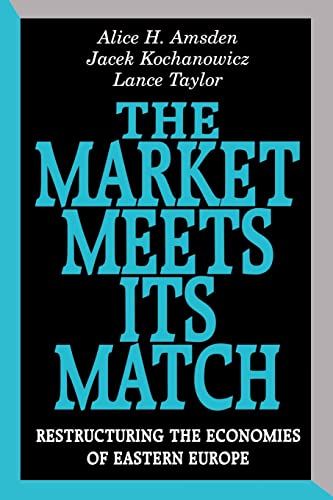
Under free-market shock therapy, the economies of Eastern Europe have fallen into crisis. Shortages may have disappeared, but so have social services, a living wage, and equitable income distribution. Political unrest increases apace as output plummets. The questions as to why so much stagnation, inflation and de-industrialization have occured, and what can be done to turn this state of affairs around, are addressed in this critique of the free-market economic policies that have shocked Eastern Europe. The authors also propose a more sensible approach to reform, including a restructuring of the state itself so that it can play a more positive role in this difficult transition. With close attention to the history and institutional realities of the region, this book explains the failure of the simplistic market medicine administered in the first five years of transition. Merely "getting the prices right" - lowering wages and raising interest rates and energy prices - won't improve competitiveness, the authors argue, as long as non-labour costs such as the quality of goods, product design, outmoded technology, and inefficient distribution channels remain problems. Easing these bottlenecks requires long-term capital accumulation and profit maximization. The institutions necessary for such growth have not developed under Eastern Europe's new "pseudo-privatization" while distributing state property to citizens, has not provided them with the capital and technology they need to succeed. This book shows that the market mechanism alone will not transform Eastern Europe's potentially productive enterprises into international competitors without government co-ordination and support.
"synopsis" may belong to another edition of this title.
About the Authors
Alice Amsden was Barton L. Weller Professor of Political Economy at the Massachusetts Institute of Technology.
Jacek Kochanowicz was Professor of Economic History at the University of Warsaw and Visiting Professor at Central European University, Budapest.
Lance Taylor is Arnhold Professor of International Cooperation and Development at the New School for Social Research.
From the Back Cover
Under free-market shock therapy, the economies of Eastern Europe have plunged into crisis. Shortages may have disappeared, but so have social services, a living wage, and equitable income distribution. Political unrest increases apace as output plummets. Why so much stagnation, inflation, and de-industrialization, and what can be done to turn this risky state of affairs around? This book, the first critique of the free-market economic policies that have jolted Eastern Europe, addresses these questions in penetrating detail. The authors also propose a sensible approach to reform, including a restructuring of the state itself so that it can play a more positive role in this difficult transition. With close attention to the history and institutional realities of the region, The Market Meets Its Match explains the failure of the simplistic market medicine administered in the first five years of transition. Merely "getting the prices right" - lowering wages and raising interest rates and energy prices - won't improve competitiveness, the authors argue, as long as nonlabor costs such as the quality of goods, product design, outmoded technology, and inefficient distribution channels remain problems. Easing these bottlenecks requires long-term capital accumulation and profit maximization. The institutions necessary for such growth have not developed under Eastern Europe's new "pseudo-capitalism", as the authors demonstrate, and "pseudo-privatization", while distributing state property to citizens, has not provided them with the capital and technology they need to succeed. This book shows that the market mechanism alone will not transform Eastern Europe's potentially productive enterprises intointernational competitors without careful government coordination and support.
"About this title" may belong to another edition of this title.
Search results for The Market Meets its Match: Restructuring the Economies...

Stock Image
The Market Meets its Match: Restructuring the Economies of Eastern Europe
Seller: AwesomeBooks, Wallingford, United Kingdom
Seller rating 5 out of 5 stars

Paperback. Condition: Very Good. The Market Meets its Match: Restructuring the Economies of Eastern Europe This book is in very good condition and will be shipped within 24 hours of ordering. The cover may have some limited signs of wear but the pages are clean, intact and the spine remains undamaged. This book has clearly been well maintained and looked after thus far. Money back guarantee if you are not satisfied. See all our books here, order more than 1 book and get discounted shipping. Seller Inventory # 7719-9780674549845
Buy Used
£ 4.09
£ 4.12 shipping
Ships from United Kingdom to U.S.A.
Ships from United Kingdom to U.S.A.
Quantity: 2 available
Stock Image
The Market Meets Its Match: Restructuring the Economies of Eastern Europe
Published by
Harvard University Press, 1998
ISBN 10: 0674549848
ISBN 13: 9780674549845
Used
Softcover
Seller: Wonder Book, Frederick, MD, U.S.A.
Seller rating 5 out of 5 stars
Condition: Very Good. Very Good condition. A copy that may have a few cosmetic defects. May also contain light spine creasing or a few markings such as an owner's name, short gifter's inscription or light stamp. Bundled media such as CDs, DVDs, floppy disks or access codes may not be included. Seller Inventory # M06Q-00037
Stock Image
The Market Meets its Match: Restructuring the Economies of Eastern Europe
Seller: Bahamut Media, Reading, United Kingdom
Seller rating 4 out of 5 stars

Paperback. Condition: Very Good. This book is in very good condition and will be shipped within 24 hours of ordering. The cover may have some limited signs of wear but the pages are clean, intact and the spine remains undamaged. This book has clearly been well maintained and looked after thus far. Money back guarantee if you are not satisfied. See all our books here, order more than 1 book and get discounted shipping. Seller Inventory # 6545-9780674549845
Buy Used
£ 5.12
£ 6.98 shipping
Ships from United Kingdom to U.S.A.
Ships from United Kingdom to U.S.A.
Quantity: 2 available
Stock Image
Market Meets Its Match : Restructuring the Economies of Eastern Europe
Published by
Harvard University Press, 1998
ISBN 10: 0674549848
ISBN 13: 9780674549845
New
Softcover
Seller: GreatBookPrices, Columbia, MD, U.S.A.
Seller rating 5 out of 5 stars
Condition: New. Seller Inventory # 622708-n
Stock Image
The Market Meets Its Match
Seller: PBShop.store US, Wood Dale, IL, U.S.A.
Seller rating 5 out of 5 stars
PAP. Condition: New. New Book. Shipped from UK. Established seller since 2000. Seller Inventory # WH-9780674549845
Seller Image
The Market Meets Its Match
Published by
Harvard University Press, US, 1998
ISBN 10: 0674549848
ISBN 13: 9780674549845
New
Paperback
Seller: Rarewaves.com USA, London, LONDO, United Kingdom
Seller rating 5 out of 5 stars
Paperback. Condition: New. Under free-market shock therapy, the economies of Eastern Europe have plunged into crisis. Shortages may have disappeared, but so have social services, a living wage, and equitable income distribution. Political unrest increases apace as output plummets. Why so much stagnation, inflation, and de-industrialization, and what can be done to turn this risky state of affairs around? This book, the first critique of the free-market economic policies that have jolted Eastern Europe, addresses these questions in penetrating detail. The authors also propose a sensible approach to reform, including a restructuring of the state itself so that it can play a more positive role in this difficult transition. With close attention to the history and institutional realities of the region, The Market Meets Its Match explains the failure of the simplistic market medicine administered in the first five years of transition. Merely "getting the prices right"-lowering wages and raising interest rates and energy prices-won't improve competitiveness, the authors argue, as long as nonlabor costs such as the quality of goods, product design, outmoded technology, and inefficient distribution channels remain problems. Easing these bottlenecks requires long-term capital accumulation and profit maximization. The institutions necessary for such growth have not developed under Eastern Europe's new "pseudo-capitalism," as the authors demonstrate, and "pseudo-privatization," while distributing state property to citizens, has not provided them with the capital and technology they need to succeed. This book shows that the market mechanism alone will not transform Eastern Europe's potentially productive enterprises into international competitors without careful government coordination and support. Seller Inventory # LU-9780674549845
Buy New
£ 32.37
Free Shipping
Ships from United Kingdom to U.S.A.
Ships from United Kingdom to U.S.A.
Quantity: 1 available
Stock Image
The Market Meets Its Match
Seller: PBShop.store UK, Fairford, GLOS, United Kingdom
Seller rating 5 out of 5 stars
PAP. Condition: New. New Book. Shipped from UK. Established seller since 2000. Seller Inventory # WH-9780674549845
Buy New
£ 29.02
£ 4.16 shipping
Ships from United Kingdom to U.S.A.
Ships from United Kingdom to U.S.A.
Quantity: 2 available
Seller Image
Market Meets Its Match : Restructuring the Economies of Eastern Europe
Published by
Harvard University Press, 1998
ISBN 10: 0674549848
ISBN 13: 9780674549845
Used
Softcover
Seller: GreatBookPrices, Columbia, MD, U.S.A.
Seller rating 5 out of 5 stars
Condition: As New. Unread book in perfect condition. Seller Inventory # 622708
Stock Image
The Market Meets its Match: Restructuring the Economies of Eastern Europe
Published by
Harvard University Press, 1998
ISBN 10: 0674549848
ISBN 13: 9780674549845
New
Softcover
Seller: Kennys Bookshop and Art Galleries Ltd., Galway, GY, Ireland
Seller rating 5 out of 5 stars
Condition: New. Major changes have occurred in Eastern European economies in recent years, but unforeseen problems arose. This critique of the free-market economic policies that have shocked Eastern Europe examines the reasons behind such problems, and suggests more sensible, alternative approaches to reform. Num Pages: 232 pages, 9 line illustrations; 25 tables. BIC Classification: 1DV; KCB; KCM. Category: (P) Professional & Vocational; (UP) Postgraduate, Research & Scholarly; (UU) Undergraduate. Dimension: 235 x 155 x 14. Weight in Grams: 372. . 1998. Illustrated. paperback. . . . . Seller Inventory # V9780674549845
Seller Image
Market Meets Its Match : Restructuring the Economies of Eastern Europe
Published by
Harvard University Press, 1998
ISBN 10: 0674549848
ISBN 13: 9780674549845
New
Softcover
Seller: GreatBookPricesUK, Woodford Green, United Kingdom
Seller rating 5 out of 5 stars
Condition: New. Seller Inventory # 622708-n
Buy New
£ 32.37
£ 15 shipping
Ships from United Kingdom to U.S.A.
Ships from United Kingdom to U.S.A.
Quantity: 2 available