
Synopsis
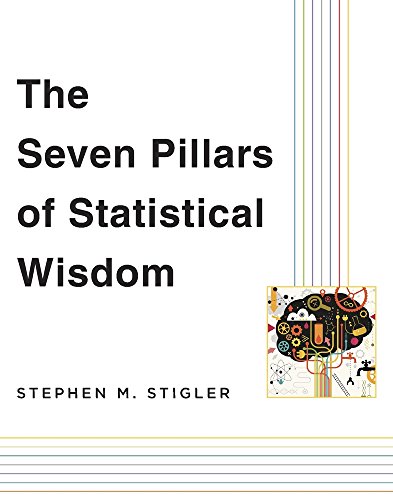
What gives statistics its unity as a science? Stephen Stigler sets forth the seven foundational ideas of statistics a scientific discipline related to but distinct from mathematics and computer science.Even the most basic idea aggregation, exemplified by averaging is counterintuitive. It allows one to gain information by discarding information, namely, the individuality of the observations. Stigler s second pillar, information measurement challenges the importance of "big data" by noting that observations are not all equally important: the amount of information in a data set is often proportional to only the square root of the number of observations, not the absolute number. The third idea is likelihood the calibration of inferences with the use of probability. Intercomparison is the principle that statistical comparisons do not need to be made with respect to an external standard. The fifth pillar is regression both a paradox (tall parents on average produce shorter children; tall children on average have shorter parents) and the basis of inference, including Bayesian inference and causal reasoning. The sixth concept captures the importance of experimental design for example, by recognising the gains to be had from a combinatorial approach with rigorous randomisation. The seventh idea is the residual the notion that a complicated phenomenon can be simplified by subtracting the effect of known causes, leaving a residual phenomenon that can be explained more easily.The Seven Pillars of Statistical Wisdom presents an original, unified account of statistical science that will fascinate the interested layperson and engage the professional statistician."
"synopsis" may belong to another edition of this title.
About the Author
Stephen M. Stigler is Ernest DeWitt Burton Distinguished Service Professor in the Department of Statistics at the University of Chicago.
"About this title" may belong to another edition of this title.
Search results for The Seven Pillars of Statistical Wisdom

Seller Image
The Seven Pillars of Statistical Wisdom
Published by
Harvard University Press, 2016
ISBN 10: 0674088913
ISBN 13: 9780674088917
Used
Softcover
Seller: Greenworld Books, Arlington, TX, U.S.A.
Seller rating 5 out of 5 stars

Condition: good. Fast Free Shipping â" Good condition. It may show normal signs of use, such as light writing, highlighting, or library markings, but all pages are intact and the book is fully readable. A solid, complete copy that's ready to enjoy. Seller Inventory # GWV.0674088913.G
Stock Image
The Seven Pillars of Statistical Wisdom
Published by
Harvard University Press, 2016
ISBN 10: 0674088913
ISBN 13: 9780674088917
Used
paperback
Seller: Evergreen Goodwill, Seattle, WA, U.S.A.
Seller rating 5 out of 5 stars
paperback. Condition: Good. Seller Inventory # mon0000170303
Stock Image
The Seven Pillars of Statistical Wisdom
Published by
Harvard University Press, 2016
ISBN 10: 0674088913
ISBN 13: 9780674088917
Used
Softcover
Seller: World of Books (was SecondSale), Montgomery, IL, U.S.A.
Seller rating 5 out of 5 stars
Condition: Good. Item in good condition. Textbooks may not include supplemental items i.e. CDs, access codes etc. Seller Inventory # 00105713042
Stock Image
The Seven Pillars of Statistical Wisdom
Published by
Harvard University Press, 2016
ISBN 10: 0674088913
ISBN 13: 9780674088917
Used
Softcover
Seller: World of Books (was SecondSale), Montgomery, IL, U.S.A.
Seller rating 5 out of 5 stars
Condition: Very Good. Item in very good condition! Textbooks may not include supplemental items i.e. CDs, access codes etc. Seller Inventory # 00106633914
Stock Image
The Seven Pillars of Statistical Wisdom
Published by
Harvard University Press, 2016
ISBN 10: 0674088913
ISBN 13: 9780674088917
Used
Softcover
Seller: More Than Words, Waltham, MA, U.S.A.
Seller rating 5 out of 5 stars
Condition: Very Good. A bright, square, and overall a nice copy. Seller Inventory # BOS-J-12d-01784
Stock Image
The Seven Pillars of Statistical Wisdom
Published by
Harvard University Press, 2016
ISBN 10: 0674088913
ISBN 13: 9780674088917
Used
Paperback
Seller: ThriftBooks-Atlanta, AUSTELL, GA, U.S.A.
Seller rating 5 out of 5 stars
Paperback. Condition: Good. No Jacket. Pages can have notes/highlighting. Spine may show signs of wear. ~ ThriftBooks: Read More, Spend Less. Seller Inventory # G0674088913I3N00
Stock Image
The Seven Pillars of Statistical Wisdom
Published by
Harvard University Press, 2016
ISBN 10: 0674088913
ISBN 13: 9780674088917
Used
Paperback
Seller: ThriftBooks-Atlanta, AUSTELL, GA, U.S.A.
Seller rating 5 out of 5 stars
Paperback. Condition: As New. No Jacket. Pages are clean and are not marred by notes or folds of any kind. ~ ThriftBooks: Read More, Spend Less. Seller Inventory # G0674088913I2N00
Stock Image
Seven Pillars of Statistical Wisdom
Published by
Harvard University Press, 2016
ISBN 10: 0674088913
ISBN 13: 9780674088917
Used
Softcover
Seller: Better World Books, Mishawaka, IN, U.S.A.
Seller rating 5 out of 5 stars
Condition: Fine. Used book that is in almost brand-new condition. May contain a remainder mark. Better World Books: Buy Books. Do Good. Seller Inventory # 38273534-6
Stock Image
Seven Pillars of Statistical Wisdom
Published by
Harvard University Press, 2016
ISBN 10: 0674088913
ISBN 13: 9780674088917
Used
Softcover
Seller: Better World Books, Mishawaka, IN, U.S.A.
Seller rating 5 out of 5 stars
Condition: Good. Former library copy. Pages intact with minimal writing/highlighting. The binding may be loose and creased. Dust jackets/supplements are not included. Includes library markings. Stock photo provided. Product includes identifying sticker. Better World Books: Buy Books. Do Good. Seller Inventory # 11912390-75
Stock Image
The Seven Pillars of Statistical Wisdom
Published by
Harvard University Press, 2016
ISBN 10: 0674088913
ISBN 13: 9780674088917
Used
Softcover
Seller: Wonder Book, Frederick, MD, U.S.A.
Seller rating 5 out of 5 stars
Condition: Very Good. Very Good condition. A copy that may have a few cosmetic defects. May also contain light spine creasing or a few markings such as an owner's name, short gifter's inscription or light stamp. Seller Inventory # K12R-00470