
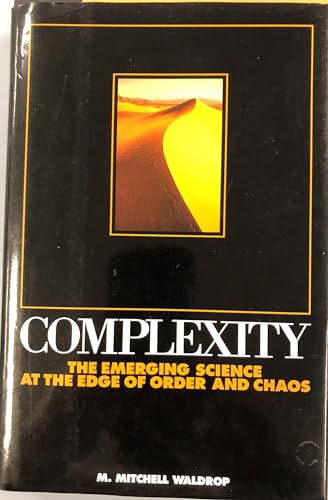
Items related to Complexity: The Emerging Science at the Edge of Order...
Synopsis
A look at the rebellious thinkers who are challenging old ideas with their insights into the ways countless elements of complex systems interact to produce spontaneous order out of confusion
"synopsis" may belong to another edition of this title.
Review
Heinz Pagels
physicist
"The Washington Post"
If you liked "Chaos," you'll love "Complexity." Waldrop creates the most exciting intellectual adventure story of the year.
Douglas R. Hofstadter
author of "Go tel, Esther, Bach"
One comes away from "Complexity" both intellectually excited by ideas and emotionally involved with the people struggling to formulate them. This is a deep tale of science in the making.
"The New York Times Book Review"
Lucidly shows physicists, biologists, computer scientists and economists swapping metaphors and reveling in the sense that epochal discoveries are just around the corner....[Waldrop] has a special talent for relaying the exhilaration of moments of intellectual insight.
"The Washington Post"
If you liked "Chaos, " you'll love "Complexity." Waldrop creates the most exciting intellectual adventure story of the year.
Heinz Pagels
physicist
I am convinced that the nations and people who master the new sciences of complexity will become the economic, cultural, and political superpowers of the next century.
Douglas R. Hofstadter
author of "Gotel, Esther, Bach"
One comes away from "Complexity" both intellectually excited by ideas and emotionally involved with the people struggling to formulate them. This is a deep tale of science in the making.
"The Washington Post"If you liked "Chaos," you'll love "Complexity." Waldrop creates the most exciting intellectual adventure story of the year.
Heinz PagelsphysicistI am convinced that the nations and people who master the new sciences of complexity will become the economic, cultural, and political superpowers of the next century.
Douglas R. Hofstadterauthor of "Gotel, Esther, Bach"One comes away from "Complexity" both intellectually excited by ideas and emotionally involved with the people struggling to formulate them. This is a deep tale of science in the making.
From the Back Cover
In a rented convent in Santa Fe, a revolution has been brewing. The activists are not anarchists, but rather Nobel Laureates in physics and economics such as Murray Gell-Mann and Kenneth Arrow, and pony-tailed graduate students, mathematicians, and computer scientists down from Los Alamos. They've formed an iconoclastic think tank called the Santa Fe Institute, and their radical idea is to create a new science called complexity. These mavericks from academe share a deep impatience with the kind of linear, reductionist thinking that has dominated science since the time of Newton. Instead, they are gathering novel ideas about interconnectedness, coevolution, chaos, structure, and order - and they're forging them into an entirely new, unified way of thinking about nature, human social behavior, life, and the universe itself. They want to know how a primordial soup of simple molecules managed to turn itself into the first living cell - and what the origin of life some four billion years ago can tell us about the process of technological innovation today. They want to know why ancient ecosystems often remained stable for millions of years, only to vanish in a geological instant - and what such events have to do with the sudden collapse of Soviet communism in the late 1980s. They want to know why the economy can behave in unpredictable ways that economists can't explain - and how the random process of Darwinian natural selection managed to produce such wonderfully intricate structures as the eye and the kidney. Above all, they want to know how the universe manages to bring forth complex structures such as galaxies, stars, planets, bacteria, plants, animals, and brains. There are commonthreads in all of these queries, and these Santa Fe scientists seek to understand them. Complexity is their story: the messy, funny, human story of how science really happens. Here is the tale of Brian Arthur, the Belfast-born economist who stubbornly pushed his theories of economic change in the face of hostile orthodoxy. Here, too, are the stories of Stuart Kauffman, the physician-turned-theorist whose most passionate desire has been to find the principles of evolutionary order and organization that Darwin never knew about; John Holland, the affable computer scientist who developed profoundly original theories of evolution and learning as he labored in obscurity for thirty years; Chris Langton, the one-time hippie whose close brush with death in a hang-glider accident inspired him to create the new field of artificial life; and Santa Fe Institute founder George Cowan, who worked a lifetime in the Los Alamos bomb laboratory, until - at age sixty-three - he set out to start a scientific revolution. Most of all, however, Complexity is the story of how these scientists and their colleagues have tried to forge what they like to call "the sciences of the twenty-first century".
"About this title" may belong to another edition of this title.
Search results for Complexity: The Emerging Science at the Edge of Order...

Stock Image
Complexity: The Emerging Science at the Edge of Order and Chaos
Seller: World of Books (was SecondSale), Montgomery, IL, U.S.A.
Seller rating 5 out of 5 stars

Hardback. Condition: Fair. Why did the stock market crash more than 500 points on a single Monday in 1987? Why do ancient species often remain stable in the fossil record for millions of years and then suddenly disappear? In a world where nice guys often finish last, why do humans value trust and cooperation? At first glance these questions don't appear to have anything in common, but in fact every one of these statements refers to a complex system. The science of complexity studies how single elements, such as a species or a stock, spontaneously organize into complicated structures like ecosystems and economies; stars become galaxies, and snowflakes avalanches almost as if these systems were obeying a hidden yearning for order. Drawing from diverse fields, scientific luminaries such as Nobel Laureates Murray Gell-Mann and Kenneth Arrow are studying complexity at a think tank called The Santa Fe Institute. The revolutionary new discoveries researchers have made there could change the face of every science from biology to cosmology to economics. M. Mitchell Waldrop's groundbreaking bestseller takes readers into the hearts and minds of these scientists to tell the story behind this scientific revolution as it unfolds. Seller Inventory # 00108855723
Seller Image
Complexity: The Emerging Science at the Edge of Order and Chaos
Seller: Dream Books Co., Denver, CO, U.S.A.
Seller rating 5 out of 5 stars
Condition: good. Gently used with minimal wear on the corners and cover. A few pages may contain light highlighting or writing, but the text remains fully legible. Dust jacket may be missing, and supplemental materials like CDs or codes may not be included. May be ex-library with library markings. Ships promptly! Seller Inventory # DBV.0671767895.G
Stock Image
Complexity: The Emerging Science at the Edge of Order and Chaos
Seller: ThriftBooks-Atlanta, AUSTELL, GA, U.S.A.
Seller rating 5 out of 5 stars
Hardcover. Condition: Fair. No Jacket. Readable copy. Pages may have considerable notes/highlighting. ~ ThriftBooks: Read More, Spend Less. Seller Inventory # G0671767895I5N00
Stock Image
Complexity: The Emerging Science at the Edge of Order and Chaos
Seller: World of Books Inc, Montgomery, IL, U.S.A.
Seller rating 4 out of 5 stars

Hardback. Condition: Fair. Why did the stock market crash more than 500 points on a single Monday in 1987? Why do ancient species often remain stable in the fossil record for millions of years and then suddenly disappear? In a world where nice guys often finish last, why do humans value trust and cooperation? At first glance these questions don't appear to have anything in common, but in fact every one of these statements refers to a complex system. The science of complexity studies how single elements, such as a species or a stock, spontaneously organize into complicated structures like ecosystems and economies; stars become galaxies, and snowflakes avalanches almost as if these systems were obeying a hidden yearning for order. Drawing from diverse fields, scientific luminaries such as Nobel Laureates Murray Gell-Mann and Kenneth Arrow are studying complexity at a think tank called The Santa Fe Institute. The revolutionary new discoveries researchers have made there could change the face of every science from biology to cosmology to economics. M. Mitchell Waldrop's groundbreaking bestseller takes readers into the hearts and minds of these scientists to tell the story behind this scientific revolution as it unfolds. Seller Inventory # CIN0671767895A
Stock Image
Complexity: The Emerging Science at the Edge of Order and Chaos
Published by
Simon & Schuster (edition ), 1992
ISBN 10: 0671767895
ISBN 13: 9780671767891
Used
Hardcover
Seller: BooksRun, Philadelphia, PA, U.S.A.
Seller rating 5 out of 5 stars
Hardcover. Condition: Fair. With dust jacket. The item might be beaten up but readable. May contain markings or highlighting, as well as stains, bent corners, or any other major defect, but the text is not obscured in any way. Seller Inventory # 0671767895-7-1-13_29
Stock Image
Complexity: The Emerging Science at the Edge of Order and Chaos
Seller: Housing Works Online Bookstore, New York, NY, U.S.A.
Seller rating 5 out of 5 stars
Hardcover. Condition: Good. Light general wear. May have light notes/highlighting. shelf wear. bumped edges. worn cover. Hardcover. Seller Inventory # JN2-00873-IN
Stock Image
Complexity: The Emerging Science at the Edge of Order and Chaos
Seller: HPB-Movies, Dallas, TX, U.S.A.
Seller rating 4 out of 5 stars
Hardcover. Condition: Very Good. Connecting readers with great books since 1972! Used books may not include companion materials, and may have some shelf wear or limited writing. We ship orders daily and Customer Service is our top priority! Seller Inventory # S_480759504
Stock Image
Complexity: The Emerging Science at the Edge of Order and Chaos
Seller: HPB Inc., Dallas, TX, U.S.A.
Seller rating 5 out of 5 stars
Hardcover. Condition: Very Good. Connecting readers with great books since 1972! Used books may not include companion materials, and may have some shelf wear or limited writing. We ship orders daily and Customer Service is our top priority! Seller Inventory # S_481596236
Stock Image
Complexity : The Emerging Science at the Edge of Order and Chaos
Seller: Better World Books: West, Reno, NV, U.S.A.
Seller rating 5 out of 5 stars
Condition: Good. Pages intact with minimal writing/highlighting. The binding may be loose and creased. Dust jackets/supplements are not included. Stock photo provided. Product includes identifying sticker. Better World Books: Buy Books. Do Good. Seller Inventory # 4053447-6
Stock Image
Complexity : The Emerging Science at the Edge of Order and Chaos
Seller: Better World Books, Mishawaka, IN, U.S.A.
Seller rating 5 out of 5 stars
Condition: Good. Pages intact with minimal writing/highlighting. The binding may be loose and creased. Dust jackets/supplements are not included. Stock photo provided. Product includes identifying sticker. Better World Books: Buy Books. Do Good. Seller Inventory # 4053447-6