
Items related to Doghouse Roses: Stories
Synopsis
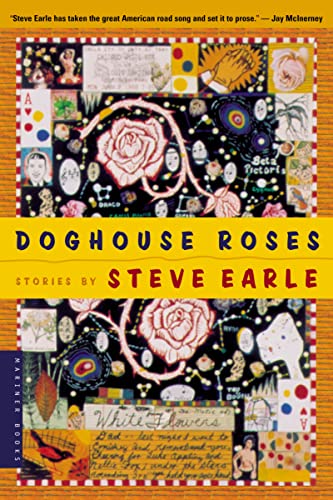
Steve Earle has taken his considerable narrative talents -- already evidenced in a songwriting career spanning three decades -- and applied them to the page in DOGHOUSE ROSES, his first story collection. With all the grace, poetry, and passion that has made his music honored around the world, Earle offers eleven stories in this remarkable literary debut. He chronicles the lives of the lost and the lonely -- rebels, addicts, outlaws, and drifters -- with a voice that is "vigorous, punchy, often profane and more often profound" (The Oregonian).
"synopsis" may belong to another edition of this title.
About the Author
STEVE EARLE is a singer-songwriter, actor, activist, and the author of a Los Angeles Times Book of the Year, the story collection Doghouse Roses. He has released more than a dozen critically acclaimed albums, including the Grammy winners The Revolution Starts Now, Washington Square Serenade, and Townes. He has appeared on film and television, with celebrated roles in The Wire and Treme. His album entitled I'll Never Get Out of This World Alive was produced by T Bone Burnett. He often tours with his wife, singer-songwriter Allison Moorer.
Excerpt. © Reprinted by permission. All rights reserved.
Doghouse Roses
StoriesBy Steve EarleMariner Books
Copyright © 2002 Steve EarleAll right reserved.
ISBN: 0618219242
Excerpt
DOGHOUSE ROSES
Pick any means of transportation, public or private, over land, sea,
or air. No matter which direction you travel, it takes three hours to
get out of L.A. Yeah, I know there are all those folks with a head
start for the Grapevine out in Northridge and Tarzana, but hell, to
those of us in the trenches, the real Angelenos, those places are
only luminescent names on big green signs seemingly suspended in
midair above the 101 Freeway. Yeah, yeah, I know all about the good
citizens of Encino and Toluca Lake who are always bragging about the
convenience of friendly little Burbank Airport, but let"s get real -
they"re not going anywhere anyway.
I"m talking about the other side of the hill - Downtown,
Hollywood, Santa Monica, Venice, and Silver Lake - the transient
heart of the city, the L.A. of Raymond Chandler, Chet Baker, and Tom
Waits. A place where folks come to do Great Things - make movies and
records, write screenplays and novels, which they hope will become
screenplays someday, because that"s where the money is. And every-
fucking-body"s got a "treatment" that they"re working on, including
half of the L.A.P.D. Most of these folks only wind up as minor
characters in the work of the fortunate few. You"ve seen them -
aging bit players with tough, brown hides, mummified from years of
sitting around motel swimming pools waiting for the phone to ring.
The drug-ravaged former rock stars in raggedy-ass Porches and Saabs
on an unending orbit of the downtown streets. Even the lucky ones
only get as far as the Hollywood Hills or maybe Malibu, where they
live out their lives with their backs to the world"s widest and
deepest ocean, waiting for wildfire to rain down from the canyons
above. And should they decide to get out? Well, like I said, it takes
three hours, and most people simply don"t have the resolve.
Bobby Charles certainly didn"t. He left L.A. in disgrace, low-
riding in the passenger seat of his soon-to-be ex-wife"s BMW. Not
that he wanted to go, but this town kicked his ass so thoroughly
there was simply no fight left in him. Kim West (she had never taken
Bobby"s last name, for professional reasons) had finally given up on
her talented but troubled husband of five years, and now she just
wanted him out of her town.
When Kim and Bobby met, he was a country-rock singer whose
first marriage had already begun to buckle under the stress of
constant touring, the distance alone taking a considerable toll. His
wife and two kids were back in Nashville, but his real home was a
forty-foot Eagle bus he shared with his band and crew. At age thirty-
five Bobby was somewhat of a cult figure, the kind of recording
artist who, thanks to a loyal following, sold one hundred thousand
records per release, although this was barely enough to recoup his
recording costs. The critics loved his work, however, and he lent a
certain amount of integrity to a record label"s roster. Before Kim
came along, he had always considered L.A. a nice place to visit, at
best.
Bobby had always avoided strong women like the plague, but
something about the diminutive, up-and-coming producer fascinated
him. Kim came out from St. Louis to attend the UCLA film school,
switching to a business major midway through her second year. She
went on to an M.B.A. and a job at a major studio. When a mutual
friend introduced the pair at a party after the Grammy Awards, Kim
thought Bobby was cute, in a primitive sort of way, like Crocodile
Dundee or something. She was bored to tears with dating
other "industry" types, who saved all the receipts from dinner and
talked shop in bed. Bobby was a little loud, a little reckless, and
she knew her mother would hate him.
They left the party together in a rented 5.0 Mustang
convertible. They wound up parked somewhere way up Mulholland Drive
with Kim"s panties hanging on the rearview mirror, breathlessly
gazing down on all those lights. From that moment, L.A. had Bobby
Charles by the balls.
Bobby didn"t discover heroin in L.A. Hell, he grew up in San
Antonio, Texas, 150 miles from the Mexican border. Despite the much
publicized efforts of the U.S. government, brown heroin steadily
seeped across the Rio Grande like tainted blood from a gangrenous
wound. Bobby first tried it at an impromptu party at a friend"s house
when he was fourteen. For years he managed to get away with his off-
and-on habit. He always managed to detox in time for this tour or
that record, and even if he was dope-sick he never missed a show. By
the time he met Kim, though, it was starting to catch up with him.
Once Bobby left his family and moved to L.A., cheap, strong dope,
guilt, and a long, nasty divorce combined to provide him with all the
excuse any addict needs to bottom out.
At first it was just a matter of L.A."s dependable supply of
heroin, but pretty soon Bobby discovered speedballs - deadly
intravenous cocktails of heroin and cocaine. It wasn"t long before he
had two habits to support. In L.A. time passes in its own surreal
fashion - too subtle to even be detectable to folks who are used to
four seasons. So if you asked Bobby, he couldn"t tell you exactly
when his habit got to be too much work. He only knew that at some
point, in what passed for a moment of clarity, he enrolled in a
private methadone program. He woke up early every morning to line up
at the clinic with the other "clients" to take communion at the
little window - a plastic cup of the bitter powder dissolved in an
orange-flavored liquid, chased by water from the cooler. Bobby was
then "free" from the need to run down to Hoover Street to buy heroin
twice a day. So he took up smoking crack.
Because he no longer used needles, Bobby told himself and
anyone who would listen that he was back on track. He"d get smoked up
and rattle on for hours about the "next record." Kim listened
dutifully, but she knew it was only talk. Bobby hadn"t written a song
in more than three years. How could he? All of his guitars (along
with a few that didn"t belong to him) were in the pawnshop.
Kim knew Bobby was a junkie when she married him. She just
didn"t know he was a junkie junkie. At first she saw dope as part of
Bobby"s "thing," his mystique. It made him seem more dangerous, and
after all, she was slumming. It stopped being cute when money began
to turn up missing from her account. Or when he called her at work,
whacked out of his skull and thoroughly convinced that their little
craftsman bungalow in Larchmont Village was surrounded by police.
Kim, having little or no experience in such matters, immediately
called her lawyer and rushed home to find Bobby hiding in the hall
closet with a loaded shotgun and a crack pipe. When she opened the
door and stood there in tears, Bobby only stared back indignantly.
"What?"
That was the day that Kim decided to bail, but she couldn"t
bring herself to simply leave. After all, she really loved the guy;
she was just at the end of her rope. She decided that if she could
just get Bobby out of L.A., back to Nashville where his friends were,
or maybe just as far as Texas where his folks lived, maybe - well,
at least she wouldn"t have to watch him die.
So Kim went to Jeff Shapiro, her boss at the studio, and
asked for a leave of absence, which under the circumstances he was
more than willing to grant. Shapiro always considered Bobby a hick
and beneath Kim anyway. So Kim then canceled her subscription to the
Los Angeles Times, notified the home security service that she and
Bobby would be out of town indefinitely, serviced the car, and picked
up some cash at the bank on the way home.
Bobby never knew what hit him. It took Kim less than half an
hour to pack some T-shirts and the few pairs of jeans that still fit
Bobby (he"d lost an alarming amount of weight) and a few changes of
clothes for herself. She told him it would do them both good to get
away for a while. Bobby went through the motions of putting up a
fight, but before he knew it he was in the car headed down Beverly
Boulevard toward the 101.
They didn"t get far. Junkies can"t go directly from point A
to point B like other people, mainly because another hit always lies
somewhere in between. First they stopped at the methadone clinic on
Beverly and picked up Bobby"s daily dose and a week"s worth of "take-
homes" for the road. Kim had already called the doctor in advance and
begged for these, because doses "to go" were a privilege and Bobby
hadn"t been able to manage a single "clean" urine specimen in six
months on the program.
Between the clinic and the freeway, tucked in between the
innocuous little bungalows, were at least fifty corners where street
kids and soda pop gangsters sold crack cocaine (called "rock" on the
West Coast) to the drive-up trade. Kim and Bobby made it as far as
the left turn onto Vermont Avenue, just before the 101 on-ramp, then
Bobby threatened to get out of the car if Kim didn"t drive him to a
nearby spot. Reluctantly, she agreed, telling herself that this would
be the last time.
They headed north on Vermont and took a right into a little
rundown corner of East Hollywood. Two more rights followed by a quick
left brought Bobby and his reluctant chauffeur to a cul-de-sac, cut
off from the rest of the world by the freeway viaduct - a great
graffiti-covered concrete monstrosity that bore the rest of the world
noisily over the heads of the folks who had to live in this desperate
little neighborhood. It was after dark, so anybody out on the street
was either selling rock or "plugs" - little pieces of soap carved up
to look like the real thing. Bobby was no stranger to this
neighborhood. He ignored the hucksters and had Kim drag the block
slowly until he spotted Luis.
"There he is."
Bobby rolled down the window and whistled; a skinny kid with
Mayan features - long, sloping forehead, almond-shaped eyes, and
angular nose - came running over to the car. He was all of fifteen
years old.
"Hey, vato! Where you been, homes?"
Luis wasn"t Bobby"s only source, merely the nearest to the
freeway.
"Around. What"s up?"
"I got the grandes, homes. The monkey nuts. Check it out."
Luis reached down into his sock and produced a large prescription
medicine bottle, half full of off-white chunks of cooked-up coke,
rattling them around like the pebbles inside a pair of maracas. Bobby
noticed that Luis was acting strange, a little more wary than usual.
He kept glancing nervously, from side to side, over his shoulder as
they talked through the passenger-side window of Kim"s BMW.
"What"s up, kid? Five-O been through?"
"Naw, just some guys. Don"t worry "bout it, homes. What you
need?"
"How much for all of it?"
Luis looked down at the bottle, rattled it some more, as if
he was weighing it and doing the math in his head at a pace that
belied his sixth-grade education.
"How "bout two yards?"
"Come on with it." Bobby handed Luis a wad of twenties, took
the bottle, and turned to Kim. "Let"s roll."
They made a U-turn in the cul-de-sac and headed back toward
Vermont and the 101. Kim couldn"t wait to get out of the
neighborhood, and Bobby had to tell her to slow down a little. About
halfway up the street they met a customized Chevy van rolling toward
the cul-de-sac with its lights off and the sliding cargo door locked
open. Bobby looked in his side mirror just in time to see little Luis
break and run as the van"s headlights suddenly came on, freezing Luis
in the middle of the street. Kim jumped as the van came alive with
gunfire, the muzzle flash of at least three weapons visible through
the open door. The last time Bobby saw Luis, he was lying face down
in the street as the van circled like a great, hulking predator over
a fresh kill - then it sped off, passing Kim and Bobby as if they
weren"t even there.
Kim drove on, her heart pounding in her throat while Bobby
navigated.
"Next right. Now left. OK, one more left and we"re out of
Indian Country."
Kim turned left back onto Vermont. When she stopped at the
light before the 101 on-ramp, she looked over at Bobby for the first
time during the ordeal. He was cutting up one of the big rocks with
his Buck knife, using the leather-covered console for a cutting
board. His own car had hundreds of tiny slices in the upholstery by
the time the police confiscated it last fall. Kim started to say
something but caught herself. Why bother? This is the last time. I"ll
just have it re-covered and it"ll be just like new. Jesus fucking
Christ, I just witnessed a murder! A fucking murder! OK, it"s over.
Just drive.
She turned left across traffic and onto the 101 headed east.
"Get all the way over to the left lane, unless you want to
end up in Downey or someplace."
She complied, but it irritated her to take directions from
someone who had lived in L.A. all of two years. How does he know
these places? But she knew the answer. Bobby could show locals parts
of this town they never knew existed. Dope does that. It creates its
own parallel geography, dark, scary places hidden from the real world
behind a facade of palm trees and stucco. If you aren"t looking, you
won"t see it - and you probably don"t need to. Most of the folks on
the freeway that night were simply following well-worn grooves in the
asphalt to and from work or school or wherever. They only knew where
to get on the freeway and where to get off. They had no idea where
they really were, what kind of places and lives they were passing
through or over.
Bobby did. It was an obsession with him. He roamed the
freeways at night, exiting here and there just for the hell of it, to
have a look around. He could tell you about the different styles of
street signs and lights in the old L.A. neighborhoods. Each
neighborhood had its own look - one for Hollywood, another for the
Crenshaw District, and so on. He even knew a fair amount of L.A."s
checkered history, the scandals and secrets that had shaped it.
Continues...
Excerpted from Doghouse Rosesby Steve Earle Copyright © 2002 by Steve Earle. Excerpted by permission.
All rights reserved. No part of this excerpt may be reproduced or reprinted without permission in writing from the publisher.
Excerpts are provided by Dial-A-Book Inc. solely for the personal use of visitors to this web site.
"About this title" may belong to another edition of this title.
Search results for Doghouse Roses: Stories

Stock Image
Doghouse Roses: Stories
Seller: World of Books (was SecondSale), Montgomery, IL, U.S.A.
Seller rating 5 out of 5 stars

Condition: Very Good. Item in very good condition! Textbooks may not include supplemental items i.e. CDs, access codes etc. Seller Inventory # 00101911304
Stock Image
Doghouse Roses: Stories
Seller: World of Books (was SecondSale), Montgomery, IL, U.S.A.
Seller rating 5 out of 5 stars
Condition: Good. Item in good condition. Textbooks may not include supplemental items i.e. CDs, access codes etc. Seller Inventory # 00102345089
Stock Image
Doghouse Roses: Stories
Seller: World of Books (was SecondSale), Montgomery, IL, U.S.A.
Seller rating 5 out of 5 stars
Condition: Acceptable. Item in Acceptable condition. Textbooks may not include supplemental items i.e. CDs, access codes etc. Seller Inventory # 00110508763
Seller Image
Doghouse Roses: Stories
Seller: 3Brothers Bookstore, Egg harbor township, NJ, U.S.A.
Seller rating 5 out of 5 stars
Condition: good. Books may contain some notes and highlighting. Supplements such as Access Codes, Cd's Dust Jackets, etc. are not guaranteed with used book purchases. Seller Inventory # EVV.0618219242.G
Seller Image
Doghouse Roses: Stories
Seller: Greenworld Books, Arlington, TX, U.S.A.
Seller rating 5 out of 5 stars
Condition: good. Fast Free Shipping â" Good condition. It may show normal signs of use, such as light writing, highlighting, or library markings, but all pages are intact and the book is fully readable. A solid, complete copy that's ready to enjoy. Seller Inventory # GWV.0618219242.G
Seller Image
Doghouse Roses: Stories
Seller: Greenworld Books, Arlington, TX, U.S.A.
Seller rating 5 out of 5 stars
Condition: very_good. Fast Free Shipping â" Very Good condition book with a firm cover and clean pages. Shows normal use and some light wear or limited notes markings. A solid, nice copy to enjoy. Seller Inventory # GWV.0618219242.VG
Stock Image
Doghouse Roses: Stories
Seller: Once Upon A Time Books, Siloam Springs, AR, U.S.A.
Seller rating 4 out of 5 stars

Paperback. Condition: Acceptable. This is a used book. It may contain highlighting/underlining and/or the book may show heavier signs of wear . It may also be ex-library or without dustjacket. This is a used book. It may contain highlighting/underlining and/or the book may show heavier signs of wear . It may also be ex-library or without dustjacket. Seller Inventory # mon0003449410
Stock Image
Doghouse Roses: Stories
Seller: HPB-Ruby, Dallas, TX, U.S.A.
Seller rating 5 out of 5 stars
paperback. Condition: Very Good. Connecting readers with great books since 1972! Used books may not include companion materials, and may have some shelf wear or limited writing. We ship orders daily and Customer Service is our top priority! Seller Inventory # S_462715049
Stock Image
Doghouse Roses: Stories
Seller: Half Price Books Inc., Dallas, TX, U.S.A.
Seller rating 5 out of 5 stars
Paperback. Condition: Very Good. Connecting readers with great books since 1972! Used books may not include companion materials, and may have some shelf wear or limited writing. We ship orders daily and Customer Service is our top priority! Seller Inventory # S_460902163
Stock Image
Doghouse Roses: Stories
Seller: HPB Inc., Dallas, TX, U.S.A.
Seller rating 5 out of 5 stars
Paperback. Condition: Very Good. Connecting readers with great books since 1972! Used books may not include companion materials, and may have some shelf wear or limited writing. We ship orders daily and Customer Service is our top priority! Seller Inventory # S_471739432