
Items related to Object-Oriented Programming with Visual Basic.NET
Synopsis
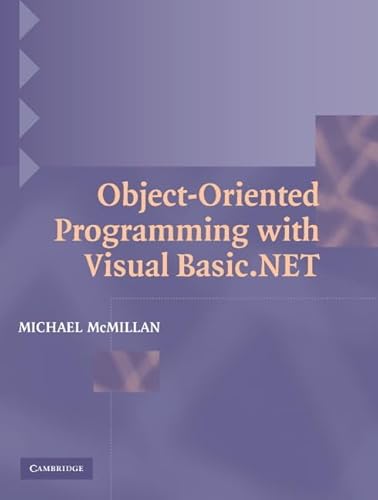
Michael McMillan provides a complete presentation of the object-oriented features of the Visual Basic .NET language for advanced Visual Basic programmers. Beginning with an introduction to abstract data types and their initial implementation using structures, he explains standard OOP topics including class design, inheritance, access modifiers and scoping issues, abstract classes, design and implemention of interfaces and design patterns, and refactoring in VB.NET. More advanced OOP topics are included as well, such as reflection, object persistence, and serialization. To tie everything together, McMillan demonstrates sound OOP design and implementation principles through practical examples of standard Windows applications, database applications using ADO.NET, Web-based applications using ASP.NET, and Windows service applications.
"synopsis" may belong to another edition of this title.
Review
"...it is written clearly, and any student who has successfully completed a programming course in any language should be able to use it as a stepping-stone into the world of applications programming in Microsoft's dot-NET framework. Recommended." S.L. Tanimoto, University of Washington, Choice
"Beginning with an overview of the syntax and primary constructs of the VB.NET language, the book elaborates standard object-oriented programming topics including class, inheritance, access modifiers and scoping issues, abstract classes, design and implementation of interfaces and design patterns, and refactoring in VB.NET...All in all, the book will help VB users to develop a firm understanding of object-oriented programming in VB.NET." ACM SIGSOFT Software Engineering Notes
Book Description
This thorough tutorial covers all the details of designing object-oriented programs using the Visual Basic .NET language. Along with the standard OOP topics (classes, inheritance, and interfaces), the author discusses less-covered topics such as reflection, object persistence, design patterns, and refactoring. The book ends with example applications of OOP principles using ADO.NET and ASP.NET.
"About this title" may belong to another edition of this title.
Search results for Object-Oriented Programming with Visual Basic.NET

Stock Image
Object-Oriented Programming with Visual Basic. NET
Published by
Cambridge University Press, 2004
ISBN 10: 0521539838
ISBN 13: 9780521539838
Used
Softcover
Seller: Better World Books Ltd, Dunfermline, United Kingdom
Seller rating 5 out of 5 stars

Condition: Very Good. Former library copy. Pages intact with possible writing/highlighting. Binding strong with minor wear. Dust jackets/supplements may not be included. Includes library markings. Stock photo provided. Product includes identifying sticker. Better World Books: Buy Books. Do Good. Seller Inventory # 10328491-6
Buy Used
£ 4.82
£ 5 shipping
Ships from United Kingdom to U.S.A.
Ships from United Kingdom to U.S.A.
Quantity: 2 available
Stock Image
Object-Oriented Programming with Visual Basic.NET
Seller: Bahamut Media, Reading, United Kingdom
Seller rating 5 out of 5 stars
Paperback. Condition: Very Good. This book is in very good condition and will be shipped within 24 hours of ordering. The cover may have some limited signs of wear but the pages are clean, intact and the spine remains undamaged. This book has clearly been well maintained and looked after thus far. Money back guarantee if you are not satisfied. See all our books here, order more than 1 book and get discounted shipping. Seller Inventory # 6545-9780521539838
Buy Used
£ 4.29
£ 6.98 shipping
Ships from United Kingdom to U.S.A.
Ships from United Kingdom to U.S.A.
Quantity: 2 available
Stock Image
Object Oriented Prog Visual Basic
Published by
Cambridge University Press, 2004
ISBN 10: 0521539838
ISBN 13: 9780521539838
Used
Paperback
Seller: ThriftBooks-Atlanta, AUSTELL, GA, U.S.A.
Seller rating 5 out of 5 stars
Paperback. Condition: Very Good. No Jacket. May have limited writing in cover pages. Pages are unmarked. ~ ThriftBooks: Read More, Spend Less. Seller Inventory # G0521539838I4N00
Stock Image
Object-Oriented Programming with Visual Basic. NET
Published by
Cambridge University Press, 2004
ISBN 10: 0521539838
ISBN 13: 9780521539838
Used
Softcover
Seller: Better World Books, Mishawaka, IN, U.S.A.
Seller rating 5 out of 5 stars
Condition: Good. Former library copy. Pages intact with minimal writing/highlighting. The binding may be loose and creased. Dust jackets/supplements are not included. Includes library markings. Stock photo provided. Product includes identifying sticker. Better World Books: Buy Books. Do Good. Seller Inventory # GRP16493621
Stock Image
Object-Oriented Programming with Visual Basic.NET
Published by
Cambridge University Press, 2004
ISBN 10: 0521539838
ISBN 13: 9780521539838
New
Softcover
Seller: California Books, Miami, FL, U.S.A.
Seller rating 4 out of 5 stars

Condition: New. Seller Inventory # I-9780521539838
Stock Image
Object-Oriented Programming with Visual Basic.NET
Published by
Cambridge University Press, 2004
ISBN 10: 0521539838
ISBN 13: 9780521539838
New
paperback
Seller: BennettBooksLtd, Los Angeles, CA, U.S.A.
Seller rating 5 out of 5 stars
paperback. Condition: New. In shrink wrap. Looks like an interesting title! Seller Inventory # Q-0521539838
Stock Image
Object-Oriented Programming with Visual Basic.NET
Published by
Cambridge University Press, 2004
ISBN 10: 0521539838
ISBN 13: 9780521539838
New
Paperback / softback
Seller: THE SAINT BOOKSTORE, Southport, United Kingdom
Seller rating 5 out of 5 stars
Paperback / softback. Condition: New. This item is printed on demand. New copy - Usually dispatched within 5-9 working days. Seller Inventory # C9780521539838
Buy New
£ 58.55
£ 16.11 shipping
Ships from United Kingdom to U.S.A.
Ships from United Kingdom to U.S.A.
Quantity: Over 20 available
Stock Image
Object-Oriented Programming with Visual Basic.NET
Published by
Cambridge University Press CUP, 2004
ISBN 10: 0521539838
ISBN 13: 9780521539838
New
Softcover
Seller: Books Puddle, Woodside, NY, U.S.A.
Seller rating 4 out of 5 stars
Condition: New. pp. xi + 304 Index 1st Published. Seller Inventory # 26163478
Stock Image
Object-Oriented Programming with Visual Basic.NET
Published by
Cambridge University Press, 2004
ISBN 10: 0521539838
ISBN 13: 9780521539838
New
Softcover
Seller: Majestic Books, Hounslow, United Kingdom
Seller rating 4 out of 5 stars
Condition: New. Print on Demand pp. xi + 304 Figures, Illus. Seller Inventory # 7717193
Buy New
£ 87.70
£ 6.50 shipping
Ships from United Kingdom to U.S.A.
Ships from United Kingdom to U.S.A.
Quantity: 4 available
Stock Image
Object-Oriented Programming with Visual Basic.NET
Seller: Revaluation Books, Exeter, United Kingdom
Seller rating 5 out of 5 stars
Paperback. Condition: Brand New. illustrated edition. 316 pages. 9.00x7.00x0.50 inches. In Stock. Seller Inventory # x-0521539838
Buy New
£ 84.05
£ 12.50 shipping
Ships from United Kingdom to U.S.A.
Ships from United Kingdom to U.S.A.
Quantity: 2 available