
Items related to Between Memory and Desire: The Middle East in a Troubled...
Synopsis
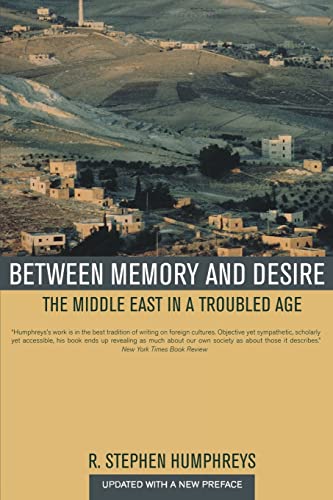
Middle Easterners today struggle to find solutions to crises of economic stagnation, political gridlock, and cultural identity. In recent decades Islam has become central to this struggle, and almost every issue involves fierce, sometimes violent debates over the role of religion in public life. In this post-9/11 updated edition R. Stephen Humphreys presents a thoughtful analysis of Islam's place in today's Middle East and integrates the medieval and modern history of the region to show how the sacred and secular are tightly interwoven in its political and intellectual life.
"synopsis" may belong to another edition of this title.
About the Author
R. Stephen Humphreys is Professor of History and Islamic Studies at the University of California, Santa Barbara, and author of Islamic History: A Framework for Inquiry (second edition, 1991) among other works.
From the Back Cover
PRAISE FOR THE FIRST EDITION:
"Humphreys brings a historian's deep and dispassionate perspective to the modern Middle East. In Between Memory and Desire, he poses incisive questions, elaborates convincing arguments and does not shy from tackling the prickliest of topics. All this is achieved with an eye for telling detail and a concise style that is rare in academic writing.... Humphreys's work is in the best tradition of writing on foreign cultures. Objective yet sympathetic, scholarly yet accessible, his book ends up revealing as much about our own society as about those it describes."--Max Rodenbeck, New York Times Book Review
"In this sober and highly informative book, Humphreys introduces educated readers to the nuances of Middle Eastern political and social discourse. He goes behind the headlines and offers a sophisticated and yet accessible analysis of Islamic polity for Western readers."--Library Journal
"'People know a lot of things that aren't so, ' warns Stephen Humphreys, and then he tells us all we should really know about the Middle East--a vast, complex, and frequently misunderstood universe. It is a rare achievement that combines erudition, compelling writing, and personal experience."--Meron Benvenisti, author of City of Stone
From the Inside Flap
PRAISE FOR THE FIRST EDITION:
Humphreys brings a historian's deep and dispassionate perspective to the modern Middle East. In Between Memory and Desire, he poses incisive questions, elaborates convincing arguments and does not shy from tackling the prickliest of topics. All this is achieved with an eye for telling detail and a concise style that is rare in academic writing.... Humphreys's work is in the best tradition of writing on foreign cultures. Objective yet sympathetic, scholarly yet accessible, his book ends up revealing as much about our own society as about those it describes.--Max Rodenbeck, New York Times Book Review
In this sober and highly informative book, Humphreys introduces educated readers to the nuances of Middle Eastern political and social discourse. He goes behind the headlines and offers a sophisticated and yet accessible analysis of Islamic polity for Western readers.--Library Journal
'People know a lot of things that aren't so, ' warns Stephen Humphreys, and then he tells us all we should really know about the Middle East--a vast, complex, and frequently misunderstood universe. It is a rare achievement that combines erudition, compelling writing, and personal experience.--Meron Benvenisti, author of City of Stone
Excerpt. © Reprinted by permission. All rights reserved.
Between Memory and Desire
The Middle East in a Troubled AgeBy R. Stephen HumphreysUniversity of California Press
Copyright © 2005 R. Stephen HumphreysAll right reserved.
ISBN: 9780520246911
Chapter One
HARD REALITIES
Population Growth and Economic Stagnation
First impressions can be desperately misleading, but revisited in thelight of longer experience, they often point to basic truths. When mywife and I got off the plane and walked across the tarmac into theCairo airport terminal for the first time on a hot spring night inApril 1966, we were immediately engulfed in a crush of would-beporters, all clamoring for the privilege of carrying our bags to thetaxi stand. We chose a likely prospect, who snatched up our stuffand carried it about fifty feet. There he passed it off to a second manand in the same motion stuck out his hand for the customary two-piastertip. The second porter repeated the same act, and then a thirdand a fourth. I am happy to say that our first taxi driver took us allthe way downtown without a break, but as soon as we stepped outof the cab a pack of boys materialized out of the shadows, all shoutingand grabbing for our luggage. It was only about twenty feet tothe door of our pension, so this time we fended them off with barkingand a bit of pushing. By some miracle the elevator was working(just how rare a miracle it was in the Cairo of 1966 we would soondiscover), and we were quickly and peaceably delivered to the doorof Mme Seoudi's fifth-story hotel-pension.
Our initial experience was repeated hundreds of times over inthe coming weeks. The simplest task required three or four or halfa dozen people. What we were dealing with, plainly, was too manypeople chasing too few jobs. The causes for this phenomenon wereby no means obvious to the superficial observer, but a bit of readingand talking to the right people told us more or less what wasgoing on. The countryside was jammed and could no longer provideany kind of living wage for agricultural workers, and so displacedpeasants were flowing into the cities to find whatever workthey could. In spite of a determined push toward industrializationby the Nasser government, there were still few factory jobs. In anycase, these rural immigrants were mostly illiterate and utterly withoutthe skills needed even for assembly-line labor; all they couldfind was pick-up work at minuscule wages. As for the boys whoswarmed around us wherever we went, they were supposed to bein school, but that was boring, irrelevant to any purpose they couldsee, and anyhow, their families desperately needed the pittances thatthey could scrounge from sympathetic or unwary tourists. Finally,however inadequate the high schools and universities may have beenin view of the number of teenagers and young adults who neededan education, they were still producing far more graduates than theEgyptian economy could find room for. To soak up the excess, Nasserhad decreed that the government would be the employer of lastresort?hence the five sullen tellers and cashiers needed to stamp thesextuplicate forms that authorized us to exchange dollars for Egyptianpounds.
To us the Cairo of thirty years ago seemed extraordinarily crowded.People were jammed into the buses, and it was common for a dozenor more boys to hitch a free ride by clinging to the outside of thesecareening contrivances. The buses were battered and had a perpetuallist, and it is amazing they held together as well as they did. Froma present-day perspective, however, the city was almost empty. Ithad a total population of only some 3 million, the medieval tombcities to the south and east still housed mostly the dead, and the Pyramidsstood alone in the bright, clear air, many miles from the smallmiddle-class suburb of Giza on the west bank of the Nile. The streetswere mostly narrow and ill designed for modern traffic, but thereweren't a lot of cars and most of these were of astonishing antiquity.When I went back seven years later, in 1973, Cairo had 6 millionpeople (many of them refugees from the Suez Canal cities, whichwere then inside a war zone), the buses were even more insanelypacked, the tomb cities had been commandeered by squatters, andurban sprawl had infected the Nile's western bank and was movingup toward the Pyramids. But even this falls far short of the realitiesof 1997. There are something like 15 million people (though noone knows for sure) in Greater Cairo. The city sprawls across at leastthree separate governorates, high-rise apartment buildings reach almostto the base of the Pyramids (which are often masked in densegray smog), and the traffic jams compete with any in the world. Overthe last decade Cairo has been outfitted with a good modern infrastructure,at least downtown; there is a complex throughway networkand a good subway system, the water runs, the telephoneswork, the electricity is reliable, faxes and copy shops are ubiquitous.But the schools and universities continue to pour out graduates bythe hundreds of thousands, and after four decades of policies aimedat making Egypt into a dynamic modern economy there are still notremotely enough jobs to go around. The university class of 1985, forexample, was awarded its guaranteed government jobs only in 1993.
Egypt is now and has always been a peculiar place, even withinthe Middle East. But its employment problems are quite typical ofmost countries in the region?Morocco, Tunisia, Turkey, to nameonly countries that have not been directly afflicted by war or politicalrevolution in recent decades. Istanbul (which has grown fromabout 1.5 to 10 million people over the past quarter century) andCasablanca are just as overgrown and congested as Cairo. Theseproblems are no doubt partly the result of bad policy: wanting amodern economy will not create one, especially if the goal is pursuedthrough contradictory, constantly shifting, and ill-administeredpolicies. (Americans familiar with the anomalies of their own healthand welfare systems will surely understand how situations like thiscan come about.) But Middle Eastern policy makers have been thevictims of paradox; some of their greatest successes?building comprehensivealbeit desperately overcrowded systems of higher educationor lowering the infant mortality rate by more than 50 percentin a decade?have only intensified the economic problems they mustcontend with. So we must ask, with genuine humility, how and whythey have fallen into their present quandary.
It is very common, and very misleading, to say that the modernMiddle East suffers from overpopulation. In fact the Middle Eastand North Africa as a whole possess approximately the same sizepopulation as the United States and a considerably larger land area?300million people in about 5 million square miles. The largest andmost populous countries in the region?Egypt, Iran, and Turkey?eachhave some 60 million people. That is, they have populationsequal to those of France, Italy, and the United Kingdom, all of whichare much smaller in area. So we cannot talk about "overpopulation"in an absolute sense, as if a given parcel of land could absorb somefixed number of people and that barrier had now been breached.The real problem is not the number of people in the Middle Eastbut how rapidly and recently they have appeared on the scene.
The first thing one needs to know about the contemporary MiddleEast is that the average age of the population is about sixteen?halfthe average age in the United States. That one fact tells volumesabout the intractable problems confronting the governments of theregion, and why their record in solving these problems is such aspotty one. To begin with, it means that the majority of the population(taking both the very young and the aged) is a consumer of expensiveservices, especially education, housing, food, and medicalcare, while producing little wealth. It also means that the labor marketsare flooded with young adults, increasingly well educated andequipped to participate in a modern economy, but also increasinglyfrustrated in their efforts to get even a low-paying entry-level job.That is why university graduates in law and engineering and philosophy,some with advanced degrees, serve as night clerks in luxuryhotels or as tourist guides. I retain vivid memories of a wonderfulprécis of contemporary trends in philosophy in the Arab world,which I heard from a concierge in Fez in 1990; he held an M.A. fromMuhammad V University in Rabat, and he delivered his disquisitionimpromptu in fluent and sonorous Classical Arabic (akin tospeaking Latin off the cuff), but he could have told me the samethings equally well in French or English. This represents, I believe,a standard that few American hotel clerks could match. (There arePh.D. taxi drivers and waitresses in the United States, I know, butonly as a temporary expedient; in the Middle East there is nothingtemporary about it.) On a different level, young people everywhereare impatient with authority and in search of meaning fortheir lives?hence the magnetism of ideologies that explain and solveeverything. When two-thirds of the population is less than twenty-five,the search for meaning and alienation from the stifling establishedorder inevitably become a defining element of the wholesociety.
Each of the points in the preceding paragraph raises crucial questions.Why is the average age in these countries so low? Why haveMiddle Eastern economies failed to provide enough jobs for theirpeople? Are there any positive prospects for the future, or must weexpect worsening economic stagnation and involution? Finally, whatare the ideologies that have most appealed to the restless (or desperate)young, and how can we account for their appeal?
We begin with the reasons for the very youthful median age. Sixteenis not in itself an astonishingly low figure?before the midnineteenthcentury it was in fact probably the norm in most of theworld. At the time of the first U.S. census some two hundred yearsago (ca. 1800), for example, the median age in this country was sixteen.However, that was due less to a high birthrate than to the verylow life expectancies of that era?only some thirty-five to forty years.But in the contemporary Middle East the same figure reflects a verydifferent phenomenon?namely, a massive population boom.
This is a relatively recent phenomenon in the Middle East, as it isin the rest of the world. In 1830 (a date I choose because it marksthe first efforts at a modern-style census in the region, and also theearliest phase of the European colonial era) the population of the entireMiddle East and North Africa from Morocco to Iran, includingmodern Turkey but not the Balkan possessions of the Ottoman Empire,did not exceed 34 million. (This number is admittedly only aneducated guess.) By World War I the region's population had reached68 million?which is to say that it had doubled in eighty-some years.(In this case the numbers are based on fairly good censuses, exceptin Iran and the Arabian Peninsula.) The current population of 300million?again, after an interval of eighty years?is four and a halftimes the World War I figure and more than eight times the originalnumber. This represents an average growth rate over the past onehundred sixty years of just about 2 percent per annum?a rate thatallows a population to double in less than forty years, and a startlingdemonstration of the long-term impact of even moderate populationgrowth.
How can we explain the recent and very rapid population growthin the region? Birthrates, as far back as we can trace them, have alwaysbeen high in the Middle East. No doubt this is partly due to apatriarchal culture that valued a large number of children both as aproof of virility and as a supply of manpower to defend the clan ortribe. But far more important was the crucial need, universally experiencedin the ancient and medieval world, to compensate forcruelly high death rates among children and adolescents. To takejust one example, it has been argued that in the relatively prosperous,well-fed, secure Roman Empire of the first and second centuriesA.D., a woman needed to bear five children in order for two of themto reach adulthood and the age of reproduction. In modern demographicparlance, a fertility rate of 5 was needed to ensure a stablepopulation. (In modern times, a fertility rate of about 2.1 will dothe trick.) A failure to produce children was no mere personal misfortune;small families were an unaffordable luxury. Precisely thesame considerations held true for the Middle East at least down tothe end of the nineteenth century.
In the first half of the twentieth century the region's birthratesremained high and possibly even rose slightly, but death rates werebeginning to fall. The divergence between the two curves was at firstfairly small, but after World War II things began to change quiterapidly, and in the last two decades overall death rates have fallenprecipitously. In a few countries of the region they are now comparableto those found in Europe, Japan, and North America. Birthrates,in contrast, have been much stickier; in many countries within theregion they have hardly budged at all, while in others they havebegun to slip only in the last decade. As a result, the rate of populationgrowth has remained quite high, on the order of 2.5 percent to 3percent, throughout the region since the end of World War II. As apoint of reference, with a growth rate of 3 percent a given populationwill double in twenty-five years. At the rate of growth experiencedduring the 1980s, therefore, the Middle East would reach apopulation of 500 million by the year 2015?a figure comparable toall Europe minus the former Soviet Union.
Broad generalizations of this kind of course mask great complexityand nuance, and they do nothing to explain the phenomena thatthey describe. We need to ask whether all Middle Eastern countriesare following the same demographic track. Likewise, we need to understandthe dynamics underlying the crude birth- and death rates?thatis, what the region is experiencing in terms of the number ofbabies born and surviving, life expectancies, age pyramids, and soon. Some of the relevant numbers are given in tables 1 and 2, sothat the discussion can continue without cluttering the text withnumbers.
In terms of broad trends, the countries of the Middle East clearlyhave much in common. All have succeeded in raising their averagelife expectancy markedly over the past two decades?overall, fromabout age fifty-five to sixty-four, and in some cases more than tenyears. For this there are many reasons, but the most important byfar is the precipitous decline in infant mortality since the early 1970s.Drops of more than 50 percent are the norm for this twenty-yearperiod. Egypt and Turkey have managed a decline of almost two-thirds,and Saudi Arabia a full 75 percent. This is by any standarda remarkable achievement, especially in view of the extremely highrates that existed at the beginning of the period. In percentage terms,European, Japanese, and North American rates have fallen as fast,but of course the initial mortality rate was much lower, about one-sixththe Middle Eastern rate. In the developed countries, changesin infant mortality are a question of significant but marginal improvements;in the Middle East, the same percentages represent atransformation of family life and structure?and of course a demographicrevolution.
The causes for such a dramatic shift can be traced through nationalstatistics for nutrition, clean water, the number of doctors andnurses, immunization rates, and so on. But improvements in theseareas are not hidden in columns of numbers; they are immediatelyvisible to anyone who has been traveling in the region since the mid-1960s.When I first went to Egypt in 1966, I was astounded by thenumber of people, including a great many children, who were blindor afflicted with serious eye infections. This was true not only in slumquarters but downtown as well. Less astounding, but still striking,was the appearance of the people: Cairo seemed divided, far fromequally, between the gaunt and the obese. In 1993 I found a differentscene. Eye disease was conspicuous by its rarity, in Cairo and Alexandriaat least, and people in general looked much better fed?asindeed they were, because a wide array of fresh fruits and vegetableswere now available in abundance. People my age were awareof both things (young adults tended to be puzzled by my comments,since their memories did not extend back into the bad oldtimes), and commented that both government and mosque-basedclinics had been quite effective in getting poorer mothers to keep theirchildren's faces and eyes washed, in spite of fears about the EvilEye. As for fruits and vegetables, those came from new lands openedup in the Sinai and Western deserts. Wealthy countries like SaudiArabia have built an extremely impressive health care network, includingwell-equipped specialist hospitals. The facilities of the KingFaysal Hospital in Riyadh, for example, would certainly be the envyof many American cities. Only for very advanced or innovativetreatment do Saudi citizens need to go to Germany or the UnitedStates these days. But even poor countries like Egypt have built animpressive number of rural clinics and dispensaries, readily availableto most of their people. What these places can do is quite limited?butin fact effective health care is often a matter of simple treatmentand early intervention rather than costly high-end technology.(Greece, for example, enjoys one-third of America's per capita GDPand relies heavily on primary care clinics staffed by newly mintedphysicians, but its life span and infant mortality rates are equal toor better than U.S. numbers.) Finally, a less direct but no doubt extremelypotent cause for the radical improvements in infant andearly-childhood health is the spread of public education, especiallyamong the younger generation of women, in which much attentionis paid to issues of hygiene and public health.
As is so often the case, policies have unintended consequences?orrather, success in one arena inevitably creates new problems inothers. Thus it is that the rapid fall in infant mortality, combinedwith general improvements in public health and longevity, has createda population crisis. To repeat a basic point, this crisis is notone of absolute numbers. Quite apart from overall populations, noMiddle Eastern country is as densely packed as Germany or Japan.Even Egypt, where almost the entire population lives on about5 percent of the country's territory, has an effective population densityno higher than Belgium and the Netherlands. The problem lieselsewhere. First, there is the demographer's favorite cliche, "If presenttrends continue ..." If present trends continue, the populationof the Middle East will reach some 700 million by 2025 and will topout at over a billion sometime after midcentury. That will be a lot ofpeople, by any standard.
The second problem, already sketched above, is more complex.High birthrates mean an influx of young people into the economy.For the first fourteen or fifteen years these children are marginal producersand high consumers; they may be able to get low-skill (andmiserably paid) craft jobs in the cities, for example, but of coursethey cannot earn enough to pay for the costs of their schooling,health, or housing. They cost the economy far more than they cancontribute in wages and services. In many countries child labor is afact of life. If one pokes into the workshops of Fez, where the city'swonderful traditional crafts are produced, one finds that most ofthe simpler tasks are performed by preteens and adolescents?for awage totaling about $5 to $7.50 per week. When they reach youngadulthood, of course, these young people should be highly productiveworkers, especially if (as is increasingly the case) they are ableto complete their secondary, or university education. But a huge flowof new workers challenges any country to find jobs for them; only avery dynamic, growth-oriented economy can hope to succeed in thistask. The anecdotes with which I opened this chapter suggest thatMiddle Eastern economies have in fact been unable to provide productiveemployment for their young people, and now we need toask why.
The first thing any American does in such a situation is to blamethe politicians, and Middle Eastern politicians are certainly not withoutfault. Since achieving political independence after World War II,they have pursued policies that made eminently good sense in manyrespects but failed to lay the foundations for sustained long-termgrowth. Quite the contrary in fact. Of course, it is easy to point tofailure; it is much harder to explain it?to show why a given policyhas failed and to define more effective alternatives. As we look atthe debris of Middle Eastern economic policy, both realism and a bitof humility will be in order.
Let us begin with the obvious. Every government's first goal isto stay in power, and it will bend every effort to direct its revenuestoward programs that will help it achieve that goal. As we have alreadyseen, most Middle Eastern governments since World War IIhave been haunted by the specter of illegitimacy, by the fear (usuallyquite well founded) that in the eyes of their subjects and of neighboringstates they have no right to rule. They are afflicted by a kindof rational paranoia, induced by the military and/or revolutionaryroots of so many regimes, the Arab-Israeli conflict, internal ethnictensions, the colonial origin of national borders within the region,and the social turmoil provoked by intensely felt and perpetuallyfrustrated popular aspirations. To a large degree, therefore, the policyof governments throughout the region has been driven first andforemost by the quest for security. The economic and fiscal consequencesare clear; the last four decades have witnessed an extraordinaryrate of military expenditures by almost every Middle Easterncountry. There is an irony in this, of course; by far the greatest dangerto these regimes came not from the armies of hostile foreignpowers but from coups, revolution, or subversion?things againstwhich tanks and aircraft are almost useless, as the late Shah of Irancould attest.
But however misdirected their response to an admittedly dangerousenvironment may have been, by the end of the 1970s MiddleEastern governments were spending an average of 14 percent of theirgross national product on the military; fourteen cents of every dollarproduced by those economies went for soldiers and guns. Evenif these expenditures had been entirely internal?that is, devoted tosoldiers' salaries and the purchase of domestically produced weaponsand materiel?they would still have represented a very high opportunitycost. It is not just a question of guns versus butter?of "nationalsecurity" versus civilian consumption?but more importanta question of guns versus roads, telephones, schools, and factories.Not only civilian consumption but long-term investment sufferedgravely. And in fact, military expenditures in the Middle East (incontrast to the United States) have not been internally directed. Untilvery recently, almost all the advanced weaponry possessed by everycountry had to be purchased abroad. In 1978, 39 percent of arms importsthroughout the whole world were obtained by Middle Easterngovernments?or to put this number in a more telling context,fully one-half of the total arms imported by developing countrieswent to the Middle East. (What these purchases actually cost is lessclear; France and Great Britain demanded cash on the barrelhead,but the United States and the USSR supplied arms to poorer countriesthrough grants, long-term credits, barter, and so on. But evenhere there were important quid pro quos.)
The 1970s may have been a golden age for the international armsmerchant, but the 1980s hardly saw a collapse in the market?evenby 1988, Middle Eastern countries were spending some 9 percent oftheir GNP on the military, half again as much as the United States atthe very climax of the Reagan arms buildup. The number of menunder arms as a proportion of population was twice as high as anywhereelse in the world (18.3 per 1,000 in the Middle East versus9.1 in the United States). There were certain constraints, to be sure,not least those stemming from the abrupt collapse of oil prices after1984. This massive fall in revenues coincided with other limiting factors.First of all, the 1979 Camp David Accords and the 1982 peacetreaty between Egypt and Israel held firm, in spite of very seriouspoints of tension like Israel's 1982 invasion of Lebanon. However,the peace was to a large degree secured by the willingness of theUnited States to supply the arms needs of both countries on verygenerous terms. Iran, mired in the excruciatingly long and bloodyIran-Iraq War (eight years, with at least a half-million combat-relateddeaths between the two countries), obviously enjoyed no peace dividend.But ironically, though it had been one of the biggest spendersin the 1970s, during the war it was reduced to drawing on existingarms stocks, clandestinely obtained weapons, and the uncountedbodies of its youth. Iraq, in contrast, must have spent enough forboth countries with its massive mobilization of manpower and foreignarms purchases. It is worth recalling that Iraq's crippling wartimedebt to Kuwait was the immediate pretext for its occupation ofthat country in August 1990. Finally, there is the distinctive case ofSaudi Arabia and Libya, two wealthy but thinly populated countries.The Saudis and Libyans continued to build enormous stockpilesof weapons and materiel, in spite of a serious revenue crunchcaused by falling oil prices. Both maintained only a small number ofmen under arms, however, so their manpower costs did not rise agreat deal.
It does seem possible that the decade of the 1990s has witnessed asubstantial change in this long-entrenched pattern. The Gulf War hasended Iraq's capacity to buy arms at least temporarily, the USSR isno longer around to tempt the United States into funding a regionalarms race, and the emerging though very uneasy modus vivendibetween Israel and its Arab neighbors may ultimately reduce thefeverish quest for military "parity" on that front. But even if the regionalarms race stays cooled down, a lot of damage has been done,a host of opportunities have been lost for good. Even countries thathave received arms on concessionary terms from sympathetic suppliers,like Egypt under Sadat and Mubarak, are now burdened bygenuinely mind-boggling levels of foreign debt. And even the Saudishave had to strip their once-boundless cash reserves to maintain ahigh level of arms purchases.
Many commentators have argued that military expenditure producesimportant indirect benefits, of course. They point to the technologicalspin-offs from the U.S. space program, or new industrialcapacity that can ultimately be converted?however inefficiently?frommilitary to civilian production. However, it is doubtful thatmost Middle Eastern states have reaped such benefits in any significantmeasure. Even the United States could not figure out, after thecold war wound down, how to convert its military aerospace industryto (for example) the production of high-speed trains. Economistscount military expenditures as consumption, for the very good reasonthat such expenditures do not in any direct way provide newcapital investment that can fuel future growth. In general, militarygoods are either stockpiled in warehouses or smashed to pieces,much like children's toys. We might suppose that the training receivedby soldiers in high-tech weaponry would create a technologicallysophisticated stratum in society?that is certainly how the U.S.armed forces sell themselves to potential recruits. Likewise, one couldargue that massive and costly arms imports will lead to efforts tomanufacture them locally, and thereby lay the foundations for high-techmanufacturing. But neither has happened.
Except for Israel (and to a lesser degree Egypt and Turkey), nostate in the region has really learned how to manufacture modernweapons; even everyday staples like small arms are imported. Iraqclearly tried to develop a strategic-weapons capacity on its own, butthe choice of chemical-biological weapons and nuclear bombs wasnot a happy one, even if the Gulf War had not derailed these initiatives.These technologies have few uses and little spin-off in thecivilian sector, with the not very convincing exception (for an oil-richstate) of nuclear power. Iran might ultimately have developedan arms-manufacturing capacity?certainly the Shah intended to doso?but the revolutionary government quite systematically marginalizedthe country's regular armed forces, even in the face of theeight-year war with Iraq. Military service may lead to some enhancementin the quality of the labor force, but in every country apart fromIsrael the armies represent large conscript forces possessing only rudimentarylevels of training and expertise.
Military expenditures have obviously been a very conspicuousform of government consumption in the region, but they have notbeen the only one. Since the mid-1950s, most Middle Eastern regimeshave also devoted a substantial proportion of their resources to socialwelfare expenditures (though not as much as several other regionsin the Third World): food subsidies for urban populations, clinicsand hospitals, schools, and various kinds of social insurance. In avery real sense, these too are expenditures aimed at political security.
Now obviously welfare expenditures reflect first of all the publiclyexpressed (and no doubt sincerely held) ideals of these regimes.After all, many of them originally seized power with the claim thatthey represented the neglected and impoverished masses and thattheir mission was to use the powers of the state to improve the lot ofthe people. On a second, more political level, such expenditures validatethese governments in the eyes of their supporters; since manyof them have only a narrow basis of support, they can ill afford toalienate the few groups who are committed to their success. Finally,social-welfare expenditures reflect the need of governments that haveseized power by main force to purchase a morsel of legitimacy insociety at large, to demonstrate even to the hostile or indifferentthat they have acted not for their own selfish benefit but for thegood of all.
Many social-welfare expenditures are now widely considered afundamental obligation of government. A state that does not attemptto provide "free" public education or basic medical care isregarded with contempt throughout most of the world. (Americandebates on these subjects are found almost nowhere else.) Other expendituresare a matter of political prudence if not sheer survival.For decades the International Monetary Fund has been demanding anend to food subsidies that allow urban populations, even the well-off,to buy bread, rice, sugar, and oil at prices far below the costs ofproduction and distribution. But few Third World governments canstand up to the massive riots that are unleashed every time suchsubsidies are slashed. Economic rationality is never a match for thesolidly entrenched demands of the urban masses, and it is hard toblame people as poor as most of those in Cairo or Casablanca orTehran for struggling violently to hold on to the few breaks they get.On balance, Middle Eastern governments do what is expected ofthem, and perhaps what they have to do, in the arena of social welfareand entitlements. But such policies inevitably mortgage the future,in that they reduce the resources available for investment andlong-term economic growth. They do so also because these policiesoften disrupt the weak market mechanisms that exist in these countries,replacing them with systems of central planning and distributionthat make the old Soviet Gosplan seem a model of efficiency.
If it is true that Middle Eastern regimes have been stronglyconsumption-oriented, this does not mean that they have ignoredthe need for investment. Even though they have been severely constrainedthroughout the century in the domestic resources they coulddevote to this task, they began developing investment plans evenin the 1920s and 1930s, and since the late 1950s they have pursuedthese assiduously. They have certainly not fallen behind in the productionof five-year plans and the design of grand projects. Nor havetheir efforts been entirely without practical results. If Middle Easternfive-year plans often possess the same detachment from realityas construction cost projections in the United States, several of thegreat schemes have in fact come to fruition. Everyone "knows" aboutEgypt's massive and controversial Aswan Dam. Far less known arethe even more daunting Jubail and Yanbu industrial cities in SaudiArabia, far advanced but still very much in midstream. Each of thesedeserves a glance, to grasp both the opportunities and the pitfallscreated by such massive efforts, designed to jerk stagnant nationaleconomies into self-sustaining growth in one pull.
Continues...
Excerpted from Between Memory and Desireby R. Stephen Humphreys Copyright © 2005 by R. Stephen Humphreys. Excerpted by permission.
All rights reserved. No part of this excerpt may be reproduced or reprinted without permission in writing from the publisher.
Excerpts are provided by Dial-A-Book Inc. solely for the personal use of visitors to this web site.
"About this title" may belong to another edition of this title.
Search results for Between Memory and Desire: The Middle East in a Troubled...

Stock Image
Between Memory and Desire: The Middle East in a Troubled Age
Published by
University of California Press, 2005
ISBN 10: 0520246918
ISBN 13: 9780520246911
Used
Softcover
Seller: World of Books (was SecondSale), Montgomery, IL, U.S.A.
Seller rating 5 out of 5 stars

Condition: Good. Item in good condition. Textbooks may not include supplemental items i.e. CDs, access codes etc. Seller Inventory # 00103918792
Stock Image
Between Memory and Desire: The Middle East in a Troubled Age
Published by
University of California Press (edition First Edition, Updated with a New Preface), 2005
ISBN 10: 0520246918
ISBN 13: 9780520246911
Used
Paperback
Seller: BooksRun, Philadelphia, PA, U.S.A.
Seller rating 5 out of 5 stars
Paperback. Condition: Very Good. It's a well-cared-for item that has seen limited use. The item may show minor signs of wear. All the text is legible, with all pages included. It may have slight markings and/or highlighting. First Edition, Updated with a New Preface. Seller Inventory # 0520246918-11-1
Stock Image
Between Memory and Desire: The Middle East in a Troubled Age
Published by
University of California Press, 2005
ISBN 10: 0520246918
ISBN 13: 9780520246911
Used
Softcover
Seller: More Than Words, Waltham, MA, U.S.A.
Seller rating 5 out of 5 stars
Condition: Very Good. A bright, square, and overall a nice copy. Seller Inventory # BOS-A-05j-01664
Stock Image
Between Memory and Desire: The Middle East in a Troubled Age
Published by
University of California Press, 2005
ISBN 10: 0520246918
ISBN 13: 9780520246911
Used
paperback
Seller: Half Price Books Inc., Dallas, TX, U.S.A.
Seller rating 5 out of 5 stars
paperback. Condition: Very Good. Connecting readers with great books since 1972! Used books may not include companion materials, and may have some shelf wear or limited writing. We ship orders daily and Customer Service is our top priority! Seller Inventory # S_466231895
Stock Image
Between Memory and Desire: The Middle East in a Troubled Age
Published by
University of California Press, 2005
ISBN 10: 0520246918
ISBN 13: 9780520246911
Used
Paperback
Seller: ThriftBooks-Atlanta, AUSTELL, GA, U.S.A.
Seller rating 5 out of 5 stars
Paperback. Condition: Very Good. No Jacket. May have limited writing in cover pages. Pages are unmarked. ~ ThriftBooks: Read More, Spend Less. Seller Inventory # G0520246918I4N00
Stock Image
Between Memory and Desire: The Middle East in a Troubled Age
Published by
University of California Press, 2005
ISBN 10: 0520246918
ISBN 13: 9780520246911
Used
Paperback
Seller: ThriftBooks-Dallas, Dallas, TX, U.S.A.
Seller rating 5 out of 5 stars
Paperback. Condition: Very Good. No Jacket. May have limited writing in cover pages. Pages are unmarked. ~ ThriftBooks: Read More, Spend Less. Seller Inventory # G0520246918I4N00
Stock Image
Between Memory and Desire : The Middle East in a Troubled Age
Published by
University of California Press, 2005
ISBN 10: 0520246918
ISBN 13: 9780520246911
Used
Softcover
Seller: Better World Books, Mishawaka, IN, U.S.A.
Seller rating 5 out of 5 stars
Condition: Very Good. (rev)05 Edition. Pages intact with possible writing/highlighting. Binding strong with minor wear. Dust jackets/supplements may not be included. Stock photo provided. Product includes identifying sticker. Better World Books: Buy Books. Do Good. Seller Inventory # 4338887-6
Stock Image
Between Memory and Desire : The Middle East in a Troubled Age
Published by
University of California Press, 2005
ISBN 10: 0520246918
ISBN 13: 9780520246911
Used
Softcover
Seller: Better World Books, Mishawaka, IN, U.S.A.
Seller rating 5 out of 5 stars
Condition: Good. (rev)05 Edition. Pages intact with minimal writing/highlighting. The binding may be loose and creased. Dust jackets/supplements are not included. Stock photo provided. Product includes identifying sticker. Better World Books: Buy Books. Do Good. Seller Inventory # 612064-6
Stock Image
Between Memory and Desire : The Middle East in a Troubled Age
Published by
University of California Press, 2005
ISBN 10: 0520246918
ISBN 13: 9780520246911
Used
Softcover
Seller: Better World Books: West, Reno, NV, U.S.A.
Seller rating 5 out of 5 stars
Condition: Very Good. (rev)05 Edition. Former library copy. Pages intact with possible writing/highlighting. Binding strong with minor wear. Dust jackets/supplements may not be included. Includes library markings. Stock photo provided. Product includes identifying sticker. Better World Books: Buy Books. Do Good. Seller Inventory # 6113184-75
Stock Image
Between Memory and Desire
Published by
University of California Press, 2005
ISBN 10: 0520246918
ISBN 13: 9780520246911
Used
Paperback
Seller: HPB-Movies, Dallas, TX, U.S.A.
Seller rating 5 out of 5 stars
Paperback. Condition: Very Good. Connecting readers with great books since 1972! Used books may not include companion materials, and may have some shelf wear or limited writing. We ship orders daily and Customer Service is our top priority! Seller Inventory # S_269117820