
Items related to States and Women’s Rights: The Making...
Synopsis
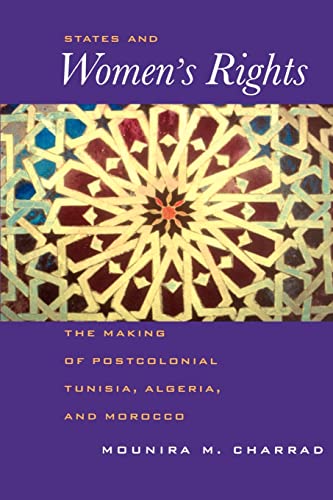
At a time when the situation of women in the Islamic world is of global interest, here is a study that unlocks the mystery of why women's fates vary so greatly from one country to another. Mounira M. Charrad analyzes the distinctive nature of Islamic legal codes by placing them in the larger context of state power in various societies.
Charrad argues that many analysts miss what is going on in Islamic societies because they fail to recognize the logic of the kin-based model of social and political life, which she contrasts with the Western class-centered model. In a skillful synthesis, she shows how the logic of Islamic legal codes and kin-based political power affect the position of women. These provide the key to Charrad's empirical puzzle: why, after colonial rule, women in Tunisia gained broad legal rights (even in the absence of a feminist protest movement) while, despite similarities in culture and religion, women remained subordinated in post-independence Morocco and Algeria. Charrad's elegant theory, crisp writing, and solid scholarship make a unique contribution in developing a state-building paradigm to discuss women's rights.
This book will interest readers in the fields of sociology, politics, law, women's studies, postcolonial studies, Middle Eastern studies, Middle Eastern history, French history, and Maghrib studies.
Charrad argues that many analysts miss what is going on in Islamic societies because they fail to recognize the logic of the kin-based model of social and political life, which she contrasts with the Western class-centered model. In a skillful synthesis, she shows how the logic of Islamic legal codes and kin-based political power affect the position of women. These provide the key to Charrad's empirical puzzle: why, after colonial rule, women in Tunisia gained broad legal rights (even in the absence of a feminist protest movement) while, despite similarities in culture and religion, women remained subordinated in post-independence Morocco and Algeria. Charrad's elegant theory, crisp writing, and solid scholarship make a unique contribution in developing a state-building paradigm to discuss women's rights.
This book will interest readers in the fields of sociology, politics, law, women's studies, postcolonial studies, Middle Eastern studies, Middle Eastern history, French history, and Maghrib studies.
"synopsis" may belong to another edition of this title.
About the Author
Mounira M. Charrad is on the faculty of the Department of Sociology and the Center for Middle Eastern Studies at the University of Texas, Austin.
From the Back Cover
"Brilliantly conceptualized and thoroughly researched, Mounira Charrad's book breaks important new ground in the explanation of legal changes affecting women's rights. We learn why apparently similar countries have taken very different paths. This book is a 'must read' not only for students of North Africa, but for everyone interested in the impact of nation-building and state policies on gender relations."--Theda Skocpol, author of States and Social Revolutions
"Theoretically powerful and historically rich, this is an important study in comparative political sociology. Using the comparative method at its best to make a provocative argument about kin-based politics, Charrad gives us a new way of looking at state-building strategies."--Seymour M. Lipset, author of Political Man
"In a stunning scholarly achievement, Charrad identifies the links between Islamic legal codes, kin-based political power and the subordination of women. She traces the inner logic of political systems, showing how the different bases on which nations are built have very different implications for the rights of women."--Ann Swidler, author of Talk of Love: How Culture Matters
"Charrad adds a new dimension to the consideration of women's rights and state formation not only in the Middle East, but throughout the world. In a rigorous comparative analysis of the origins and development of women's rights in Tunisia, Algeria and Morocco, she demonstrates how history and politics shape family law."--Elizabeth W. Fernea, author of In Search of Islamic Feminism
"Necessary reading for those who wish to understand the role of state formation and cultural identity in diverse patterns of Muslim family law reform, a legacy which continues to impact contemporary Muslim politics."--John Esposito, author of Islam and Politics
"Charrad has offered one of the most systematic and insightful comparative analyses of the relationships between family systems, family law, and state. That the 'personal is political' becomes very concrete as she persuasively demonstrates that family relations are inseparable from state politics."--Suad Joseph, editor of Citizenship and Gender in the Middle East
"Dr. Charrad's convincingly argued and meticulously researched book raises the bar of comparative studies of gender and the State, while making a unique contribution to knowledge about the rights and status of Muslim women in general and of the women of the Maghrib in particular."--Rae Blumberg, author of Engendering Wealth and Well-being
"A new interpretation that will change the way we think about women's status and family law in North Africa."--Nancy Gallagher, author of Approaches to the History of the Middle East
"Charrad's book is a wonderful example of the strength of the comparative method . . . Her study is a major contribution to the literature on women's rights and to the tradition of historical sociology."--Randall Collins, author of Macrohistory: Essays in Sociology of the Long Run
From the Inside Flap
"Brilliantly conceptualized and thoroughly researched, Mounira Charrad's book breaks important new ground in the explanation of legal changes affecting women's rights. We learn why apparently similar countries have taken very different paths. This book is a 'must read' not only for students of North Africa, but for everyone interested in the impact of nation-building and state policies on gender relations."--Theda Skocpol, author of States and Social Revolutions
"Theoretically powerful and historically rich, this is an important study in comparative political sociology. Using the comparative method at its best to make a provocative argument about kin-based politics, Charrad gives us a new way of looking at state-building strategies."--Seymour M. Lipset, author of Political Man
"In a stunning scholarly achievement, Charrad identifies the links between Islamic legal codes, kin-based political power and the subordination of women. She traces the inner logic of political systems, showing how the different bases on which nations are built have very different implications for the rights of women."--Ann Swidler, author of Talk of Love: How Culture Matters
"Charrad adds a new dimension to the consideration of women's rights and state formation not only in the Middle East, but throughout the world. In a rigorous comparative analysis of the origins and development of women's rights in Tunisia, Algeria and Morocco, she demonstrates how history and politics shape family law."--Elizabeth W. Fernea, author of In Search of Islamic Feminism
"Necessary reading for those who wish to understand the role of state formation and cultural identity in diverse patterns of Muslim family law reform, a legacy which continues to impact contemporary Muslim politics."--John Esposito, author of Islam and Politics
"Charrad has offered one of the most systematic and insightful comparative analyses of the relationships between family systems, family law, and state. That the 'personal is political' becomes very concrete as she persuasively demonstrates that family relations are inseparable from state politics."--Suad Joseph, editor of Citizenship and Gender in the Middle East
"Dr. Charrad's convincingly argued and meticulously researched book raises the bar of comparative studies of gender and the State, while making a unique contribution to knowledge about the rights and status of Muslim women in general and of the women of the Maghrib in particular."--Rae Blumberg, author of Engendering Wealth and Well-being
"A new interpretation that will change the way we think about women's status and family law in North Africa."--Nancy Gallagher, author of Approaches to the History of the Middle East
"Charrad's book is a wonderful example of the strength of the comparative method . . . Her study is a major contribution to the literature on women's rights and to the tradition of historical sociology."--Randall Collins, author of Macrohistory: Essays in Sociology of the Long Run
Excerpt. © Reprinted by permission. All rights reserved.
Excerpt
State Formation in Kin-Based Societies
Tunisia, Algeria, and Morocco share a common denominator with many postcolonialnation-states in that they are "old societies" at the same time that they are"new states," to use Clifford Geertz's classic formulation. What makes them newis the novelty of their political independence. Until fairly recently on theworld historical scene, these countries were colonies or enjoyed only limitedsovereignty. Their populations, however, are not new. They have had a culturalidentity for centuries. Upon gaining sovereignty, a major imperative confrontingpostcolonial nations such as those of the Maghrib was to develop a nationalstate and nation-wide institutions in the context left by colonial rule. Thetask often was to be done in a society characterized by a segmented socialorganization, as colonization had left many new nations with separatecollectivities that were not integrated into a national whole. The separatecollectivities varied in nature. They could be ethnic, caste or kinship-based,tribal, religious, or linguistic. In the case of the Maghrib, they were largelytribal and kin based.
The important similarity among many old societies and new states is thatloyalties and foci of solidarity rested with the collectivities themselvesrather than with nation-wide institutions. Postcolonial newly independentnations had to become nation-states in which the territoriality of the nationwas coterminous with that of the state. Following a worldwide wave ofdecolonization in the mid-twentieth century, the development of nation-statesgenerated tensions with local solidarities in many parts of the world. Theproblem of state formation, nation building, or national integration has beenwidespread in the postcolonial world, as is demonstrated by references "to?dual? and ?plural? or ?multiple? societies, to ?mosaic? or ?composite? socialstructures, to ?states? that are not ?nations? and ?nations? that are not?states,? to ?tribalism,? ?parochialism,? and ?communalism.? "
This chapter discusses the conceptualization of state and state formation insocieties characterized by politically significant local solidarities. Theessential starting point is an appreciation of the tensions inherent to nationbuilding and state formation in postcolonial nation-states in general and inthe kin-based societies of the Maghrib in particular.
States, Nations, and Local Solidarities
When analyzing state formation, it is more appropriate to consider theextent to which a given collectivity meets criteria that are part ofstatehood in given periods than to ask whether a collectivity does or does notconstitute a state. The same applies to nationhood. Max Weber offers adefinition useful for the conceptualization of the state used in this book. Hewrites: "A compulsory political association with continuous organization will becalled ?a state? if and in so far as its administrative staff successfullyupholds a claim to the monopoly of the legitimate use of physical force in theenforcement of its order. A state thus is an institution that places a claim onthe authority to make binding decisions for all, on the monopoly of force, andon a territory. In the modern world, a state is usually associated with anadministrative apparatus in the form of a bureaucracy.
By implication, state formation involves the expansion of administrative reachover a territory combined with authority within national boundaries. Nationbuilding refers to the development of a collective identity and the integrationof separate collectivities into a national whole. The connections between stateformation and nation building are intricate and vary from case to case. Somecountries face nation building and state formation all at once. Others alreadyhave a collective identity when they develop a central state. Still othersbecome national entities only after the development of a central state.
As an overall concept for the social ties binding communities in old societieswith separate collectivities, Geertz speaks of "primordial attachments." He seesthe attachments as stemming from the "givens of social existence," mainly"immediate contiguity and kin connection," including kinship, ethnicity,language, region, religion, or custom. The concept of primordial ties taps acrucial reality in the new nations because it highlights the segmentation ofsocial organization. Primordial ties often serve as a source of solidarity andcohesion for communities in local areas. They serve as a basis for members ofcommunities to claim their separateness both from other communities and centralpower. If primordial ties remain strong and separate collectivities persist, itis generally not because people refuse to relinquish centuries-old, deep-rootedbeliefs that no longer make sense in a modern era. The ties remain, not asmeaningless vestiges of the past, but as social forms that serve a usefulfunction in the here and now. In some cases, ties previously forgotten arereinvented. In the Maghrib, as elsewhere, traditions are invented, abandoned,reinvented, and transformed for reasons rooted in the present.
There is a direct conflict between local solidarities based on primordial ties(which I refer to in brief as local solidarities) and a nation-state. Eachinstitution requires loyalties of its members. Each involves mutually exclusivedefinitions of what the maximal political unit ought to be. Insofar asprimordial solidarities sometimes become candidates for nationhood, theycompete with the state or challenge its very existence. Precisely because theyrepresent alternative institutions of power and social control, primordialcommunities and national institutions find themselves in a relationship ofongoing tension. The tension may be open or latent. Considering other nationsmay help to place the Maghrib in perspective. In India, for example, the tensionhas crystallized into violent conflict. Many of the problems of Indian societyinvolve managing the complexities of a society that includes several languages,castes, religions, and ethnic groups. Similar conflicts based in part on similarkinds of solidarities have arisen in places as diverse as Morocco, Nigeria,Rwanda, China, the former Soviet Union, and the former Yugoslavia, to name onlya few. One may think of Lebanon and Afghanistan as countries where in recenthistory, for a variety of national and transnational reasons, loyalties groundedin kinship, ethnicity, or religion challenged the state and one another.
The tension between communal solidarities and society-wide institutions is notunique to new nation-states. It was also experienced, but in a different way, bythe West. Reinhard Bendix reminds us that Max Weber's lifework was an effort toanalyze the tension. Bendix writes about Weber's work: "[It was an effort] todocument the proposition that Christian doctrine and the revival of Roman lawmilitated against familial and communal ties as foci of loyalty which competeeffectively with the universal claims of legal procedure..." Such familial andcommunal ties as foci of loyalty competed also with national political,social, and economic entities. Some communal ties, particularly ethnic,linguistic, and religious, remain to this day social and political issues inadvanced industrial nations. Witness, for example, French-speaking Canada,Basque nationalism in Spain or, on a more limited scale, the Corsican movementin France. In general in Western Europe, however, communal solidarities werebroken, or at least weakened, in a gradual fashion, over several centuries byindustrial capitalism and political struggles in absolutist regimes. Jack Goodytraces the weakening of solidarities grounded in extended kinship ties to aneven earlier period and associates it with the expansion of the Christian Churchin Western Europe.
In the Maghrib as in other new nations, there are two essential differences.First, the timing of state formation is different. Whereas England and France,for example, were already nation-states when industrialization took place, thenew nations sometimes had to face state formation, nation building,industrialization, and a host of other imperatives all at once. Second, some ofthe primordial communities have remained basic social institutions up to thepresent in many new nation-states. This is not to say that there was no changein those societies until recently. In many cases, however, the dynamic ofchange was such that primordial communities were able to maintain themselves,either by making necessary but minimal adjustments or by openly struggling fortheir autonomy.
The development of a national state requires the redirection of resourcespreviously embedded in local networks of obligation toward national goals. Asnew states attempt to channel resources away from local communities, theychallenge primordial ties. Members of separate collectivities find theirautonomy jeopardized and their life affected in all respects, sometimes even themost private. To establish the hegemony of the state, the groups in power musttransfer social control at least in part from its prior basis in local, ethnic,or kin-based communities to national institutions. Only then is the state in aposition to make binding decisions for all. Although new nation-states share theprimordial-national dialectic, the particular way in which this dialectic isplayed out varies greatly, as is evinced by the diversity of institutionalconfigurations in the postcolonial world.
There are multiple kinds of national unity, multiple kinds of nation-wideinstitutions, and multiple forms of state hegemony. In theoretical terms,central power may a) confront kin-based solidarities and try to subordinatethem; b) tolerate them and timidly chip away at their political leverage; or c)manipulate them in a divide-and-rule approach to politics. Conversely,kin-based corporate structures may exist in a variety of relationships to thestate. Such structures may a) compete with the state by representing a focus ofloyalties for those groups trying to escape state control; b) support the statein both direct and indirect ways; or c) compete among themselves in an attemptto gain the favors of the state. Groups in power can establish state hegemony ina variety of ways, thus giving different forms to the relationship betweencentral power and local solidarities. There also can be shifts in the strategyof any given state, resulting in variations from one historical period toanother in the same country. And the process may reverse itself. As LisaAnderson reminds us, "the march of bureaucratic domination," to use Weber'sphrase, is reversible and states may lose power they once had over theperiphery.
Central/Local Tension in the History of the Maghrib
The nation-state had an ambiguous identity in the political history of theMaghrib. Only with the achievement of independence from colonial rule has themodern state emerged to challenge or undermine the authority of traditionalstructures of solidarity and social control. Historically, authoritativeinstitutions were of two types in the Maghrib: the immediate kin-based communityor tribe on the one hand and the world Islamic community on the other. Neitherunit of reference overlapped with the boundaries of a nation-state. One unit ofidentification, the tribe, did not reach the level of the nation-state. Theother unit, the world Islamic community, bypassed the nation-state altogether.It transcended it geographically, and it subsumed the political within anall-encompassing religious frame of reference.
In terms of social organization, the tribe or kin grouping is critical becauseit historically has constituted the basic community in the Maghrib. A featureshared by Maghribi and other Middle Eastern societies is their origin in atribal structure. Nikki Keddie states that, when analyzing the history of theMiddle East, it is necessary to consider how a large-scale tribal presence hasaffected the society as a whole. Tribal origins do not belong to a forgottenpast. There are entire regions where individuals continue to identifythemselves as members of a tribe. Scholars have documented the existence of atribal structure to varying degrees in Tunisia, Algeria, and Morocco well intothe twentieth century. Elbaki Hermassi, for example, indicates that most ruralareas in the Maghrib "remained predominantly tribal, preserving their socialstructures intact until the beginning of the twentieth century. Tribalsolidarities may overlap with linguistic, ethnic, or other identities. In theMaghrib as a whole, however, significant local solidarities have restedprimarily upon tribal roots.
The Maghribi experience derives in large part from a history of tension betweena social group holding power in the political center and autonomous localcollectivities resisting its control. Precolonial states, with varying degreesof administrative capacities, expanded and contracted depending on how muchcontrol they could master over tribal areas in the periphery. Tribes coexistedwith partially bureaucratic centers that had shifting boundaries and oftenlacked stable systems of administration at the regional and local levels. Keddiehas suggested that Middle Eastern history could be reconstructed by looking atthe "various permutations and combinations of a nomadic-agricultural-urbansynthesis." This applies well to the Maghrib. The nomads were usually at theperiphery, resisting control by the center. Settled agricultural populationsoccupied a middle position; they reluctantly submitted to partial control bycentral authority when it was ascendant. Urban groups, those at the center,constituted the core of the state's domain. They submitted to taxation andprovided a pool for the armed force of the ruler.
A phrase attributed to the Prophet Muhammad reads as follows: "The plow will notenter a family's dwelling without also bringing debasement." Whoever uses aplow is attached to a piece of land. The notion expressed in the phrase is thatwith the tie to land comes the obligation to submit to the demands of centralauthority and, in particular, to pay taxes. The nomad, who has neither plow norland, has freedom to move and thus to escape obligations. The nomadic way oflife is often glorified in Maghribi culture. Even today, it is not uncommon tohear that whoever has Bedouin blood (i.e., nomadic ancestors) belongs to theauthentic core of Maghribi society. Until the nineteenth century in most of theMaghrib, power was the basis of wealth, which was under constant threat if itdid not go hand in hand with control over tribes. Ruling elites usually hadlittle or no stable landed patrimony and therefore lacked an enduring basis forsupport. Wealth in the form of land for the settled population and cattle fornomads could disappear suddenly in case of war among tribes?and these warsoccurred frequently. It would also vanish if the social group in the centerwere displaced by another group?and this too happened quite often. Thebest way, then, to retain wealth was to be in a position of political power,that is to say, to be in control of other tribal groups.
The clash between tribes and central authority in precolonial timescharacteristically was less acute where central authority infringed little onthe life of the population. In areas where central authority restricted itsdemands to the payment of a tribute and to respect for peace, settledagricultural communities could tolerate these demands. They did not feel overlythreatened as long as the institutions of social control, the organization ofproduction, and the general orchestration of communal life were still in theirown hands. Furthermore, numerous communities were altogether out of the reachof central authority. The relative autonomy left to separate socialgroups?even to those from which the political center succeeded inextracting tributes?contributed to the preservation of different socialnorms and to the ongoing cohesiveness of each group.
The "Republics of Cousins" in Politics
Reflecting the importance of kin-based solidarities in the Maghrib, there hasbeen a revival of the work of Ibn Khaldun, the great Maghribi historian of thefourteenth century (1332-1406). There are obvious differences between IbnKhaldun's time and modern times. In particular there are now territorialnation-states with fixed boundaries. Yet, there is good reason for turning toIbn Khaldun. His analysis provides insights for the understanding of theMaghrib in the nineteenth century and the first half of the twentieth. The mainquestion preoccupying Ibn Khaldun was that of "solidarity" or "group cohesion."He was concerned with what held a collectivity together, gave it strength andpower, and prevented its atomization.
The concept of asabiyya, central to Ibn Khaldun's work, has provenparticularly useful for the analysis of Maghribi history. Asabiyya is oftentranslated as "solidarity" or "esprit de clan." A more accuratetranslation proposed by David Hart is "unifying structural cohesion" or"agnation in action. "What mattered greatly for the history of any group wasthe strength of its asabiyya, its "unifying structural cohesion" based on tiesamong agnates, or male kin in the paternal line. The groups with the greatestasabiyya were those best capable of resisting control by other groups, includingcentral authority, and sometimes to displace central authority altogether.Hence, a strong asabiyya was politically advantageous and instrumentalfor the survival of the tribal group. The French anthropologist Germaine Tillioneffectively captures this linkage between kinship and politics by referring tothe many "republics of cousins" in the traditional political order of theMaghrib. The patrilineage historically has been the building block of tribalcommunities or larger kin groupings with political functions. Members of a tribetypically perceived themselves as related to one another through kinship ties,however broad the definition of a meaningful link might be.
Colonization did not fundamentally alter extended kinship systems in theMaghrib. Its effect on kinship was far from a simple restructuring. The era ofcolonization in the Maghrib as a whole covered part of the nineteenth centuryand the beginning of the twentieth. At that time, the world-historical settingwas such that colonizers primarily were interested in the economic advantagesprovided by colonies. They were concerned with matters of social organizationsuch as kinship or the family only insofar as these matters facilitated orhindered colonial rule and economic domination. Often, the objective of thecolonizer was to make tribal kin groupings serve as conservative, stabilizingelements of the social order, as political power at the center was monopolizedby colonial authority. Among the colonized, the extended kinship unit acquiredfurther value as a refuge from those dimensions of society being transformed bythe colonizer. Kin-based solidarities thereby were reinforced in response tothe experience of colonial domination.
Kin groupings historically acted as corporate structures striving for autonomyfrom the centers of political power. In the precolonial and colonial periods andin some instances after independence, the republics of cousins engaged inintermittent conflict, latent or overt, with the political center. Because localcollectivities found their source of cohesion in the nexus of kinship ties, theprocess of state formation demanded everywhere in the Maghrib a socialtransformation involving the integration of republics of cousins. Throughout theMaghrib, a transformation from a locally based society to a centrally integratednation-state confronted the political leadership after independence, even wherethe process had started before colonization. The transformation was not smooth;on the contrary, it was accompanied by conflicts serious enough to threaten thestability of the polity.
During the nationalist period, kin-based local solidarities entered thepolitical equation in all three countries in the Maghrib. Although it haddeveloped a semibureaucratic state earlier than its neighbors because ofdevelopments starting in the precolonial period, Tunisia neverthelessexperienced the turmoil of tribal politics during the anticolonial struggle.Algerian and Moroccan societies exhibited an even more segmented socialorganization in which ties of lineage and tribe remained stronger. AboutAlgeria at the end of colonization, Jeanne Favret remarks that "socialdiscontinuity [was] more marked than in any other country freed from colonialrule."About the formative history of Morocco, Clifford Geertz notes: "Thecritical feature of Morocco is that its cultural center of gravity lay...in themobile, aggressive, now federated, now fragmented tribes who not only harassedand exploited [the cities] but also shaped their growth." Commenting on thelater phase of the colonial period in Morocco, Ernest Gellner writes: "For thetribesmen, political life was the conflict of local groups, alignments,lineages, families, for local power, and the game was played out within theregion."
Solidarities based on kinship may respond to change in numerous and complexways: they may resist it; they may tighten up protectively in the face ofexternal threats; they may change in limited ways so as to adapt to newsituations; or they may change in substantial ways. Instead of treating kinshipas an institution that is immediately altered in response to changes in thesociety at large, it is thus helpful to use a broader conceptualization of howkinship systems respond to social transformations. Furthermore, interestingquestions can be raised if one considers the relationship between changes inkinship and in other institutional spheres. Kin groups or families have beenprimarily defined as economically relevant units, whether these units are seenin their productive function in preindustrial societies or in terms of theirsocio-economic status in advanced industrial countries. Once the economicaspect of kinship units is emphasized, the main question that arises concernsthe reciprocal effect between kinship and the economy. This is an importantquestion, but not the only one worth considering.
Kinship systems also can be seen in their political and integrative functions,and therefore in relation to the polity. This is especially the case in parts ofthe world where clans, lineages, and other kin-based forms of associationremained meaningful social entities in the modern era. For example, JudithStacey shows how kinship systems in China not only persisted but played acrucial role in shaping the course of social and political change. In theMaghrib, throughout the nineteenth century and in many regions in the first halfof the twentieth, kin-based solidarities remained strong in local areas,although profound changes were affecting the region. Even when they had notmaintained enough separate identity to be properly called a tribe, manyrepublics of cousins had retained a sense of themselves as corporate entitiesand remained operative in the political order. In several regions of theMaghrib, the coming of national independence heightened the tension betweenlocal collectivities and central authority. The intervention of nationalists andthen of the national government in rural politics reactivated kin-based localsolidarities in all three countries but it did so within different scenarios.
In Morocco in the aftermath of independence, the monarchy was the key arbitratorin an intricate web of loyalty and dependence within a system of segmentedpolitics. I. William Zartman indicates that the royal strategy was to formalliances with tribal notables in rural areas. John Waterbury calls attention tothe king's ability to manipulate, encourage, and balance off factions. Giventhat many factions were anchored in rural coalitions that included a tribalbase, it would not have been advantageous for the monarchy to challengekin-based solidarities. It was more sensible to maintain them and to leaveunthreatened the kinship structure that served as the basis of socialorganization in rural areas.
In Algeria, the strategy of the political leadership was double-sided. A majorpostindependence insurrection showed a republic of cousins coming together.According to Favret, it was an example of the manipulation of kin-based groupsin rural areas by what she calls their "elite city cousins" in nationalpolitics. She remarks that the primordial groups in newly independent Algeriasurvived "not as unconscious anachronisms but as a result of deliberatereaction. "This was only part of the story, however. There was a tension inindependent Algeria between the manipulation of local kin-based solidarities andan attempt to create a polity independent from such solidarities.
In Tunisia, conflicts involving kin-based solidarities flared up in violentoutbreaks during the nationalist struggle and immediately followingindependence, but the conflicts ended with the defeat of tribally basedcoalitions. In the aftermath of independence, the balance of forces wasfavorable to those elements of the national leadership that were mostinterested in reducing the political weight of social groups attached tokin-based solidarities. As a result, the national state in Tunisia had a betterchance to achieve autonomy from tribal kin groupings than either its Algerian orMoroccan counterpart.
To emphasize the importance of kin-based solidarities is not to say that theMaghrib was classless until the mid-twentieth century. Once capitalismdeveloped as a world system, no world region escaped its influence. Furthermore,there was some form of semibureaucratic state with uneven control over territoryand frequently changing boundaries in each Maghribi country already in theprecolonial period. "State" by definition implies appropriation of surplus andtherefore class inequality. The important point is that kin-based politicalorganization and noncapitalist social formations coexisted with capitalistinterests. Where kin-based political solidarities existed during the colonialperiod, they continued to make their mark on politics after independence, thistime within a national context.
When nationalist leaders mobilized tribal areas in the nationalist struggle orafter independence, most did so to increase their power in national politics,not to create a separate nation. It would be an anachronism to treat thepolitics of the mid-twentieth century as nothing other than a sheer reenactmentof tribal dissidence in the precolonial period. Coalitions based on tribal kingroupings played a role in nationalism and then in the independentnation-state, and they did so by entering the modern politics of themid-twentieth century.
In the context of the Maghrib, the solidarity of tribal kin groupings aspolitical communities claiming the loyalty of their members thus must be givencentral place in the investigation of issues of political authority at leastuntil the period of national independence. Whatever institution or policy atthe national level is studied in the period of independence, it is necessary toask how it was affected by the interaction between the local areas where tribalorganization prevailed and the newly formed central state. The integration oftribes into a nation-state was a long process, often accompanied by bloodshedand violence. The timing and particular mechanisms of that process have shapedthe development of the national state, its relationship to social groups, andthe policies it adopted in the aftermath of national sovereignty. I turn nextto another major similarity in the Maghrib, the centrality of Islam and familylaw.
Continues...
Excerpted from States and Women's Rightsby M. Charrad Copyright © 2001 by M. Charrad. Excerpted by permission.Copyright © 2001 M. Charrad
All rights reserved. No part of this excerpt may be reproduced or reprinted without permission in writing from the publisher.
Excerpts are provided by Dial-A-Book Inc. solely for the personal use of visitors to this web site.
All right reserved.
"About this title" may belong to another edition of this title.
Search results for States and Women’s Rights: The Making...

Stock Image
States and Women's Rights: The Making of Postcolonial Tunisia, Algeria, and Morocco
Published by
University of California Press, 2001
ISBN 10: 0520225767
ISBN 13: 9780520225763
Used
Paperback
Seller: ThriftBooks-Atlanta, AUSTELL, GA, U.S.A.
Seller rating 5 out of 5 stars

Paperback. Condition: Very Good. No Jacket. May have limited writing in cover pages. Pages are unmarked. ~ ThriftBooks: Read More, Spend Less. Seller Inventory # G0520225767I4N00
Stock Image
States and Women's Rights: The Making of Postcolonial Tunisia, Algeria, and Morocco
Published by
University of California Press, 2001
ISBN 10: 0520225767
ISBN 13: 9780520225763
Used
Paperback
Seller: World of Books (was SecondSale), Montgomery, IL, U.S.A.
Seller rating 5 out of 5 stars
Paperback. Condition: Good. This study attempts to unlock the mystery of why women's fates vary so greatly from one Islamic country to another. The book analyzes the distinctive nature of Islamic legal codes by placing them in the larger context of the different historical bases of state power in various societies. Seller Inventory # 00104072549
Stock Image
States and Women's Rights: The Making of Postcolonial Tunisia, Algeria, and Morocco
Published by
University of California Press, 2001
ISBN 10: 0520225767
ISBN 13: 9780520225763
Used
Paperback
Seller: ThriftBooks-Phoenix, Phoenix, AZ, U.S.A.
Seller rating 5 out of 5 stars
Paperback. Condition: Very Good. No Jacket. May have limited writing in cover pages. Pages are unmarked. ~ ThriftBooks: Read More, Spend Less. Seller Inventory # G0520225767I4N00
Stock Image
States and Women's Rights: The Making of Postcolonial Tunisia, Algeria, and Morocco
Published by
University of California Press, 2001
ISBN 10: 0520225767
ISBN 13: 9780520225763
Used
Softcover
Seller: Wonder Book, Frederick, MD, U.S.A.
Seller rating 5 out of 5 stars
Condition: Good. Good condition. A copy that has been read but remains intact. May contain markings such as bookplates, stamps, limited notes and highlighting, or a few light stains. Seller Inventory # Q15O-00750
Stock Image
States and Women's Rights: The Making of Postcolonial Tunisia, Algeria, and Morocco
Published by
University of California Press, 2001
ISBN 10: 0520225767
ISBN 13: 9780520225763
Used
paperback
First Edition
Seller: The Maryland Book Bank, Baltimore, MD, U.S.A.
Seller rating 5 out of 5 stars
paperback. Condition: Good. First Edition. Corners are bent. Used - Good. Seller Inventory # 3-R-1-0732
Stock Image
States and Women's Rights : The Making of Postcolonial Tunisia, Algeria, and Morocco
Published by
University of California Press, 2001
ISBN 10: 0520225767
ISBN 13: 9780520225763
Used
Softcover
Seller: Better World Books, Mishawaka, IN, U.S.A.
Seller rating 5 out of 5 stars
Condition: Good. Pages intact with minimal writing/highlighting. The binding may be loose and creased. Dust jackets/supplements are not included. Stock photo provided. Product includes identifying sticker. Better World Books: Buy Books. Do Good. Seller Inventory # 5740929-6
Stock Image
States and Women's Rights : The Making of Postcolonial Tunisia, Algeria, and Morocco
Published by
University of California Press, 2001
ISBN 10: 0520225767
ISBN 13: 9780520225763
Used
Softcover
Seller: Better World Books, Mishawaka, IN, U.S.A.
Seller rating 5 out of 5 stars
Condition: Very Good. Pages intact with possible writing/highlighting. Binding strong with minor wear. Dust jackets/supplements may not be included. Stock photo provided. Product includes identifying sticker. Better World Books: Buy Books. Do Good. Seller Inventory # 10738479-6
Stock Image
States and Women's Rights: The Making of Postcolonial Tunisia, Algeria, and Morocco
Published by
University of California Press, 2001
ISBN 10: 0520225767
ISBN 13: 9780520225763
Used
Paperback
Seller: Midtown Scholar Bookstore, Harrisburg, PA, U.S.A.
Seller rating 5 out of 5 stars
Paperback. Condition: Very Good. Very Good - Crisp, clean, unread book with some shelfwear/edgewear, may have a remainder mark - NICE Standard-sized. Seller Inventory # M0520225767Z2
Stock Image
States and Women's Rights: The Making of Postcolonial Tunisia, Algeria, and Morocco
Published by
University of California Press, 2001
ISBN 10: 0520225767
ISBN 13: 9780520225763
Used
Paperback
Seller: Midtown Scholar Bookstore, Harrisburg, PA, U.S.A.
Seller rating 5 out of 5 stars
Paperback. Condition: Good. Good - Bumped and creased book with tears to the extremities, but not affecting the text block, may have remainder mark or previous owner's name - GOOD Standard-sized. Seller Inventory # M0520225767Z3
Stock Image
States and Women's Rights: The Making of Postcolonial Tunisia, Algeria, and Morocco
Published by
University of California Press, 2001
ISBN 10: 0520225767
ISBN 13: 9780520225763
Used
Paperback
Seller: World of Books Inc, Montgomery, IL, U.S.A.
Seller rating 4 out of 5 stars

Paperback. Condition: Good. This study attempts to unlock the mystery of why women's fates vary so greatly from one Islamic country to another. The book analyzes the distinctive nature of Islamic legal codes by placing them in the larger context of the different historical bases of state power in various societies. Seller Inventory # CIN0520225767G