
Items related to Musicology & Difference – Gender & Sexuality...
Synopsis
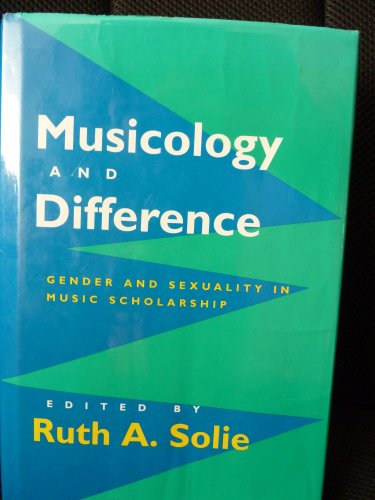
Addressing Western and non-Western music, composers from Francesca Caccini to Charles Ives, and musical communities from twelfth-century monks to contemporary opera queens, these essays explore questions of gender and sexuality. Musicology and Difference brings together some of the freshest and most challenging voices in musicology today on a question of importance to all the humanistic disciplines.
"synopsis" may belong to another edition of this title.
About the Author
Ruth A. Solie is Professor of Music at Smith College.
Excerpt. © Reprinted by permission. All rights reserved.
Musicology and Difference: Gender and Sexuality in Music Scholarship
By Ruth A. Solie, editorUniversity of California Press
Copyright 1993 Ruth A. Solie, editorAll right reserved.
ISBN: 0520079272
Gender and Other Dualities of Music History
Leo Treitler
Music history is, among other things, a discourse of myth through which "Western civilization" contemplates and presents itself. This is said, not in order to question the truth value of music-historical narratives, but to emphasize their aspect as stories of traditional form that the culture tells in its desire to affirm its identity and values.
From early on music history has been guided by gender duality in its description, evaluation, and narrative form. Boethius, a principal conduit of ideas about music from antiquity to the Middle Ages, sounded a theme of lament in the midst of a music-historical narrative that would become typical in evaluations of "the present state of music":
Ruder peoples delight in the harsher modes of the Thracians; civilized peoples, in more restrained modes; though in these days this almost never occurs. Since humanity is now lascivious and effeminate, it is wholly captivated by scenic and theatrical modes.1
As in this passage, gender typically plays its role in concert with dualities of ethnicity, nationality, or raceall dichotomies of self and Other that are linked as markers in the pathways and panoramas of understanding in our culture. The wording of my title hints at my sense of gender as the archetypal duality.
This interpretation arises from my experience with a particular collective discourse of music historythe story of medieval chantand I shall try to give an account of how certain canonical beliefs about that subject have come to be formed, and what their broader associations are.
Boethius, "De institutione musica," trans. Oliver Strunk, Source Readings in Music History (New York, 1950), p. 81.
But there is a backdrop in "an ancient mythology that explains human consciousness as divided in two permanently antagonistic parts . . . a mythology in which reason and sensuality are mutually opposed, and that opposition is characterized as the duality of the masculine and the feminine."2 The linkage of the duality of the rational and the sensual with that of the masculine and the feminine is a fact embedded in Western tradition. Here I shall be concerned to show how that linkage has been active in categories of music history and criticism.
Yet a third topic arises as underpinning for this central one. Gender duality, functioning as a structure of music-historical interpretation, depends on the-largely unreflectedidentification of gender attributes in music. I want to consider such identification as it has been practiced historically, and to bring out the dilemma into which it leads as it is put into service in recent attempts to ground a feminist music criticism. The question of whether music can have an immanently masculine or feminine character that transcends history and culture brings forward anewwith highly specific ideological motifs and motivesalready much-debated issues of aesthetic theory concerning what music conveys, expresses, and represents, and how one can know about such things. I shall ask whether, thus transformed, these issues merit the privileged status to which they seem to have been raised, and also whether their newly explicit ideological dimension exempts them from critical reflection, for that is the implication of some of the writings on the subject.
Finally, the issue of essentialism, which is raised by the practice of gender identification in music, points to the same issue with respect to race. The two modes of essentialist thinking have the same culture-historical background, they have played parallel and linked roles in the criticism and historical narrative of the arts, and they have functioned under the same ideological tenets.
The story that serves as my gateway may seem out of the way, to say the least: the modern reception-history of the liturgical chant of the medieval Western Church. I shall refer to it simply as "plainchant," following Jean-Jacques Rousseau, the writer with whom that history began.3 Example 1 shows two stylistically different versions of an Introit antiphon, a chant that accompanied the entrance of the celebrant into the church and his procession to the altar to begin the Mass. The two versions belong to different medieval traditions. One, the Old Roman tradition, was sung only in Rome, and then only until it died out in the twelfth century. We
Leo Treitler, Music and the Historical Imagination (Cambridge, Mass., 1989), pp. 1112.
Rousseau's Dictionnaire de Musique (Paris, 1768) includes an article entitled Plain Chant (pp. 95105).
Example 1
From the Introit antiphon Rorate caeli desuper , in the
Old Roman and the Gregorian tradition.
have the chant from notated manuscripts written in Rome in the eleventh and twelfth centuries. The other version belongs to a tradition that was transmitted in writing rather uniformly throughout most of Western Europe and the British Isles from the tenth century on; it has come down to us as Gregorian chant. There is no evidence that melodies of this
tradition were sung in Rome before the arrival there of some French chant books in the twelfth century.
The Old Roman melody is quite recursive. It turns on itself repeatedly in numerous circular figures which create an overall melismatic texture. The melodic line shows an overall direction, but it is highly decorated. The outlines of the Gregorian version are sharper. It, too, is ornamented, but not as uniformly so. On the whole, whereas the decorative figures determine the character of the Old Roman version, in the Gregorian version it is the overall melodic shape and direction that stand out.
Students of medieval plainchant are in agreement that this difference is characteristic of the two traditions. They are also in agreement that the difference of style has something important to do with the origins of plainchant and its early history in the Middle Ages. And since plainchant is the earliest European music known to us, the questions raised by the difference we have observed open out to nothing less than questions about the origins and nature of European music. And the disagreements that take over at this pointdisagreements over how the style difference came about, how to characterize it, whether either version can be identified as original and the other somehow derivative, and just what all this can tell about the history as a wholeare argued out with a vigor that is worthy of the rank to which this subject has now been elevated. I shall sample some of the interpretations that have been offered and consider what they portend for vital matters of cultural identity that are at the center of my subject.4
Here is Bruno Stblein, a preeminent German plainchant scholar, writing about Old Roman chant: "Endless streams of melody that overflow the boundaries of textual divisions, . . . melodies that spread over their texts like a chain of pearls or a voluptuous gown . . . soft, elegant, charming and graceful, without sharp edges or corners."5 Their style is "naive, youthfully fresh, blossom-like, the expression of a general Italic, folk-like feeling."6 The Gregorian melodies, by contrast, are "disciplined and ordered, a product of rational thinking." They are "clear, sculpted configurations, systematically chiselled; a system of musical rhetoric reigns in them." They display a "more perfect qualityperfectior scientia , a wonderful expression that carries with it the thought of the thoroughly systematic working-through of the musical language, accomplished with
An overview of the positions that have been taken is given by Helmut Hucke in "Gregorian and Old Roman Chant," in The New Grove Dictionary of Music and Musicians , ed. Stanley Sadie (London, 1980), vol. 7, pp. 69397.
"Die Entstehung des gregorianischen Chorals," Die Musikforschung 27 (1974): 11.
Die Gesnge des altrmischen Graduale Vat . lat . 5319 , Monumenta Monodica Medii aevi II (Kassel, 1970) (=MMM II), p. 38*.
the highest intelligence."7 Stblein appends a list of attributes medieval writers had themselves found in Gregorian chant: vis (strength), virtus (manliness), vigor , potestas (power), ratio (reason).8
In Stblein's view the Old Roman tradition is the older one, from which the Gregorian tradition was achieved by "stripping down and reshaping the unrestrained coloratura of the originals." This happened in Rome, whence the new melodies were carried, as the Cantus Romanus, to the major ecclesiastical and political centers of the Frankish North during the reigns of Pepin and the Emperor Charlemagne. Through this transformation, writes Stblein, the provincial Roman melodies were raised to a higher, super-regional level as "melodies for a world power."9 "Rome" is presented as two kinds of place: the provincial Italic home of a luxuriant Mediterranean singing practice, and the place where an efficient and economical model was fashioned for a European melodic style.
Clarity, system, understandability, strength, vigor, power, reason, manliness, on one side; on the other, softness, roundedness, elegance, charm, grace. It does not require much exegesis to recognize here, as the underlying principle, gender duality and its association with the duality of the rational and the sensual and with the concept of power.
An obvious alternative interpretation of the historical relationship of two such opposite melodic styles is that the Gregorian tradition is the older one, originating in Rome and diffused throughout the Empire in Carolingian times, as in the other story. The Old Roman tradition is a late survival representative of a local singing practice typical of the Mediterranean south, where Carolingian power and cultural influence were less decisive. Earlier Gregorian sources of Roman provenance were all lost. This interpretation is indeed represented in the modern literature, for example in the work of Hans Schmidt and Walther Lipphardt.10 The difference is important for the view taken of the way things happened, but it is not great so far as critical assessment of the two styles is concerned. The one important difference is that this second interpretation picks up the concept of corruption, which had been an important part of this story from the beginning. That concept, too, is aligned on the female side of the duality.
In the Dictionnaire de Musique Rousseau wrote of plainchant as
a noble relic, very much disfigured, but very precious, of [ancient] Greek music, which having passed through the hands of barbarians has not,
"Die Entstehung," pp. 13, 17. In the final citation Stblein is quoting a ninth-century writer on ecclesiastical matters, Walafried Strabo (De rebus ecclesiasticis 22, published in Migne, Patrologia latina 114, p. 946).
"Die Entstehung," p. 14.
Ibid.
See the bibliography in Hucke's review.
however, been able to lose its natural beauties. There remains yet enough of it to render it much preferable . . . to those effeminate and theatrical pieces which in some churches are substituted in its place.11
The plainchant is, by implication, masculine, and the word with which Rousseau labels its oppositeeffmine , literally, "effeminated"carries a sense of deterioration from what is by nature manly. This "dread of corruption," as E. H. Gombrich has called it, was an obsession with writers of the Enlightenment, and a fear they implanted deeply in the modern unconscious.12
But as to the Old RomanGregorian question, we might well wonder why, of all possible interpretations, it would enter someone's mind to differentiate these two singing traditions as masculine and feminine . The answer is surely that it was already in his mind, as a primary form of cognition and therefore as "the very stuff" of a historical narrative that transcends its apparent content.13 What is displayed here is an underlying mythic story that is told and retold with changing material. My hope is that it may be the more boldly displayed because the very idea of medieval chant traditions differentiated as masculine and feminine will strike us as strange on the face of it. But the narrative of a cultural ascendance from a feminine condition to a masculine one is readily transformed, in the same mythology, into the parameters of other dualities.
In 1921 Peter Wagner, the most influential German writer on this subject to date, used language similar to the language of Stblein when he characterized Gregorian Alleluia chants as "models of clear formal structure and symmetrical organization, the work of aesthetic deliberation."14 Thirteen years later Dom Paolo Ferretti, a writer just as in-
I quote from the English translation by William Waring: (London, 1779), pp. 6465. I think my interpolation of "ancient" before Greek is not problematic. Unlike his followers John Hawkins and Charles Burney, Rousseau had no interest in bringing the Byzantine Greeks into the story.
See E. H. Gombrich, The Ideas of Progress and Their Impact on Art (New York: The Cooper Union School of Art and Architecture, 1971), pp. 1234. Gombrich writes here about Rousseau's forerunner and exact counterpart as historian of the figurative arts, Johann Joachim Winckelmann, who set up a dualism virtually identical with Rousseau's: "the noble simplicity," "purity," and "quiet grandeur of Greek statues" on one side, the "corruption," "artificiality," "affectation," and "effeminacy " of the works of artists like Bernini, on the other (Thoughts on the Imitation of Greek Works in Painting and Sculpture [Dresden, 1755; English edition, London, 1765], my emphases; Gombrich refers to this work as "the famous manifesto of classicism"). "Corrupt" and "effeminate" are so closely associated in this usage that they become virtually synonymous.
I take this phrase from the opening page of Hayden White's The Content of the Form : Narrative Discourse and Historical Representation (Baltimore, 1989), p. ix. This is not the first time I have found White's writing on historiography helpful.
Einfhrung in die gregorianische Melodien , III . Gregorianische Formenlehre : Eine choralische Stilkunde (Leipzig, 1921), p. 398.
fluential for readers of Italian and French, characterized the composers of Gregorian chant as "artists," creating under the inspiration of their "personal genius" and the "logic" of musical principles. Their chants are "organic," "harmonious," "homogeneous," and "logical."15 Wagner's language aimed at a contrast with an older layer of chants whose melodies were "unregulated and without plan." The difference is like that between a "skillfully laid-out flower bed" and a "luxuriantly proliferating growth." Those older melodies remind him of the "unregulated undulation of the melismatics of the Orient," whereas the later ones display "Latin, Roman traits."16
That these traits, which come down to matters of formal order and unity, are seen as epitomizing European music altogether comes out in one of the most extravagant-sounding bits of encomium in the whole story, a passage in Willi Apel's 1958 survey of Gregorian chant. Concluding an analysis of a group of Gradual chants, Apel wrote that "the perception of their structural properties greatly enhances their significance as unified works of art, no less so than in the case of a sonata by Beethoven."17 This remark makes explicit what was implicit in the project all along: its task of qualifying Gregorian chants for their position at the headwaters of the main stream of Europeanas against Orientalmusic by finding in them just those qualities that count as value and greatness in the culture that validated them in this way. At the same time the chants, by virtue of their historical authority as the beginning of European music, validated those qualities as the quintessential qualities of European music.18
By a stunning coincidence, this doctrine is displayed in almost identical form in a passage in Anton Webern's book legitimating "the new music."
Estetica gregoriana , ossia Trattato delleforme musicali del canto gregoriano (Rome, 1934), pp. viiviii. That a treatise on musical forms would constitute the extension of the title "Gregorian aesthetic" is as significant as is the fact that a theory of form, in Wagner's title, would constitute a science of style. Regarding the influence of these aesthetic issues on the analysis of chant, see my essay "'Centonate' Chant: bles Flickwerk or E pluribus unus ," in Journal of the American Musicological Society 27 (1975): 123.
Einfhrung in die gregorianische Melodien , pp. 398, 403.
Gregorian Chant (Bloomington, 1958), p. 362.
I was myself once persuaded of the attractiveness of this way of thinking and have, regrettably, been a contributor to the mythology based on it. My essay "On the Structure of the Alleluia Melisma: A Western Tendency in Western Chant" (Harold Powers, ed., Studies in Music History : Essays for Oliver Strunk [Princeton, 1968], pp. 5972) conveys in its very title the a priori idea that closure and unity of melodic structure and coherence of melodic syntax are essentially Western, as opposed to Oriental, features. Moreover, the interpretations of melody within the essay I now regard as too restrictive about what constitutes unity and coherence, even within the "Western" tradition. I would rather have my current understanding of that question be represented by the analysis of the Old Romanmelody in my essay "The 'Unwritten' and 'Written Transmission' of Medieval Chant and the Start-up of Musical Notation," Journal of Musicology 10 (1992): 13191. I offer that analysis, too, as counterexample to the characterizations of Old Roman and Gregorian chant that I have cited above. On its terms the Old Roman melody shown there is as coherent and unified as any Gregorian melody. It seems we are forever apt to allow ideology to command analytical methods, which then, of course, produce the accounts we desire.
Webern analyzed the form of a Gregorian Alleluia melody and exclaimed that it is "already the full structure of the large symphonic forms, expressed exactly as in the symphonies of Beethoven."19 This time the demonstration drives in the opposite direction: the formal principles the new music has inherited from Beethoven are still more deeply rooted, lying in the most ancient European tradition.
But there is a difference between these accounts. In Apel's expression of this doctrine it is embedded in the duality of the European and the Oriental, which is not really an issue for Webern. No one has contributed more to our understanding of that duality as a structure of history than Edward Said, in his Orientalism . "Orientalism," writes Said, is
a way of coming to terms with the Orient [the Near East] that is based on the Orient's special place in European Western experience. The Orient is not only adjacent to Europe; it is also the place of Europe's greatest and richest and oldest colonies, the source of its civilizations and languages, its cultural contestant, and one of its deepest and most recurring images of the Other. In addition, the Orient has helped to define Europe (or the West) as its contrasting image, idea, personality, experience [and as] a surrogate, underground self for the West.20
Later, in "Orientalism Reconsidered," Said wrote directly about the parallelism of the male-female and Europe-Orient dualities: "Orientalism is a praxis of the same sort . . . as male gender dominance, or patriarchy, in metropolitan societies: the Orient was routinely described as feminine, its riches as fertile, its main symbols the sensual woman, the harem, and the despoticbut curiously attractiveruler."21 I would take that one step further: the two are not only of the same sort, they are the same myth, differently peopled.
The similarity implies a psychological factor operating together with the ideological, political, and sociological factors that function to define our historical fields. It is the tendency to build an identityindividual or culturalby positioning the self against a sharply defined Other that is contrasted with the self in essential ways. But what are regarded as the opposite traits of the Other are interpretable as the traits of a surro-
Der Weg zur neuen Musik (Vienna, 1960), p. 23. I am grateful to Professor Anne Schreffler of the University of Chicago for pointing out this passage to me.
(New York, 1978), pp. 12.
Cultural Critique 1 (1985): 103.
gate, undergroundwe might as well say unconsciousself. The Other, in effect, is a projection of a suppressed and feared aspect of the self and consequently inspires deeply ambivalent attitudes in the acknowledged self.
Rousseau's influential article on plainchant in the Dictionnaire de Musique begins by characterizing the chant as "a noble relic, very much disfigured, but very precious, of [ancient] Greek music, which, having passed through the hands of Barbarians, has not, however, been able to lose all its natural beauties." Two related themes are set out here that are essential elements in the cultural self-portrait that was being drawn: the theme of the ancient Greek heritage of this founding tradition of European musicwhence it derives its purity and perfectionand the "dread of corruption" (the dark side of the expectation of perfection in enlightenment historiography) at the hands of barbarians: Graecophilia and barbarophobia.22
Rousseau wrote as a participant in a major project in the forging of a European identity, which has been described by Martin Bernal in his Black Athena :
[There are] two models of Greek history: one viewing Greece as essentially European or Aryan, the other seeing it as Levantine, on the periphery of the Egyptian and Semitic cultural area. I call them the "Aryan" and the "Ancient" models. The "Ancient Model" was the conventional view among Greeks in the Classical and Hellenistic ages. According to it, Greek culture had arisen as the result of colonization, around 1500 B.C., by Egyptians and Phoenicians who had civilized the native inhabitants.23
But under the paradigm of "races" that was applied to all human studies at the end of the eighteenth century,
it became increasingly intolerable for Greece, which was seen not only as the epitome of Europe but also its pure childhood, to have been the result of the mixture of native Europeans and colonizing Africans and Semites.24
Beginning with Rousseau's article (pp. 6667 of the English edition), the theme of corruption and the desire for the restoration of the pure tradition is concretized in a creation myth about Gregorian chant that has its origins in the ninth century and a transmission into the twentieth. See my essay "Homer and Gregory: The Transmission of Epic Poetry and Plainchant," in Musical Quarterly 60 (1974): 33372. Conrad Donakowski has interpreted the theme of the restoration of plainchant in the context of changes in European thought from the Enlightenment to the Romantic era: see A Muse for the Masses : Ritual and Music in an Age of Democratic Revolution 1770 1870 (Chicago, 1972), chapter 5, "A Musical Return to the State of Nature."
Black Athena : The Afroasiatic Roots of Classical Civilization . Vol. 1: The Fabrication of Ancient Greece 1785 1985 (New Brunswick, N.J, 1987), p. 1.
Ibid., p. 29.
Figure 1.
Musical Hall of Fame , reproduced from The Etude magazine for December,
1911. The genre is that of the group portrait of artists in a sort of
Parnassus, sacred to Apollo and the Muses. Composers shown, from
left to right: Chopin, Handel, Gluck, Schumann, Weber, Bach (seated),
Haydn, Mozart, Schubert, Beethoven, Mendelssohn, Wagner, Meyerbeer,
Gounod, Verdi (seated), Liszt, Bruckner, Brahms, Grieg.
Bernal identifies this conception as "European chauvinism." The European-Oriental duality is itself entwined with the theme of Greek patrilineage. The two ideas reinforce one another.
The Aryan Model, which most of us have been brought up to believe, developed only during the first half of the nineteenth century. In its earlier or "Broad" form, the new model denied the truth of the Egyptian settlements and questioned those of the Phoenicians. According to the Aryan Model, there had been an invasion from the northunreported in ancient traditionwhich had overwhelmed the local "Aegean" or "Pre-Hellenic" culture. Greek civilization is seen as the result of the mixture of the IndoEuropean-speaking Hellenes and their indigenous subjects. It is from the construction of this Aryan Model that I call this [first of three] volume[s] The Fabrication of Ancient Greece 17851985.25
There is nothing surprising in this legitimation of a conception and evaluation of the present through reference to the authority of origins. Nor is it a coincidence that the Greece that emerged through that process became at once the epitome of what counted as Western Civilization, the transcendent and timeless context for all our cultural achievements; that was the role for which it was created.
Figure 1, called The Musical Hall of Fame , is a vivid embodiment of that quality of timeless transcendence. When Willi Apel emerged from his analytical labors over Gregorian chants and proclaimed them to be as unified as a sonata by Beethoven, he was rescuing them from slipping into the Orient and assuring their place in this Graeco-European musical order presided over by Beethoven. The invention of Ancient Greece provided both a patrilineage for European culture and a model to contrast against the cultural Other. The two aspects work hand in hand.
The chauvinist/racist and sexist undertones of the historical and critical categories that underlie the modern reception of medieval chant were turned up to full volume in the culture-historical ideology published in the Germany of the 1920s and '30s. I refer first of all to work that was presented, not yet as Nazi propaganda, but as "scientific" research of a kind called Rassenforschung , heritage of a Romantic preoccupation with its roots in the late eighteenth century,26 and productive of books with titles such as Kunst und Rasse , Rasse und Stil , Rasse und Seele , Rassenkunde Europas , Die Rasse in den Geisteswissenschaften , Rassengeschichte des Hellenischen und des
Ibid., pp. 12.
See George W. Stocking, Race , Culture , and Evolution : Essays in the History of Anthropology (Chicago, 1982), p. 44: "[The ramifications of] the nineteenth-century notion of race couldand shouldbe followed into various areas of social, historical, literary, philological, biological, and political thought, as well as into the 'external' reality of European expansion, slavery, nationalism, and all the manifold events and processes which help to define men's thinking regarding the problem of human differences."
Rmischen Volkes , Rassenkunde des Jdischen Volkes , Musik und Rasse . My interest here is in the last of these, by Richard Eichenauer.27
Eichenauer displays exactly what Bernal describes as the racist dimension of the "Aryan theory" of Greek history: "Race research has demonstrated that Greek behavioral patterns as a whole show the picture of a great ascent under Nordic influence followed by a decline brought about by Entnordung " (de-Nordification, we might say; he also speaks of Semitisierung ).28 Greek musical styles he characterizes with yet another duality that has its own background of identification with the duality of the rational and the sensual: that between the Apollonian, which is Nordic, and the Dionysian, which is Near Eastern, that is, Oriental/Semitic.29
The history of Gregorian chant begins in the latter cultural domain, with the Jewish chant of the Near East. But with the spread of Christianity it "wandered into the heartland of the Nordic race" where "the Germanic musical feeling expressed itself ever more strongly." Peter Wagner is criticized for having had all the facts in his Einfhrung , yet failing to draw this clear conclusion. But Eichenauer did not fail to pick up the passage in Wagner that I have already cited: "We recall that one of the strongest Orientally flavored characteristics of ecclesiastical chant were the long melismas. Wagner thus distinguishes an older, still purely Oriental group from a younger group with Roman traits. He finds the difference in the turn from unregulated up-and-down meandering [of the former] to the clear structure [of the latter]."30
Then Eichenauer confronts the difficult problem of what is meant by "Roman." He quotes Wagner again: "Systematic and design-wise melodic process was ever the spiritual task of a strong side of the Roman genius"; and Heinrich Besseler, author of the influential Musik des Mittelalters und der Renaissance : "In [the Gregorian Alleluia chants] rational control [his word is the more violent Bewltigung ] and the establishment of musical form are felt most strongly as against the voluptuously proliferating [the German wuchernd carries the pejorative sense of a decadent fleshiness] Oriental melismatic style." According to Eichenauer, Besseler attributes to the Roman cantors "a certain ideal of melodic cogency, terseness, and clarity."31 In all this Eichenauer sees a "racial influence." He writes: "If it was really 'Roman genius' that was at work here, then it was surely the ancient Roman-Nordic, still showing through in individual creative spirits" (this is Wagner's "Latin-Roman," as opposed to Stblein's "old-Italic"). Eichenauer continues: "But for the period in question it is not impossible
(Munich, 1932). Bibliographic details for the other titles can be found in Eichenauer.
Ibid., p. 37.
Ibid.
Ibid., pp. 67, 87 note 1, 89.
Ibid., p. 89.
that a 'new-Roman'=Germanic genius ['Holy Roman'] is also speaking. In either case it would be the Nordic-strict constructive spirit that strives for the clear working-through of form."32
Since Beethoven there has been a tendency to compose European music history very much around that composer as the epitome of European music, in the sense that he is believed to epitomize the virtue of rational form that is held to be the defining quality of European music. He is the Apollo in the Parnassus depicted in The Musical Hall of Fame . Not far behind the scenes, however, is the implication that he epitomizes the essential masculinity of European music, given the history of the associations of the rational, formal, efficient, and so forth, with the masculine (the word virtue is chosen with care). It may be initially surprising that this identification should be made explicit in the new domain of feminist music criticism. I quote from Susan McClary:
The tonality that underlies Western concert music is strongly informed by a specific sort of erotic imagery. . . . [M]usic after the Renaissance most frequently appeals to libidinal appetites: at the historical moment at which the legitimation of culture moved from the sacred to the secular realm, the "truth" that authorized musical culture became expressly tied to male-defined models of sexuality. . . . For most of the history of post-Renaissance Western music and in virtually all of its critical literature, the sexual dimensions of its mechanisms have been shamelessly exploited and yet consistently denied. The principle of building to climax three-quarters of the way through a piece is discussed in metaphors that almost always betray their underlying erotic assumptions, while at the same time the climax-principle (like the phallus of the classical Greek column) has been transcendentalized to the status of a value-free universal form.33
Ibid.
It is easy and common enough to decode Greek columns as phallic symbols. But in the recent The Reign of the Phallus : Sexual Politics in Ancient Athens (New York, 1985), the classicist Eva C. Keuls provides reason for caution. The book opens thus: "In the case of a society dominated by men who sequester their wives and daughters, denigrate the female role in reproduction, erect monuments to the male genitalia, have sex with the sons of their peers, sponsor public whorehouses, create a mythology of rape, and engage in rampant saber-rattling, it is not inappropriate to refer to a reign of the phallus. Classical Athens was such a society" (p. 1). Then to the point: "In speaking of 'the display of the phallus,' I am not referring, as Freudians do, to symbols that may remind us of the male organ, such as bananas, sticks, or Freud's own cigar [or architectural columns, we might add]. In Athens no such coding was necessary. . . . Athenian men habitually displayed their genitals, and their city was studded with statues of gods with phalluses happily erect" (p. 2). This raises a question about where the gender coding that is criticized in such writing as McClary's originates, whether in the artistic tradition itself or in the writing of the critic. I shall return to the question further on.
[The climax principle] is not even viewed as sexual (let alone masculine!) any longerit is simply the way music is supposed to go. . . . The leading German encyclopedia of music, Die Musik in Geschichte und Gegenwart , goes so far as to define the dynamic of sonata form thus: "Two basic human principles are expressed in each of . . . two main themes: the thrusting, active masculine principle and the passive, feminine principle."34
This seems like a report made in outrage. But then McClary endorses the position herself, and all at once what promised to be a valuable piece of ideology-critique is derailed:
As if the thrusting impulse characteristic of tonality and the aggression characteristic of first themes were not enough, Beethoven's symphonies add two other dimensions to the history of style: assaultive pelvic pounding (for instance in the last movement of the Fifth Symphony and in all but the "passive" third movement of the Ninth) and sexual violence. The point of recapitulation in the first movement of the Ninth is one of the most horrifying moments in music, as the carefully prepared cadence is frustrated, damming up energy which finally explodes in the throttling, murderous rage of a rapist incapable of attaining release.35
There is a confusion here, as there is in the characterization of Greek columns as phallic, about where the gender-labeling is coming from. McClary writes about social constructions of gender, and thesefor example, the gender-labeling of themes in writing about sonata form since the mid-nineteenth centuryare at first the objects of her critique. She attacks the writers who do that labeling, and even the writers of modern textbooks and dictionary articles who transmit it. But then she also attacks the compositional traditions, and the composers operating within them, for purveying such gender constructions. In doing so she must assert, implicitly or explicitly, that instrumental music can and does embody or express those constructions. How she arrives at that premise, and at her particular decoding of the gender character of music, is problematic. In her most recent publication it is sometimes simply by direct assertion, sometimes by reference to semiotic codes she claims to be culturally understood, sometimes by appeal to contemporary witnesses.36 She seems to work in parallel with literary critics who scrutinize the gender roles and relations in works of fiction, but in the absence of counterparts in musical works to the explicit embodiments of such constructions in texts about
"Getting Down Off the Beanstalk: The Presence of a Woman's Voice in Janika Vandervelde's Genesis II ," Minnesota Composers Forum Newsletter (February 1987): unpaged; included, in an altered version, in her Feminine Endings: Music , Gender , and Sexuality (Minneapolis, 1991), pp. 11231; see pp. 12425, 130.
Ibid.
"Narrative Agendas in 'Absolute' Music: Identity and Difference in Brahms's Third Symphony," in the present volume.
men and women she must first herself construct them out of the musical materials. In doing so she adopts the very stereotypes that she has deplored, underscoring them by contrast with the feminine character that she describes in music composed by women. That ascription adds to the confusion, because then it is no longer gender-labeling itself to which she objects, but the male-dominated, gendered scenarios that have filled European music since the Renaissance.
The "woman's voice" in the composition identified in McClary's title sounds in "an alternative to the dominant discourse [that the composer had] internalized in the course of her training," displaying such qualities as these: "asymmetries of rhythm and pitch," "a sense of existence that is . . . timeless," "gentle ebb and flow," "non-directional model techniques that revel in the present moment, rhythms that are grounded in the physicality and repetitiveness of the dance."37 That these are feminine traits is taken as self-evident.
Most of the composers shown in The Musical Hall of Fame , plus some others, were given a machismo rating by Charles Ives, as has been reported by Maynard Solomon: "Ives . . . wants to reject the sensuous in music, in sound, in life, to regard himself as a 'thinker,' a 'philosopher,' a 'rational' maker of music." The genius (for Ives) must fortify himself by "that self-restraint . . . which can control the emotional and intellectual impulses, as a 'man,' not a degenerate."38
These are Ives's assessments: Mozart, Mendelssohn, early Beethoven, Haydn, Tchaikovsky, Gounod, Massenet: all emasculated. "Richy Wagner is a soft-bodied sensualist=pussy." The three B's: "None of them 'as strong and great as Carl Ruggles . . . too much of the sugar-plum for the soft-ears."'39 Chopin: "One just naturally thinks of him with a skirt on." But Franck, D'Indy, and Elgar are praised for their wholesomeness, manliness, humility. Debussy: "Sensual sensuousness . . . better if he had hoed corn or sold newspapers for a living." Sibelius: "An emasculated cherry . . . yellow sap flowing from a stomach that had never had an idea."40
The genderization of music, of which Bruno Stblein's and Charles Ives's utterances are but isolated instances, has been inescapably associ-
"Getting Down Off the Beanstalk."
"Charles Ives: Some Questions of Veracity," Journal of the American Musicological Society 40 (1987): 467. (SeeJudith Tick's essay in this volume for another discussion of these remarks by IvesEd.)
Ibid., pp. 452, 467, 453. An interesting coincidence: Ives makes an exception of one of McClary's exemplary masculine works, the Fifth Symphony, but on account of the philosophical character of the Fate Motive.
Ibid., p. 452.
ated with the pejoration and oppression of the feminine, however that is identified. Against that background the new gender characterizations from the feminist standpoint can appear initially liberating, in three senses at least. First, the preoccupation of music historians with the triumph of form as the main line of European music historylike the idea, since the eighteenth century, of the triumph of reason as the main line of history in generalis easily decoded as a celebration of the masculine (because it can be shown that excellence of form and the faculty of reason have been treated historically as masculine traits), and it is liberating to bring that into the open. Second, it is a kind of affirmative action. Said has written of "the right of formerly un-or mis-represented human groups to speak for and represent themselves in domains defined, politically and intellectually, as normally excluding them, usurping their signifying and representing functions, overriding their historical reality."41 Here it would concern the right of women to speak themselves of the feminine in music and to judge the significance of such assessments. And, third, the mystical and mysterious categories of gender we encountered at the outset are replaced with what may be claimed to be demonstrable categories of gender difference, referred directly to immediate feelings and experiences of sexuality.
But these new claims about gender in music force open again a Pandora's box of questions about musical aesthetics that used to be fiercely debated without resolution and about which there has been, in the mainstream of musicological activity, tacit agreement to let them lie. I wonder whether we are really meant to stir them up anew. I am talking now about grand questions: whether music possesses a content beyond its purely musical syntax and structure (for example, the "erotic imagery" that informs "the tonality that underlies Western concert music"); or whether music imitates action or experience ("assaultive pelvic pounding"); or how music affects the listener ("music after the Renaissance . . . appeals to libidinal appetites"); or whether it expresses feeling (the "throttling, murderous rage of a rapist incapable of attaining release"). If we do not like to put it so grandiosely as that we can simply ask: What are the rules for playing the game that has been set up here? How, for instance, do we choose between McClary's language about the Ninth Symphony and Hermann Kretzschmar's ("The development unrolls the Faustian portrait still further: seeking and not attaining, rosy fantasies of future and past,... the fulfilled reality of a pain that now suddenly makes itself felt")?42 Where is the context of agreement that is a condition for the conveyance of meaning? Will McClary's hermeneutic provoke another
"Orientalism Reconsidered," p. 91.
Fuhrer durch den Konzertsaal , vol. 1 (Leipzig, 1932), p. 253.
round of formalist defenses, like the ones that Schenker threw up against Kretzschmar?43 If I find a woman's composition assertive and thrusting (for example, Joan Tower's Concerto for Orchestra, 1991) and if a man's composition conveys to me a "sense of existence that is ... timeless" (I have even thought that about the same Ninth Symphony of Beethoven)44 am I bound to think that they are cross-dressing?
The rules of the game become ever more elusive. In another context McClary gives the principle of "building to climax three-quarters of the way through a piece" a different twist.45 About the harmonic syntax of tonal music she writes: "This process is intensely teleological in that it draws its power from its ability to make the listener desire and finally experience the achievementusually after much postponement of gratificationof predetermined goals." To this point we might still be in the neighborhood of sexuality, but then: "The social values it articulates are those held most dear by the middle class [of eighteenth-and nineteenth-century Europe]: belief in progress, in expansion, in the ability to attain ultimate goals through rational striving, in the ingenuity of the individual strategist operating both within and in defiance of the norm."46 If these two interpretations of the "teleological principle" are taken literally, they combine to suggest that those social values are in some deep sense modeled on male sexuality and that history may be read as an advance toward a great, cosmic male orgasma big-bang theory of history, we might say. We are bound to wonder about the guidelines for choosing interpretations, and about the criteria of evaluation to which they might be subject.
Yet another assertion of McClary's about music and gender reaches us at second hand, by way of Rose Rosengard Subotnik. Writing about a passage in Chopin's Berceuse, op. 57, that evades resolution (mm. 4753), Subotnik reports that McClary had "suggested a sexual interpretation. . . . Chopin's music, she noted, is often characterized as effeminate. Could this not be, in part, because its lingering sensuousness at such typical moments, in contrast to the masculine Beethovenian climax, evokes and affirms the quality and the rhythm conventionally associated with female sexuality?"47 I would myself be inclined to doubt this explanation for the reputation of Chopin's music as "effeminate," not least because of my impression that this characterization has been largely
See my essay "History, Criticism, and Beethoven's Ninth Symphony," in Music and the Historical Imagination (Cambridge, Mass., 1987), especially pp. 2829.
Ibid., pp. 1920.
"The Blasphemy of Talking Politics During the Bach Year," in Richard Leppert and Susan McClary, eds. Music and Society : The Politics of Composition , Performance , and Reception (Cambridge, 1987), pp. 1362.
Ibid., p. 22.
"On Grounding Chopin," in Music and Society , p. 127 note 20.
owing to men, in whose vocabulary this word is, after all, most at home, and who are mainly responsible for its association with "sensuousness," but whose authority regarding the quality and rhythm of female sexuality I am disinclined to trust (I am surprised to see these terms and their linking so valorized in this text). But beyond this question of convention, knowledge, and familiarity, the interpretation raises once again the question of guidelines, to which we may add the question of limits. Shall we say that the Mazurka, op. 7 no. 5, whose last written measure carries the notation Dal segno [end of m. 4] senza fine , is the ultimate "effeminate" work, since Chopin has set it up so as to prevent climax forever? But then I am confused, because the driving-motor rhythm of the piece could make me think of pelvic thrusting. Is this the frustrated masculine side of Chopin, unable, like Beethoven after all, to go the distance?
I miss the point of singling out those six measures of the Berceuse, since the piece breathes between the same two sonorities from beginning to end (who has not been struck by the circular and the evasive in Chopin's music, but within a psychological range of the greatest scope and the finest differentiation, which includes the most assertive, driving, teleologicalif you must, "masculine"expressions?). The sort of peasant music that Chopin heard in the Polish countryside every summer until he moved to Paris prominently displays just the sort of nonprogressive, nonclimactic, nonteleological back-and-forth movement between sonorities that commands both of the pieces we have just had before us.48 We thus find ourselves having come full circle, linking the non-Western or the rustic with the feminine.
Introducing the enterprise of his book, Richard Eichenauer comments how limited music's representation is; it is never concrete but is confined to stirrings of the human soul and to moods and changes of mood. We can certainly agree with him about this important condition that sets music apart from the figurative and literary arts. But then he asks: "Are there nevertheless ways and means to read out of the disembodied lines of a musical work the face of a particular racial character [Rassenseele ]?"49 Of course he thinks there are, and the body of his book is given over to thumbnail racial characterizations of musical traditions and of the works of individual composersan essentialism of race in musicframed in apposite historical narratives. I think I do not need to support with examples my impression of the low quality of
We now have the opportunity to hear such music, in the tape recording accompanying William H. Noll, "Peasant Music Ensembles in Poland: A Culture History," Ph.D. diss., University of Washington, 1986.
Musik und Rasse , p. 13.
these assessments.50 But that is not to say that someone else would have made a better job of it. The problem is with the question itself, which deserves answers of such quality.
Is it now to be a task of gender studies in music to reinforce the long-practiced role of gender duality in critical and historical discourse by developing a more explicit essentialism of gender? Does it speak better for the quality of gender characterizations if they are referred directly to the character of sexual feelings and experiences? This makes me think of an anecdote that circulated when I was an undergraduate at the University of Chicago, where the great psychoanalyst Bruno Bettelheim taught. He is said to have interrupted a lecture to inform a woman student who was knitting in the front row that knitting is symbolic of masturbation, and she is said to have responded, "Professor Bettelheim, when I knit, I knit; when I masturbate, I masturbate." I cite this piece of mischief not in order to dismiss the idea of sexuality embodied in music-something about which we may surely have strong personal impressions and convictions-but to affirm that to transform such impressions into critical accounts and historical categories will require a hermeneutics of greater subtlety and power than we have encountered here in the gender characterizations of medieval chant, Beethoven symphonies, or Chopin piano music, or in Charles Ives's ranked lists of composers.51 And it reminds us that communication requires a context of basic agreement about what will signify what.
In the first of her essays from which I have quoted, Susan McClary includes a poem by Adrienne Rich, "The Ninth Symphony Understood at Last as a Sexual Message":
A man in terror of impotence
or infertility, not knowing the difference
a man trying to tell something
howling from the climacteric
music of the entirely
isolated soul
yelling at joy from the tunnel of the ego
music without the ghost
of another person in it, music
A summary is given by Warren Dwight Allen in Philosophies of Music History (New York, 1939), p. 165.
I count Ives's assessments as essentialist because underlying them must be an idea that there is some kind of musical quality that is essentially masculine, and that works by male composers would naturally embody it (that is, the old essentialism of the essentialist-nominalist debate). Music by male composers that does not display this musical masculinity is defective, emasculated (not effeminate). That Ives listed only male composers and evidently had no place for the feminine in his system is an acute sign of what I have already suggested, that until recently genderization has been essentially a masculine project.
trying to tell something the man
does not want to, would keep if he could
gagged and bound and flogged with chords of joy
where everything is silence and the
beating of a bloody fist upon
a splintered table.52
McClary writes of this intense poetic expression of a personal response to Beethoven's work that the poet has "arrived at a remarkably similar reading of the piece" to her own. But I find myself resisting the collapsing of a critic's "reading" of a work and a poet's sense of it into a single thing, yet without wanting to say those are entirely separate things. I think I know what McClary is responding to when she speaks of "the phallic violence lurking behind the 'value-free' conventions of classical form."53 But I want to judge that phrase more as poetry than as criticism or history. Yet I don't mean by that to exclude personal feeling from criticism and history. That is what makes so difficult the question I have been raising in this conclusiona question to which I do not by any means pretend to have an answer.
There is a third way of thinking about such a statement as the one just quoted: not as criticism or history, not as poetry, but as a speech-act in the context of the professionalization of a new discourse. Like the assertions about the gender character of Beethoven symphonies and about the social meaning of the harmonic syntax of tonal music, it is a way into an interpretation that can be interesting in itself and that can sometimes achieve insights as social commentary, despite the naive quality of the musical judgment that is its point of departure, despite the ambiguity over whose judgment it is, despite its failure to provide insights into the music itself, and despite the dubiousness of the claim that the social commentary is suggested by the music. In fact, as a speech-act it challenges the authority of the phrase "the music itself."
The effect of this way of thinking is to end criticism's subordination to its objects, to liberate it from its texts, to make it autonomous. It is a challenge not only to the authority of the idea of "the music itself" but to the authority of music and of composers, which (who) become demystified and reduced to occasions for criticism. It is predictable as a next step that criticism will replace music and composers as the occasions for criticism. Perhaps there will be talk of the death of the composer, as there has been about the death of the author. In the course of this process the critic rises into a newly privileged position, from which she can adopt the
Diving into the Wreck : Poems , 1971 1972 (New York: Norton, 1973).
"Getting Down Off the Beanstalk."
accusatory and patronizing (irony intended) mode of McClary's comments about Beethoven, for example. There is a circularity in this: it is exactly from this privileged position that the critic can make such arbitrary statements about music, statements with which one can neither agree nor disagreethe kinds of statements that led me to ask earlier: "What are the rules for playing this game?" From this vantage point it is clear that no answer will be forthcoming, other than "Say what you need to say in order to get into the critical discourse that you want to run." It will seem maudlin in just this context to say that criticism will no longer proceed from the critic's response to music.
I have been guided in this description/prediction, because of the striking parallels, by published descriptions of what has happened in literary criticism, and especially by a new account by Brian McCrea.54 There is one intriguing difference: the arcanum, the obscurantism, the neologisms of some literary-critical fashions, which have certainly had their counterparts as exclusionary empowering devices in analytical branches of music criticism and in some musicological discourses, have as their counterparts in this new feminist music criticism their opposites, cognitively speaking. There is nothing hard to understand in the discourse I have described. What is obscure is the set of criteria for selecting the things that are said. But that is a sufficient obscurity to challenge an old authority and establish a new one.
I do not know whether there are masculine and feminine voices to be heard in music or whether there is a music criticism that will be sensitive to such a difference. If criticism aims to help us understand the workings of the human imagination, then a feminist music criticism is something we may well hope for. In the texts I have reviewed here, however, I have not encountered any criticism that is sensitive to qualities that have their source in gender, but only varieties of adversarial exegesis in which, against some standard of how music should be, one voice is held up as exemplary and the other as defective. (In McClary's exegesis, Beethoven's Ninth is just as flawed by its defective gender parameter as are all those "endless streams of melody that overflow the boundaries of textual divisions" in Stablein's account of Old Roman chant, and all that "emasculated" music in Ives's list.) That sort of exegesis cannot pass for criticism; it is, rather, an exploitation of the idea of gender difference in the service of political and ideological agendas for music history and criticism. When produced in the name of feminist criticism such a practice, I think, can only impede the development of the genuine article. But as I owe my own sensitivity to such exploitation initially to feminist writers, especially
Addison and Steele Are Dead : The English Department , Its Canon , and the Professionalization of Literary Criticism (Newark, Del., 1990).
on the history of philosophy and science,55 I am struck by the range of what may be known as feminist theory and criticism.
The historical links between the essentialisms of race and gender are unmistakable. By virtue of their common roots in late eighteenth- and nineteenth-century social, cultural, and biological thought, the essentialist doctrines of race, ethnicity, and gender each constitute an aspect of the historical context of the others.56 They developed simultaneously as scientific concepts with explanatory force and as ideological precepts supporting political will. As scientific concepts they have, on the whole, been discredited. We cannot read passages like the following, from one of the most influential treatises on music aesthetics of the nineteenth century, and think that anyone would say such things today:
The cause of this ["why women . . . have not amounted to much as composers"] lies . . . in the plastic aspect of musical composing, which demands renunciation of subjectivity . . . while women are by nature preeminently dependent upon feeling . . . it is not feeling which composes music, but the specifically musical, artistically trained talent.
The tyranny of the upper vocal part among the Italians has one main cause in the mental indolence of those people for whom the sustained penetration with which the northerner likes to follow an ingenious work of harmonic contrapuntal activity [is impossible].57
But without the ideological framework to which race and gender were subordinated as explanatory notions they would not have been linked, and we are not bound to link them now. We need to be aware of that history, because it has left its residue in our language and conceptual vocabulary. But we are not bound because of it to foreclose in advance the possibility of thinking about the role of sexuality in the musical imagination, or the possibility of developing a sensitivity to the voices of gender in music itself. The question would be whether those possibilities can remain open without giving over again to the idea that music and its history are ineluctably determined by a naturewhether of race or eth-
For example, Genevieve Lloyd, The Man of Reason : "Male " and "Female " in Western Philosophy (Minneapolis, 1984); Susan Bordo, "The Cartesian Masculinization of Thought," in Sandra Harding and Jean F. O'Barr, eds., Sex and Scientific Inquiry (Chicago, 1975), pp. 24764; Evelyn Fox Keller, Reflections on Gender and Science (New Haven, 1985).
The background of the essentialism of race is given by Stocking. Literature regarding the history of the essentialism of gender is cited by Ruth Solie in her essay "Whose Life? The Gendered Self in Schumann's Frauenliebe Songs," in Steven Paul Scher, ed., Music and Text : Critical Inquiries (Cambridge, 1991), pp. 21940. I am grateful to Professor Solie for providing me with a prepublication typescript of this essay.
Eduard Hanslick, On the Musically Beautiful : A Contribution Toward the Revision of the Aesthetics of Music , trans. and ed. Geoffrey Payzant (Indianapolis, 1986), pp. 46, 64.
nicity or genderto which the artist is born and from which he or she cannot escape; the idea that it is the critic's and historian's task to enunciate the principles of that nature and to write exegetical and hermeneutic works of criticism and history based on them. Therein lies the dilemma to which I alluded near the beginning of this essay.
Whatever ways there may be out of this dilemma, I believe they will have to be guided by the recognition of what is evident from this study: that such supposed natures are not natural at all, but are constructions that have been responsive to personal and cultural needs and ideologies. As critics and historians we can exercise choice concerning these constructions, but in the end we remain responsible for our choices.
Continues...
Excerpted from Musicology and Difference: Gender and Sexuality in Music Scholarship by Ruth A. Solie, editor Copyright 1993 by Ruth A. Solie, editor. Excerpted by permission.
All rights reserved. No part of this excerpt may be reproduced or reprinted without permission in writing from the publisher.
Excerpts are provided by Dial-A-Book Inc. solely for the personal use of visitors to this web site.
"About this title" may belong to another edition of this title.
Search results for Musicology & Difference – Gender & Sexuality...

Stock Image
Musicology and Difference : Gender and Sexuality in Music Scholarship
Published by
University of California Press, 1993
ISBN 10: 0520079272
ISBN 13: 9780520079274
Used
Hardcover
Seller: Better World Books, Mishawaka, IN, U.S.A.
Seller rating 5 out of 5 stars

Condition: Good. Former library copy. Pages intact with minimal writing/highlighting. The binding may be loose and creased. Dust jackets/supplements are not included. Includes library markings. Stock photo provided. Product includes identifying sticker. Better World Books: Buy Books. Do Good. Seller Inventory # 610650-75
Stock Image
Musicology and Difference : Gender and Sexuality in Music Scholarship
Published by
University of California Press, 1993
ISBN 10: 0520079272
ISBN 13: 9780520079274
Used
Hardcover
Seller: Better World Books, Mishawaka, IN, U.S.A.
Seller rating 5 out of 5 stars
Condition: Very Good. Former library copy. Pages intact with possible writing/highlighting. Binding strong with minor wear. Dust jackets/supplements may not be included. Includes library markings. Stock photo provided. Product includes identifying sticker. Better World Books: Buy Books. Do Good. Seller Inventory # 11448523-6
Stock Image
Musicology and Difference: Gender and Sexuality in Music Scholarship
Published by
University of California Press, 1993
ISBN 10: 0520079272
ISBN 13: 9780520079274
Used
Hardcover
Seller: Wonder Book, Frederick, MD, U.S.A.
Seller rating 5 out of 5 stars
Condition: Good. Good condition. Very Good dust jacket. A copy that has been read but remains intact. May contain markings such as bookplates, stamps, limited notes and highlighting, or a few light stains. Seller Inventory # W02OS-00149
Stock Image
Musicology and Difference: Gender and Sexuality in Music Scholarship
Published by
University of California Press, 1993
ISBN 10: 0520079272
ISBN 13: 9780520079274
Used
Hardcover
Seller: Midtown Scholar Bookstore, Harrisburg, PA, U.S.A.
Seller rating 5 out of 5 stars
hardcover. Condition: Good. Torn/worn dj. Good hardcover with some shelfwear; may have previous owner's name inside. Standard-sized. Seller Inventory # mon0000354653
Stock Image
Musicology and Difference
Published by
University of California Press, Berkeley, California, 1993
ISBN 10: 0520079272
ISBN 13: 9780520079274
Used
Hardcover
Seller: The Corner Bookshop, Bath, ME, U.S.A.
Seller rating 4 out of 5 stars

Hardcover. Condition: Very Good. Dust Jacket Condition: Very Good. Some slight wear and creasing to top edge of jacket spine, else pages and jacket very good. Seller Inventory # 100452
Stock Image
Musicology and Difference: Gender and Sexuality in Music Scholarship
Published by
University of California Press, 1993
ISBN 10: 0520079272
ISBN 13: 9780520079274
Used
Hardcover
Seller: Anybook.com, Lincoln, United Kingdom
Seller rating 5 out of 5 stars
Condition: Fair. This is an ex-library book and may have the usual library/used-book markings inside.This book has hardback covers. In fair condition, suitable as a study copy. No dust jacket. Some pencil markings. Please note the Image in this listing is a stock photo and may not match the covers of the actual item,850grams, ISBN:0520079272. Seller Inventory # 9430287
Buy Used
£ 16.46
£ 13.04 shipping
Ships from United Kingdom to U.S.A.
Ships from United Kingdom to U.S.A.
Quantity: 1 available
Stock Image
Musicology and Difference: Gender and Sexuality in Music Scholarship
Published by
University of California Press, 1993
ISBN 10: 0520079272
ISBN 13: 9780520079274
Used
Hardcover
First Edition
Seller: Bingo Books 2, Vancouver, WA, U.S.A.
Seller rating 4 out of 5 stars
Hardcover. Condition: Near Fine. Dust Jacket Condition: Very Good. 1st Edition. hardback book in near fine condition,dust jacket is very good. Seller Inventory # 317739
Seller Image
Musicology And Difference: Gender And Sexuality In Music Scholarship
Published by
University Of California Press, Berkeley, 1993
ISBN 10: 0520079272
ISBN 13: 9780520079274
Used
Hardcover
First Edition
Seller: Hall of Books, Oswestry, SHROP, United Kingdom
Seller rating 5 out of 5 stars
Hardback. Condition: Near Fine. Dust Jacket Condition: Near Fine. 1st. First edition first printing hardback, 1993, with unclipped jacket. In overall near fine used condition with only slight signs of age, handling and storage. Internally clean. Binding tight and appears almost unread; no annotation or inscriptions; text bright and clear throughout. Not an old library book. Seller Inventory # 200348
Buy Used
£ 24.95
£ 15.95 shipping
Ships from United Kingdom to U.S.A.
Ships from United Kingdom to U.S.A.
Quantity: 1 available
Seller Image
Musicology & Difference: Gender & Sexuality in Music Scholarship: Gender and Sexuality in Music Scholarship
Published by
University of California Press, 1993
ISBN 10: 0520079272
ISBN 13: 9780520079274
Used
Hardcover
First Edition
Seller: Fireside Bookshop, Stroud, GLOS, United Kingdom
Seller rating 5 out of 5 stars
hardcover. Condition: Very Good. Dust Jacket Condition: Very Good. First Edition. Light shelf wear to edges. Seller Inventory # 724188
Seller Image
MUSICOLOGY AND DIFFERENCE: GENDER AND SEXUALITY IN MUSIC SCHOLARSHIP.
Published by
University Of California Press, Berkeley,, 1993
ISBN 10: 0520079272
ISBN 13: 9780520079274
Used
Hardcover
First Edition
Seller: Burwood Books, Wickham Market, United Kingdom
Seller rating 5 out of 5 stars
Hardcover. Condition: Fine. First Edition. Hardback. Dust Jacket. 8vo. Original publisher's green cloth, lettered silver at the spine. Ownership signature of Philip Reed (of the ENO), distinguished writer and expert on classical music. ISBN: 0520079272 Pages: 353 Fine in fine dust jacket. Seller Inventory # C85125
Buy Used
£ 30
£ 22.50 shipping
Ships from United Kingdom to U.S.A.
Ships from United Kingdom to U.S.A.
Quantity: 1 available