
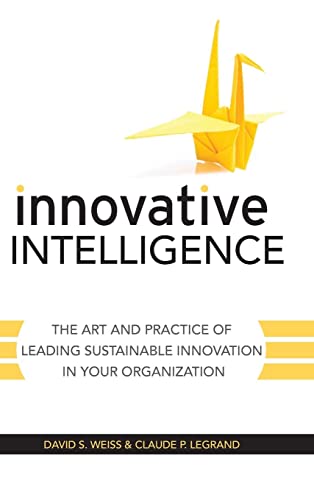
Innovative Intelligence: The Art and Practice of Leading Sustainable Innovation in Your Organization - Hardcover
Synopsis
Innovation is a key source of competitive advantage, but it remains frustratingly elusive for many organizations. This book shows you how to close the innovation gap by making individuals and organizations systematically and sustainably innovative. You will learn how to embrace a culture of innovation and make it permeate every level of the organization. You will find a clear road map and practical tools to redefine your workplace's culture, identify and tap into the existing innovative intelligence, and develop leaders who can close the innovation gap for greater business success.
"synopsis" may belong to another edition of this title.
About the Author
Dr. David S. Weiss is President and CEO of Weiss International Ltd., a firm specializing in innovation, leadership, and Human Resources consulting. Previously Chief Innovation Officer in a multinational consulting firm, David’s current university positions include Affiliate Professor at the Rotman School of Management of University of Toronto, and Senior Research Fellow of Queen’s University. David is a sought-after keynote speaker who has presented at over 200 conferences and is the author or co-author of four best-selling business books: Leadership Solutions (2007), The Leadership Gap (2005), High Performance HR (2000), and Beyond The Walls of Conflict (1996). For more information, visit www.weissinternational.ca.
Claude P. Legrand is the founder and President of Ideaction Inc., a consulting firm which specializes in sustainable innovation. For over 20 years he has been one of North America’s leading experts in practical innovation and is an acclaimed and frequent conference presenter. He leads a team of experienced consultants who help organizations become innovation-capable and deliver major innovation projects. In 2007, he was the founding Program Director of the Centre of Excellence in Innovation Management at the Schulich Executive Education Centre. For more information, please visit www.ideaction.net.
From the Back Cover
Innovation is a key source of competitive advantage, but it remains frustratingly elusive for many organizations. Too many organizations try to improve innovation by focusing on one element at a time, particularly in the area of new products and services. They train individuals, hire more creative people, or create specialized innovation departments. Yet, for most organizations, these investments yield only disappointing results. They have not had sustainable solutions―practical and reliable programs that deliver long-term, predictable results. Instead, they have had an endless array of partial answers. They are left with an alarming innovation gap.
Innovative Intelligence answers the question: How can we close the innovation gap by making individuals and organizations systematically and sustainably innovative? The key to systematic success is to ensure that organizational practices and culture genuinely foster innovative thinking. Innovative Intelligence presents the case for a new focus for leaders centered on innovative thinking, and demonstrates how leaders can maximize the innovative capacity of their employees and teams. It shows how to embrace a culture of innovation and have it permeate throughout the organization, at every level.
Innovative Intelligence gives readers a clear roadmap and practical tools to make their cultures more supportive of innovation, identify and tap into the innovative intelligence in their workplace and develop leaders who can close the innovation gap for greater business success.
From the Inside Flap
Innovation is a key source of competitive advantage, but it remains frustratingly elusive for many organizations. Too many organizations try to improve innovation by focusing on one element at a time, particularly in the area of new products and services. They train individuals, hire more creative people, or create specialized innovation departments. Yet, for most organizations, these investments yield only disappointing results. They have not had sustainable solutions—practical and reliable programs that deliver long-term, predictable results. Instead, they have had an endless array of partial answers. They are left with an alarming innovation gap.
Innovative Intelligence answers the question: How can we close the innovation gap by making individuals and organizations systematically and sustainably innovative? The key to systematic success is to ensure that organizational practices and culture genuinely foster innovative thinking. Innovative Intelligence presents the case for a new focus for leaders centered on innovative thinking, and demonstrates how leaders can maximize the innovative capacity of their employees and teams. It shows how to embrace a culture of innovation and have it permeate throughout the organization, at every level.
Innovative Intelligence gives readers a clear roadmap and practical tools to make their cultures more supportive of innovation, identify and tap into the innovative intelligence in their workplace and develop leaders who can close the innovation gap for greater business success.
Excerpt. © Reprinted by permission. All rights reserved.
Innovative Intelligence
The Art and Practice of Leading Sustainable Innovation in Your OrganizationBy David S. Weiss Claude LegrandJohn Wiley & Sons
Copyright © 2011 John Wiley & Sons, LtdAll right reserved.
ISBN: 978-0-470-67767-4
Chapter One
THE INNOVATION GAP
"The problem is much more complex and challenging than we thought," the CEO declared to his executive team. "Initially, we thought our challenge was to sustain our leading position in the new competitive environment. We thought we were an innovative pharmaceutical company—but really we're only an innovative R&D company. And now our R&D pipeline has almost ground to a halt. Healthcare regulators are not approving our new products. Generic drug companies are contesting our patents through intense litigation. Doctors don't have the time to see us. We're facing unprecedented political pressure to reduce the costs of our drugs. It's obvious that we must become innovative throughout our company and not just in R&D. But how do we do that quickly?"
"We've trained our best leaders to focus on short-term problems and 'making'the numbers. We haven't trained them to think innovatively. Our few innovative leaders have left to join healthcare start-ups that appreciate their innovative thinking. So we don't have the skilled innovative leaders who can help lead us out of this mess."
The CEO raised his voice and challenged his executive team, "I'm not the only leader here. Together, we must radically change our culture and champion innovative leadership throughout our business to compete in our industry. Are you with me?" The executives saw the panic in the CEO's eyes and nodded in agreement—but they didn't believe they would make any meaningful changes—not because they didn't want to, but because they just didn't know how to do what the CEO wanted. And they didn't believe the CEO knew either.
It is stories like this one that motivated us to write this book. Many organizations are caught in the turbulent world of the knowledge economy. They may have good intentions to become more innovative—but not many of their leaders know how to do it. They recognize that innovation is a key source of competitive advantage. However, despite extensive efforts to change, many organizations are having difficulty achieving the levels of innovation they require. This dynamic is an innovation gap.
Innovation Gap The difference between the stated importance of innovation and the actual results in an organization
Our purpose in Innovative Intelligence is twofold:
• To provide business leaders and senior HR executives with an accelerated strategy to close the innovation gap.
• To supply a series of practical and implementable frameworks and tactics for developing leaders who can drive innovation in their organizations.
THE INNOVATION CHALLENGE
Let's begin with the challenge of innovation.
Frequently it is only after the crisis has occurred—after the competition has captured market share, after the market has dried up, after organizations have slashed costs—that organizations react. Then they say they need to "innovate"—as best they can under the pressure of the crisis. Too often, they overreact and confuse systemic innovation with unbridled creativity. This kind of creativity merely produces high-risk ideas with no pragmatic means of applying them and no built-in process to sustain them.
Organizations face three major challenges as they attempt to respond to the innovation gap:
1. Lack of a common understanding of what innovation is, how it happens, and what prevents it. Despite many attempts at defining innovation, a lack of consensus on a common definition still exists. Too often, leaders define innovation only in terms of technology or scientific research, yet organizations require innovation in almost all areas.
2. Lack of innovative leaders. Most leaders have never learned how to be innovative and how to lead an organization so that it becomes more innovative. They may understand that they have a key role in innovation, but they do not know how to systematically generate new and better solutions. They also do not know how to reinforce the right innovative skills for their direct reports and teams.
3. Lack of enabling organizational practices and cultures to reinforce innovation. Many organizations inadvertently discourage innovation through their organizational practices (e.g. planning, budgeting, rewards). In addition, many organizations have cultures that drive short-term results and risk avoidance. Without changing some organizational practices and building a culture of innovation, leaders will not close the innovation gap.
Today, innovation is often extolled; however, on closer investigation, far more talk than action occurs. In this context, the old adage "talk is cheap" actually becomes "talk is expensive," because organizations pay a hefty price if they do not practice what they preach. Failure to innovate can be terminal.
WHAT IS INNOVATION?
Let's first define innovation. Then, we'll explain the innovation gap dynamic and substantiate it with our evidence.
Most use the concept of "innovation" as either an outcome or a process. This book is not about innovation as an outcome, although a great deal of research describes the innovation gap that is associated with the lack of innovative outcomes in organizations.
Instead, our approach focuses on the process of innovation and how innovation happens. Here are some key aspects of the innovation process:
• The innovation process applies to everything an organization does or could do, as well as how it does it. For example, innovation applies to how the organization develops and implements strategies, creates new products and services, manufactures products and services, and ensures that internal functions support the business.
• It is an essential enabler of business strategies and goals—but it is not, in and of itself, the strategy or the goal.
• It is simply about innovating. It is a process that enables the organization to deliver on its strategies and its goals, in the same way that manufacturing, marketing, or accounting enables the organization to achieve its goals—no more and no less.
We use the word innovation in a very different way than the way we use the word creativity. Here are some comparisons of creativity and innovation:
• Creativity is about having new ideas, relevant or not, useful or not, implementable or not, while the output of innovation achieves defined value for an organization.
• Creativity is a stand-alone output, not a sustainable business outcome. On the other hand, innovation is directed toward achieving a sustainable outcome that can improve what people do or how they do it.
Our definition of innovation in a business context is as follows:
Innovation Applied creativity that achieves business value
The confusion between innovation and creativity has been costly to many organizations. Once, a CEO of a successful bank indicated he did not want more innovation (because it would be too disruptive). What he was actually referring to was not innovation but creativity without boundaries, direction, or a rigorous process for application.
It is difficult to blame executives for their anxiety with unbridled creativity. Many executives are focused on risk mitigation and ensuring that the formula for success for their organization can be repeated continuously. Uncontrolled creativity could put an organization at risk, and although some executives say they want new ideas and innovation, they do not always support it when it occurs.
Even the expression "unleashing creativity" reflects this anxiety. To "unleash" implies that creativity was formerly restrained on a leash because it was dangerous. As a result, many executives do not focus on developing the innovation skills of their leaders because they are concerned that it will introduce uncontrollable risk.
Of course, managing risk is important—but concern with risk should not stop the innovation process. In fact, not taking risks and not changing is often the biggest risk of all, even if it is not immediately obvious. We need both innovation and risk mitigation at the same time.
We need both innovation and risk mitigation at the same time.
It is similar to the perceived oxymoron that higher quality can occur with lower cost. But it is true—better quality can be less expensive. The same is true for innovation: greater innovation can occur within acceptable levels of risk. Risk management should always be built into the innovative process.
Executives are correct in assuming that unbridled creativity could be disastrous—but focused innovation within acceptable risk levels can yield outstanding benefits for the business. To reduce associated risk, innovation needs to operate within clear boundaries and to be focused on achieving specific business outcomes.
The issue is that leaders often do not know how to foster innovation or how to manage risks on an ongoing basis. Risk is, just like innovation, an area that is spoken about frequently but with very little understanding or action. Risk is usually carefully evaluated for large projects or investments, but the discussion of risk for smaller projects is usually minimal. In most cases it is just glossed over, only to be discovered if something goes wrong later.
INNOVATIVE THINKING MAKES INNOVATION HAPPEN
Although there are many ways to understand innovation, most experts agree that innovation happens when people use innovative thinking.
Our definition of innovative thinking is as follows:
Innovative thinking is the process of solving problems by discovering, combining, and arranging insights, ideas, and methods in new ways.
The process of innovating is done by individuals or small teams that engage in innovative thinking. Computers, systems, cultures, or organizations do not innovate—only people do. However, the role of organizations and systems is critical; they are key enablers or potential blockers of innovative thinking by individuals and teams.
The Challenge to Innovate in the Knowledge Economy
The shift from the industrial economy to the knowledge economy has changed the nature of work more in the last 20 years than it changed in the last century. In the industrial economy, an organization could ask a few elite leaders to be innovative and focus everyone else on simply doing the work. When a problem happened, it was escalated to the elite "thinkers," who solved the problem and communicated the "right" decision throughout the organization.
In the knowledge economy, there is a need for all employees to use their intellectual potential because the nature of work is constantly changing and presenting complex challenges at every level of organizations. In this new economy, better solutions can only come from new ways of thinking—innovative thinking—not from conventional linear analytical thinking alone.
We need innovative thinking in our schools and businesses, in our health care and justice systems, and throughout our public institutions, in everything from politics to parenting. Even in manufacturing, the traditional hub of the industrial economy, all employees need to contribute to innovative thinking.
Unfortunately, in the context of today's collapsed time and increasing work complexity, many complain that there is little time for innovating, and too few people are able to dedicate time to thinking, let alone innovative thinking.
Almost no organization has a culture that allocates thinking time for employees as Google reputedly does—and "lack of time" is the most common obstacle cited by workers when asked why they are not more innovative. Employees who designate office time to think about problems and issues are often assumed to be wasting time—as one bank employee told us: "When I think, I feel guilty because I am not doing." Some employees cannot think at work because they spend so much time in meetings, and they believe more in an "open door policy" (whereby anyone can disturb them at anytime), than in allocating time for dedicated "closed door" thinking.
In addition, the recent proliferation of smart phones has placed an even greater premium on instant reactions and instant solutions, to the detriment of well-thought-out decisions. As a result, some employees sneak away from their offices, just to have a few moments of undisturbed innovative thinking time.
We need to value thinking at work and create a climate where innovative thinking is legitimized and valued in meetings and during dialogue, and where we confront and understand complex issues that we encounter in the work setting.
Organizations need to value thinking at work and create a climate where innovative thinking is legitimized and valued.
THE EVIDENCE IS IN—WE ARE UNDERACHIEVING
While innovation is often heralded as a key source of competitive advantage, many organizations are woefully underachieving when it comes to innovation. When they need it most, they have seldom been able to achieve the type of innovation that anticipates, adapts, and leads change rather than following it. This is particularly true when an organization compares its actual business achievements to the potential of its individual workers and teams. Few organizations leverage the full potential of their employees and teams.
Many articles and researchers focus on innovative organizations such as Apple, Google, Toyota Motor Corp., General Electric, and Microsoft. There are also other, less visible, innovative organizations in the private sector, social enterprise (non-profit) sector, and public sector. However, for every organization that succeeds at innovation, there are many more that are either not engaged in it or not doing enough. One executive director of a creative dance company said it best in his presentation to encourage his management team to be more innovative: "Have we had innovation? Of course. Incremental improvement? Yes. Big ideas? A few. Sustainable innovation? Seldom. Enough innovation? Not even close." This observation is true for many organizations today.
What has emerged in organizations is a wide-ranging and potentially disastrous innovation gap. To validate the dynamic of the innovation gap, we reviewed a number of survey reports on innovation published over the past five years in North America and Europe. We also conducted our own research on innovation in the workplace to validate some of the findings that already existed, to test some of the underlying assumptions that appear to be the basis for much of the research, and to explore some additional questions.
What the Research Shows
The first overriding result in almost every research report is that there is a significant gap between innovation expectations and performance. The dynamic is as follows:
• Innovation Expectations: Most executives believe innovation is "very important" or "important" for the future success of their organizations, and it is among the top priorities for their businesses.
• Innovation Results: Most executives are not satisfied with the innovation results their organizations are achieving.
Research validates these findings. The first survey we led targeted senior leaders in 500 large organizations. We found the same dramatic differences between innovation expectations and innovation results. The results of the following two questions illustrate the point:
• "Innovation is important for our future success" = 88 percent of respondents
• "Our organization is effective at innovation" = 33 percent of respondents
Another question we asked was, "Who was responsible for innovation?" The findings (Table 1.1) showed that 78 percent believed the executive team was responsible for innovation (and not specifically the CEO).
Of course, there are high-profile examples of innovative CEOs who have almost single-handedly led their organizations to new industry innovations—however, these types of executives are few and far between. These unique innovative leaders are often found in owner-operated companies where the CEO may have launched the company after discovering a breakthrough concept, service, or product and retains that position of being the primary, and sometimes exclusive, generator of innovative ideas.
We also conducted a survey of 550 HR professionals (including 130 HR executives) focusing on the Human Resource professionals' perception of the innovation gap. This research compared the results of the respondents who said their organization was innovative (referred to as "innovative organization") to the ones who said their organization was not innovative (referred to as "non-innovative organization"). These results clearly showed that the HR respondents believed leadership was the single most discriminating factor for innovation success (see Table 1.2).
(Continues...)
Excerpted from Innovative Intelligenceby David S. Weiss Claude Legrand Copyright © 2011 by John Wiley & Sons, Ltd. Excerpted by permission of John Wiley & Sons. All rights reserved. No part of this excerpt may be reproduced or reprinted without permission in writing from the publisher.
Excerpts are provided by Dial-A-Book Inc. solely for the personal use of visitors to this web site.
"About this title" may belong to another edition of this title.
Other Popular Editions of the Same Title

Search results for Innovative Intelligence: The Art and Practice of Leading...

Stock Image
Innovative Intelligence: The Art and Practice of Leading Sustainable Innovation in Your Organization
Seller: World of Books (was SecondSale), Montgomery, IL, U.S.A.
Seller rating 5 out of 5 stars

Condition: Good. Item in good condition. Textbooks may not include supplemental items i.e. CDs, access codes etc. Seller Inventory # 00098919353
Seller Image
Innovative Intelligence: The Art and Practice of Leading Sustainable Innovation in Your Organization
Seller: Zoom Books Company, Lynden, WA, U.S.A.
Seller rating 5 out of 5 stars
Condition: very_good. Book is in very good condition and may include minimal underlining highlighting. The book can also include "From the library of" labels. May not contain miscellaneous items toys, dvds, etc. . We offer 100% money back guarantee and 24 7 customer service. Seller Inventory # ZBV.0470677678.VG
Seller Image
Innovative Intelligence: The Art and Practice of Leading Sustainable Innovation in Your Organization
Seller: Zoom Books Company, Lynden, WA, U.S.A.
Seller rating 5 out of 5 stars
Condition: like_new. Seller Inventory # ZBV.0470677678.LN
Stock Image
Innovative Intelligence: The Art and Practice of Leading Sustainable Innovation in Your Organization
Seller: Once Upon A Time Books, Siloam Springs, AR, U.S.A.
Seller rating 4 out of 5 stars

hardcover. Condition: Very Good. Seller Inventory # mon0003361312
Stock Image
Innovative Intelligence: The Art and Practice of Leading Sustainable Innovation in Your Organization
Seller: Once Upon A Time Books, Siloam Springs, AR, U.S.A.
Seller rating 4 out of 5 stars
hardcover. Condition: Good. This is a used book in good condition and may show some signs of use or wear . This is a used book in good condition and may show some signs of use or wear . Seller Inventory # mon0003192263
Stock Image
Innovative Intelligence : The Art and Practice of Leading Sustainable Innovation in Your Organization
Published by
Wiley & Sons, Incorporated, John, 2011
ISBN 10: 0470677678
ISBN 13: 9780470677674
Used
Hardcover
Seller: Better World Books, Mishawaka, IN, U.S.A.
Seller rating 5 out of 5 stars
Condition: Good. Pages intact with minimal writing/highlighting. The binding may be loose and creased. Dust jackets/supplements are not included. Stock photo provided. Product includes identifying sticker. Better World Books: Buy Books. Do Good. Seller Inventory # 48643008-6
Stock Image
Innovative Intelligence : The Art and Practice of Leading Sustainable Innovation in Your Organization
Published by
Wiley & Sons, Incorporated, John, 2011
ISBN 10: 0470677678
ISBN 13: 9780470677674
Used
Hardcover
Seller: Better World Books, Mishawaka, IN, U.S.A.
Seller rating 5 out of 5 stars
Condition: Good. Former library copy. Pages intact with minimal writing/highlighting. The binding may be loose and creased. Dust jackets/supplements are not included. Includes library markings. Stock photo provided. Product includes identifying sticker. Better World Books: Buy Books. Do Good. Seller Inventory # 9933426-6
Stock Image
Innovative Intelligence : The Art and Practice of Leading Sustainable Innovation in Your Organization
Published by
Wiley & Sons, Incorporated, John, 2011
ISBN 10: 0470677678
ISBN 13: 9780470677674
Used
Hardcover
Seller: Better World Books, Mishawaka, IN, U.S.A.
Seller rating 5 out of 5 stars
Condition: Very Good. Pages intact with possible writing/highlighting. Binding strong with minor wear. Dust jackets/supplements may not be included. Stock photo provided. Product includes identifying sticker. Better World Books: Buy Books. Do Good. Seller Inventory # GRP96790240
Stock Image
Innovative Intelligence: The Art and Practice of Leading Sustainable Innovation in Your Organization
Seller: BooksRun, Philadelphia, PA, U.S.A.
Seller rating 5 out of 5 stars
Hardcover. Condition: Very Good. 1. It's a well-cared-for item that has seen limited use. The item may show minor signs of wear. All the text is legible, with all pages included. It may have slight markings and/or highlighting. Seller Inventory # 0470677678-11-1
Seller Image
Innovative Intelligence: The Art and Practice of Leading Sustainable Innovation in Your Organization
Seller: Bay State Book Company, North Smithfield, RI, U.S.A.
Seller rating 5 out of 5 stars
Condition: very_good. Seller Inventory # BSM.117E3