
Items related to Teach Yourself VISUALLY Jewelry Making and Beading:...
Teach Yourself VISUALLY Jewelry Making and Beading: 6 (Teach Yourself VISUALLY Consumer) - Softcover
Book 4 of 8: Teach Yourself VISUALLY Consumer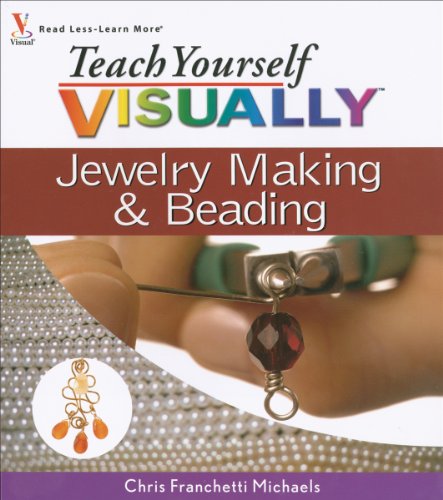
Synopsis
A step-by-step, full-color VISUAL guide to the art of jewelry making
A 2006 study found that beading and jewelry making is the nation’s sixth most popular craft. This guide shows readers how to do everything from basic bead stringing to wire wrapping, all in the series’ easy-to-follow, full-color format. The book includes 20 detailed patterns for making earrings, necklaces, bracelets, and more.
"synopsis" may belong to another edition of this title.
About the Author
Chris Franchetti Michaels is a writer and jewelry artisan specializing in beaded designs, wirework, and metal fabrication. She has written extensively about jewelry and jewelry making on the Internet since 2003, and she is the author of Beading VISUAL Quick Tips, Wire Jewelry VISUAL Quick Tips, and Teach Yourself VISUALLY Beadwork. Chris has also appeared on several episodes of the DIY Network television show Jewelry Making, and her designs have been featured in popular jewelry project books. Visit her website BeadJewelry.net for more help and inspiration.
From the Back Cover
You've probably coveted jewelry you've seen in artsy boutiques and fashion magazines or envied friends who have the perfect bling to accent everything. With this book, you'll learn to craft designs that are chic but inexpensive. With hundreds of detailed photos, this book covers tools and supplies, bead stringing and weaving, wire wrapping, and more. Terrific projects will get you started and inspire you to create your own jewelry and beadwork designs.
Concise two-page lessons show you all the steps to a skill and are ideal for quick review
- Each skill or technique is defined and described
- Detailed color photos demonstrate each step
- Step-by-step instructions accompany each photo
- Helpful tips provide additional guidance
From the Inside Flap
You've probably coveted jewelry you've seen in artsy boutiques and fashion magazines or envied friends who have the perfect bling to accent everything. With this book, you'll learn to craft designs that are chic but inexpensive. With hundreds of detailed photos, this book covers tools and supplies, bead stringing and weaving, wire wrapping, and more. Terrific projects will get you started and inspire you to create your own jewelry and beadwork designs.
Concise two-page lessons show you all the steps to a skill and are ideal for quick review
- Each skill or technique is defined and described
- Detailed color photos demonstrate each step
- Step-by-step instructions accompany each photo
- Helpful tips provide additional guidance
Excerpt. © Reprinted by permission. All rights reserved.
Teach Yourself VISUALLY Jewelry Making & Beading
By Chris Franchetti MichaelsJohn Wiley & Sons
Copyright © 2007 Chris Franchetti MichaelsAll right reserved.
ISBN: 978-0-470-10150-6
Chapter One
Introduction to Jewelry Making and Beading
Become a Jewelry Artisan 4 Beads and Beading Supplies 6 Wire and Wirework Supplies 18 Macram Knotting and Braiding Supplies 24 Jewelry Findings 26
Are you interested in learning how to make jewelry and work with beads, but unsure where to begin? Let this book guide you through the basic skills and techniques you will need to create the most popular styles of jewelry and beadwork. In this chapter, you will learn about the essential tools, equipment, and supplies used for common tasks. Then you can set up your work area and start exploring this creative hobby.
Become a Jewelry Artisan
Jewelry making and beading are very personal and rewarding crafts. With some basic supplies and a little creativity, you can adorn yourself, and the people in your life, with beautiful objects that communicate your inner feelings and your sense of style.
People have been crafting jewelry and beading for thousands of years. Throughout human history, jewelry and beads have symbolized social status, wealth, and spiritual beliefs. Some cultures even attribute magical powers to their jewelry and gemstones. Today, many people still view jewelry as more than mere decoration; they use it to symbolize love and commitment, religion, politics, life experiences, the birth of children, and important memories. Our choice of jewelry conveys important information about us. It helps us-and those around us-to understand who we are.
When you begin making your own jewelry and beaded artwork, you will use many of the same techniques that ancient crafters used thousands of years ago. Your designs will be special because you made them by hand to your own specifications. You will experience the satisfaction of making jewelry you really love (and that fits you), while avoiding the cheaply made, mass-produced jewelry that you see at so many retail stores.
You can also save money by making your own jewelry. Using the basic techniques covered in this book, you can affordably make jewelry that is very similar to expensive designer jewelry from department stores and boutiques. You will also find that gift-giving becomes far less challenging for the jewelry and beadwork lovers on your gift lists.
One of the most rewarding aspects of jewelry making and beading is that your creations can serve any purpose and match any style that you choose. If you love fashion, you can be your own personal fashion jewelry designer. If you're interested in a particular culture, religion, spiritual path, or time in history, your designs can reflect what's important to you. You can even reassemble your old jewelry into new, updated designs.
As you work through this book, allow yourself plenty of time to experiment and play with new techniques. You may master some skills quickly, but others will take practice. Be patient, and keep in mind that you will be able to complete projects faster over time. Enjoy each new accomplishment, and use your newfound talents to bring more creativity and enrichment into your life.
Beads and Beading Supplies
Beads are the most popular and widely available jewelry-making components. You can find them at craft stores, bead shops, and on the Internet. (See pages 282-283 for a list of bead resources.) Typically, beads are categorized by material, shape, and size.
Common Bead Materials
GLASS BEADS
Glass beads are available in just about any color and style you can imagine. Their quality is often linked to where and how they are made. For example, many glass beads currently made in China and India are less consistent in size and color than glass beads from Europe; however, they typically are less expensive than European beads.
Some of the most popular glass beads from Europe are made in the Czech Republic. These are often referred to as Czech glass beads. Some Czech glass beads are pressed, or manufactured in molds. You can find them in a lot of fun shapes like flowers, animals, and even fruit. Other Czech glass beads are fire polished. Fire polishing is a special process that gives glass extra shine and sparkle. But fire-polished glass beads are not quite as eye-catching as crystal beads. Crystal is glass that contains a small amount of lead. The lead makes the glass softer so that it can be cut into more precise shapes. It also changes the way light reflects within the glass, creating extreme shine. The highest-quality crystal beads are made in Austria and Czech Republic, but less expensive variations are also manufactured in China.
Seed beads are tiny glass beads that are commonly used to create woven beaded fabric. You can also use them to make thin, beaded strands. As with larger beads, seed beads vary in quality depending on how and where they were made. You will learn more about bead weaving and selecting quality seed beads in Chapter 5.
Although most glass beads are made by machine, some are individually handmade. Lampwork beads are an especially popular style of handmade glass beads. They are crafted by manually applying molten glass to metal rods.
Other beads are created by a combination of mechanical and handmade methods. For example, some manufactured glass beads are hand faceted, or cut to have multiple flat surfaces, to mimic the look of gemstone beads.
GEMSTONE BEADS
Most gemstone beads are made from semiprecious natural stone. Semiprecious stone is more abundant, and less costly, than the precious gemstones used in fine jewelry settings. Agate, jade, quartz, jasper, and turquoise are examples of common semiprecious stones. You can also find semiprecious varieties of more expensive stones like ruby, amethyst, emerald, and citrine.
Gemstone beads are usually shaped by hand. Like glass beads, their quality and cost often depend on where they were made. Some of the most affordable gemstone beads are made in India. They are colorful and beautiful, but their shapes and sizes are less consistent than more expensive gemstone beads from China.
Many gemstone beads are treated, which means that they may be dyed, oiled, heated, irradiated, or injected with waxes. Treatments improve the look of lower-quality stones, but treated stones remain less valuable than Higher-quality, untreated stones. Treated gemstone is not the same as synthetic gemstone. Synthetic gemstone beads are not really made from stone; they are another material made to look like stone. Many synthetic stones-especially synthetic quartzes-are made from glass. They can be very beautiful, but they are typically considered inferior to natural stone.
CERAMIC BEADS
Ceramic beads are made from earthen clay. They can have a simple, natural look or be highly decorative. Colorful ceramic beads are usually painted, printed, or glazed. With painted ceramic beads, the paint is brushed on or the beads are dipped into paint. A coat of lacquer may be applied to seal the paint in place. Printed ceramic beads are either stamped with paint or have designs transferred onto them from other surfaces. Transferred designs are usually applied using heat, but otherwise they are similar to stamps. Printed and transferred designs are less time-consuming to create, and more regular in appearance, than hand-painted designs. Glazed ceramic beads are coated with colored or clear glass.
Some ceramic beads are shaped by hand, and others are molded, carved, or impressed. Impressed beads have indented or three-dimensional designs made by pressing a mold or modeling tool onto the clay before it hardens.
METAL BEADS
Metal beads can be made of precious metal or base metal. Precious metal is less abundant and more expensive than base metal. The most common precious metals used in handmade jewelry are sterling silver and gold. Base metal refers to any of the more common, less expensive metals like copper, brass, nickel, tin, or aluminum-or to any mixture, or alloy, of more than one type of base metal. Base metal beads are often finished or plated. Finishing is a technique used to change the color of the surface of metal to make it look more like another metal. It can also be used to darken metal, making it look oxidized, or antiqued. Plated metal is coated with a very thin layer of another metal. Common examples are silver-plate and gold-plate. Plated beads have a nice look, but their plating can wear off relatively easily.
Most solid metal beads are cast, or molded. Hollow metal beads are often made of two stamped sheets of metal joined together at the seam. Handmade metal beads are usually made from precious metals, and they are significantly more expensive than cast beads because of the time and effort required to make them. Most handmade metal beads are fabricated using traditional, advanced jewelry-making techniques. Others are hand-formed from metal clay. (For more information on metal fabrication and metal clay, see Chapter 12.)
PLASTIC BEADS
While some plastic beads are inexpensive and of low quality, others are pricey and highly collectible. Beads made from hard vintage plastics like Bakelite and celluloid are especially sought after. Artificial resin is a soft plastic used to make bright, colorful beads, or to replicate natural materials like amber and cinnabar. (In fact, modern beads called "cinnabar" are usually made from red or black resin, because natural cinnabar is highly toxic.) Some basic plastic, or acrylic, beads are coated to look like metal beads. Others look like carved bone, tortoise shell, or pearls.
Many handmade plastic beads are made from polymer clay, which is a heavy plastic that can be shaped easily and layered to create interesting artistic effects. (For more information on polymer clay, see Chapter 12.)
ORGANIC BEADS
Historians believe that the first beads ever made were crafted from small seeds or tiny pieces of shell. These materials are organic because they come from living things. Pearl is an all-time favorite organic bead material. Pearls are formed by little water creatures called mollusks. When an irritant, like a piece of sand, gets trapped in the mollusk's tissue, it deposits layers of a substance called nacre around the irritant. Multiple layers of nacre create a pearl. Most pearls are cultured, meaning that irritants were manually placed into mollusks' tissues to create them. Natural pearls are pearls that form without any human intervention. They are very rare and expensive, and so the pearls you use in jewelry will likely be cultured. Pearl beads are often dyed, but they can also have a natural white, cream, or tan color. There are many different qualities, or grades, of pearl beads. Even the lower-grade, inexpensive varieties can look stunning in jewelry.
Other organic bead materials include wood, seeds, shell, amber, bone, and horn. Amber is a very lightweight material made from the natural resin of ancient trees. Bone and horn beads typically derive from the byproducts of large livestock like cows and sheep. Beads made from these materials are usually handcrafted, and many are hand carved.
Bead Shapes
Beads are available in many shapes. Here are the most common shapes you will encounter when bead shopping.
Bead Sizes
With the exception of tiny seed beads, bead sizes are typically described in millimeters. (To learn about the unique sizing classifications for seed beads, see page 95 in Chapter 5.)
The size of a round bead is its diameter, which is the same measurement as either its length (the distance between the two openings of the drill hole) or its width (the distance between the other two sides of the bead). The sizes of other shapes of beads are often described by both their length and width. Typically, length is the first measurement given, but sometimes width is provided first. (For this reason, it's important to examine the bead in question to understand its width versus length.) Here are some examples of common bead sizes.
Pendants and Charms
You can use pre-made pendants and charms in just about any type of jewelry you make. They are sold at most bead shops and jewelry supply stores, and you can even take them off of old jewelry and reuse them for new designs.
Pendants are usually larger than charms and serve as focal pieces for necklaces. They can be made from any material that beads are made from. The little devices that hold pendants onto necklaces are called bails.
Charms are typically used as accent pieces rather than focal points. You can use a single charm in a design, or a collection of many. Charms usually attach to jewelry with split rings or jump rings (see page 27).
Bead Stringing Materials
You can string beads on many different materials. Here's a brief look at the most common stringing materials used for beading. You will learn more about them in Chapters 3, 4, and 5.
BEADING WIRE AND MEMORY WIRE
Unlike regular metal wire, beading wire is soft and flexible. It's made up of many tiny metal strands woven or wound together. Most beading wire is covered with a thin layer of nylon plastic. To learn more about the types and sizes of beading wire, see "Select a Stringing Material" in Chapter 3.
Memory wire is hard, single-strand steel wire designed to hold a circular shape. You can use it to make beaded coil bracelets, necklaces, and rings that don't require clasps.
CORD AND RIBBON
Cord is non-metal material that often consists of smaller strands woven together. Silk, nylon, cotton, and satin are popular types of multiple-strand cord. Leather, suede, and rubber are typical single-strand cords. Stretch cord can have single or multiple strands. Most cord is sized in millimeters or inches according to its diameter, but some manufacturers use their own sizing system using numbers or letters. Ribbon for beading is usually made of soft fabric, like organza or satin.
BEADING THREAD
Beading thread is a special synthetic thread designed for beading. It has a very small diameter and can fit through tiny bead holes. Like cord, it is often composed of multiple strands. Beading thread is usually stronger and smoother than thread used for sewing. To learn about beading thread sizes, see "Select Beads, Thread, and Needle" in Chapter 5.
Beading Tools and Supplies
Although beads and stringing material are the basic necessities of any beading project, there are other tools and supplies that can make your beadwork easier and help you create more complicated designs. Here's a look at some items that you may find useful. You will learn more about working with many of them in Chapters 3, 4, and 5.
BEADING MATS, BEADING DISHES, AND BEAD BOARDS
Because many beads are round, they can easily roll away from your work area. You can keep better track of your beads by working on a beading mat. A beading mat can be any flat surface that is textured to keep beads from rolling. It can be as simple as a terry cloth hand towel or as fancy as a specially engineered, rubberized mat from a bead shop. Textured foam drawer-liner material also makes a nice bead mat, and you can find it at most drug stores.
When you work with tiny seed beads, you may find it more helpful to keep them on a ceramic dish or in a shallow, smooth bowl. This makes it easier to pick up the beads using a beading needle.
A bead board is a three-dimensional tray with long grooves for holding and arranging beads. Most bead boards are made of plastic with a velvety coating that helps beads stay in place. Bead boards are available in a variety of shapes and sizes, and they usually have measurement marks to help you gauge the lengths of your designs.
(Continues...)
Excerpted from Teach Yourself VISUALLY Jewelry Making & Beadingby Chris Franchetti Michaels Copyright © 2007 by Chris Franchetti Michaels. Excerpted by permission.
All rights reserved. No part of this excerpt may be reproduced or reprinted without permission in writing from the publisher.
Excerpts are provided by Dial-A-Book Inc. solely for the personal use of visitors to this web site.
"About this title" may belong to another edition of this title.
Search results for Teach Yourself VISUALLY Jewelry Making and Beading:...

Seller Image
Teach Yourself VISUALLY Jewelry Making and Beading (Teach Yourself VISUALLY Consumer)
Seller: Zoom Books East, Glendale Heights, IL, U.S.A.
Seller rating 5 out of 5 stars

Condition: good. Book is in good condition and may include underlining highlighting and minimal wear. The book can also include "From the library of" labels. May not contain miscellaneous items toys, dvds, etc. . We offer 100% money back guarantee and 24 7 customer service. Seller Inventory # ZEV.0470101504.G
Stock Image
Teach Yourself VISUALLY Jewelry Making and Beading (Teach Yourself VISUALLY Consumer)
Seller: New Legacy Books, Annandale, NJ, U.S.A.
Seller rating 5 out of 5 stars
paperback. Condition: Good. The cover shows normal wear. Fast shipping and order satisfaction guaranteed. A portion of your purchase benefits Non-Profit Organizations, First Aid and Fire Stations! Seller Inventory # mon0000192226
Seller Image
Teach Yourself VISUALLY Jewelry Making and Beading (Teach Yourself VISUALLY Consumer)
Seller: ZBK Books, Carlstadt, NJ, U.S.A.
Seller rating 5 out of 5 stars
Condition: very_good. Fast & Free Shipping â" Very Good condition book with a firm cover and clean pages. Shows normal use and some light wear or limited notes markings. A solid, nice copy to enjoy. Seller Inventory # ZWV.0470101504.VG
Seller Image
Teach Yourself VISUALLY Jewelry Making and Beading (Teach Yourself VISUALLY Consumer)
Seller: Greenworld Books, Arlington, TX, U.S.A.
Seller rating 5 out of 5 stars
Condition: very_good. Fast Free Shipping â" Very Good condition book with a firm cover and clean pages. Shows normal use and some light wear or limited notes markings. A solid, nice copy to enjoy. Seller Inventory # GWV.0470101504.VG
Stock Image
Teach Yourself VISUALLY Jewelry Making and Beading (Teach Yourself VISUALLY Consumer)
Seller: More Than Words, Waltham, MA, U.S.A.
Seller rating 5 out of 5 stars
Condition: Good. . . Before placing your order for please contact us for confirmation on the book's binding. Check out our other listings to add to your order for discounted shipping. All orders guaranteed and ship within 24 hours. Seller Inventory # BOS-V-08j-01542
Stock Image
Teach Yourself VISUALLY Jewelry Making and Beading (Teach Yourself VISUALLY Consumer)
Seller: Evergreen Goodwill, Seattle, WA, U.S.A.
Seller rating 5 out of 5 stars
paperback. Condition: Good. Seller Inventory # mon0000032681
Stock Image
Teach Yourself VISUALLY Jewelry Making and Beading
Seller: Goodwill, Brooklyn Park, MN, U.S.A.
Seller rating 4 out of 5 stars

Condition: Good. Stains on outside cover/inside the book. Cover/Case has some rubbing and edgewear. Access codes, CDs, slipcovers and other accessories may not be included. Seller Inventory # 2Y6JCK006EGB
Seller Image
Teach Yourself VISUALLY Jewelry Making and Beading (Teach Yourself VISUALLY Consumer)
Seller: Dream Books Co., Denver, CO, U.S.A.
Seller rating 5 out of 5 stars
Condition: good. Gently used with minimal wear on the corners and cover. A few pages may contain light highlighting or writing, but the text remains fully legible. Dust jacket may be missing, and supplemental materials like CDs or codes may not be included. May be ex-library with library markings. Ships promptly! Seller Inventory # DBV.0470101504.G
Stock Image
Teach Yourself Visually Jewelry Making and Beading
Seller: ThriftBooks-Reno, Reno, NV, U.S.A.
Seller rating 5 out of 5 stars
Paperback. Condition: Fair. No Jacket. Readable copy. Pages may have considerable notes/highlighting. ~ ThriftBooks: Read More, Spend Less. Seller Inventory # G0470101504I5N00
Stock Image
Teach Yourself Visually Jewelry Making and Beading
Seller: ThriftBooks-Atlanta, AUSTELL, GA, U.S.A.
Seller rating 5 out of 5 stars
Paperback. Condition: Good. No Jacket. Pages can have notes/highlighting. Spine may show signs of wear. ~ ThriftBooks: Read More, Spend Less. Seller Inventory # G0470101504I3N00