
Items related to A Field Guide to Rocks and Minerals: 7 (Peterson Field...
Synopsis
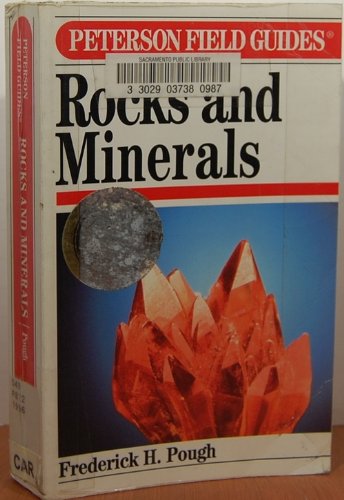
This Field Guide has been, and still is, the classic and useful Field Guide. Despite its title, this is mainly oriented toward minerals. Well organized and interestingly written, this is one of the few mineralogy texts which is both readable for enjoyment, and useful to both the beginner and the expert. Part I includes an introduction on the philosophy and adjuncts of the collecting and study of minerals, briefly reviews geology and its rocks, discusses the physical properties of minerals (such as may be used to help distinguish the various species), introduces crystallography, a chemical classification of minerals written for the layman, and finally Tests, Techniques, and Tips, with many useful down-to-earth hints. Part II is Mineral Descriptions, each one with name, formula, crystal system, and visual aids in the plates which include both diagrams and photographs. Several headings in each description are in boldface: Environment, Crystal description, Physical properties, Composition, Tests, Distinguishing characteristics, Occurrence, and Interesting Facts. Also includes glossary, bibliography, index. Well organized and accurate, this little book has been used by some amateur mineralogists who, although using several more technical books during years of study, still find this one useful. Although another well-known text is the most commonly used one for college mineralogy courses, I have recommended that students also get a copy of the Field Guide. For the amateur exercising a bit of Emersonian self-reliance in the testing of his own specimens, this Field Guide is one of the very few remaining guides including good Tests (which have actually been tried before including them) under eachspecies. Appeals to collectors to first try a few tests on extra material before turning specimens over to others such as over-burdened professionals. Also appeals to study some phase of the subject for one's own edification and enjoyment, as one will get as much out of it as he or she puts into it. This Field Guide shows you how. --This text refers to the Hardcover edition.
"synopsis" may belong to another edition of this title.
About the Author
Roger Tory Peterson, one of the world's greatest naturalists, received every major award for ornithology, natural science, and conservation as well as numerous honorary degrees, medals, and citations, including the Presidential Medal of Freedom. The Peterson Identification System has been called the greatest invention since binoculars. These editions include updated material by Michael O'Brien, Paul Lehman, Bill Thompson III, Michael DiGiorgio, Larry Rosche, and Jeffrey A. Gordon.
Synopsis
Describes hundreds of minerals and lists their geographic distribution, physical properties, chemical composition, and crystalline structure.
"About this title" may belong to another edition of this title.
Search results for A Field Guide to Rocks and Minerals: 7 (Peterson Field...

Seller Image
A Field Guide To Rocks & Minerals, 5th edition
Seller: Bay State Book Company, North Smithfield, RI, U.S.A.
Seller rating 5 out of 5 stars

Condition: good. The book is in good condition with all pages and cover intact, including the dust jacket if originally issued. The spine may show light wear. Pages may contain some notes or highlighting, and there might be a "From the library of" label. Boxed set packaging, shrink wrap, or included media like CDs may be missing. Seller Inventory # BSM.1C7N4
Stock Image
A Field Guide To Rocks & Minerals, 5th edition
Seller: Half Price Books Inc., Dallas, TX, U.S.A.
Seller rating 5 out of 5 stars
hardcover. Condition: Very Good. Connecting readers with great books since 1972! Used books may not include companion materials, and may have some shelf wear or limited writing. We ship orders daily and Customer Service is our top priority! Seller Inventory # S_480781572
Stock Image
A Field Guide To Rocks & Minerals, 5th edition
Seller: ThriftBooks-Dallas, Dallas, TX, U.S.A.
Seller rating 5 out of 5 stars
Hardcover. Condition: Good. No Jacket. Pages can have notes/highlighting. Spine may show signs of wear. ~ ThriftBooks: Read More, Spend Less. Seller Inventory # G0395727782I3N00
Stock Image
A Field Guide to Rocks and Minerals (Peterson Field Guide Series, 7, Band 7)
Published by
Houghton Mifflin (Trade), 1976
ISBN 10: 0395727782
ISBN 13: 9780395727782
Used
Hardcover
Seller: Sigrun Wuertele buchgenie_de, Altenburg, Germany
Seller rating 5 out of 5 stars
Condition: Gut - gebraucht. Gebundene Ausgabe 396 S. Guter Zustand ohne Schutzumschlag Zustand: 3, Gut - gebraucht, Gebundene Ausgabe Houghton Mifflin (Trade) , 1976 396 S. , A Field Guide to Rocks and Minerals (Peterson Field Guide Series, 7, Band 7), Frederick H. Pough. Seller Inventory # BU295856