
Synopsis
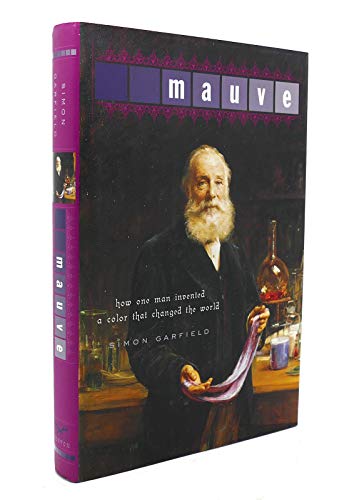
Offers a study of the color mauve--created in 1856 by eighteen-year-old English chemist William Perkin, who was working on a treatment for malaria in his home laboratory and accidentally discovered what became the most desired shade in fashion and ultimately led to the development of explosives, perfume, photography, and modern medicine.
"synopsis" may belong to another edition of this title.
Review
Mauve? Not the butchest of colours perhaps; you might be forgiven for wondering whether, if a Longitude-style book had to be written about hues, Red, Blue or Yellow might not be the place to start instead. But Garfield has chosen his colour well: mauve and its 19th-century inventor William Perkin constitute a fascinating story. This book convincingly argues that Perkin's invention of this chemical dye became a major turning point in the history of Western science and industry. Purple had always been a royal colour, in part because it was so difficult (and hence expensive) to achieve a good shade out of the animal, mineral or plant raw materials from which all dyes were derived; it took 17,000 dried and crushed cactus insects to make one ounce of cochineal. Perkin found a cheap way to produce a synthetic purple; he made a fortune and prompted a craze for the colour in the fashion industry of his day. But more than this, Garfield argues, he kick-started chemistry from being a gentleman-amateur pastime into becoming the major world industry it is today. Mauve (the Victorians pronounced it "morv", apparently) really did change the world. Just as Perkins's colour was something wholly new, Garfield's Mauve represents a new sort of book, a more varied synthesis than the run-of-the-mill animal, mineral or plant books. In part it is a biography, in part a social and cultural history, and partly it is a meditation on the roles chemistry (and colour) play in our world. It even manages to function as a primer in inorganic chemistry. Garfield achieves this last without being either baffling or condescending; he breaks us in gently to the subject of, for instance, benzene rings by relating Friedrich Kekule's 1858 dream, dozing in front of the fire, "gambolling atoms in snake-like motion, one of the snakes had seized hold of its own tail: his benzene structure consisted of six carbon atoms, each attached to a hydrogen atom C6H6". The model for this integration of chemistry into everyday life is taken from the period itself--at one point we're told that "William Perkins Jnr wrote again, enquiring about the atomic structures of various synthetic perfumes and wishing his father a happy birthday". Presumably in that order. Garfield's book draws you into this world of dyes and dyers; the reader emerges a little mauver than when they started. --Adam Roberts
Review
'This remarkable book about how the colour was discovered opened my eyes... Garfield's study is far more than a social history of fashion. It is a book about science which also happens to be a miniature work of art.' Daily Telegraph
"About this title" may belong to another edition of this title.
Other Popular Editions of the Same Title

Search results for Mauve: How One Man Invented a Color That Changed the...

Stock Image
Mauve: How One Man Invented a Color That Changed the World
Seller: HPB-Diamond, Dallas, TX, U.S.A.
Seller rating 5 out of 5 stars

hardcover. Condition: Very Good. Connecting readers with great books since 1972! Used books may not include companion materials, and may have some shelf wear or limited writing. We ship orders daily and Customer Service is our top priority! Seller Inventory # S_469078976
Stock Image
Mauve: How One Man Invented a Color That Changed the World
Seller: World of Books (was SecondSale), Montgomery, IL, U.S.A.
Seller rating 5 out of 5 stars
Condition: Very Good. Item in very good condition! Textbooks may not include supplemental items i.e. CDs, access codes etc. Seller Inventory # 00105717425
Stock Image
Mauve: How One Man Invented a Color That Changed the World
Seller: World of Books (was SecondSale), Montgomery, IL, U.S.A.
Seller rating 5 out of 5 stars
Condition: Good. Item in good condition. Textbooks may not include supplemental items i.e. CDs, access codes etc. Seller Inventory # 00098414817
Stock Image
Mauve : How One Man Invented a Color That Changed the World
Published by
Norton & Company, Incorporated, W. W., 2001
ISBN 10: 0393020053
ISBN 13: 9780393020052
Used
Hardcover
Seller: Better World Books: West, Reno, NV, U.S.A.
Seller rating 5 out of 5 stars
Condition: Very Good. Former library copy. Pages intact with possible writing/highlighting. Binding strong with minor wear. Dust jackets/supplements may not be included. Includes library markings. Stock photo provided. Product includes identifying sticker. Better World Books: Buy Books. Do Good. Seller Inventory # GRP79955888
Stock Image
Mauve : How One Man Invented a Color That Changed the World
Published by
Norton & Company, Incorporated, W. W., 2001
ISBN 10: 0393020053
ISBN 13: 9780393020052
Used
Hardcover
Seller: Better World Books, Mishawaka, IN, U.S.A.
Seller rating 5 out of 5 stars
Condition: Very Good. Pages intact with possible writing/highlighting. Binding strong with minor wear. Dust jackets/supplements may not be included. Stock photo provided. Product includes identifying sticker. Better World Books: Buy Books. Do Good. Seller Inventory # 4229806-6
Stock Image
Mauve : How One Man Invented a Color That Changed the World
Published by
Norton & Company, Incorporated, W. W., 2001
ISBN 10: 0393020053
ISBN 13: 9780393020052
Used
Hardcover
Seller: Better World Books, Mishawaka, IN, U.S.A.
Seller rating 5 out of 5 stars
Condition: Good. Former library copy. Pages intact with minimal writing/highlighting. The binding may be loose and creased. Dust jackets/supplements are not included. Includes library markings. Stock photo provided. Product includes identifying sticker. Better World Books: Buy Books. Do Good. Seller Inventory # 4021550-6
Seller Image
Mauve: How One Man Invented a Color That Changed the World
Seller: Volunteers of America Ohio & Indiana, Columbus, OH, U.S.A.
Seller rating 4 out of 5 stars

Condition: good. Seller Inventory # VOAV.0393020053.G
Stock Image
Mauve. How One Man Invented a Color That Changed the World
Seller: Research Ink, Takoma Park, MD, U.S.A.
Seller rating 5 out of 5 stars
Hardcover. Condition: Very Good. Dust Jacket Included. 222 pp. dj. Rubber-stamped on front-free endpaper. book. Seller Inventory # 35537 B009
Stock Image
Mauve: How One Man Invented a Color That Changed the World
Seller: HPB Inc., Dallas, TX, U.S.A.
Seller rating 5 out of 5 stars
hardcover. Condition: Very Good. Connecting readers with great books since 1972! Used books may not include companion materials, and may have some shelf wear or limited writing. We ship orders daily and Customer Service is our top priority! Seller Inventory # S_471118338
Stock Image
Mauve: How One Man Invented a Color That Changed the World
Seller: HPB-Emerald, Dallas, TX, U.S.A.
Seller rating 5 out of 5 stars
hardcover. Condition: Very Good. Connecting readers with great books since 1972! Used books may not include companion materials, and may have some shelf wear or limited writing. We ship orders daily and Customer Service is our top priority! Seller Inventory # S_471786057