
Items related to Rare Earth: Why Complex Life is Uncommon in the Universe
Synopsis
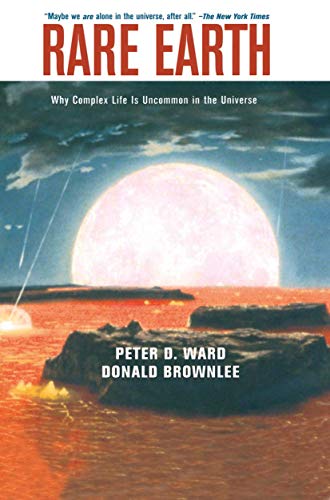
What determines whether complex life will arise on a planet, or even any life at all? Questions such as these are investigated in this groundbreaking book. In doing so, the authors synthesize information from astronomy, biology, and paleontology, and apply it to what we know about the rise of life on Earth and to what could possibly happen elsewhere in the universe. Everyone who has been thrilled by the recent discoveries of extrasolar planets and the indications of life on Mars and the Jovian moon Europa will be fascinated by Rare Earth, and its implications for those who look to the heavens for companionship.
"synopsis" may belong to another edition of this title.
About the Author
Peter D. Ward is Professor of Geological Sciences and Curator of Paleontology at the University of Washington in Seattle.
From the Back Cover
In November 12, 2002, Dr. John Chambers of the NASA Ames Research Center gave a seminar to the Astrobiology Group at the University of Washington. The audience of about 100 listened with rapt attention as Chambers described results from a computer study of how planetary systems form. The goal of his research was to answer a deceptively simple question: How often would newly forming planetary systems produce Earth-like planets, given a star the size of our own sun? By ¿Earth-like¿ Chambers meant a rocky planet with water on its surface, orbiting within a star¿s ¿habitable zone. ¿ This not-too-hot and not-too-cold inner region, relatively close to the star, supports the presence of liquid water on a planet surface for hundreds of million of years¿the time-span probably necessary for the evolution of life. To answer the question of just how many Earth-like planets might be spawned in such a planetary system, Chambers had spent thousands of hours running highly sophisticated modeling programs through arrays of powerful computers. The results presented at the meeting were startling. The simulations showed that rocky planets orbiting at the ¿right¿ distances from the central star are easily formed, but they can end up with a wide range of water content. Earth seems to be quite a gem¿a rocky planet where not only can liquid water exist for long periods of time, but where water can be found as a heathy oceanful¿not too little and not too much. Our planet seems to reside in a benign region of the Galaxy, where comet and asteroid bombardment is tolerable and habitable-zone planets can commonly grow to Earth size. Such real estate in our galaxy¿perhaps in any galaxy¿is prime for life. And rare as well.
"About this title" may belong to another edition of this title.
Search results for Rare Earth: Why Complex Life is Uncommon in the Universe

Stock Image
Rare Earth : Why Complex Life Is Uncommon in the Universe
Seller: Better World Books, Mishawaka, IN, U.S.A.
Seller rating 5 out of 5 stars

Condition: Good. Pages intact with minimal writing/highlighting. The binding may be loose and creased. Dust jackets/supplements are not included. Stock photo provided. Product includes identifying sticker. Better World Books: Buy Books. Do Good. Seller Inventory # 6166955-6
Stock Image
Rare Earth : Why Complex Life Is Uncommon in the Universe
Seller: Better World Books: West, Reno, NV, U.S.A.
Seller rating 5 out of 5 stars
Condition: Good. Former library copy. Pages intact with minimal writing/highlighting. The binding may be loose and creased. Dust jackets/supplements are not included. Includes library markings. Stock photo provided. Product includes identifying sticker. Better World Books: Buy Books. Do Good. Seller Inventory # 6287531-6
Stock Image
Rare Earth: Why Complex Life is Uncommon in the Universe
Published by
Copernicus, 2004
ISBN 10: 0387952896
ISBN 13: 9780387952895
Used
Soft cover
First Edition
Seller: The Extreme History Project, Bozeman, MT, U.S.A.
Seller rating 4 out of 5 stars

Soft cover. Condition: Near Fine. 1st Edition. Bookstore sticker on back cover. First Softcover edition. Seller Inventory # ABE-1715095685022
Seller Image
Rare Earth: Why Complex Life is Uncommon in the Universe
Seller: Goodwill of Greater Milwaukee and Chicago, Racine, WI, U.S.A.
Seller rating 5 out of 5 stars
Condition: very_good. Seller Inventory # SEWV.0387952896.VG
Stock Image
Rare Earth: Why Complex Life is Uncommon in the Universe
Published by
Springer-Verlag New York Inc., 2003
ISBN 10: 0387952896
ISBN 13: 9780387952895
Used
Paperback
Seller: World of Books (was SecondSale), Montgomery, IL, U.S.A.
Seller rating 5 out of 5 stars
Paperback. Condition: Good. Our planet seems to reside in a benign region of the Galaxy, where comet and asteroid bombardment is tolerable and habitable-zone planets can commonly grow to Earth size. Seller Inventory # 00108876949
Stock Image
Rare Earth: Why Complex Life is Uncommon in the Universe
Published by
Springer-Verlag New York Inc., 2003
ISBN 10: 0387952896
ISBN 13: 9780387952895
Used
Paperback
Seller: World of Books (was SecondSale), Montgomery, IL, U.S.A.
Seller rating 5 out of 5 stars
Paperback. Condition: Very Good. Our planet seems to reside in a benign region of the Galaxy, where comet and asteroid bombardment is tolerable and habitable-zone planets can commonly grow to Earth size. Seller Inventory # CIN0387952896VG
Stock Image
Rare Earth: Why Complex Life is Uncommon in the Universe
Published by
Springer-Verlag New York Inc., 2003
ISBN 10: 0387952896
ISBN 13: 9780387952895
Used
Paperback
Seller: World of Books Inc, Montgomery, IL, U.S.A.
Seller rating 4 out of 5 stars
Paperback. Condition: Good. Our planet seems to reside in a benign region of the Galaxy, where comet and asteroid bombardment is tolerable and habitable-zone planets can commonly grow to Earth size. Seller Inventory # CIN0387952896G
Stock Image
Rare Earth: Why Complex Life is Uncommon in the Universe
Published by
Springer-Verlag New York Inc., 2003
ISBN 10: 0387952896
ISBN 13: 9780387952895
Used
Paperback
Seller: World of Books Inc, Montgomery, IL, U.S.A.
Seller rating 4 out of 5 stars
Paperback. Condition: Very Good. Our planet seems to reside in a benign region of the Galaxy, where comet and asteroid bombardment is tolerable and habitable-zone planets can commonly grow to Earth size. Seller Inventory # CIN0387952896VG
Stock Image
Rare Earth: Why Complex Life is Uncommon in the Universe
Seller: Textbooks_Source, Columbia, MO, U.S.A.
Seller rating 5 out of 5 stars
Paperback. Condition: Good. 12/17/03. Ships in a BOX from Central Missouri! May not include working access code. Will not include dust jacket. Has used sticker(s) and some writing or highlighting. UPS shipping for most packages, (Priority Mail for AK/HI/APO/PO Boxes). Seller Inventory # 000601417U
Stock Image
Rare Earth: Why Complex Life is Uncommon in the Universe
Seller: WorldofBooks, Goring-By-Sea, WS, United Kingdom
Seller rating 5 out of 5 stars
Paperback. Condition: Very Good. The book has been read, but is in excellent condition. Pages are intact and not marred by notes or highlighting. The spine remains undamaged. Seller Inventory # GOR001981725
Buy Used
£ 11.32
£ 5.60 shipping
Ships from United Kingdom to U.S.A.
Ships from United Kingdom to U.S.A.
Quantity: 2 available