Synopsis
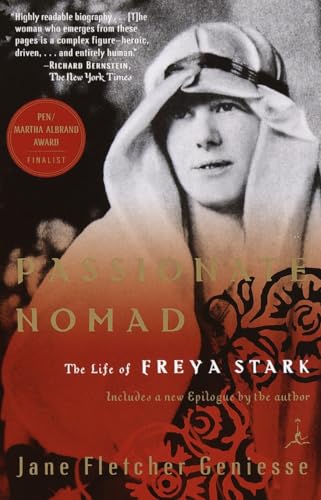
A New York Times Notable Book - Finalist for the PEN/Martha Albrand Award for First Nonfiction <p/>"Highly readable biography . . . The woman who emerges from these pages is a complex figure--heroic, driven . . . and entirely human."--Richard Bernstein, The New York Times <p/>Passionate Nomad captures the momentous life and times of Freya Stark with precision, compassion, and marvelous detail. Hailed by The Times of London as "the last of the Romantic Travellers" upon her death in 1993, Freya Stark combined unflappable bravery, formidable charm, fearsome intellect, and ferocious ambition to become the twentieth century's best-known woman traveler. Digging beneath the mythology, Geniesse uncovers a complex, controversial, and quixotic woman whose indomitable spirit was forged by contradictions: a child of privilege, Stark grew up in near poverty; yearning for formal education, she was largely self-taught; longing for love, she consistently focused on the wrong men. Despite these hardships, Stark's astonishing career spanned more than sixty years, during which she produced twenty-two books that sealed her reputation as a consummate woman of letters. <p/>This edition includes a new Epilogue by the author that, citing newly discovered evidence, calls into question the circumstances of Stark's birth and adds new insight into this adventurous and lively personality. <p/>Praise for Passionate Nomad <p/>"Passionate Nomad is a work of nonfiction that reads and sings with the drama and lilt of a fine novel. The story of Freya Stark is stunning, inspiring, sad, funny, unique, and moving. Jane Fletcher Geniesse tells it straight, but with a care for delicious detail and a sympathy for the characters that make this a truly special book."--Jim Lehrer <p/>"Passionate Nomad supplies a fascinating individual thread in the tapestry of twentiethcentury Middle Eastern history. . . . [Geniesse] has achieved, in the end, an admirable focus, at once critical and sympathetic. . . . For all Stark's unresolved contradictions, . . . her distinction as a latter-day woman of letters survives."--The New York Times Book Review <p/> "Compulsively readable . . . [Geniesse] has done a thorough job re-creating the life of a woman many consider to be the last of the great romantic travelers."--The Plain Dealer (Cleveland)
"synopsis" may belong to another edition of this title.
About the Author
Jane Fletcher Geniesse is a former reporter for The New York Times whose writing has been featured in The Washington Post, New York magazine, and Town & Country, among others. She is the author of a novel, The Riches of Life, and lives in Washington, D.C.
From the Back Cover
Freya Stark--traveler, explorer, Arabist, and woman of letters--began the extraordinary adventures that would glamorize her--and would catapult her into public life for the next sixty years--in 1927. And with the publication of The Valley of the Assassins in 1934, her legend was launched.
Leaving behind a miserable family life, Freya set out, at the age of thirty-four, to explore remote and dangerous regions of the Middle East. She was captured in 1927 by the French military police after penetrating their cordon around the rebellious Druze. She explored the mountainous territory of the mysterious Assassins of Persia, became the first woman to explore Luristan in western Iran, and followed ancient frankincense routes to locate a lost city. Admired by British officialdom, her knowledge of Middle Eastern languages and culture aided the military and diplomatic corps, for whom she conceived an effective propaganda network during WWII.
But Stark's indomitable spirit was forged by contradictions, her high-profile wanderings often masking deep insecurities. A child of privilege, she grew up in near poverty; she longed for love, but consistently focused on the wrong men. This is a brilliant and balanced biography--filled with sheikhs, diplomats, nomad warriors and chieftains, generals, would be lovers, and luminaries. Author Jane Geniesse digs beneath the mythology to uncover a complex, quixotic, and controversial woman.
From the Inside Flap
#8212;traveler, explorer, Arabist, and woman of letters began the extraordinary adventures that would glamorize her and would catapult her into public life for the next sixty years in 1927. And with the publication of The Valley of the Assassins in 1934, her legend was launched.
Leaving behind a miserable family life, Freya set out, at the age of thirty-four, to explore remote and dangerous regions of the Middle East. She was captured in 1927 by the French military police after penetrating their cordon around the rebellious Druze. She explored the mountainous territory of the mysterious Assassins of Persia, became the first woman to explore Luristan in western Iran, and followed ancient frankincense routes to locate a lost city. Admired by British officialdom, her knowledge of Middle Eastern languages and culture aided the military and diplomatic corps, for whom she conceived an effective propaganda network during WWII.
But Stark s indomitable spirit w
Excerpt. © Reprinted by permission. All rights reserved.
The Beginning
What I am, and why learning Arabic, is a mystery. If I say I do it for pleasure, there is a look of such incredulity that I begin to feel as self-conscious about it as if I were telling the most blatant lie," wrote Freya Stark to her mother as she shivered through the winter of 1927-28 in French-controlled Lebanon.
Freya had arrived in the middle of December with a copy of Dante's Inferno, very little money, a revolver, and a fur coat. This last was to prove the most useful, for the weather was freezing. Immaculately polite and maintaining her good humor despite being wrapped from head to toe in woolens, she was just beginning to feel the throaty Arabic syllables slide more easily from her lips. She was thirty-four years old, stood scarcely five feet, one inch, in stocking feet, and was still extremely thin from a recent illness. Both the missionaries and the Arabs in the little mountain town where she had come to study agreed that she was perfectly charming. Few suspected that this appealing young person, so apparently unassuming, old-fashioned, even--they might have said--quaint, had a will of steel.
In November 1927, Freya had embarked on a cargo ship for Beirut, leaving behind what she had long concluded was an unacceptable life. "It is so wonderful to be away, really away; a new land opening out every morning," she exulted as the SS Abbazia tossed through the rough Mediterranean. It did not matter that a cargo ship was all she could afford. She watched pigs, sugar, even once a Marconi telegraph machine being off-loaded between stops that grew more picturesque and unfamiliar with every passing day.
"We are now among islands in the Ionian Sea. Is not the very name an enchantment? The sea is quiet, the twilight falling. I asked the name of an island on the right. 'Ithaca,' says the Captain, as if the name were mere geography."
She had sat in her deck chair, the cold sirocco whipping the pages of her writing tablet, and felt that, at last, all the years of lonely study on her own, her determined efforts to make up for the schooling she had begged to have, which had been interrupted by the terrible Great War, no longer needed to be regretted so bitterly. It had been wrenching to slip out from under the attachments of family and embark on this journey. But if she had not gone when she did, she feared that she would never have got away, just as her sister Vera never did. Both had been prisoners to responsibilities they abhorred, but unlike Vera, Freya had refused to succumb. Instead, Freya had consoled herself by reading dazzling accounts of European explorers in the lands of the Arabs. One day, she had resolved, the world would hear of her "in the deserts of Arabia discovering buried cities."
In 1920 Freya sensed a path quietly open. In April of that year everyone on the Italian Riviera was riveted by the events taking place at San Remo, only a few miles from Freya's home. The victorious Allies were gathering in that coastal town, and anyone who could tried to get a glimpse of the British prime minister, David Lloyd George, as he hurried back from and forth to meetings with Premier Georges Clemenceau of France. The purpose of the conference was to dispose of the sprawling territories of the defeated enemy, the Ottoman Empire. Because the United States refused to sign on to the League of Nations, the British and French were free to slice up the Middle East to their own imperial satisfaction. The Arab lands governed for over 467 years by the Grand Turk were to be "mandates" until such time as they "could stand on their own." Great Britain would supervise Mesopotamia, Transjordan, Palestine, and Egypt, while France would look after Greater Syria, including Lebanon. As for Persia, long the target of foreign influence, postwar turmoil would spark a coup against the old Qajar regime in 1921 and bring to prominence a Cossack Brigade commander, Reza Khan, who four years later would crown himself shah of a new Pahlavi dynasty.
Freya's heart had soared at the thought of visiting these regions. Like everyone else who had been revolted and depressed by the seemingly hopeless bloody trench warfare in Europe, she had raptly followed the successes of Colonel T. E. Lawrence in spearheading an Arab revolt against the Turks. It had been thrilling to imagine this young intelligence officer racing through the desert on camel-back in the company of hawk-eyed Bedouin warriors. But Lawrence was only the latest hero in the history of brilliant Eastern adventures, and Freya plunged avidly into its literature.
She began to consume all she could find about the early-nineteenth-century travelers. There was Johann Burckhardt, who disguised himself as a holy man and found the great Nabataean city of Petra before dying of plague in Cairo. Ulrich Seetzen located the lost ruins of Roman Jerash, mapped the Dead Sea, and was murdered by the imam of Yemen for being a spy for the czar. She read what she could get of the works of the great Orientalist Sir Richard Burton, famed for his search for the Nile and secret ventures into Mecca and Medina. Recently Freya had finished the vast and ponderous Travels in Arabia Deserta by Charles Montagu Doughty, who had died just one year before she herself sailed East. The lives of these explorers and the many others were filled with bold and daring deeds, and Freya read them with shining eyes. Since she was a child she had loved Kipling's tales of British imperial grandeur, and the story of Kim and the Red Lama had been her favorite book. That many of these Europeans had doubled as intelligence agents in the "great game" between their rival governments only intrigued her more. To Freya, the East seemed the most exotic place left on earth.
From the Hardcover edition.
"About this title" may belong to another edition of this title.
Search results for Passionate Nomad: The Life of Freya Stark (Modern Library)

Stock Image
Passionate Nomad The Life of F
Seller: World of Books (was SecondSale), Montgomery, IL, U.S.A.
Seller rating 5 out of 5 stars

Condition: Very Good. Item in very good condition! Textbooks may not include supplemental items i.e. CDs, access codes etc. Seller Inventory # 00094522295
Stock Image
Passionate Nomad The Life of F
Seller: World of Books (was SecondSale), Montgomery, IL, U.S.A.
Seller rating 5 out of 5 stars
Condition: Good. Item in good condition. Textbooks may not include supplemental items i.e. CDs, access codes etc. Seller Inventory # 00074996740
Stock Image
Passionate Nomad: The Life of Freya Stark (Modern Library (Paperback))
Published by
Random House Publishing Group, 2001
ISBN 10: 0375757465
ISBN 13: 9780375757464
Used
paperback
Seller: Orion Tech, Kingwood, TX, U.S.A.
Seller rating 5 out of 5 stars
paperback. Condition: Fair. Seller Inventory # 0375757465-4-33026213
Seller Image
Passionate Nomad: The Life of Freya Stark (Modern Library (Paperback))
Published by
Random House Publishing Group, 2001
ISBN 10: 0375757465
ISBN 13: 9780375757464
Used
Softcover
Seller: Goodwill of Colorado, COLORADO SPRINGS, CO, U.S.A.
Seller rating 5 out of 5 stars
Condition: good. All pages and cover are intact. Dust jacket included if applicable, though it may be missing on hardcover editions. Spine and cover may show minor signs of wear including scuff marks, curls or bends to corners as well as cosmetic blemishes including stickers. Pages may contain limited notes or highlighting. "From the library of" labels may be present. Shrink wrap, dust covers, or boxed set packaging may be missing. Bundled media e.g., CDs, DVDs, access codes may not be included. Seller Inventory # COLV.0375757465.G
Stock Image
Passionate Nomad: The Life of Freya Stark (Modern Library (Paperback))
Seller: Wonder Book, Frederick, MD, U.S.A.
Seller rating 5 out of 5 stars
Condition: Good. Good condition. A copy that has been read but remains intact. May contain markings such as bookplates, stamps, limited notes and highlighting, or a few light stains. Seller Inventory # Q20P-00942
Stock Image
Passionate Nomad: The Life of Freya Stark (Modern Library (Paperback))
Published by
Random House Publishing Group, 2001
ISBN 10: 0375757465
ISBN 13: 9780375757464
Used
Softcover
Seller: Wonder Book, Frederick, MD, U.S.A.
Seller rating 5 out of 5 stars
Condition: Good. Good condition. A copy that has been read but remains intact. May contain markings such as bookplates, stamps, limited notes and highlighting, or a few light stains. Bundled media such as CDs, DVDs, floppy disks or access codes may not be included. Seller Inventory # O09N-00230
Seller Image
Passionate Nomad: The Life of Freya Stark (Modern Library (Paperback))
Published by
Random House Publishing Group, 2001
ISBN 10: 0375757465
ISBN 13: 9780375757464
Used
Softcover
Seller: Zoom Books East, Glendale Heights, IL, U.S.A.
Seller rating 5 out of 5 stars
Condition: good. Book is in good condition and may include underlining highlighting and minimal wear. The book can also include "From the library of" labels. May not contain miscellaneous items toys, dvds, etc. . We offer 100% money back guarantee and 24 7 customer service. Seller Inventory # ZEV.0375757465.G
Stock Image
Passionate Nomad: The Life of Freya Stark (Modern Library (Paperback))
Published by
Random House Publishing Group, 2001
ISBN 10: 0375757465
ISBN 13: 9780375757464
Used
paperback
Seller: HPB-Emerald, Dallas, TX, U.S.A.
Seller rating 5 out of 5 stars
paperback. Condition: Very Good. Connecting readers with great books since 1972! Used books may not include companion materials, and may have some shelf wear or limited writing. We ship orders daily and Customer Service is our top priority! Seller Inventory # S_428648956
Stock Image
Passionate Nomad: The Life of Freya Stark (Modern Library Paperbacks)
Seller: HPB-Diamond, Dallas, TX, U.S.A.
Seller rating 5 out of 5 stars
Paperback. Condition: Very Good. Connecting readers with great books since 1972! Used books may not include companion materials, and may have some shelf wear or limited writing. We ship orders daily and Customer Service is our top priority! Seller Inventory # S_444010295
Stock Image
Passionate Nomad: The Life of Freya Stark (Modern Library (Paperback))
Seller: HPB-Ruby, Dallas, TX, U.S.A.
Seller rating 5 out of 5 stars
paperback. Condition: Very Good. Connecting readers with great books since 1972! Used books may not include companion materials, and may have some shelf wear or limited writing. We ship orders daily and Customer Service is our top priority! Seller Inventory # S_439899937