
Items related to Executioner's Current: Thomas Edison, George Westinghous...
Executioner's Current: Thomas Edison, George Westinghouse, and the Invention of the Electric Chair - Softcover
Synopsis
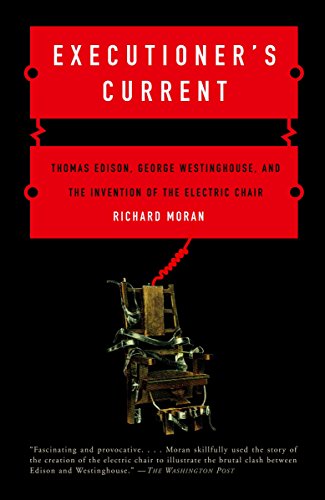
A "fascinating and provocative" story (The Washington Post) of high stakes competition between two titans that shows how the electric chair developed through an effort by one nineteenth-century electric company to discredit the other.
In 1882, Thomas Edison ushered in the "age of electricity" when he illuminated Manhattan's Pearl Street with his direct current (DC) system. Six years later, George Westinghouse lit up Buffalo with his less expensive alternating current (AC). The two men quickly became locked in a fierce rivalry, made all the more complicated by a novel new application for their product: the electric chair. When Edison set out to persuade the state of New York to use Westinghouse's current to execute condemned criminals, Westinghouse fought back in court, attempting to stop the first electrocution and keep AC from becoming the "executioner's current." In this meticulously researched account of the ensuing legal battle and the horribly botched first execution, Moran raises disturbing questions not only about electrocution, but about about our society's tendency to rely on new technologies to answer moral questions."synopsis" may belong to another edition of this title.
About the Author
RICHARD MORAN is professor of sociology at Mount Holyoke College and the author of Knowing Right from Wrong: The Insanity Defense of Daniel McNaughtan and numerous articles and reviews. He has also served as a commentator for National Public Radio's Morning Edition and written op-eds for the Boston Globe, Washington Post, Los Angeles Times, Philadelphia Inquirer, Chicago Tribune, Christian Science Monitor, New York Times, Newsweek, and The Wall Street Journal. He lives in South Hadley, Massachusetts.
From the Back Cover
In this amazing story of high stakes competition between two titans, Richard Moran shows how the electric chair developed not out of the desire to be more humane but through an effort by one nineteenth-century electric company to discredit the other.
In 1882, Thomas Edison ushered in the "age of electricity" when he illuminated Manhattan's Pearl Street with his direct current (DC) system. Six years later, George Westinghouse lit up Buffalo with his less expensive alternating current (AC). The two men quickly became locked in a fierce rivalry, made all the more complicated by a novel new application for their product: the electric chair. When Edison set out to persuade the state of New York to use Westinghouse's current to execute condemned criminals, Westinghouse fought back in court, attempting to stop the first electrocution and keep AC from becoming the "executioner's current." In this meticulously researched account of the ensuing legal battle and the horribly botched first execution, Moran raises disturbing questions not only about electrocution, but about about our society's tendency to rely on new technologies to answer moral questions.
From the Inside Flap
In this amazing story of high stakes competition between two titans, Richard Moran shows how the electric chair developed not out of the desire to be more humane but through an effort by one nineteenth-century electric company to discredit the other.
In 1882, Thomas Edison ushered in the age of electricity when he illuminated Manhattan s Pearl Street with his direct current (DC) system. Six years later, George Westinghouse lit up Buffalo with his less expensive alternating current (AC). The two men quickly became locked in a fierce rivalry, made all the more complicated by a novel new application for their product: the electric chair. When Edison set out to persuade the state of New York to use Westinghouse s current to execute condemned criminals, Westinghouse fought back in court, attempting to stop the first electrocution and keep AC from becoming the executioner s current. In this meticulously researched account of the ensuing legal battle and the horribly botched first execution, Moran raises disturbing questions not only about electrocution, but about about our society s tendency to rely on new technologies to answer moral questions.
"About this title" may belong to another edition of this title.
Search results for Executioner's Current: Thomas Edison, George Westinghous...

Seller Image
Executioner's Current: Thomas Edison, George Westinghouse, and the Invention of the Electric Chair
Published by
Knopf Doubleday Publishing Group, 2003
ISBN 10: 037572446X
ISBN 13: 9780375724466
Used
Softcover
Seller: Greenworld Books, Arlington, TX, U.S.A.
Seller rating 5 out of 5 stars

Condition: good. Fast Free Shipping â" Good condition. It may show normal signs of use, such as light writing, highlighting, or library markings, but all pages are intact and the book is fully readable. A solid, complete copy that's ready to enjoy. Seller Inventory # GWV.037572446X.G
Stock Image
Executioner's Current: Thomas Edison, George Westinghouse, and the Invention of the Electric Chair
Seller: HPB-Red, Dallas, TX, U.S.A.
Seller rating 5 out of 5 stars
Paperback. Condition: Good. Connecting readers with great books since 1972! Used textbooks may not include companion materials such as access codes, etc. May have some wear or writing/highlighting. We ship orders daily and Customer Service is our top priority! Seller Inventory # S_439846714
Stock Image
Executioner's Current: Thomas Edison, George Westinghouse, and the Invention of the Electric Chair
Seller: Amazing Books Pittsburgh, Pittsburgh, PA, U.S.A.
Seller rating 5 out of 5 stars
Paperback. Condition: Very Good. Unmarked text. Minor edge wear to cover. Sticker from previous shop on front cover in top right corner. PA. Seller Inventory # Sq19944
Seller Image
Executioner's Current : Thomas Edison, George Westinghouse, and the Invention of the Electric Chair
Published by
Knopf Doubleday Publishing Group, 2003
ISBN 10: 037572446X
ISBN 13: 9780375724466
Used
Softcover
Seller: GreatBookPrices, Columbia, MD, U.S.A.
Seller rating 5 out of 5 stars
Condition: As New. Unread book in perfect condition. Seller Inventory # 1627532
Stock Image
Executioner's Current: Thomas Edison, George Westinghouse and the Invention of the Electric Chair
Published by
vintage Books (Div. of RandomHouse), 1st, 2003
ISBN 10: 037572446X
ISBN 13: 9780375724466
Used
Paperback
First Edition
Seller: M & M Books, ATHENS, GA, U.S.A.
Seller rating 3 out of 5 stars

Paperback. Condition: Fine. No Jacket. 1st Edition. Seller Inventory # 123774
Seller Image
Executioner's Current : Thomas Edison, George Westinghouse, and the Invention of the Electric Chair
Published by
Knopf Doubleday Publishing Group, 2003
ISBN 10: 037572446X
ISBN 13: 9780375724466
New
Softcover
Seller: GreatBookPrices, Columbia, MD, U.S.A.
Seller rating 5 out of 5 stars
Condition: New. Seller Inventory # 1627532-n
Stock Image
Executioner's Current (Paperback)
Published by
Random House USA Inc, New York, 2003
ISBN 10: 037572446X
ISBN 13: 9780375724466
New
Paperback
Seller: Grand Eagle Retail, Bensenville, IL, U.S.A.
Seller rating 5 out of 5 stars
Paperback. Condition: new. Paperback. Thomas Edison, George Westinghouse, and the Invention of the Electric ChairA "fascinating and provocative" story (The Washington Post) of high stakes competition between two titans that shows how the electric chair developed through an effort by one nineteenth-century electric company to discredit the other.In 1882, Thomas Edison ushered in the "age of electricity" when he illuminated Manhattan's Pearl Street with his direct current (DC) system. Six years later, George Westinghouse lit up Buffalo with his less expensive alternating current (AC). The two men quickly became locked in a fierce rivalry, made all the more complicated by a novel new application for their product: the electric chair. When Edison set out to persuade the state of New York to use Westinghouse's current to execute condemned criminals, Westinghouse fought back in court, attempting to stop the first electrocution and keep AC from becoming the "executioner's current." In this meticulously researched account of the ensuing legal battle and the horribly botched first execution, Moran raises disturbing questions not only about electrocution, but about about our society's tendency to rely on new technologies to answer moral questions. Tracing the origins and development of the electric chair, a story of industrial and political intrigue describes the battle between Thomas Edison and George Westinghouse for commercial control of electricity, the first use of electricity to execute a criminal, the legal battle that ensued over the This item is printed on demand. Shipping may be from multiple locations in the US or from the UK, depending on stock availability. Seller Inventory # 9780375724466
Stock Image
Executioner's Current
Published by
Knopf Doubleday Publishing Group, 2003
ISBN 10: 037572446X
ISBN 13: 9780375724466
New
PAP
Seller: PBShop.store UK, Fairford, GLOS, United Kingdom
Seller rating 5 out of 5 stars
PAP. Condition: New. New Book. Shipped from UK. Established seller since 2000. Seller Inventory # L2-9780375724466
Buy New
£ 17.64
£ 4.16 shipping
Ships from United Kingdom to U.S.A.
Ships from United Kingdom to U.S.A.
Quantity: Over 20 available
Stock Image
Executioner's Current: Thomas Edison, George Westinghouse, and the Invention of the Electric Chair
Print on DemandSeller: Majestic Books, Hounslow, United Kingdom
Seller rating 4 out of 5 stars

Condition: New. Print on Demand pp. 304. Seller Inventory # 5530965
Buy New
£ 22.81
£ 6.50 shipping
Ships from United Kingdom to U.S.A.
Ships from United Kingdom to U.S.A.
Quantity: 4 available
Stock Image
Executioner's Current: Thomas Edison, George Westinghouse, and the Invention of the Electric Chair
Seller: Books Puddle, New York, NY, U.S.A.
Seller rating 4 out of 5 stars
Condition: New. pp. 304. Seller Inventory # 262349706