
Items related to Flashback
Synopsis
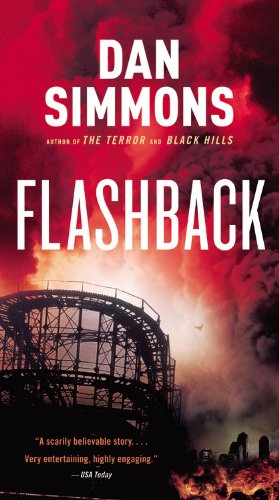
A provocative dystopian thriller set in a future that seems scarily possible, Flashback proves why Dan Simmons is one of our most exciting and versatile writers.
The United States is near total collapse. But 87% of the population doesn't care: they're addicted to flashback, a drug that allows its users to re-experience the best moments of their lives. After ex-detective Nick Bottom's wife died in a car accident, he went under the flash to be with her; he's lost his job, his teenage son, and his livelihood as a result.
Nick may be a lost soul but he's still a good cop, so he is hired to investigate the murder of a top governmental advisor's son. This flashback-addict becomes the one man who may be able to change the course of an entire nation turning away from the future to live in the past.
"synopsis" may belong to another edition of this title.
About the Author
Dan Simmons is the Hugo Award-winning author of several novels, including the New York Times bestsellers Olympos and The Terror. He lives in Colorado.
Excerpt. © Reprinted by permission. All rights reserved.
Flashback
By Dan SimmonsLittle, Brown and Company
Copyright © 2013 Dan Simmons
All rights reserved.
ISBN: 978-0-316-00697-2All rights reserved.
CHAPTER 1
1.00
Japanese Green Zone Above Denver—Friday, Sept. 10
You're probably wondering why I asked you to come here today, Mr. Bottom,"said Hiroshi Nakamura.
"No," said Nick. "I know why you brought me here."
Nakamura blinked. "You do?"
"Yeah," said Nick. He thought, Fuck it. In for a penny, in for a pound.Nakamura wants to hire a detective. Show him you're a detective. "You wantme to find the person or persons who killed your son, Keigo."
Nakamura blinked again but said nothing. It was as if hearing his son's namespoken aloud had frozen him in place.
The old billionaire did glance to where his squat but massive security chief,Hideki Sato, was leaning against a step-tansu near the openshoji that looked out on the courtyard garden. If Sato gave his employerany response by movement, wink, or facial expression, Nick sure as hell couldn'tsee it. Come to think of it, he didn't remember having seen Sato blinkduring the ride up to the main house in the golf cart or during theintroductions here in Nakamura's office. The security chief's eyes were obsidianmarbles.
Finally Nakamura said, "Your deduction is correct, Mr. Bottom. And, as SherlockHolmes would say, an elementary deduction since you were the homicidedetective in charge of my son's case when I was still in Japan and you and Ihave never met nor had any other contact."
Nick waited.
After the glance in Sato's direction, Nakamura had returned his gaze to thesingle sheet of interactive e-vellum in his hand, but now his gray eyes lookedup and bored into Nick.
"Do you think you can find my son's killer or killers, Mr. Bottom?"
"I'm certain I can," lied Nick. What the old billionaire was really asking him,he knew, was Can you turn back the clock and keep my only son from beingkilled and make everything all right again?
Nick would have said I'm certain I can to that question as well. Hewould have said anything he had to say to get the money this man could pay him.Enough money for Nick to return to Dara for years to come. Perhaps a lifetime tocome.
Nakamura squinted slightly. Nick knew that one didn't become a hundred-times-overbillionaire in Japan, or one of only nine regional Federal Advisors inAmerica, by being a fool.
"What makes you think that you can be successful now, Mr. Bottom, whenyou failed six years ago, at a time when you were a real homicide detective withthe full resources of the Denver Police Department behind you?"
"There were four hundred homicide cases pending then, Mr. Nakamura. We hadfifteen homicide detectives working them all, with new cases coming in everyday. This time I'll have just this one case to concentrate on and to solve. Nodistractions."
Nakamura's gray gaze, as unblinking as Sato's darker stare and already chilly,grew noticeably chillier. "Are you saying, former detective sergeant Bottom,that you did not give my son's murder the attention it deserved six years ago,despite the ... ah ... high profile of it and direction to give it priority fromthe governor of Colorado and from the president of the United States herself?"
Nick felt the flashback itch crawling in him like a centipede. He wanted to getout of this room and pull the warm wool cover of then, not-now, her, not-thisover himself like a blanket.
"I'm saying that the DPD didn't give any of its murder cases the manpower orattention they deserved six years ago," said Nick. "Including your son's case.Hell, it could have been the president's kid murdered in Denver and the MajorCrimes Unit couldn't have solved it then." He looked Nakamura straight in theeye, betting everything on this absurd tactic of honesty.
"Or solve it now," he added. "It's fifty times worse today."
The billionaire's office had not a single chair to sit in, not even one for Mr.Nakamura, and Nick Bottom and Hiroshi Nakamura stood facing each other acrossthe narrow, chest-high expanse of the rich man's slim, perfectly bare mahoganystand-up desk. Sato's casual posture over at the tansu didn't obscurethe facts—at least to Nick Bottom's eye—that the security chief wasfully alert, would have been dangerous even if he weren't armed, and had theindefinable lethality of an ex-soldier or cop or member of some other professionthat had trained him to kill other men.
"It is, of course, your expertise after many years on the Denver PoliceDepartment, and your invaluable insights into the investigation, that are theprime reason we are considering you for this investigation," Mr. Nakamura saidsmoothly.
Nick took a breath. He'd had enough of playing by Nakamura's script.
"No, sir," he said. "Those aren't the reasons you're considering hiringme. If you hire me to investigate your son's murder, it's because I'm the onlyperson still alive who—under flashback—can see every page of thefiles that were lost in the cyberattack that wiped out the DPD's entire archivesfive years ago."
Nick thought to himself—And it's also because I'm the only person whocan, under the flash, relive every conversation with the witnesses and suspectsand other detectives involved. Under flashback, I can reread the Murder Bookthat was lost with the files.
"If you hire me, Mr. Nakamura," Nick continued aloud, "it will be because I'mthe only person in the world who can go back almost six years to see andhear and witness everything again in a murder case that's grownas cold as the bones of your son buried in your family Catholic cemetery inHiroshima."
Mr. Nakamura drew in a quick, shocked breath and then there was no sound at allin the room. Outside, the tiny waterfall tinkled softly into the tiny pond inthe tiny gravel-raked courtyard.
Having played almost all of his cards, Nick shifted his weight, folded his arms,and looked around while he waited.
Advisor Hiroshi Nakamura's office in his private home here in the Japanese GreenZone above Denver, although recently constructed, looked as if it might be athousand years old. And still in Japan.
The sliding doors and windows were shoji and the heavier onesfusuma and all opened out into a small courtyard with its small butexquisitely formal Japanese garden. In the room, a single opaque shojiwindow allowed natural light into a tiny altar alcove where bamboo shadows movedover a vase holding cut plants and twigs of the autumn season, the vase itselfperfectly positioned on the lacquered floor. The few pieces of furniture in theroom were placed to show the Nipponese love of asymmetry and were of wood sodark that each ancient piece seemed to swallow light. The polished cedar floorsand fresh tatami mats, in contrast, seemed to emanate their own warmlight. A sensuous, fresh dried-grass smell rose from the tatami. NickBottom had had enough contact with the Japanese in his previous job as a Denverhomicide detective to know that Mr. Nakamura's compound, his house, his garden,this office, and the ikebana and few modest but precious artifacts ondisplay here were all perfect expressions of wabi (simple quietude) andsabi (elegant simplicity and the celebration of the impermanent).
And Nick didn't give the slightest shit.
He needed this job to get money. He needed the money to buy more flashback. Heneeded the flashback to get back to Dara.
Since he'd had to leave his shoes back in the entry genkan where Satohad left his, Nick Bottom's prevalent emotion at the moment was simple regretthat he'd grabbed this particular black sock this morning—the one on hisleft foot with a hole big enough to allow his big toe to poke through. Hecovertly scrunched his foot up, trying to worm the big toe back in the hole andout of sight, but that took two feet to do right and would be too obvious. Satowas paying attention to the squirming as it was. Nick curled the big toe up asmuch as he could.
"What kind of vehicle do you drive, Mr. Bottom?" asked Nakamura.
Nick almost laughed. He was ready to be dismissed and physically thrown out bySato for his gai-jin's impertinent mention of Nakamura's all-hallowedson Keigo's cold bones, but he hadn't expected a question about his car.Besides, Nakamura had almost certainly watched him drive up on one of the fiftythousand or so surveillance cameras that had been tracking him as he approachedthe compound.
He cleared his throat and said, "Ah ... I drive a twenty-year-old GoMotorsgelding."
The billionaire turned his head only slightly and barked Japanese syllables atSato. Without straightening and with the slightest of smiles, the security chiefshot back an even deeper and faster cascade of guttural Japanese to his boss.Nakamura nodded, evidently satisfied.
"Is your ... ah ... gelding a reliable vehicle, Mr. Bottom?"
Nick shook his head.
"The lithium-ion batteries are ancient, Mr. Nakamura, and with the way Boliviafeels about us these days, it doesn't look like they're going to be replaced anytime soon. So, after a good twelve-hour charge, the piece of shi ... the car ...can go about forty miles at thirty-eight miles per hour or thirty-eight miles atforty miles per hour. We'll both just have to hope that there won't be anyBullitt-style high-speed chases in this investigation."
Mr. Nakamura showed no hint of a smile. Or of recognition. Didn't they watchgreat old movies in Hiroshima?
"We can supply you with a vehicle from the delegation for the duration of yourinvestigation, Mr. Bottom. Perhaps a Lexus or Infiniti sedan."
This time Nick couldn't stop himself from laughing. "One of your hydrogenskateboards? No, sir. That won't work. First of all, it'd just be stripped downto its carbon-fiber shell in any of the places I'll be parking in Denver.Secondly—as your director of security can explain to you—I need acar that blends in just in case I have to tail someone during the investigation.Low profile, we private investigators call it."
Mr. Nakamura made a deep, rumbling sound in his throat as if he were preparingto spit. Nick had heard this noise from Japanese men before when he'd been acop. It seemed to express surprise and perhaps a little displeasure, althoughhe'd heard it from the Nipponese men even when they were seeing somethingbeautiful, like a garden view, for the first time. It was, Nick thought,probably as untranslatable as so many other things lost between this century'snewly eager Nipponese and infinitely weary Americans.
"Very well, then, Mr. Bottom," Nakamura said at last. "Should we choose you forthis investigation, you will need a vehicle with a greater range when theinvestigation takes you to Santa Fe, Nuevo Mexico. But we can discuss thedetails later."
Santa Fe, thought Nick. Aww, God damn it. Not Santa Fe. Anywhere butSanta Fe. Just the name of the town made the deep scar tissue across andinside his belly muscles hurt. But he also heard another voice in his head, amovie voice, one of hundreds that lived there—Forget it, Jake. It'sChinatown.
"All right," Nick said aloud. "We'll discuss the car thing and a Santa Fe triplater. If you hire me."
Nakamura was again looking at the single sheet of e-vellum in his hand.
"And you're currently living in a former Baby Gap in the former Cherry CreekMall, is that correct, Mr. Bottom?"
Jesus Christ, thought Nick Bottom. With his entire future probablydepending upon the outcome of this interview, and with ten thousand questionsMr. Nakamura could have asked him that he could have answered while retaining atleast a shred of the few tatters that still remained of his dignity, it had tobe You're currently living in a former Baby Gap in the former Cherry CreekMall?
Yes, sir, Mr. Nakamura, sir, Nick was tempted to say, currently livingin one-sixth of a former Baby Gap in the former Cherry Creek Mall in a shittysection of a shitty city in one forty-fourth of the former United States ofAmerica, that's me, the former Nick Bottom. While you live up here with theother Japs on top of the mountain, surrounded by three rings of security thatfucking Osama bin Laden's fucking ghost couldn't get through.
Nick said, "The Cherry Creek Mall Condos it's called now. I guess the space mycubie's part of used to be a Baby Gap."
Of the three men, two were expensively dressed in the thin-lapelled, sleek-trousered,black-suited, crisp-white-shirted, white-pocket-squared, skinny-black-tied1960s JFK look retrieved from more than seventy-five years earlier.Even Mr. Nakamura, in his late sixties, wouldn't have been able to remember thathistorical era, so why, Nick wondered, had the style gurus in Japan brought thisstyle back for the tenth time? The dead-Kennedys style looked good on slim,elegant Mr. Nakamura, and Sato was dressed almost as beautifully as his boss,although his black suit probably cost a thousand or two new bucks less thanNakamura's. But the security chief's suit would have required more tailoring.Nakamura was lean and fit despite his years, while Sato was built like theproverbial brick shithouse, if that phrase even applied to men. And if theJapanese had ever had brick shithouses.
Standing there, feeling the cool air of the breeze from the garden flowingacross his curled-up bare big toe and realizing that he was by far the tallestman in the room but also the only one whose posture included his now-habitualslump, Nick wished that he'd at least pressed his shirt. He'd meant to but hadnever found the time the past week since the call for this interview came. Sonow he stood there in a wrinkled shirt under a wrinkled, twelve-year-old suitjacket—no matching trousers, just the least rumpled and least stained ofhis chinos—all of it probably producing a combined effect that made himlook as if he'd slept not only in the clothes but on them. Nickhad discovered only that morning in his cubie that he'd put on too much weightthe last year or two to allow him to button these old trousers, or the suitjacket, or his shirt collar. He hoped that his too-wide-for-style belt might behiding the opened trouser tops and the knot of his tie might be hiding theunbuttonable shirt collar, but the damned tie itself was three times wider thanthe ties on the two Japanese men. And it didn't help Nick's self-confidence whenhe considered that his tie, a gift from Dara, had probably cost one hundredth ofwhat Nakamura had spent on his.
To hell with it. It was Nick's only remaining tie.
Born in the next-to-last decade of the previous century, Nick Bottom was oldenough to remember a tune from a child's educational program that had been on TVthen, and now the irritating singsong lyrics returned from childhood to rattlethrough his aching, flashback-hungry head—One of these things is notlike the others, one of these things just doesn't belong ...
To hell with it, thought Nick again and for a panicked second he was afraid he'dspoken aloud. It was becoming harder and harder for him to focus on anything inthis miserable, increasingly unreal non-flashback world.
And then, because Mr. Nakamura seemed very comfortable with the stretchingsilence and Sato actively amused by it while Nick Bottom wasn't at allcomfortable with it, he added, "Of course, it's been quite a few years since theCherry Creek Mall was a mall or there were any stores there. BIAHTF."
Nick pronounced the old acronym "buy-ought-if" the way everyone did and alwayshad, but Nakamura's expression remained blank or passively challenging orpolitely curious or perhaps a combination of all three. One thing was certain toNick: the Nipponese executive wasn't going to make any part of this intervieweasy.
Sato, who would have spent time on the street here in the States, didn't botherto translate it to his boss.
"Before It All Hit The Fan," Nick explained. He didn't add that the morecommonly used "die-ought-if" stood for "Day It All Hit The Fan." He was certainthat Nakamura knew both expressions. The man had been in Colorado as a federallyappointed four-state Advisor for five months now. And he had undoubtedly heardall the American colloquialisms, even if only from his murdered son, yearsbefore.
(Continues...)
Excerpted from Flashback by Dan Simmons. Copyright © 2013 Dan Simmons. Excerpted by permission of Little, Brown and Company.
All rights reserved. No part of this excerpt may be reproduced or reprinted without permission in writing from the publisher.
Excerpts are provided by Dial-A-Book Inc. solely for the personal use of visitors to this web site.
"About this title" may belong to another edition of this title.
Search results for Flashback

Seller Image
Flashback
Published by
Reagan Arthur / Little, Brown, 2013
ISBN 10: 0316006971
ISBN 13: 9780316006972
Used
Softcover
Seller: Bay State Book Company, North Smithfield, RI, U.S.A.
Seller rating 5 out of 5 stars

Condition: good. The book is in good condition with all pages and cover intact, including the dust jacket if originally issued. The spine may show light wear. Pages may contain some notes or highlighting, and there might be a "From the library of" label. Boxed set packaging, shrink wrap, or included media like CDs may be missing. Seller Inventory # BSM.1BARQ
Stock Image
Flashback
Published by
Reagan Arthur / Little, Brown, 2013
ISBN 10: 0316006971
ISBN 13: 9780316006972
Used
Soft cover
Seller: Chapter Two Bookstore, Lompoc, CA, U.S.A.
Seller rating 5 out of 5 stars
Soft cover. Condition: Good. Book and cover look really nice. Binding is tight and square. Book and pages are clean. Seller Inventory # 054319
Stock Image
Flashback
Published by
Reagan Arthur Books, 2013
ISBN 10: 0316006971
ISBN 13: 9780316006972
Used
Mass Market Paperback
Seller: ThriftBooks-Dallas, Dallas, TX, U.S.A.
Seller rating 5 out of 5 stars
Mass Market Paperback. Condition: Good. No Jacket. Pages can have notes/highlighting. Spine may show signs of wear. ~ ThriftBooks: Read More, Spend Less. Seller Inventory # G0316006971I3N00
Stock Image
Flashback
Published by
Reagan Arthur Books, 2013
ISBN 10: 0316006971
ISBN 13: 9780316006972
Used
Mass Market Paperback
Seller: ThriftBooks-Atlanta, AUSTELL, GA, U.S.A.
Seller rating 5 out of 5 stars
Mass Market Paperback. Condition: Fair. No Jacket. Readable copy. Pages may have considerable notes/highlighting. ~ ThriftBooks: Read More, Spend Less. Seller Inventory # G0316006971I5N00
Seller Image
Flashback
Published by
Reagan Arthur / Little, Brown, 2013
ISBN 10: 0316006971
ISBN 13: 9780316006972
Used
Softcover
Seller: Blue Vase Books, Interlochen, MI, U.S.A.
Seller rating 5 out of 5 stars
Condition: good. Mass market paperback in GOOD condition with normal wear from use. Cover art my differ from that shown in photo. Seller Inventory # BVV.0316006971.G
Stock Image
Flashback
Seller: Better World Books: West, Reno, NV, U.S.A.
Seller rating 5 out of 5 stars
Condition: Good. Pages intact with minimal writing/highlighting. The binding may be loose and creased. Dust jackets/supplements are not included. Stock photo provided. Product includes identifying sticker. Better World Books: Buy Books. Do Good. Seller Inventory # 5592969-6
Seller Image
Flashback
Published by
Reagan Arthur / Little, Brown, 2013
ISBN 10: 0316006971
ISBN 13: 9780316006972
Used
Softcover
Seller: Zoom Books East, Glendale Heights, IL, U.S.A.
Seller rating 5 out of 5 stars
Condition: good. Book is in good condition and may include underlining highlighting and minimal wear. The book can also include "From the library of" labels. May not contain miscellaneous items toys, dvds, etc. . We offer 100% money back guarantee and 24 7 customer service. Seller Inventory # ZEV.0316006971.G
Seller Image
Flashback
Published by
Reagan Arthur Books, New York, 2013
ISBN 10: 0316006971
ISBN 13: 9780316006972
Used
Softcover
First Edition
Seller: Ziesings, Shingletown, CA, U.S.A.
Seller rating 4 out of 5 stars

Allison Warner (illustrator). New York: Reagan Arthur Books:, 2013. First printing, Paperback, New, 708 pp. Cover artwork by: Allison Warner "The United States is near total collapse. But 87% of the population doesn't care: they're addicted to flashback, a drug that allows its users to re-experience the best moments of their lives. After ex-detective Nick Bottom's wife died in a car accident, he went under the flash to be with her; he's lost his job, his teenage son, and his livelihood as a result. Nick may be a lost soul but he's still a good cop, so he is hired to investigate the murder of a top governmental advisor's son. This flashback-addict becomes the one man who may be able to change the course of an entire nation turning away from the future to live in the past." Now a quality paperback. First printing, Paperback, New, Seller Inventory # 50450
Stock Image
Flashback
Published by
Reagan Arthur / Little, Brown, 2013
ISBN 10: 0316006971
ISBN 13: 9780316006972
New
Mass Market Paperback
Seller: BennettBooksLtd, Los Angeles, CA, U.S.A.
Seller rating 5 out of 5 stars
Mass Market Paperback. Condition: New. In shrink wrap. Looks like an interesting title! Seller Inventory # Q-0316006971