
Items related to The Orphan Stone: The Minnesinger Dream of Reich: 15...
The Orphan Stone: The Minnesinger Dream of Reich: 15 (Bibliographies and Indexes in Anthropology) - Hardcover
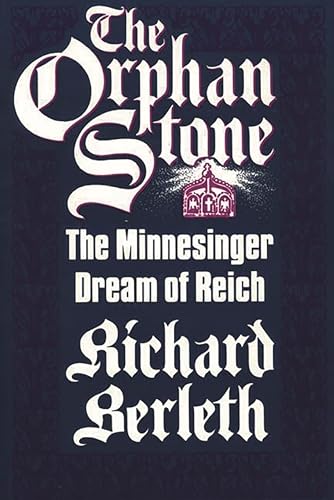
Synopsis
Americans have long viewed the Middle Ages with an emphasis on Chaucer and the French and Latin traditions. As a result, the later developments of European literature and history often take us by surprise. From our perspective, the Reformation, the birth of capitalism, and the new humanism appear as if from nowhere. The part missing is the history and literature of the German Middle Ages. While German and French publications in this field are common, the world of the German Middle Ages has not been addressed in English for many years. Filling the gap for non-German speakers, The Orphan Stone blends history and literature in a strong narrative line to portray the critical years of the medieval Reich through the eyes of the poets of the holy Roman Empire--the Minnesinger.
Modelled after the French Troubadours, the Minnesinger created brilliant lyrics and narratives that are the foundation of much of German literature and thought. Familiarity with their work and the historical context in which they operated is essential to fully understanding the culture of Freud, Wagner, Mann, Rilke, and writers as diverse as Musil and Kundera. Even the Nazis borrowed symbolism and pageantry from the Minnesinger in their distortions of history. In The Orphan Stone, the Minnesinger come alive as individuals and shake us with their sophistication about men and women in love, and with their ethical sense and human understanding. Two in particular, Walther von der Vogelweide and Gottfried von Strassburg, are acknowledged, along with Goethe, as the finest poetic talents in the German language. The Minnesinger created Tristan, Parzival, the Nibelungs, Kriemhild, and Poor Henry. They also endowed a jewel in the imperial crown, the Orphan Stone of history, with symbolic powers to elevate and ennoble all people on whom it shined. Along with this fable, The Orphan Stone contains many of our most cherished stories and universal myths which were dreamed by the Minnesinger of the medieval Reich.
"synopsis" may belong to another edition of this title.
About the Author
RICHARD J. BERLETH is an Associate Professor of Communications at St. Francis College. He is the author of The Twilight Lords: The Elizabethan Conquest of Ireland (1979) and has published numerous articles on English Literature, World Literature, and Communications. In addition, Dr. Berleth is also an advertising and marketing director. Before returning to teaching in 1986, he was an executive with Simon & Schuster and McGraw-Hill.
"About this title" may belong to another edition of this title.
Search results for The Orphan Stone: The Minnesinger Dream of Reich: 15...

Seller Image
The Orphan Stone: The Minnesinger Dream of Reich (Contributions to the Study of World History)
Seller: -OnTimeBooks-, Phoenix, AZ, U.S.A.
Seller rating 5 out of 5 stars

Condition: good. A copy that has been read, remains in good condition. All pages are intact, and the cover is intact. The spine and cover show signs of wear. Pages can include notes and highlighting and show signs of wear, and the copy can include "From the library of" labels or previous owner inscriptions. 100% GUARANTEE! Shipped with delivery confirmation, if you're not satisfied with purchase please return item! Ships via media mail. Seller Inventory # OTV.0313268568.G
Stock Image
The Orphan Stone
Print on DemandSeller: PBShop.store UK, Fairford, GLOS, United Kingdom
Seller rating 5 out of 5 stars
HRD. Condition: New. New Book. Delivered from our UK warehouse in 4 to 14 business days. THIS BOOK IS PRINTED ON DEMAND. Established seller since 2000. Seller Inventory # L1-9780313268564
Buy New
£ 82.75
£ 5.02 shipping
Ships from United Kingdom to U.S.A.
Ships from United Kingdom to U.S.A.
Quantity: Over 20 available
Stock Image
The Orphan Stone
Print on DemandSeller: PBShop.store US, Wood Dale, IL, U.S.A.
Seller rating 5 out of 5 stars
HRD. Condition: New. New Book. Shipped from UK. THIS BOOK IS PRINTED ON DEMAND. Established seller since 2000. Seller Inventory # L1-9780313268564
Stock Image
The Orphan Stone: The Minnesinger Dream of Reich (Contributions to the Study of World History)
Seller: Ria Christie Collections, Uxbridge, United Kingdom
Seller rating 5 out of 5 stars
Condition: New. In English. Seller Inventory # ria9780313268564_new
Buy New
£ 89.80
£ 11.29 shipping
Ships from United Kingdom to U.S.A.
Ships from United Kingdom to U.S.A.
Quantity: Over 20 available
Stock Image
The Orphan Stone: The Minnesinger Dream of Reich: 15 (Bibliographies and Indexes in Anthropology)
Seller: Kennys Bookshop and Art Galleries Ltd., Galway, GY, Ireland
Seller rating 5 out of 5 stars
Condition: New. Seller Inventory # V9780313268564
Buy New
£ 97.07
£ 8.07 shipping
Ships from Ireland to U.S.A.
Ships from Ireland to U.S.A.
Quantity: Over 20 available
Seller Image
The Orphan Stone
Published by
Bloomsbury Publishing Plc, US, 1990
ISBN 10: 0313268568
ISBN 13: 9780313268564
New
Hardcover
Seller: Rarewaves.com USA, London, LONDO, United Kingdom
Seller rating 5 out of 5 stars
Hardback. Condition: New. Americans have long viewed the Middle Ages with an emphasis on Chaucer and the French and Latin traditions. As a result, the later developments of European literature and history often take us by surprise. From our perspective, the Reformation, the birth of capitalism, and the new humanism appear as if from nowhere. The part missing is the history and literature of the German Middle Ages. While German and French publications in this field are common, the world of the German Middle Ages has not been addressed in English for many years. Filling the gap for non-German speakers, The Orphan Stone blends history and literature in a strong narrative line to portray the critical years of the medieval Reich through the eyes of the poets of the holy Roman Empire--the Minnesinger.Modelled after the French Troubadours, the Minnesinger created brilliant lyrics and narratives that are the foundation of much of German literature and thought. Familiarity with their work and the historical context in which they operated is essential to fully understanding the culture of Freud, Wagner, Mann, Rilke, and writers as diverse as Musil and Kundera. Even the Nazis borrowed symbolism and pageantry from the Minnesinger in their distortions of history. In The Orphan Stone, the Minnesinger come alive as individuals and shake us with their sophistication about men and women in love, and with their ethical sense and human understanding. Two in particular, Walther von der Vogelweide and Gottfried von Strassburg, are acknowledged, along with Goethe, as the finest poetic talents in the German language. The Minnesinger created Tristan, Parzival, the Nibelungs, Kriemhild, and Poor Henry. They also endowed a jewel in the imperial crown, the Orphan Stone of history, with symbolic powers to elevate and ennoble all people on whom it shined. Along with this fable, The Orphan Stone contains many of our most cherished stories and universal myths which were dreamed by the Minnesinger of the medieval Reich. Seller Inventory # LU-9780313268564
Buy New
£ 107.13
Free Shipping
Ships from United Kingdom to U.S.A.
Ships from United Kingdom to U.S.A.
Quantity: Over 20 available
Stock Image
The Orphan Stone (Hardcover)
Published by
Bloomsbury Publishing Plc, Westport, 1990
ISBN 10: 0313268568
ISBN 13: 9780313268564
New
Hardcover
Seller: Grand Eagle Retail, Bensenville, IL, U.S.A.
Seller rating 5 out of 5 stars
Hardcover. Condition: new. Hardcover. Americans have long viewed the Middle Ages with an emphasis on Chaucer and the French and Latin traditions. As a result, the later developments of European literature and history often take us by surprise. From our perspective, the Reformation, the birth of capitalism, and the new humanism appear as if from nowhere. The part missing is the history and literature of the German Middle Ages. While German and French publications in this field are common, the world of the German Middle Ages has not been addressed in English for many years. Filling the gap for non-German speakers, The Orphan Stone blends history and literature in a strong narrative line to portray the critical years of the medieval Reich through the eyes of the poets of the holy Roman Empire--the Minnesinger.Modelled after the French Troubadours, the Minnesinger created brilliant lyrics and narratives that are the foundation of much of German literature and thought. Familiarity with their work and the historical context in which they operated is essential to fully understanding the culture of Freud, Wagner, Mann, Rilke, and writers as diverse as Musil and Kundera. Even the Nazis borrowed symbolism and pageantry from the Minnesinger in their distortions of history. In The Orphan Stone, the Minnesinger come alive as individuals and shake us with their sophistication about men and women in love, and with their ethical sense and human understanding. Two in particular, Walther von der Vogelweide and Gottfried von Strassburg, are acknowledged, along with Goethe, as the finest poetic talents in the German language. The Minnesinger created Tristan, Parzival, the Nibelungs, Kriemhild, and Poor Henry. They also endowed a jewel in the imperial crown, the Orphan Stone of history, with symbolic powers to elevate and ennoble all people on whom it shined. Along with this fable, The Orphan Stone contains many of our most cherished stories and universal myths which were dreamed by the Minnesinger of the medieval Reich. A blend of history and literature which portrays the critical years of the medieval Reich through the eyes of the poets of the Holy Roman Empire - the Minnesinger. This item is printed on demand. Shipping may be from multiple locations in the US or from the UK, depending on stock availability. Seller Inventory # 9780313268564
Stock Image
The Orphan Stone (Hardcover)
Published by
Bloomsbury Publishing Plc, Westport, 1990
ISBN 10: 0313268568
ISBN 13: 9780313268564
New
Hardcover
Seller: CitiRetail, Stevenage, United Kingdom
Seller rating 5 out of 5 stars
Hardcover. Condition: new. Hardcover. Americans have long viewed the Middle Ages with an emphasis on Chaucer and the French and Latin traditions. As a result, the later developments of European literature and history often take us by surprise. From our perspective, the Reformation, the birth of capitalism, and the new humanism appear as if from nowhere. The part missing is the history and literature of the German Middle Ages. While German and French publications in this field are common, the world of the German Middle Ages has not been addressed in English for many years. Filling the gap for non-German speakers, The Orphan Stone blends history and literature in a strong narrative line to portray the critical years of the medieval Reich through the eyes of the poets of the holy Roman Empire--the Minnesinger.Modelled after the French Troubadours, the Minnesinger created brilliant lyrics and narratives that are the foundation of much of German literature and thought. Familiarity with their work and the historical context in which they operated is essential to fully understanding the culture of Freud, Wagner, Mann, Rilke, and writers as diverse as Musil and Kundera. Even the Nazis borrowed symbolism and pageantry from the Minnesinger in their distortions of history. In The Orphan Stone, the Minnesinger come alive as individuals and shake us with their sophistication about men and women in love, and with their ethical sense and human understanding. Two in particular, Walther von der Vogelweide and Gottfried von Strassburg, are acknowledged, along with Goethe, as the finest poetic talents in the German language. The Minnesinger created Tristan, Parzival, the Nibelungs, Kriemhild, and Poor Henry. They also endowed a jewel in the imperial crown, the Orphan Stone of history, with symbolic powers to elevate and ennoble all people on whom it shined. Along with this fable, The Orphan Stone contains many of our most cherished stories and universal myths which were dreamed by the Minnesinger of the medieval Reich. A blend of history and literature which portrays the critical years of the medieval Reich through the eyes of the poets of the Holy Roman Empire - the Minnesinger. This item is printed on demand. Shipping may be from our UK warehouse or from our Australian or US warehouses, depending on stock availability. Seller Inventory # 9780313268564
Buy New
£ 87.99
£ 37 shipping
Ships from United Kingdom to U.S.A.
Ships from United Kingdom to U.S.A.
Quantity: 1 available
Stock Image
The Orphan Stone: The Minnesinger Dream of Reich: 15 (Bibliographies and Indexes in Anthropology)
Seller: Kennys Bookstore, Olney, MD, U.S.A.
Seller rating 5 out of 5 stars
Condition: New. Seller Inventory # V9780313268564
Seller Image
The Orphan Stone
Print on DemandSeller: moluna, Greven, Germany
Seller rating 5 out of 5 stars
Gebunden. Condition: New. Dieser Artikel ist ein Print on Demand Artikel und wird nach Ihrer Bestellung fuer Sie gedruckt. A blend of history and literature which portrays the critical years of the medieval Reich through the eyes of the poets of the Holy Roman Empire - the Minnesinger.Über den AutorRICHARD J. BERLETH is an Associate Professor of Com. Seller Inventory # 446882197
Buy New
£ 91.74
£ 41.63 shipping
Ships from Germany to U.S.A.
Ships from Germany to U.S.A.
Quantity: Over 20 available