
Items related to Alcohol: The World's Favorite Drug
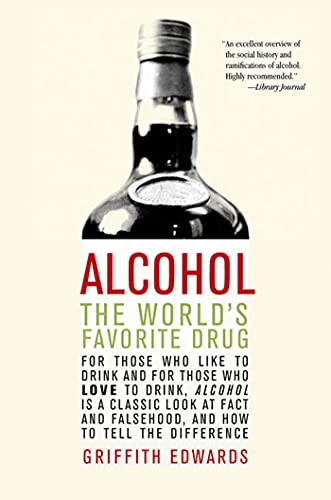
Synopsis
Alcohol is everywhere. Walk down any street in the western world and before long your feet will kick against an empty beer can, or your attention will be captured by an alluring advertisement that suggests that alcohol can magically transform your life. Its use is integral to many aspects of popular culture, but it is also a substance that has at times been preached against and even prohibited.
In this book, Griffith Edwards uses both history and chemistry to explore the whole issue of alcohol. Is it medicine, a delightful potion, poison, or a mysterious combination of all three? What part has alcohol played in various cultures and religions? Why do different people behave differently when drunk? What cures for habitual inebriation were popular in the past? Why is alcoholism considered a disease? What is "safe drinking"? Is alcohol good for the heart? Do current treatments work? Does Alcoholics Anonymous have the answer? Armed with the best solid information science, history, and sociology have to offer, Edwards asks how, in the light of this knowledge, society might in the future better handle this pleasure-giving, somewhat dangerous drug. Can society get its pleasure out of alcohol without the inevitable suffering that accompanies misuse? If so, what steps should we take to protect ourselves and others? Already considered in England to be a classic in the field, Alcohol will prove to be fascinating reading for the drinker and nondrinker alike."synopsis" may belong to another edition of this title.
About the Author
Griffith Edwards is one of the world's leading experts on alcohol. Born in India, he received his M.D. from Oxford University. For 40 years Edwards has made a specialty of being both fair-minded and catholic in his study of alcoholism. He has made the Addiction Research Unit - more recently the National Addiction Center - at the Maudsley Hospital in London, the finest international center for postgraduate education in addiction in the world. He is editor-in-chief of the scientific journal, Addiction. For many years he has been a frequent visitor to the US and was a consultant to the White House Office on the prevention of drug abuse. He has been awarded many major international scientific prizes, including the Nathan B. Eddy medal of the US College on Problems of Drug Dependence, the Jellinek Memorial Prize, and the annual award of the American Educational and Research Society on Alcohol. He was named a Commander of the British Empire (C.B.E.) in 1987, awarded for services to social science and medicine. Married with two grown-up children, he and his wife live in Greenwich, England.
Excerpt. © Reprinted by permission. All rights reserved.
Alcohol
The World's Favorite Drug
By Griffith EdwardsSt. Martin's Press
Copyright © 2000 Griffith Edwards
All rights reserved.
ISBN: 978-0-312-30236-8All rights reserved.
Contents
Title Page,
Copyright Notice,
Preface,
Acknowledgements,
Note,
1. Alcohol, What is It?,
2. Alcohol, Myths and Metaphors,
3. A Short History of Drunkenness,
4. Thomas Nashe's Menagerie,
5. Alcohol is a Drug of Dependence,
6. The American Prohibition Experiment,
7. Calling Alcoholism a Disease,
8. Alcoholics Anonymous,
9. In the Name of Treatment,
10. The Mysterious Essences of Treatment,
11. Once an Alcoholic ...,
12. Molecule as Medicine,
13. The Drinker's Dilemma,
14. Ambiguous Futures,
Sources and Further Reading,
Index,
Copyright,
CHAPTER 1
Alcohol, What is It?
This book is neither for nor against alcohol. It considers a particular mind-acting chemical both as a drug and as a social fact. However, it also deals with the myths that have been so abundantly woven around this molecule. And one doesn't get far into this territory before encountering the many stark contradictions in the way people view a substance which has been declared by the World Health Organization to be a cause of cancer, which for the Catholic Church becomes in sacramental wine the blood of Christ, and which meanwhile continues as Western civilization's favourite recreational drug. Alcohol is a pervasive fact of life, but an extraordinary fact – pleasurable and destructive, anathematized and adulated, and deeply ambiguous. This introductory chapter gives in non-technical language some basic information on what alcohol is – the objective nature of the genie in the bottle.
Alcohol the chemical
Alcohol in terms of its molecular structure is C2H5OH and looks like this:
[FORMULA OMITTED]
Thus to a spine of two carbon atoms are attached five hydrogen atoms and a hydroxyl (oxygen–hydrogen) group. That constitutes a fairly simple structure carrying rather little information, and alcohol has therefore sometimes been referred to disparagingly by biochemists as a 'stupid' molecule. Drawn on a sheet of paper (or more properly projected into three-dimensional space), its structure is much smaller and less interesting than those of such complex mind-acting chemicals as, say, heroin, nicotine or the cannabinol which is the core drug constituent of cannabis.
Alcohol at room temperature is a colourless liquid which in pure form is astringent and unpleasant on the tongue. Dilution makes it less unpalatable, and alcohol and water mix together easily. Spirits are about 40 per cent absolute (pure) alcohol; port, sherry and other fortified wines 15–20 per cent; and wine around 12 per cent. A standard beer will be about 4 per cent alcohol by volume, although strong beers can be anything up to 10 per cent. What gives these various beverages their attractive and distinct tastes is not however their alcohol (diluted or otherwise), but the chemicals which have got into them in the course of production. It is possible to produce a beer from which nearly all the alcohol has been extracted and which still tastes reasonably like beer. But take out even a little of the complex flavouring given by sugar, hops, barley and so on, and the residual drink will be a pale imitation or even a parody of the original. Put unkindly, it is the dirt in the drink which makes it attractive to the nose and the palate, and which turns a mixture of alcohol and water into a good beer, a fine wine or a famous malt whisky. Vodka is relatively free from contaminants, and hence relatively odourless and tasteless.
Before going further, let's get a technical issue out of the way. In ordinary usage the word 'alcohol' refers to the substance we expect to find in alcoholic drinks. That is the way in which the word will be employed in this book. However, for the chemist the correct name for that substance is 'ethyl alcohol' or 'ethanol', while 'alcohol' is the generic name for a class of chemicals of which ethyl alcohol is but one member. The simplest member of the family has only one carbon atom at its core and is CH3OH, methyl alcohol or methanol. Sometimes known as wood alcohol, it is a constituent of methylated spirits and is highly toxic. The higher alcohols include propyl, butyl and amyl alcohol, with respectively three, four and five carbon chains, but these substances will not figure further in this book.
Fermentation
The ultimate source of all beverage alcohol is the breakdown of naturally occurring carbohydrate (starch or glucose) to ethyl alcohol, water and carbon dioxide, by the action of enzymes. Most commercial beer derives from the action of brewers' yeast on barley or other cereals, with hops added to some beers for flavouring. Commercially available wine derives from the breakdown of the sugar contained in the juice of the grape by the yeasts which are present in the bloom on the fruit's surface, although laboratory-bred yeast may also be used. Cider is made from apples, and perry from pears.
But if those are the materials which form the basis for the fermented alcoholic beverages which most societies drink, there are myriad other plant products which have at some time been employed in the production of alcohol, especially in developing countries. In North America, birch beer has been made from the sap of the same tree that provides covering for canoes, and a birch-based drink has also been drunk in Siberia. Chicha is a fermented drink made from maize, and has been consumed over wide areas of Central and South America from the pre-Columbian era onwards. In many parts of Africa, home production of beer has for centuries been a feature of rural culture, with maize, millet or sorghum the usual basis. Barley-based beers are brewed in the more northern parts of Africa, palm wine is a favourite drink in West Africa, and bananas and many other types of fruit are used for alcohol production within other local traditions. Rice wine is popular in the Far East. Other than in the Arctic regions, there is probably no part of the world where the abundance of nature aided by a kindly enzyme has not resulted in the availability of some sort of alcoholic drink. The flavour of these drinks may not always approach that of a real ale or a chateau-bottled claret – indigenous African beer may to the Western palate taste like a diluted porridge and even have a few dead flies floating in the billycan – but alcohol is alcohol and the common factor the world over.
So simple is the process of producing an alcoholic beverage by fermentation that early humans would have got hold of this technique as soon as it was possible to gather fruit, add water, and wait a few days for enzymatic action to do its work. These conditions probably imply the beginnings of a settled and agricultural way of life rather than a nomadic existence. Having emphasized the extreme simplicity of the basic process, it should be acknowledged that modern production of beer involves advanced technology, and brewing has developed a strong scientific base. Wine production also has its science, but in some ways stays closer to its ancient pre-industrial origins.
However primitive or advanced the technology, there is a limit on the alcohol concentration which can be achieved by any form of fermentation. This is set by the fact that, when the concentration rises to a certain level, the yeast will be inhibited or killed by the alcohol which it has itself produced, and at that point the fermentation process will be shut down. Sake, the national drink of Japan, is produced by the action on rice of a non-yeast micro-organism (Aspergillus), and a concentration of about 17 per cent can be achieved before the fermentation is switched off. And that for practical purposes is probably the top alcohol concentration achievable for any beverage by natural fermentation.
Distilling as amazing innovation
For millennia the simple fact of alcohol-induced self-limitation on fermentation meant that there were ceilings on the strength of the product. To get drunk on a 12 per cent wine or a 4 per cent beer is none too difficult, although some of the traditional alcoholic drinks of the developing world have an alcohol content so low that it would require agricultural and brewing resources beyond that of any village to make widespread intoxication at all likely.
In the sixteenth century the age-old natural barrier to production of higher-concentration beverages was overcome by dissemination across Europe of the technology of distillation. Today we may view the bottles of spirits stacked on the slightly more secure shelves at the off-licence as a familiar part of the great drinks spectrum. But in the sixteenth century distillation must have looked like a revolutionary and threatening technology. Suddenly alcohol was available at more than three times the concentration at which people had previously seen or tasted it. All sorts of old balances between populations and their drinking were destabilized. The very word 'spirits' carried a dangerously magical message.
The origins of distillation go back at least 2,000 years. The process was known to the Greeks as early as the first century AD. In the third century AD, Alexander of Aphrodisias gave a description of how sea water could be distilled to produce drinking water. And in passing he mentioned the possibility of carrying out distillation on wine. As so often happened in the history of science and medicine, this Greek learning was transmitted to the Arab world, and then much later brought back to Spain and thence to the rest of Europe.
By the middle of the sixteenth century the use of distillation to provide concentrated alcoholic drinks had become a widely applied technology across the Continent. At first the resulting preparation was viewed primarily as a medicine, but before long it was the basis for a range of new beverages. The distillation of wine would give brandy to Europe and various similar spirituous drinks. From fermented grain with a little flavouring of juniper came gin – originally from Holland, with London gin a later unsweetened and competitive variety. Whisky is derived from various different cereals according to its country of origin – Scotch whisky, for instance, comes from malt and grain with caramel for colouring, the smoke of peat-fired kilns for flavour, and an esteemed spring water as carrier. Rum emerged as a distilled beverage based on molasses. Kentucky bourbon is a latecomer, dating from towards the end of the eighteenth century, made largely from a fermented maize mash which after distillation is aged in charred oak barrels.
The availability of distilled spirits in Europe had multiple consequences. Concentrated alcoholic drinks rapidly became available to the people of every country, but they were particularly well received in the more northern regions, where climate meant that wine could not be a domestic product. Government attempts to regulate and tax spirits were from early days handicapped by the ease with which illicit stills could be set up or bottles of spirits be smuggled across frontiers. One consequence of distilling was thus the earliest variant of something rather akin to the problem of illicit production of, and trade in, drugs: less bulky products are better for the black market than bulky products. A further consequence was that the manufacture and marketing of alcohol became more commercialized than had previously been the case with pre-industrial fermented beverages.
In the absence of sales figures from those early days, it is difficult to estimate the extent to which spirits added to, rather than merely substituted for, other types of alcohol consumption. But at least in some countries and in some periods there was quite a lot of addition. Before long Russia had easy access to vodka, and that was quite some competitor to birch beer. Across those great tracts of cold northern Europe where there was no hope of ever growing a grape, raw spirits penetrated the culture and became integral to the way of life, and have remained so right up to modern times. As we will see in Chapter 3, the British gin epidemic of the eighteenth century had several different determinants, but the availability of cheap gin was one of its causes. In time, European exports took spirits to many parts of the world. Distilled spirits did terrible damage to the indigenous people of North America, and were an item of barter in the slave trade with Africa. New drug technologies of any kind can often upset old ecological balances, and distillation in its day was a leap in drug technology: gin palace, opium den, crack house – there is a lineage.
Blood alcohol concentration
So there in its container of whatever kind, with its individual pretty label – or in a bucket off the back of an African pick-up truck – is our diluted and contaminated dose of ethyl alcohol ready for the taking. When swallowed, the alcohol is absorbed from the stomach and the small intestine. Absorption will be slowed by the presence of food, or can be somewhat speeded if the drink has been chilled or has been aerated with bubbles of carbon dioxide. Less concentrated drinks may have their alcohol more rapidly absorbed than stronger ones, so iced champagne drunk on an empty stomach can be an effective way of getting alcohol to the brain quickly. After a preliminary pass through the liver, some of the alcohol will be reaching the brain within minutes. The blood or brain alcohol level will then slowly increase for the next thirty to sixty minutes as the absorption of a single drink is completed. Several drinks taken together or spaced out in a series of drinks will result in the alcohol level going upwards longer and higher. But enormous variation in absorption rates can occur between individuals and on different occasions.
The blood alcohol concentration (BAC) which is achieved after any drink or drinking session will reflect a balance between, on the one hand, how much alcohol is absorbed and over what time, and, on the other hand, how quickly the body is getting rid of alcohol. The larger part of elimination (80 per cent) is achieved by metabolic breakdown in the liver, and a heavy drinker may be able to break down alcohol twice as fast as someone who drinks more lightly or occasionally. Some alcohol is excreted unchanged in the urine, and a little bit is breathed out through the lungs or lost in sweat. But the self-deceiving belief of old-time colonial hands that alcohol is relatively harmless in a hot climate, because it can be prodigiously sweated out, has no scientific basis.
Given all the variations in absorption and elimination which are likely to be brought about by food intake, the type of drink taken and variations in individual physiology, calculations of what BAC will be produced by what kind of alcohol intake can never be exact. As a rough guide, however, one may assume that a single British standard drink (one glass of wine, half a pint of beer, a measure of spirits, each of which contains 8–10 grams of alcohol) will raise the drinker's BAC by about 20 mg% (20 milligrams of alcohol per 100 millilitres of blood).
Here is an illustration of how calculations can be made on the sort of BAC level which may be expected to result from a specific drinking occasion. If someone were to throw back ten drinks in quick time, the arithmetic would suggest that the BAC achieved would be 10 × 20 or 200 mg%. But in the real world no one is likely to take those ten drinks all in the first minute of a party and then sit back. Even as their absorption of spaced drinks is pushing their BAC up, so at the same time elimination will be pulling it down; as noted above, the BAC achieved at any particular moment reflects the net effect of that profit and loss. Alcohol is cleared from the body at a rate equivalent to about 15 mg% of BAC in one hour. If, therefore, we sketch a scenario in which our hypothetical party-goer consumes ten drink between 8 p.m. and 11 p.m., calculations would suggest that when he or she is stopped by a policeman at midnight the breathalyser reading would be at 10 × 20 mg% or 200 mg%, less elimination of 4 × 15 mg% or 60 mg%, thus giving 140 mg% as the likely midnight BAC figure. The outcome would be a bad case of drink driving – 80 mg% is the current British legal driving limit.
In most instances the sort of arithmetic discussed here can give a fair approximation to what is actually likely to happen to a blood alcohol level in given circumstances, but it should be emphasized again that such calculations are not an exact art. For anyone to drive a motor vehicle on the basis of do-it-yourself calculations on what will keep them below the legal BAC limit would be very ill advised. 'Do not drink and drive' is the only safe advice.
When alcohol meets the brain
What happens when the absorbed alcohol gets to the brain is the next question to address. There can be no doubt that, so far as most people are concerned, when alcohol meets the brain the event is received as good news. Something subtly pleasant begins to happen. The average drinker is not likely to sit around and attempt to put into words what he or she is beginning to experience, but after a glass or two something wanted and familiar is usually being sensed. What is experienced psychologically will be modified by personality, previous experience with alcohol, expectations of what alcohol can do for the person concerned, the company and setting, and cultural beliefs. But behind all those important influences is the core fact that when alcohol reaches the brain a mind-acting drug will begin to impact on the brain cells and brain systems in a way which can produce or facilitate pleasurable alterations in mood.
If we look for a word to characterize this experience, 'euphoria' is probably a good summary description, but every drinker will react differently in terms of talkativeness, happiness, enthusiasm, stimulation, sedation, disinhibition, loosening of thought associations, and feelings of power or sexuality. The pleasurable effect of this drug is person-specific, but generally people who have had it happen to them once will go for it again and repeatedly.
Though a change of mood is the the first, obvious, wanted effect produced by alcohol, at the same time there will be produced physiological effects such as increased pulse rate, a rise in blood pressure, and an increased secretion of urine – consequences which are usually of no great immediate importance to the drinker.
There is a dose relationship for many of these effects, so that with more drink the pleasure is increased. Eventually, however, unpleasant effects come into play and drinking becomes aversive. The level of intake at which the response switches from pleasure to aversion varies greatly from person to person, but the wanted euphoria may be replaced by depression and maudlin misery. Nausea and vomiting may be other unwanted physical effects. In addition, there will very soon at ordinary levels of drinking be, with some variation between individuals, a dose-related impairment of reaction time, coordination and balance.
(Continues...)
Excerpted from Alcohol by Griffith Edwards. Copyright © 2000 Griffith Edwards. Excerpted by permission of St. Martin's Press.
All rights reserved. No part of this excerpt may be reproduced or reprinted without permission in writing from the publisher.
Excerpts are provided by Dial-A-Book Inc. solely for the personal use of visitors to this web site.
"About this title" may belong to another edition of this title.
Search results for Alcohol: The World's Favorite Drug

Stock Image
Alcohol: The World's Favorite Drug
Seller: World of Books (was SecondSale), Montgomery, IL, U.S.A.
Seller rating 5 out of 5 stars

Condition: Good. Item in good condition. Textbooks may not include supplemental items i.e. CDs, access codes etc. Seller Inventory # 00084163497
Stock Image
Alcohol: The World's Favorite Drug
Published by
St. Martin's Griffin (edition First Edition), 2003
ISBN 10: 0312302363
ISBN 13: 9780312302368
Used
Paperback
First Edition
Seller: BooksRun, Philadelphia, PA, U.S.A.
Seller rating 5 out of 5 stars
Paperback. Condition: Fair. First Edition. The item might be beaten up but readable. May contain markings or highlighting, as well as stains, bent corners, or any other major defect, but the text is not obscured in any way. Seller Inventory # 0312302363-7-1
Stock Image
Alcohol : The World's Favorite Drug
Seller: Better World Books, Mishawaka, IN, U.S.A.
Seller rating 5 out of 5 stars
Condition: Good. Pages intact with minimal writing/highlighting. The binding may be loose and creased. Dust jackets/supplements are not included. Stock photo provided. Product includes identifying sticker. Better World Books: Buy Books. Do Good. Seller Inventory # 10576078-20
Stock Image
Alcohol : The World's Favorite Drug
Seller: Better World Books, Mishawaka, IN, U.S.A.
Seller rating 5 out of 5 stars
Condition: Good. Former library copy. Pages intact with minimal writing/highlighting. The binding may be loose and creased. Dust jackets/supplements are not included. Includes library markings. Stock photo provided. Product includes identifying sticker. Better World Books: Buy Books. Do Good. Seller Inventory # 8733414-6
Stock Image
Alcohol : The World's Favorite Drug
Seller: Better World Books: West, Reno, NV, U.S.A.
Seller rating 5 out of 5 stars
Condition: Very Good. Pages intact with possible writing/highlighting. Binding strong with minor wear. Dust jackets/supplements may not be included. Stock photo provided. Product includes identifying sticker. Better World Books: Buy Books. Do Good. Seller Inventory # 39329283-6
Stock Image
Alcohol: The World's Favorite Drug
Seller: ThriftBooks-Dallas, Dallas, TX, U.S.A.
Seller rating 5 out of 5 stars
Paperback. Condition: Very Good. No Jacket. May have limited writing in cover pages. Pages are unmarked. ~ ThriftBooks: Read More, Spend Less. Seller Inventory # G0312302363I4N00
Stock Image
Alcohol: The World's Favorite Drug
Seller: WorldofBooks, Goring-By-Sea, WS, United Kingdom
Seller rating 5 out of 5 stars
Paperback. Condition: Very Good. The book has been read, but is in excellent condition. Pages are intact and not marred by notes or highlighting. The spine remains undamaged. Seller Inventory # GOR001816874
Buy Used
£ 3.68
£ 5.60 shipping
Ships from United Kingdom to U.S.A.
Ships from United Kingdom to U.S.A.
Quantity: 2 available
Seller Image
Alcohol: The World's Favorite Drug
Seller: WeBuyBooks, Rossendale, LANCS, United Kingdom
Seller rating 5 out of 5 stars
paperback. Condition: Good. Most items will be dispatched the same or the next working day. A copy that has been read but remains in clean condition. All of the pages are intact and the cover is intact and the spine may show signs of wear. The book may have minor markings which are not specifically mentioned. Seller Inventory # rev7307578515
Buy Used
£ 4.48
£ 5.13 shipping
Ships from United Kingdom to U.S.A.
Ships from United Kingdom to U.S.A.
Quantity: 1 available
Seller Image
Alcohol: The World's Favorite Drug
Seller: WeBuyBooks, Rossendale, LANCS, United Kingdom
Seller rating 5 out of 5 stars
paperback. Condition: Very Good. Most items will be dispatched the same or the next working day. A copy that has been read, but is in excellent condition. Pages are intact and not marred by notes or highlighting. The spine remains undamaged. Seller Inventory # rev2258427301
Buy Used
£ 4.48
£ 5.13 shipping
Ships from United Kingdom to U.S.A.
Ships from United Kingdom to U.S.A.
Quantity: 1 available
Stock Image
Alcohol
Seller: Half Price Books Inc., Dallas, TX, U.S.A.
Seller rating 5 out of 5 stars
Paperback. Condition: Very Good. Connecting readers with great books since 1972! Used books may not include companion materials, and may have some shelf wear or limited writing. We ship orders daily and Customer Service is our top priority! Seller Inventory # S_483248354