
Items related to DiscipleShift: Five Steps That Help Your Church to...
DiscipleShift: Five Steps That Help Your Church to Make Disciples Who Make Disciples (Exponential Series) - Softcover
Book 10 of 20: Exponential Series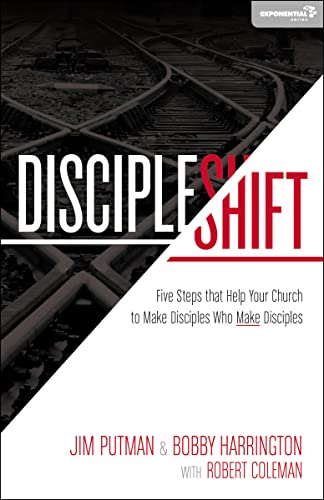
Synopsis
Question: What is the God-given purpose of the local church?
Answer: Relational discipleship.
DiscipleShift walks you through five key "shifts" that churches must make to refocus on the fundamental biblical mission of discipleship. These intentional changes will attract the world and empower your church members to be salt and light in their communities.
Over the last thirty years, many influential church leaders and church planters in America have adopted various models for reaching unchurched people. While many of these approaches have merit, something is still missing, something even more fundamental to the mission of the church: discipleship.
Making disciples—helping people to trust and follow Jesus—is the church's God-given mandate. Devoted disciples attract people outside the church because of the change others see in their Christ-like lives. And discipleship empowers Christians to be more like Christ as they intentionally develop relationships with non-believers.
Through biblical and professional insights, Jim Putman and Bobby Harrington discuss the transformational effectiveness of making disciples and just how to do so, in practical terms. You’ll learn:
- The specific roles of a disciple-making pastor.
- The components of person-to-person discipleship.
- How each ministry in your church leads to discipleship.
- How to implement discipleship in your church.
Disciple-making leaders will not produce perfect churches, but they will create effective churches.
"synopsis" may belong to another edition of this title.
About the Authors
Jim Putman is the founder and senior pastor of Real Life Ministries in Post Falls, Idaho. Real Life was launched with a commitment to discipleship and the model of discipleship Jesus practiced, which is called, “Relational Discipleship.” Outreach Magazine continually lists Real Life Ministries among the top one hundred most influential churches in America. Jim is also the founding leader of the Relational Discipleship Network. Jim holds degrees from Boise State University and Boise Bible College. He is the author of three books: Church is a Team Sport, Real Life Discipleship, and Real Life Discipleship Workbook (with Avery Willis and others). Jim’s passion is discipleship through small groups. He lives with his wife and three sons in scenic northern Idaho.
Bobby Harrington is the co-founder of discipleship.org and the founding and lead pastor of Harpeth Christian Church (19 years). He is the chairman of the board for the Relational Discipleship Network and the co-author of DiscipleShift, Dedicated: Training Your Children to Trust and Follow Jesus, and Discipleship that Fits. He has been married to Cindy for over 35 years and they have two adult children who are disciples of Jesus.
Dr. Robert Coleman is the Distinguished Senior Professor of Discipleship and Evangelism at Gordon-Conwell seminary and a prolific author, having written hundreds of articles and twenty-one books, including The Master Plan of Evangelism, which has sold multiple million copies and is the book for which he is best known. He directed the School of World Mission and Evangelism at Trinity Evangelical Divinity School for eighteen years and currently serves on the Mission America Facilitation Committee and several international mission boards and is the president of Christian Outreach. From 1989-2001, he led the Institute of Evangelism in the Billy Graham Center at Wheaton College and served as Dean of the Billy Graham International Schools of Evangelism. He is also a founding member of the Lausanne Committee for World Evangelism and a past president of the Academy for Evangelism in Theological Education. His personal interests include spending time with his family, including his children and grandchildren, and keeping in touch with those he has discipled.
Excerpt. © Reprinted by permission. All rights reserved.
DiscipleShift
five steps that help your church to make disciples who make disciples
By Jim Putman, Bobby Harrington, Robert ColemanZONDERVAN
Copyright © 2013 Jim Putman and Bob Harrington
All rights reserved.
ISBN: 978-0-310-49262-7All rights reserved.
Contents
| Foreword by Robert E. Coleman.............................................. | 11 |
| Introduction............................................................... | 13 |
| 1. The Engine That Drives It All........................................... | 19 |
| SHIFT 1 FROM REACHING TO MAKING............................................ | |
| 2. Defining a Disciple..................................................... | 41 |
| 3. How to Start Growing People............................................. | 55 |
| 4. The Four Spheres........................................................ | 77 |
| SHIFT 2 FROM INFORMING TO EQUIPPING........................................ | |
| 5. The Role of the Leader.................................................. | 97 |
| 6. A New Job Title: Equipper............................................... | 113 |
| SHIFT 3 FROM PROGRAM TO PURPOSE............................................ | |
| 7. Components of Person-to-Person Discipleship............................. | 133 |
| 8. Rolling Up Our Sleeves and Engaging..................................... | 151 |
| SHIFT 4 FROM ACTIVITY TO RELATIONSHIP...................................... | |
| 9. Rethinking Our Practices................................................ | 169 |
| 10. The Relational Small Group............................................. | 183 |
| SHIFT 5 FROM ACCUMULATING TO DEPLOYING..................................... | |
| 11. A New Scorecard for Success............................................ | 201 |
| 12. Making the "DiscipleShift" in Your Church.............................. | 215 |
| Acknowledgments............................................................ | 231 |
| Notes...................................................................... | 232 |
| About the Authors.......................................................... | 237 |
Excerpt
CHAPTER 1
THE ENGINE THAT DRIVES IT ALL
What is the God-given purpose of the local church?
Bobby Harrington gave a lot of his extra time for about a decade totrain church planters and create church planting networks. He did itjoyfully. But one day, flying out of Nashville for a network meetingin another city, a vague thought became a clear realization: he wasuneasy with the churches being planted. Would the result of all thesechurch planting efforts really last? Would the churches planted trulyplease God, long term?
The church planters were godly, wonderful people. The theologywas good. Their level of commitment was inspiring. But hewondered if the approach to church planting that he and his peers(including various church planting organizations) were advocatingwas often leading to a shallow, cultural Christianity. Before givinghimself to church planting, he had already concluded the same thingabout many established churches. Too often they had problems withlegalism or traditionalism or they lacked authenticity or somethingelse that missed Jesus' heart for a lost and hurting world. But thatday, he finally admitted to himself that he was witnessing much ofthe same cultural Christianity in the church planting world. Somethingat a fundamental level needed reevaluation.
It was around this time that we (Jim and Bobby) became goodfriends. We had the same fundamental belief. Maybe you agree withus? When it comes to the local church in North America today,something is not working.
The big question driving this book is the question of effectiveness.For a moment, resist the urge to defend yourself or your church.Don't defend your experience in ministry, your seminary degrees, oryour genuine heart for seeing people come to know Christ. Don'tdefend any of the activities taking place at your church. And don'tdefend the size of your congregation, the amount of giving, your serviceto the poor, or the number of new converts. Simply ask yourself,Is the church producing results? Is it doing its job in the best waypossible? And please resist the urge to quickly answer yes.
It's true that throughout North America today, though numbersare declining, there are still many people coming to church, andsome are busy with ministry-related activities. There are ministriesto the poor. Buildings are being built. Programs are running at fulltilt. Money is being given.
But attendance, busyness, construction, finances, and programsare not real indications of success. The core question of effectiveness— the question that ultimately matters—is whether thepeople who are getting saved are being conformed to the likeness ofChrist. Are we making mature disciples of Jesus who are not onlyable to withstand the culture but are also making disciples of Jesusthemselves?
Let's look at some research.
Consider how recent statistics show that when it comes to moralityand lifestyle issues, there is little difference between the behavior(and one can assume condition of the heart) of Christians andnon-Christians.
Divorce rates are about the same.
The percentages of men who regularly view pornography areroughly the same—and it's a lot of men.
Christians are considered to be more than two times as likely tohave racist attitudes as non-Christians.
Domestic violence, drug and alcohol abuse, and most other problemsare just as prevalent among Christians as among non-Christians.
Consider too statistics about evangelicals. About one in fourpeople living together outside marriage call themselves evangelicals.
Only about 6 percent of evangelicals regularly tithe.
Only about half the people who say they regularly attend churchactually do. And a significant number of younger adults (millennials)believe that evangelical churches are not even Christlike orChristian. Sixty to 80 percent of young people will leave the churchin their twenties.
Fewer than one out of five who claim to be born-again Christianshave a worldview of even a few fundamental biblical beliefs.Plenty of people call themselves Christians, but very few people canactually tell you what it means—from the Bible's perspective—tobe a Christian. They might call themselves Christians, but theyalso believe that the Bible is full of errors or that God is not oneGod manifest in three persons or that Jesus Christ did not lead asinless life (or that he isn't God) or that simply being good will getyou into heaven.
When you ask most evangelicals what their job as a believer is,they may tell you that they are to share Christ, but how many actuallydo? At worst, they follow the rule that you don't talk about politicsand religion, and they will die without ever seeing anyone cometo faith. At best, they may invite people to church, but they thinkmaking disciples is not their job; it's the pastor's job.
We could go on and on. One can't help but conclude that somethingis wrong. Where's the lasting life change? Where are the transformedlives? Why are people in our churches just like the world?Why are we not developing people who are Christlike?
A few years back, Bill Hybels, pastor of Willow Creek Church,one of the most influential churches in America, revealed the resultsof a months-long study into the church's effectiveness. The conclusionwas that the church simply wasn't producing the results theywere hoping for. Willow Creek's leaders did research into otherchurches across the country and came to the same conclusions.In the foreword to Reveal, a book outlining their discoveries, BillHybels wrote, "The local church is the hope of the world. For a numberof years now, I have shared this message whenever I've had theopportunity to serve pastors of local churches across the nation andaround the world. It's a message I believe with all my heart. So youcan imagine my reaction when three people whose counsel I valuetold me that the local church I've been the pastor of for more thanthree decades was not doing as well as we thought when it came tospiritual growth. As if that wasn't bad enough, they said this wasn'tjust their opinion. It was based on scientific research."
The results rocked Willow Creek's world. Willow Creek's leadersrealized that they had to make significant changes. Hybels put it thisway: "Our dream is that we fundamentally change the way we dochurch. That we take out a clean sheet of paper and we rethink all ofour old assumptions. Replace it with new insights. Insights that areinformed by research and rooted in Scripture. Our dream is reallyto discover what God is doing and how he's asking us to transformthis planet."
That's what's required of us as well. To be effective, we need tomake a fundamental shift in the way we do church. What we'redoing now isn't working, at least not like we'd hoped. We havedefined ourselves by emphases and methodologies that don't produceresults.
Fortunately, there is hope ahead. Within the pages of God'sWord is a design that will lead to effectiveness. The solution to ourineffectiveness as churches involves following a clear and uncomplicatedway to train people to be spiritually mature, fully devotedfollowers of Christ, and then in turn having those disciples makemore disciples.
What we need in our churches today are fewer "Christians," atleast in today's popular definition of the word. Now, I don't wantfewer saved people. Far from it. I want as many to be saved as possible.But the point is that fewer than we think are actually saved.
What I want are full-fledged followers of Jesus Christ, and toproduce that in our churches today, we need a radical shift. We needmore of the engine that Jesus used to change the world, the enginehe instructs us to use. This engine will not create perfect churches,but it will create effective churches.
FOUR MAIN CATEGORIES
How did the church get to the state it's in today? Simply put, the problemstems from the way today's churches are designed. Within North America,each local church is characterized by two important components.
The first is focus. Think of a church's focus as the primary emphasisthat it commits its time and resources to achieve. It's the enginethat drives everything else in that church. For instance, a church maydesire to reach lost people, so it will expend its energy and resources onbridge events and worship ser vices focused on giving reasons to believeand issuing invitations to accept and follow Christ.
The second component is methodology. This is the way a churchsets itself up systematically to accomplish its purpose, or the mannerin which it tries to achieve its focus. It could also be thought of as astructure or a system environment (as we call it in the sports world)that a church has created to accomplish what it values.
Every church has its focus and its methodology for achievingits focus whether it realizes it or not. When looking at the differentkinds of churches, leaders disagree over how many categories ofchurches exist today. Some hold that there are only two main categories— attractional and missional. Others add a third—organic(sometimes called "house"). Others add a fourth—educational.The disagreement stems mainly from crossover and blending offocus and methodologies. Truly, most churches don't fit any categoryexactly. Nevertheless, I find that most churches today willlean toward one of the following four categories, even if a categorydoesn't fit precisely.
Category 1: Educational
A pastoral-educational focus with a classroom methodology.
In the educational category, a church uses the bulk of its energyon biblical education, and it's understood that the pastor's job (alongwith the pastoral staff) is to provide this education for the people.Leaders and members make well-intentioned statements such as,"We believe the Bible is God's Word, and we want to get it into theheads of our people." Churches with this emphasis focus on Biblestudy and doctrine.
The methodology in these churches is most often the classroommodel. A strong emphasis is placed on Sunday morning teachingtimes, Sunday school attendance, perhaps a midweek educationalforum, youth and children's programs and Bible studies, and perhapsinformation-oriented teacher-led small groups.
Sometimes a strong emphasis is placed on pastoral care as well,though few churches, especially larger churches, are intentionalabout this aspect. The paid, formally trained, professional pastorsare responsible for developing and implementing programs for teachingBible knowledge. The pastors in churches where care is expectedare also responsible for caring for the congregants, so heavy expectationsare placed on the pastors' time. Congregants want pastors tovisit them in the hospital, counsel them, open meetings with prayer,attend myriad planning meetings, drop everything to come to theiraid in family crises, and seldom take time off for vacation (otherwise,who will lead the church?).
The educational model typically doesn't stress attracting new peopleto the church as much as it does educating and taking care of peoplewho are already there. Those who come through the door expect tobe biblically educated, and this is often (in their minds) the meaningof "becoming a mature disciple." The hope is that the education willtranslate to Christian behavior outside the walls of the church.
Category 2: Attractional
An attractional focus with an entertainment methodology.
The well-meaning emphasis in the attractional category is placedon biblical evangelism through church ser vices and large events thatattract people. Helping people to "make decisions for Christ" is primary.It is assumed that discipleship will happen through churchattendance. Some churches in this category seek to retain peoplewho have attended church for years in more traditional settings, byupdating the way songs are sung and lessons are taught. The modernway of doing things tends to keep people from being bored withchurch, at least for a while. The key is to design church ser vices towin people.
In this category, people are attracted to the church because theyhave real questions and hurts that need answering and dealing with.The sermons are designed to answer those questions and addressthose hurts. The leaders in these churches are focused on takingground outside the walls of the church by using the weekend serviceas a hook. They really seek to inspire Christians to invite theirfriends to the ser vices where an invitation to accept Christ is given.Worship ser vices are usually professional and celebratory in nature,limited in depth, and will sometimes use non-Christian music toidentify with the church's primary demographic—unsaved people.Good coffee is served. Dress is casual. Messages are shorter, practical,and relational in style.
Category 3: Missional
A missional focus with a ser vice-opportunity methodology.
Churches in the missional category are sometimes referred to associal justice churches. The focus is biblical action. These churchesare designed around the paradigm in which God has given each persona kingdom-oriented purpose, and each person needs to discoverthat purpose and then live it out in practical, tangible, community-changingways.
The methodology is ser vice. Christians are primarily encouragedto become active outside their church's walls for the purpose of socialchange and as a means of "living out Christ's kingdom."
The church might encourage its people, for instance, to focus onfeeding the homeless or working in a women's shelter. People mightorganize community cleanup days in the name of Jesus, or anonymouslyleave packets of diapers on the doorsteps of young mothers.People might be encouraged to live radically and simply, focusing onothers rather than possessions.
Missional churches are typically contemporary in style, but notalways. Some are more liturgical. Some are traditional yet have astrong, driving sense of outreach.
Category 4: Organic or "Home"
A fellowship focus with an organic methodology.
In the organic category, the emphasis is biblical relationships, orfellowship. These churches focus on Bible verses that talk about howpeople need to be devoted to each other in brotherly love and closefellowship.
The methodology used is home groups (sometimes called"house churches"). In this model, a group of believers might gathertogether in an informal, relational way for teaching, worship, service,and fellowship, yet there would be very little organizationalstructure involved. They would hold few or no regular public,large group ser vices and may not have any main meeting placeother than the homes they live in. (Though I am aware of severalchurches in this model that like to meet as a whole once a monthin a rented facility.)
They might initiate activities to serve their communities, butthe emphasis is placed on the home group doing the ser vice, ratherthan attracting people into the house church. The main emphasis is"doing life together," or journeying together as people who love Godand are devoted to him.
Your church may fit precisely into one of these categories. Or itmight straddle two or more of them. Your church might believe in allor some of the church functions that these categories represent, but itprobably focuses on one and hopes the others will happen naturally.That's okay. Think of these categories as broad brushstrokes thathelp to provide definitions.
THE COMMON ELEMENT: SOMETHING'S MISSING
Please note that my purpose is never to bash any other churches.Rather, I want to enter into the struggles these other churches arefacing. In the Relational Discipleship Network training sessions, wework with churches in each of these categories every month, so weget to see and hear firsthand what is working and what isn't. Thechurches are led by people who love the Lord, but the leaders knowand articulate that something is missing. To be clear, there is muchto commend in all four models. None are intrinsically wrong, andleaders of each model can use proof texts to create biblical reasonsfor what they do. Plus, there are pockets of effectiveness in eachmodel—even tremendous effectiveness for a period of time.
But there are also tremendous challenges with each. Again, wemust ask if any of these models are truly succeeding. Are peoplebeing transformed from spiritual immaturity to maturity, and arethey following Jesus in regular, lasting, and effective ways? Theanswer, according to the statistics we referred to earlier, is sometimesyes and sometimes no. But mostly, unfortunately, no.
The common element in the four categories of churches is thatthe models are incomplete. The focus and the methodologies areimproperly placed, in such a way that there are missing componentsthat leave the church one-dimensional, when it was meant to becomplete. That only causes problems in the long run. That's whatwe're aiming to shift.
For instance, in an educational model, one of the greatest challengesis pastoral burnout if the pastor is expected to teach and carefor all the people in relational ways. I've talked with pastors operatingin this model who tell how they get so caught up in creatingsermons, making sure all the programs are running, and caringfor all the perceived needs of the church that they are continuallyexhausted. The expectations placed on church leaders in this modelare sky-high, impossible to fulfill. Those in this category also have avery real problem with effectiveness even in the area of real learning.Usually people who go to these churches love to listen to the pastorspeak and become very reliant upon him and his understandingrather than learning to understand the Bible for themselves. Whenthey do read themselves, it just isn't as interesting as when they hearit from the master teacher. Also, lecturing is the least effective way toteach anything and leads to few really understanding the truth thatthe teacher wants them to understand. Because the teacher cannotunpack what he is teaching in practical ways, the people often havewrong understandings of how to apply the truth. They can misrepresentor misunderstand what the teacher really believes or would doin any given situation in the real world of their everyday lives.
(Continues...)
(Continues...)
Excerpted from DiscipleShift by Jim Putman. Copyright © 2013 by Jim Putman and Bob Harrington. Excerpted by permission of ZONDERVAN.
All rights reserved. No part of this excerpt may be reproduced or reprinted without permission in writing from the publisher.
Excerpts are provided by Dial-A-Book Inc. solely for the personal use of visitors to this web site.
"About this title" may belong to another edition of this title.
Search results for DiscipleShift: Five Steps That Help Your Church to...

Stock Image
DiscipleShift: Five Steps That Help Your Church to Make Disciples Who Make Disciples
Seller: World of Books (was SecondSale), Montgomery, IL, U.S.A.
Seller rating 5 out of 5 stars

Paperback. Condition: Good. In DiscipleShift, Jim Putman, Bobby Harrington, and Robert Coleman walk readers through five key shifts that any church can make to refocus on the mission of making disciples. When church leaders make discipleship their churchs core mission, they attract the unchurched by empowering believers to become salt and light in their communities. Seller Inventory # 00106099228
Stock Image
DiscipleShift: Five Steps That Help Your Church to Make Disciples Who Make Disciples
Seller: World of Books (was SecondSale), Montgomery, IL, U.S.A.
Seller rating 5 out of 5 stars
Paperback. Condition: Very Good. In DiscipleShift, Jim Putman, Bobby Harrington, and Robert Coleman walk readers through five key shifts that any church can make to refocus on the mission of making disciples. When church leaders make discipleship their churchs core mission, they attract the unchurched by empowering believers to become salt and light in their communities. Seller Inventory # 00110753757
Stock Image
DiscipleShift: Five Steps That Help Your Church to Make Disciples Who Make Disciples (Exponential Series)
Seller: Orion Tech, Kingwood, TX, U.S.A.
Seller rating 5 out of 5 stars
paperback. Condition: Fair. Seller Inventory # 0310492629-4-35957379
Stock Image
DiscipleShift: Five Steps That Help Your Church to Make Disciples Who Make Disciples (Exponential Series)
Seller: Gulf Coast Books, Cypress, TX, U.S.A.
Seller rating 5 out of 5 stars
paperback. Condition: Fair. Seller Inventory # 0310492629-4-35957379
Seller Image
DiscipleShift: Five Steps That Help Your Church to Make Disciples Who Make Disciples (Exponential Series)
Seller: Zoom Books East, Glendale Heights, IL, U.S.A.
Seller rating 5 out of 5 stars
Condition: very_good. Book is in very good condition and may include minimal underlining highlighting. The book can also include "From the library of" labels. May not contain miscellaneous items toys, dvds, etc. . We offer 100% money back guarantee and 24 7 customer service. Seller Inventory # ZEV.0310492629.VG
Stock Image
DiscipleShift: Five Steps That Help Your Church to Make Disciples Who Make Disciples (Exponential Series)
Seller: BooksRun, Philadelphia, PA, U.S.A.
Seller rating 5 out of 5 stars
Paperback. Condition: Fair. The item might be beaten up but readable. May contain markings or highlighting, as well as stains, bent corners, or any other major defect, but the text is not obscured in any way. Seller Inventory # 0310492629-7-1-13
Stock Image
DiscipleShift: Five Steps That Help Your Church to Make Disciples Who Make Disciples (Exponential Series)
Seller: BooksRun, Philadelphia, PA, U.S.A.
Seller rating 5 out of 5 stars
Paperback. Condition: Very Good. It's a well-cared-for item that has seen limited use. The item may show minor signs of wear. All the text is legible, with all pages included. It may have slight markings and/or highlighting. Seller Inventory # 0310492629-11-1
Seller Image
DiscipleShift: Five Steps That Help Your Church to Make Disciples Who Make Disciples (Exponential Series)
Seller: Greenworld Books, Arlington, TX, U.S.A.
Seller rating 5 out of 5 stars
Condition: very_good. Fast Free Shipping â" Very Good condition book with a firm cover and clean pages. Shows normal use and some light wear or limited notes markings. A solid, nice copy to enjoy. Seller Inventory # GWV.0310492629.VG
Stock Image
DiscipleShift: Five Steps That Help Your Church to Make Disciples Who Make Disciples (Exponential Series)
Seller: Evergreen Goodwill, Seattle, WA, U.S.A.
Seller rating 5 out of 5 stars
paperback. Condition: Acceptable. Seller Inventory # mon0000109757
Stock Image
DiscipleShift: Five Steps That Help Your Church to Make Disciples Who Make Disciples (Exponential Series)
Seller: Read&Dream, SAINT LOUIS, MO, U.S.A.
Seller rating 4 out of 5 stars

Condition: Very Good. Seller Inventory # 50K_MV_H0005ZC1