
Items related to Nation of Devils: Democracy and the Problem of Obedience:...
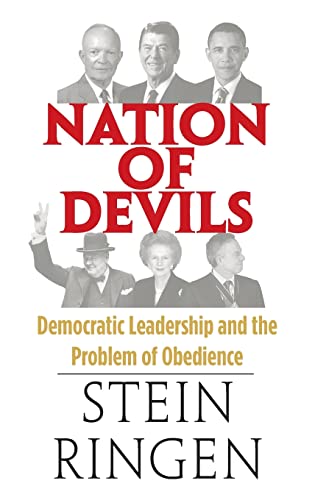
Nation of Devils: Democracy and the Problem of Obedience: Democratic Leadership and the Problem of Obedience - Hardcover
Synopsis
Oxford University political theorist Stein Ringen offers a thought-provoking meditation on the art of democratic rule: how does a government persuade the people to accept its authority? Every government must make unpopular demands of its citizens, from levying taxes to enforcing laws and monitoring compliance to regulations. The challenge, Ringen argues, is that power is not enough; the populace must also be willing to be led. Ringen addresses this political conundrum unabashedly, using the United States and Britain as his prime examples, providing sharp opinions and cogent analyses on how the culture of national obedience is created and nurtured. He explores the paths leaders must choose if they wish to govern by authority rather than power, or, as the philosopher Immanuel Kant put it, to "maintain order in a nation of devils".
"synopsis" may belong to another edition of this title.
About the Author
Stein Ringen is professor emeritus of sociology and social policy at Oxford University. He lives in London.
Excerpt. © Reprinted by permission. All rights reserved.
NATION OF DEVILS
DEMOCRATIC LEADERSHIP AND THE PROBLEM OF OBEDIENCE
By STEIN RINGENYale UNIVERSITY PRESS
Copyright © 2013 Stein Ringen
All rights reserved.
ISBN: 978-0-300-19319-0All rights reserved.
Contents
| Preface: The Futility of Power............................................. | ix |
| Chapter One: The Powerlessness of Powerful Government...................... | 1 |
| Chapter Two: How to Do It Well and Badly................................... | 12 |
| Chapter Three: How to Use Power............................................ | 35 |
| Chapter Four: How to Be a Government....................................... | 59 |
| Chapter Five: How to Give Orders........................................... | 76 |
| Chapter Six: How to Get It Right........................................... | 98 |
| Chapter Seven: How to Make Officials Obey.................................. | 116 |
| Chapter Eight: How to Make Citizens Obey................................... | 140 |
| Chapter Nine: Good Government.............................................. | 184 |
| Notes...................................................................... | 219 |
| Bibliography............................................................... | 231 |
| Acknowledgements........................................................... | 241 |
| Index...................................................................... | 243 |
CHAPTER 1
THE POWERLESSNESS OFPOWERFUL GOVERNMENT
... he finds himself surrounded by many who believethey are his equals, and because of that he cannotcommand or manage them the way he wants.
—Niccolò Machiavelli, The Prince, chapter 9
If the state is to exist, the dominated must obey the authority claimedby the powers that be." So said Max Weber, the greatest of Germanpolitical thinkers, in a famous lecture at Munich University in 1919under the title "Politik als Beruf." That might seem cynical, like a eulogyfor dictatorship, but it is nothing of the kind. Serious governments wantto rule. But also their populations want them to rule, to rule appropriately,of course, but therefore clearly to rule. Hence, in the American Declarationof Independence, "to secure these rights, Governments are institutedamong Men." We citizens want rule because we need rule for order, fairnessand protection. We need to hold the tyranny of government at baybut we also want, in our own interest, our governments to defeat our tyrannyover them. The problem, then, is obedience.
THE PUBLIC GOOD
Macho men want the government off their backs but are dead wrong, asthe bankers of the world learned after 2007 when the cost in money andesteem of radical deregulation caught up with them. When people livein society, it is government that prevents them from falling into the warof all against all that the philosopher Thomas Hobbes believed was thenatural state of affairs, and it is government that makes it possible for usto live lives that are useful for ourselves and others. The painter AmbrogioLorenzetti gave this knowledge life in fourteenth-century Italy withhis frescoes in the Palazzo Pubblico in Siena, where he created allegoriesof good government with happy people building their future in a city oforder and of bad government with idle people in a crumbling world. TheNorwegian Johan Bojer, in The Last Viking, his early twentieth-centuryepic of the winter fisheries in northern Norway in the age of sail, saw themagic at work where life is raw. A fjord is teeming with fish, the fishermenscramble for a take in the bounty, a minor civil war breaks out untilthe regulator arrives and restores order: linesmen in that part of the fjord,netsmen in the other. "A thousand men were transformed from animals tohuman beings again." On today's testing ground for progress, in Africa,the economist Paul Collier, in The Bottom Billion, sees a near perfect correlation:where government works, the economy works, and where theeconomy works there is government at work.
No wonder Aristotle praised "he who first founded the state [as] thegreatest of benefactors. For man, when perfected, is the best of animals,but when separated from law and justice, he is the worst of all."
In his first inaugural address, at the birth of the American republic,President George Washington defined the job of government as "the discernmentand pursuit of the public good." Citizens left to their own devicesare interested in their various little private goods, and at each other'sthroats. Governments are instituted to cut through that chaos and createa new reality that is public. They must discern: the public good must bedefined, explained and made accepted. They must pursue: the dominatedmust be made to obey, preferably by being made to want to obey.
LEADERS
Governments must get two things done. They must make policy and theymust put their policies to work in society. S. E. Finer, in The History ofGovernment, calls it decision making and decision implementing. In politicalreporting in the press, "politics" is almost always about the makingof policy, as it is in a great deal of writing in political science. The governmentis victorious when it is able to get its programme enacted and itloses when the opposition is able to defeat it. Well and good, those aretricky problems—but not the endgame problems. In making policy work,the challenge is just as much or more in implementation. Decisions areeverything for the members of the political class, but for society they arenothing unless they are implemented.
For example, on the 13th of February 2009, the United States Congressapproved President Barack Obama's near $800 billion economicstimulus package. That was only two weeks after his inauguration andwas, rightly, seen as a great victory. However, the money thereby allocatedwas supposed to flow through to hundreds of projects around the countryin infrastructural investments, schools, employment, social security, healthcare and much more. The decision by Congress on that day was only tomake the money available. What would flow through was yet to be seen.
An indication of some of what might happen was by coincidenceon display in the Helsinki newspaper Hufvudstadsbladet in Finland thevery next day. The Finnish government had launched its own stimuluspackage a few months earlier. A review by the paper revealed that in atleast some areas very little of what was intended had reached its objective.For reasons of legal wrangling and logistical problems, intended creditsto businesses through a government loans agency were being held up, aswas intended support to local municipalities through another governmentagency to stimulate housing construction.
President Obama's package was inspired in part by the initiatives ofPresident Franklin D. Roosevelt in 1933, but Roosevelt did much morethan to get money allocated. In his first one hundred days he not onlysummoned Congress and kept it working in emergency session to pushthrough fifty major recovery laws, but also followed up by creating a raftof new government agencies to carry allocated money into projects in thereal economy. In 2009, it took less than a week after Congress had approvedthe spending for reporting to emerge in the press about difficultiesof implementation. Political posts remained unfilled in the new administration,and political leadership was not in place in several cabinet departmentsand lower-level agencies, including the Treasury, the result beinga danger of at least delays in the implementation of policies that wereseen to be urgent. Congress earmarked at least $20 billion for energy efficiencyprojects in towns and cities across the country, which would haveto be carried out by local agencies that had few plans in place and werewithout experience of or capacity for projects on the necessary scale.President Obama had won a victory in Congress, but the significance forAmerican society of that victory would depend on the administration'sability to practically get the money put to use. A year later, the president'spopularity had collapsed, in part because of a widespread perception inthe country that a great deal of his stimulus money had been siphoned offfor pork-barrel projects with little or no relevance for economic recovery.And on the effects of the stimulus package for the economy, and how itsmultiple projects unfolded, the jury is still out.
Likewise in Britain. In late 2011, the chancellor of the exchequer,George Osborne, tempered his austerity with some public works plansto stimulate economic activity and growth. But half a year on, referring to"squabbling" and "plans left to gather dust on desks," the director generalof the Confederation of Business Industries, John Cridland, "stronglycriticised the government for the 'really disappointing' implementation ofits growth plans, asking: 'Where are the diggers on the ground.'"
FOLLOWERS
Whenever anyone wants to rule or lead, it is others they must manage—thatamorphous mass of people who must obey but are inclined not to.That is a fact of life in the running of businesses as well as the governingof countries. For governance, it is a fact in democracies as in autocracies.Always, the craft of governing is about winning over reluctant and sometimeshostile others to not frustrating, and sometimes even to supporting,your intentions. President Harry Truman knew this when he handedpower to his successor, Dwight D. Eisenhower, and predicted, not withoutschadenfreude: "Poor Ike. He'll sit right here, and he'll say do this, dothat!! And nothing will happen—it won't be a bit like the army." JonathanPowell, who was Tony Blair's chief of staff, remembers how Blair'sterm in office started: "A new prime minister pulls all the levers of powerand nothing happens." Rule has everything to do with those, from a government'spoint of view, confounded others.
Why is that? Charles Lindblom, the eminent political scientist, hasput it succinctly: "Many people constantly try to change the social world.An explanation of their failure more plausible than that of inertia is to befound in the great number of other people who are vigorously trying tofrustrate social change."
Governors bring burdens down upon the governed, principallytaxes and regulations. Therefore, the governed dislike what their governorsimpose on them. Therefore, they are looking for excuses to persuadethemselves that they are entitled to disregard the will of those they fortheir own psychological gratification call "the politicians." Therefore, aspiringleaders must deny them reasons for refusing to make themselvesfollowers.
It takes a lot. It is no good, said the philosopher Immanuel Kant inhis attempt at a treaty for perpetual peace, to assume that people are angels.We need institutions that can maintain order in a nation of devils. Institutionsare of various kinds, such as rules and culture. Good rules controldevils. Good cultures make it difficult for people to be devils. Theremust be control and there is no reason to be romantic about it: there aredevils aplenty, small and large, and leaders need to manage them.
But not everything and everyone can always be controlled. "Rule,to last," observes Henry Kissinger, speaking of China, "needs to translateforce into obligation." At the height of the debate over bank reform inBritain following the recession of 2008, the head of C. Hoare, the country'smost eccentric (and highly profitable) old-school bank, said: "We havehad this massive scare, but what was the cause? A lack of moral compassand a lack of understanding of the nature of debt and civic responsibility.Changing capital ratios will not change that." There needs to be an acceptancein people's minds, and in the way they see each other, of the validityof order. There needs to be understanding. Let's be straight about it:there needs to be some morality and some shared sense of the moral in thecultural fabric we live within. For Kant, those institutions that can controldevils are possible even among non-angels, but only if they have the intelligenceto understand that "public conduct" requires that they check eachother. Carl Schmitt, a legal scholar in Weimar Germany (whose reputationas a political thinker survived his later allegiance to Nazism), writingnearly a century ago, saw democracy somewhat mysteriously as a matter ofshared identity between the rulers and the ruled which was possible only"for a people who really think democratically." Forty years ago, whenthere was fear that democracy might crumble under the competitionfrom authoritarianism, the Trilateral Commission asked Michel Crozier,Samuel Huntington and Joji Watanuki to analyse the possible "crisis ofdemocracy." Their report was conditionally optimistic. "Democracies canwork provided their publics truly understand the nature of the democraticsystem, and particularly if they are sensitive to the subtle interrelationshipbetween liberty and responsibility."
SETTLEMENT
Some countries have found their way to a habit of leaders governing welland followers cooperating willingly. There is, in the language of SamuelHuntington and Francis Fukuyama, political order. But that apparentsimplicity is deceptive. Under the surface is a rough confrontation betweeninstinctive antagonists, between the governed and the governors.Only some countries, at some times, have the good fortune that the confrontationhas been resolved. We could call it a covenant, or a contract,but that's a bit grand. It's more of a deal, or better still a settlement, asettlement of order.
The modern study of democracy was inaugurated by the Frencharistocrat Alexis de Tocqueville in his observations in Democracy in America,published in two volumes in 1835 and 1840. He found much to admire,in particular in his first volume. He found a settled confrontation.The American Constitution gives representatives the power they need togovern but also restrains that power in a system of checks and balances.Citizens were enmeshed in networks of associations that reduced theirdependency on the state. The represented could trust their state to bebenevolent.
But in his second and more pessimistic volume, he also found thatan established settlement could disintegrate into what he called "soft despotism":a creeping erosion of freedom within a shell of democratic formality,which citizens allow to fester out of greed and indifference, graduallyand hardly perceptively.
The American settlement was soon not only to disintegrate but tocollapse into civil war when the destructive force of slavery in the republicof equality could no longer be contained. Whether a new settlement wasfound is debatable, but President Franklin Roosevelt's reforms could beseen as a quest. If that succeeded for a while, as it appeared during theEisenhower presidency, it again collapsed under the strains of the war inVietnam and the civil rights movement at home. These influences have notyet been resettled, and to that we must now add to the American scene, aswe will see, a fair dose of Tocquevillian soft despotism.
WORKABLE OR NOT
Democracies are normal or dysfunctional. In normal systems, the machinerychurns on to the making and implementation of policy. It's like anormal car. It may have some scratches but you assume that the steeringworks so that you can set off and drive without lurching into the ditch.When a leader takes up office in a normal democracy, he or she can take itthat the country is reasonably governable. We should take care not to askfor perfection, which is not available and the aspiration to which is self-defeatingand destructive, but we should ask for and expect workability.Most democracies are in this meaning normal—which is why democracyhas prospered, advanced and outdone the competition.
In dysfunctional systems, the machinery is defunct and good governmentnot available, either because necessary decisions do not get madeor, if made, are not implementable. In the next chapter, we will see howNew Labour in Britain was given all the power a democratic governmentcould dream of but that "a strong government was defeated by a weak systemof governance." In America, Barack Obama fought a brilliant electioncampaign in 2008 and came to power as the most attractive leader sinceRonald Reagan. But when he settled into office thinking that Washingtoncould be made to work according to the textbook, he was overwhelmedby vicious subversion. Good government depends on a combination offunctional institutions and competent leadership. If institutions are dysfunctional,no competence can save the day. But also, functional institutionsare only a necessary condition and never a sufficient one. There isstill the problem of obedience.
This defines the two ways that governments can fail: in a normaldemocracy if they are unable to work the system and in a dysfunctionalone because the system is unworkable. This also corresponds to my twoaims in this book, to speak to leaders about how to lead when the system isworkable and how to reform when it is not. Leadership I'm able to discussin general terms, but reform needs more specific context, which I find inthe cases of America and Britain.
(Continues...)
Excerpted from NATION OF DEVILS by STEIN RINGEN. Copyright © 2013 Stein Ringen. Excerpted by permission of Yale UNIVERSITY PRESS.
All rights reserved. No part of this excerpt may be reproduced or reprinted without permission in writing from the publisher.
Excerpts are provided by Dial-A-Book Inc. solely for the personal use of visitors to this web site.
"About this title" may belong to another edition of this title.
Search results for Nation of Devils: Democracy and the Problem of Obedience:...

Stock Image
Nation of Devils: Democratic Leadership and the Problem of Obedience
Seller: Midtown Scholar Bookstore, Harrisburg, PA, U.S.A.
Seller rating 5 out of 5 stars

Hardcover. Condition: Very Good. Very Good - Crisp, clean, unread book with some shelfwear/edgewear, may have a remainder mark - NICE Standard-sized. Seller Inventory # M030019319XZ2
Stock Image
Nation of Devils: Democratic Leadership and the Problem of Obedience
Seller: Midtown Scholar Bookstore, Harrisburg, PA, U.S.A.
Seller rating 5 out of 5 stars
Hardcover. Condition: Good. Good - Bumped and creased book with tears to the extremities, but not affecting the text block, may have remainder mark or previous owner's name - GOOD Standard-sized. Seller Inventory # M030019319XZ3
Seller Image
Nation of Devils: Democratic Leadership and the Problem of Obedience
Seller: Goodwill of Central and Coastal Virginia, Richmond, VA, U.S.A.
Seller rating 4 out of 5 stars

Condition: acceptable. Seller Inventory # CCVV.030019319X.A
Seller Image
Nation of Devils: Democracy and the Problem of Obedience: Democratic Leadership and the Problem of Obedience
Seller: WeBuyBooks, Rossendale, LANCS, United Kingdom
Seller rating 5 out of 5 stars
hardcover. Condition: Very Good. Most items will be dispatched the same or the next working day. A copy that has been read, but is in excellent condition. Pages are intact and not marred by notes or highlighting. The spine remains undamaged. Signed by Author(Unverified). Seller Inventory # rev9734284106
Buy Used
£ 15.05
£ 6.99 shipping
Ships from United Kingdom to U.S.A.
Ships from United Kingdom to U.S.A.
Quantity: 1 available
Stock Image
Nation of Devils: Democracy and the Problem of Obedience: Democratic Leadership and the Problem of Obedience
Seller: Sell Books, Elland, YORKS, United Kingdom
Seller rating 5 out of 5 stars
hardcover. Condition: Acceptable. Stains to cover, page edges, and/or pages inside. Please see the condition note after this for details, if this is missing please consider Acceptable to mean poor quality that could include major staining, water damage, writing, missing dustjacket, etc etc. Our books are dispatched from a Yorkshire former cotton mill. We list via barcode/ISBN so please note that the images are stock images and may not be the exact copy you receive, furthermore the details about edition and year might not be accurate as many publishers reuse the same ISBN for multiple editions and as we simply scan a barcode or enter an ISBN we do not check the validity of the edition data when listing. If you're looking for an exact edition please don't order (at least not without checking with us first, although we don't always have time to check). We aim to dispatch prompty, the service used will depend on order value and book size. We can ship to most countries, see our shipping policies. Payment is via Abe only. Seller Inventory # mon0000008286
Buy Used
£ 15.47
£ 12.15 shipping
Ships from United Kingdom to U.S.A.
Ships from United Kingdom to U.S.A.
Quantity: 2 available
Stock Image
Nation of Devils: Democratic Leadership and the Problem of Obedience
Seller: PAPER CAVALIER UK, London, United Kingdom
Seller rating 5 out of 5 stars
Condition: very good. Gently used. May include previous owner's signature or bookplate on the front endpaper, sticker on back and/or remainder mark on text block. Seller Inventory # 9780300193190-3
Buy Used
£ 21.76
£ 6 shipping
Ships from United Kingdom to U.S.A.
Ships from United Kingdom to U.S.A.
Quantity: 1 available
Seller Image
Nation of Devils : Democratic Leadership and the Problem of Obedience
Seller: GreatBookPrices, Columbia, MD, U.S.A.
Seller rating 5 out of 5 stars
Condition: As New. Unread book in perfect condition. Seller Inventory # 19635433
Stock Image
Nation of Devils : Democratic Leadership and the Problem of Obedience
Seller: GreatBookPrices, Columbia, MD, U.S.A.
Seller rating 5 out of 5 stars
Condition: New. Seller Inventory # 19635433-n
Stock Image
Nation of Devils
Seller: PBShop.store US, Wood Dale, IL, U.S.A.
Seller rating 5 out of 5 stars
HRD. Condition: New. New Book. Shipped from UK. Established seller since 2000. Seller Inventory # GB-9780300193190
Stock Image
Nation of Devils
Seller: PBShop.store UK, Fairford, GLOS, United Kingdom
Seller rating 5 out of 5 stars
HRD. Condition: New. New Book. Shipped from UK. Established seller since 2000. Seller Inventory # GB-9780300193190
Buy New
£ 59.95
£ 5.02 shipping
Ships from United Kingdom to U.S.A.
Ships from United Kingdom to U.S.A.
Quantity: 1 available