
Items related to The Not So Common Sense: Differences in How People...
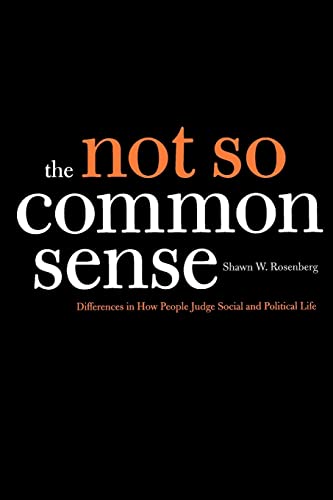
Synopsis
In this fascinating interdisciplinary book, Shawn W. Rosenberg challenges two basic assumptions that orient much contemporary social scientific thinking. Offering theory and empirical research, he rejects the classic liberal view that people share a basic "common sense" or rationality. At the same time, he questions the view of contemporary social theory that meaning is simply an intersubjective or cultural product. Through in-depth interviews, Rosenberg explores the underlying logic of cognition. Rather than discovering a common sense or rationality, he finds that people reason in fundamentally different ways, and these differences affect the kind of understandings they craft and the evaluations they make. As a result, people actively reconstruct culturally prevalent meanings and norms in their own subjective terms. Rosenberg provides a comprehensive description of three types of socio-political reasoning and the full text of three exemplary interviews. Rosenberg's findings help explain such puzzling social phenomena as why people do not learn even when it is to their advantage to do so, or why they fail to adapt to changed social conditions even when they have clear information and motivation. The author argues that this kind of failure is commonplace and discusses examples ranging from the crisis of modernity to the classroom performance of university students. Building on the ideas of Jean Piaget, George Herbert Mead, and Jurgen Habermas, Rosenberg offers a new orienting vision, structural pragmatics, to account for these social phenomena and his own research in cognition. In the concluding chapter, he discusses the implications of his work for the study of social cognition, political behavior, and democratic theory.
"synopsis" may belong to another edition of this title.
About the Author
Shawn W. Rosenberg is director of the political psychology graduate programme and professor of political science and psychology at the University of California, Irvine.
"About this title" may belong to another edition of this title.
Search results for The Not So Common Sense: Differences in How People...

Stock Image
The Not So Common Sense: Differences in How People Judge Social and Political Life
Seller: Wonder Book, Frederick, MD, U.S.A.
Seller rating 5 out of 5 stars

Condition: Good. Good condition. A copy that has been read but remains intact. May contain markings such as bookplates, stamps, limited notes and highlighting, or a few light stains. Seller Inventory # E13O-01432
Stock Image
The Not So Common Sense: Differences in How People Judge Social and Political Life
Seller: HPB-Ruby, Dallas, TX, U.S.A.
Seller rating 5 out of 5 stars
paperback. Condition: Very Good. Connecting readers with great books since 1972! Used books may not include companion materials, and may have some shelf wear or limited writing. We ship orders daily and Customer Service is our top priority! Seller Inventory # S_472709295
Stock Image
Action/ Abstraction
Published by
Yale University Press, 2008
ISBN 10: 0300122160
ISBN 13: 9780300122169
Used
Hardcover
First Edition
Seller: Gumshoe Books, Columbia, SC, U.S.A.
Seller rating 1 out of 5 stars

Hardcover. Condition: Fine. Dust Jacket Condition: Near Fine. First Edition. all the important peopls in the movement. pollock, de kooning, still, johns, rothko, krasner.steinberg, rosenberg, reinhardt, greenberg, modrian and many more. a wonderful book. Seller Inventory # 021851
Seller Image
Not So Common Sense : Differences in How People Judge Social and Political Life
Seller: GreatBookPrices, Columbia, MD, U.S.A.
Seller rating 5 out of 5 stars
Condition: As New. Unread book in perfect condition. Seller Inventory # 5020990
Seller Image
Not So Common Sense : Differences in How People Judge Social and Political Life
Seller: GreatBookPrices, Columbia, MD, U.S.A.
Seller rating 5 out of 5 stars
Condition: New. Seller Inventory # 5020990-n
Seller Image
Not So Common Sense : Differences in How People Judge Social and Political Life
Seller: GreatBookPricesUK, Woodford Green, United Kingdom
Seller rating 5 out of 5 stars
Condition: As New. Unread book in perfect condition. Seller Inventory # 5020990
Buy Used
£ 64.44
£ 15 shipping
Ships from United Kingdom to U.S.A.
Ships from United Kingdom to U.S.A.
Quantity: Over 20 available
Seller Image
Not So Common Sense : Differences in How People Judge Social and Political Life
Seller: GreatBookPricesUK, Woodford Green, United Kingdom
Seller rating 5 out of 5 stars
Condition: New. Seller Inventory # 5020990-n
Buy New
£ 67.32
£ 15 shipping
Ships from United Kingdom to U.S.A.
Ships from United Kingdom to U.S.A.
Quantity: Over 20 available
Stock Image
The Not So Common Sense: Differences in How People Judge Social and Political Life
Seller: Revaluation Books, Exeter, United Kingdom
Seller rating 5 out of 5 stars
Paperback. Condition: Brand New. 424 pages. 9.00x6.00x1.25 inches. In Stock. Seller Inventory # x-0300122160
Buy New
£ 75.80
£ 12.50 shipping
Ships from United Kingdom to U.S.A.
Ships from United Kingdom to U.S.A.
Quantity: 2 available
Seller Image
NOT SO COMMON SENSE
Seller: moluna, Greven, Germany
Seller rating 5 out of 5 stars
Condition: New. Seller Inventory # 897680372
Buy New
£ 61.86
£ 42.18 shipping
Ships from Germany to U.S.A.
Ships from Germany to U.S.A.
Quantity: Over 20 available
Stock Image
The Not So Common Sense (Paperback)
Published by
Yale University Press, New Haven, 2006
ISBN 10: 0300122160
ISBN 13: 9780300122169
New
Paperback
Seller: CitiRetail, Stevenage, United Kingdom
Seller rating 5 out of 5 stars
Paperback. Condition: new. Paperback. In this fascinating interdisciplinary book, Shawn W. Rosenberg challenges two basic assumptions that orient much contemporary social scientific thinking. Offering theory and empirical research, he rejects the classic liberal view that people share a basic common sense or rationality. At the same time, he questions the view of contemporary social theory that meaning is simply an intersubjective or cultural product.Through in-depth interviews, Rosenberg explores the underlying logic of cognition. Rather than discovering a common sense or rationality, he finds that people reason in fundamentally different ways, and these differences affect the kind of understandings they craft and the evaluations they make. As a result, people actively reconstruct culturally prevalent meanings and norms in their own subjective terms. Rosenberg provides a comprehensive description of three types of socio-political reasoning and the full text of three exemplary interviews.Rosenbergs findings help explain such puzzling social phenomena as why people do not learn even when it is to their advantage to do so, or why they fail to adapt to changed social conditions even when they have clear information and motivation. The author argues that this kind of failure is commonplace and discusses examples ranging from the crisis of modernity to the classroom performance of university students. Building on the ideas of Jean Piaget, George Herbert Mead, and Jurgen Habermas, Rosenberg offers a new orienting vision, structural pragmatics, to account for these social phenomena and his own research in cognition. In the concluding chapter, he discusses the implications of his work for the study of social cognition, political behavior, and democratic theory. In this fascinating interdisciplinary book, Shawn W. Rosenberg challenges two basic assumptions that orient much contemporary social scientific thinking. Offering theory and empirical research, he rejects the classic liberal view that people share a basic "common sense" or rationality. At the same time, he questions the view of contemporary social theory that meaning is simply an intersubjective or cultural product. Through in-depth interviews, Rosenberg explores the underlying logic of cognition. Rather than discovering a common sense or rationality, he finds that people reason in fundamentally different ways, and these differences affect the kind of understandings they craft and the evaluations they make. As a result, people actively reconstruct culturally prevalent meanings and norms in their own subjective terms. Rosenberg provides a comprehensive description of three types of socio-political reasoning and the full text of three exemplary interviews. Rosenberg's findings help explain such puzzling social phenomena as why people do not learn even when it is to their advantage to do so, or why they fail to adapt to changed social conditions even when they have clear information and motivation. The author argues that this kind of failure is commonplace and discusses examples ranging from the crisis of modernity to the classroom performance of university students. Building on the ideas of Jean Piaget, George Herbert Mead, and Jurgen Habermas, Rosenberg offers a new orienting vision, structural pragmatics, to account for these social phenomena and his own research in cognition. In the concluding chapter, he discusses the implications of his work for the study of social cognition,political behavior, and democratic theory. This item is printed on demand. Shipping may be from our UK warehouse or from our Australian or US warehouses, depending on stock availability. Seller Inventory # 9780300122169
Buy New
£ 68.99
£ 37 shipping
Ships from United Kingdom to U.S.A.
Ships from United Kingdom to U.S.A.
Quantity: 1 available