
Items related to Design Unbound: Designing for Emergence in a White...
Design Unbound: Designing for Emergence in a White Water World: Volume 1 (Infrastructures) - Softcover
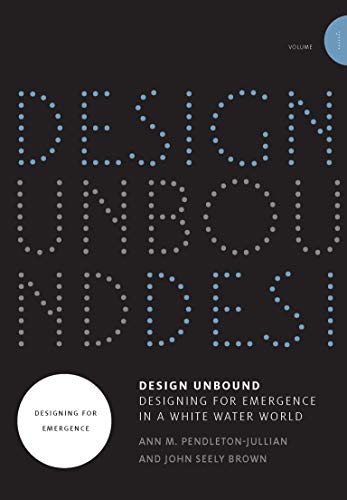
Synopsis
Tools for navigating today's hyper-connected, rapidly changing, and radically contingent white water world. Design Unbound presents a new tool set for having agency in the twenty-first century, in what the authors characterize as a white water world-rapidly changing, hyperconnected, and radically contingent. These are the tools of a new kind of practice that is the offspring of complexity science, which gives us a new lens through which to view the world as entangled and emerging, and architecture, which is about designing contexts. In such a practice, design, unbound from its material thingness, is set free to design contexts as complex systems. In a world where causality is systemic, entangled, in flux, and often elusive, we cannot design for absolute outcomes. Instead, we need to design for emergence. Design Unbound not only makes this case through theory but also presents a set of tools to do so. With case studies that range from a new kind of university to organizational, and even societal, transformation, Design Unbound draws from a vast array of domains: architecture, science and technology, philosophy, cinema, music, literature and poetry, even the military. It is presented in five books, bound as two volumes. Different books within the larger system of books will resonate with different reading audiences, from architects to people reconceiving higher education to the public policy or defense and intelligence communities. The authors provide different entry points allowing readers to navigate their own pathways through the system of books.
"synopsis" may belong to another edition of this title.
About the Author
Ann M. Pendleton-Jullian is an architect, writer, and educator. She is a Fellow at Stanford University's Center for Advanced Study in the Behavioral Sciences (CASBS), Professor and former Director at the Knowlton School of Architecture at Ohio State University, and Distinguished Visiting Professor of Design at Georgetown University and the Pardee RAND Graduate School of Public Policy. Previously, she was a Professor at MIT for fifteen years. John Seely Brown is the former Chief Scientist at Xerox and Director of its Palo Alto Research Center (PARC). He is currently Independent Cochair for Deloitte's Center for the Edge, advisor to the Provost at University of Southern California. He is coauthor of The Social Life of Information and other books.
"About this title" may belong to another edition of this title.
Search results for Design Unbound: Designing for Emergence in a White...

Stock Image
Design Unbound: Designing for Emergence in a White Water World: Designing for Emergence
Seller: World of Books (was SecondSale), Montgomery, IL, U.S.A.
Seller rating 5 out of 5 stars

Paperback. Condition: Good. Tools for navigating today's hyper-connected, rapidly changing, and radically contingent white water world. Design Unbound presents a new tool set for having agency in the twenty-first century, in what the authors characterize as a white water world-rapidly changing, hyperconnected, and radically contingent. These are the tools of a new kind of practice that is the offspring of complexity science, which gives us a new lens through which to view the world as entangled and emerging, and architecture, which is about designing contexts. In such a practice, design, unbound from its material thingness, is set free to design contexts as complex systems. In a world where causality is systemic, entangled, in flux, and often elusive, we cannot design for absolute outcomes. Instead, we need to design for emergence. Design Unbound not only makes this case through theory but also presents a set of tools to do so. With case studies that range from a new kind of university to organizational, and even societal, transformation, Design Unbound draws from a vast array of domains: architecture, science and technology, philosophy, cinema, music, literature and poetry, even the military. It is presented in five books, bound as two volumes. Different books within the larger system of books will resonate with different reading audiences, from architects to people reconceiving higher education to the public policy or defense and intelligence communities. The authors provide different entry points allowing readers to navigate their own pathways through the system of books. Seller Inventory # 00106620705
Stock Image
Design Unbound: Designing for Emergence in a White Water World: Designing for Emergence
Seller: World of Books (was SecondSale), Montgomery, IL, U.S.A.
Seller rating 5 out of 5 stars
Paperback. Condition: Very Good. Tools for navigating today's hyper-connected, rapidly changing, and radically contingent white water world. Design Unbound presents a new tool set for having agency in the twenty-first century, in what the authors characterize as a white water world-rapidly changing, hyperconnected, and radically contingent. These are the tools of a new kind of practice that is the offspring of complexity science, which gives us a new lens through which to view the world as entangled and emerging, and architecture, which is about designing contexts. In such a practice, design, unbound from its material thingness, is set free to design contexts as complex systems. In a world where causality is systemic, entangled, in flux, and often elusive, we cannot design for absolute outcomes. Instead, we need to design for emergence. Design Unbound not only makes this case through theory but also presents a set of tools to do so. With case studies that range from a new kind of university to organizational, and even societal, transformation, Design Unbound draws from a vast array of domains: architecture, science and technology, philosophy, cinema, music, literature and poetry, even the military. It is presented in five books, bound as two volumes. Different books within the larger system of books will resonate with different reading audiences, from architects to people reconceiving higher education to the public policy or defense and intelligence communities. The authors provide different entry points allowing readers to navigate their own pathways through the system of books. Seller Inventory # 00107159950
Stock Image
Design Unbound: Designing for Emergence in a White Water World, Volume 1: Designing for Emergence (Infrastructures)
Seller: Midtown Scholar Bookstore, Harrisburg, PA, U.S.A.
Seller rating 5 out of 5 stars
paperback. Condition: Acceptable. With internal markings in pen Acceptable, Reading copy only, with writing/markings, bumps/creasing, and heavy wear. Oversized. Seller Inventory # mon0000293862
Stock Image
Design Unbound: Designing for Emergence in a White Water World: Designing for Emergence
Seller: World of Books Inc, Montgomery, IL, U.S.A.
Seller rating 4 out of 5 stars

Paperback. Condition: Very Good. Tools for navigating today's hyper-connected, rapidly changing, and radically contingent white water world. Design Unbound presents a new tool set for having agency in the twenty-first century, in what the authors characterize as a white water world-rapidly changing, hyperconnected, and radically contingent. These are the tools of a new kind of practice that is the offspring of complexity science, which gives us a new lens through which to view the world as entangled and emerging, and architecture, which is about designing contexts. In such a practice, design, unbound from its material thingness, is set free to design contexts as complex systems. In a world where causality is systemic, entangled, in flux, and often elusive, we cannot design for absolute outcomes. Instead, we need to design for emergence. Design Unbound not only makes this case through theory but also presents a set of tools to do so. With case studies that range from a new kind of university to organizational, and even societal, transformation, Design Unbound draws from a vast array of domains: architecture, science and technology, philosophy, cinema, music, literature and poetry, even the military. It is presented in five books, bound as two volumes. Different books within the larger system of books will resonate with different reading audiences, from architects to people reconceiving higher education to the public policy or defense and intelligence communities. The authors provide different entry points allowing readers to navigate their own pathways through the system of books. Seller Inventory # CIN0262535793VG
Stock Image
Design Unbound
Seller: Books Puddle, Woodside, NY, U.S.A.
Seller rating 4 out of 5 stars
Condition: New. Seller Inventory # 26376413048
Stock Image
Design Unbound: Designing for Emergence in a White Water World, Volume 1: Designing for Emergence
Seller: medimops, Berlin, Germany
Seller rating 5 out of 5 stars
Condition: very good. Gut/Very good: Buch bzw. Schutzumschlag mit wenigen Gebrauchsspuren an Einband, Schutzumschlag oder Seiten. / Describes a book or dust jacket that does show some signs of wear on either the binding, dust jacket or pages. Seller Inventory # M00262535793-V
Stock Image
Design Unbound : Designing for Emergence in a White Water World
Seller: GreatBookPrices, Columbia, MD, U.S.A.
Seller rating 5 out of 5 stars
Condition: As New. Unread book in perfect condition. Seller Inventory # 32453313
Stock Image
Design Unbound Format: Paperback
Seller: INDOO, Avenel, NJ, U.S.A.
Seller rating 5 out of 5 stars
Condition: As New. Unread copy in mint condition. Seller Inventory # RH9780262535793
Stock Image
Design Unbound : Designing for Emergence in a White Water World
Seller: GreatBookPrices, Columbia, MD, U.S.A.
Seller rating 5 out of 5 stars
Condition: New. Seller Inventory # 32453313-n
Stock Image
Design Unbound Format: Paperback
Seller: INDOO, Avenel, NJ, U.S.A.
Seller rating 5 out of 5 stars
Condition: New. Brand New. Seller Inventory # 9780262535793