
Items related to Evocative Objects – Things We Think With
Synopsis
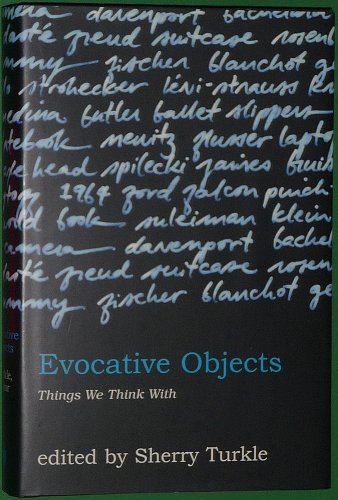
For Sherry Turkle, "We think with the objects we love; we love the objects we think with." In Evocative Objects, Turkle collects writings by scientists, humanists, artists, and designers that trace the power of everyday things. These essays reveal objects as emotional and intellectual companions that anchor memory, sustain relationships, and provoke new ideas.These days, scholars show new interest in the importance of the concrete. This volume's special contribution is its focus on everyday riches: the simplest of objects--an apple, a datebook, a laptop computer--are shown to bring philosophy down to earth. The poet contends, "No ideas but in things." The notion of evocative objects goes further: objects carry both ideas and passions. In our relations to things, thought and feeling are inseparable.Whether it's a student's beloved 1964 Ford Falcon (left behind for a station wagon and motherhood), or a cello that inspires a meditation on fatherhood, the intimate objects in this collection are used to reflect on larger themes--the role of objects in design and play, discipline and desire, history and exchange, mourning and memory, transition and passage, meditation and new vision.In the interest of enriching these connections, Turkle pairs each autobiographical essay with a text from philosophy, history, literature, or theory, creating juxtapositions at once playful and profound. So we have Howard Gardner's keyboards and Lev Vygotsky's hobbyhorses; William Mitchell's Melbourne train and Roland Barthes' pleasures of text; Joseph Cevetello's glucometer and Donna Haraway's cyborgs. Each essay is framed by images that are themselves evocative. Essays by Turkle begin and end the collection, inviting us to look more closely at the everyday objects of our lives, the familiar objects that drive our routines, hold our affections, and open out our world in unexpected ways.
"synopsis" may belong to another edition of this title.
Review
"Evocative Objects is a collection of great richness and complexity. Reading these essays transforms one's sense of the most commonplace objects, and prompts us to explore the palimpsest of the past within us." --Jill Ker Conway, President Emerita, Smith College, author of The Road from Coorain "Original, absorbing, and beautifully written, this collection of essays will forever change the way you look at the objects in your life." --Helen Epstein, author of Children of the Holocaust and Where She Came From: A Daughter's Search for her Mother's History
Synopsis
Autobiographical essays, framed by two interpretive essays by the editor, describe the power of an object to evoke emotion and provoke thought: reflections on a cello, a laptop computer, a 1964 Ford Falcon, an apple, a mummy in a museum, and other "things-to-think-with." For Sherry Turkle, "We think with the objects we love; we love the objects we think with." In "Evocative Objects", Turkle collects writings by scientists, humanists, artists, and designers that trace the power of everyday things. These essays reveal objects as emotional and intellectual companions that anchor memory, sustain relationships, and provoke new ideas. These days, scholars show new interest in the importance of the concrete. This volume's special contribution is its focus on everyday riches: the simplest of objects - an apple, a datebook, a laptop computer - are shown to bring philosophy down to earth. The poet contends, "No ideas but in things." The notion of evocative objects goes further: objects carry both ideas and passions. In our relations to things, thought and feeling are inseparable.
Whether it's a student's beloved 1964 Ford Falcon (left behind for a station wagon and motherhood), or a cello that inspires a meditation on fatherhood, the intimate objects in this collection are used to reflect on larger themes - the role of objects in design and play, discipline and desire, history and exchange, mourning and memory, transition and passage, meditation and new vision. In the interest of enriching these connections, Turkle pairs each autobiographical essay with a text from philosophy, history, literature, or theory, creating juxtapositions at once playful and profound. So we have Howard Gardner's keyboards and Lev Vygotsky's hobbyhorses; William Mitchell's Melbourne train and Roland Barthes' pleasures of text; Joseph Cevetello's glucometer and Donna Haraway's cyborgs. Each essay is framed by images that are themselves evocative. Essays by Turkle begin and end the collection, inviting us to look more closely at the everyday objects of our lives, the familiar objects that drive our routines, hold our affections, and open out our world in unexpected ways."About this title" may belong to another edition of this title.
Search results for Evocative Objects – Things We Think With

Stock Image
Evocative Objects: Things We Think With
Seller: ANARTIST, New York, NY, U.S.A.
Seller rating 5 out of 5 stars

Hardcover with dustjacket, 386 pages; good condition; pen marks in margins of first 12 pages; a few pages dog-eared. Foreign shipping may be extra. Seller Inventory # EvTuMI7
Stock Image
Evocative Objects : Things We Think With
Published by
MIT Press, 2007
ISBN 10: 0262201682
ISBN 13: 9780262201681
Used
Hardcover
First Edition
Seller: Better World Books, Mishawaka, IN, U.S.A.
Seller rating 5 out of 5 stars
Condition: Good. 1st Edition. Former library copy. Pages intact with minimal writing/highlighting. The binding may be loose and creased. Dust jackets/supplements are not included. Includes library markings. Stock photo provided. Product includes identifying sticker. Better World Books: Buy Books. Do Good. Seller Inventory # 5467931-6
Stock Image
Evocative Objects Things We Think With
Published by
MIT Press, Cambridge, Mass - .London, England, 2007
ISBN 10: 0262201682
ISBN 13: 9780262201681
Used
Hardcover
First Edition
Seller: Ann Open Book, Lansing, MI, U.S.A.
Seller rating 5 out of 5 stars
Hardcover. Condition: Very Good. Dust Jacket Condition: Very Good. 1st Edition. Seller Inventory # 187835
Seller Image
Evocative Objects: Things We Think With
Seller: Black Tree Books, Davenport Center, NY, U.S.A.
Seller rating 4 out of 5 stars

Hardcover. Condition: Fine. Dust Jacket Condition: Fine. 4th Edition. Fine in a fine wrapper. Bright and clean copy. Sharp corners. Tight and square copy. Light sticker residue on spine panel. Internally, the pages are bright, clean and free from notations or marginalia. A gift condition copy. Seller Inventory # 8004
Seller Image
Evocative Objects: Things We Think With
Seller: Diatrope Books, Berkeley, CA, U.S.A.
Seller rating 5 out of 5 stars
Hardcover. Condition: Very Good. Dust Jacket Condition: very good. Unmarked text. Dust jacket under clear archival mylar cover. Edited by Sherry Turkle, with introductory and closing essays. Contributors include Tod Machover, Howard Gardner, Gail Wight, William J. Mitchell, Caroline A. Jones, Evelyn Fox Keller, and others. Notes. Bibliography. Illustrations. 385p. Measures 5.5x8.25 inches. Seller Inventory # 31917
Stock Image
Evocative Objects: Things We Think With
Published by
Massachusetts Institute of Technology, Cambridge, MA, 2007
ISBN 10: 0262201682
ISBN 13: 9780262201681
Used
Hardcover
Seller: Voyageur Book Shop, Milwaukee, WI, U.S.A.
Seller rating 5 out of 5 stars
Hardcover. Condition: As New. Dust Jacket Condition: As New. 385pp. Size: 8vo - over 7¾" - 9¾" tall A1. Seller Inventory # 001034
Stock Image
Evocative Objects: Things We Think With (with a signed, warm dedication by Turkle)
Published by
Mit Pr, 2007
ISBN 10: 0262201682
ISBN 13: 9780262201681
Used
Hardcover
First Edition
Signed
Seller: Tim's Used Books Provincetown Mass., Provincetown, MA, U.S.A.
Seller rating 5 out of 5 stars
Hardcover. Condition: Very Good. Dust Jacket Condition: Very Good. 1st Edition. No marks in text. Not a library book. Ships today in a cardboard enclosure, with tracking. One copy only of this title at this price. The book you see listed here is the book you'll receive. Tim's Used Books, open shop in Provincetown, Mass., recognized for great books and great service since 1991. shelf LL/second from right. Inscribed by Author(s). Seller Inventory # 269147
Seller Image
Evocative Objects: Things We Think With
Seller: Goodwill of Greater Milwaukee and Chicago, Racine, WI, U.S.A.
Seller rating 5 out of 5 stars
Condition: good. Book is considered to be in good or better condition. The actual cover image may not match the stock photo. Hard cover books may show signs of wear on the spine, cover or dust jacket. Paperback book may show signs of wear on spine or cover as well as having a slight bend, curve or creasing to it. Book should have minimal to no writing inside and no highlighting. Pages should be free of tears or creasing. Stickers should not be present on cover or elsewhere, and any CD or DVD expected with the book is included. Book is not a former library copy. Seller Inventory # SEWV.0262201682.G
Seller Image
Evocative Objects: Things We Think With
Seller: Solr Books, Lincolnwood, IL, U.S.A.
Seller rating 5 out of 5 stars
Condition: acceptable. This book is in Acceptable condition. All pages are intact, but may have lots of notes, water damage or other issues and be ex library. Seller Inventory # BCV.0262201682.A
Stock Image
Evocative Objects:; Things We Think With
Published by
The MIT Press, 2007
ISBN 10: 0262201682
ISBN 13: 9780262201681
Used
Hardcover
First Edition
Seller: B-Line Books, Amherst, NS, Canada
Seller rating 5 out of 5 stars
Hardcover. Condition: Fine. Dust Jacket Condition: Fine. First Edition; First Printing. Stiff unmarked book in crisp dust jacket. About new; 8.1 X 5.7 X 1.2 inches; 400 pages; For Sherry Turkle, "We think with the objects we love; we love the objects we think with." In Evocative Objects, Turkle collects writings by scientists, humanists, artists, and designers that trace the power of everyday things. These essays reveal objects as emotional and intellectual companions that anchor memory, sustain relationships, and provoke new ideas. These days, scholars show new interest in the importance of the concrete. This volume's special contribution is its focus on everyday riches: the simplest of objects--an apple, a datebook, a laptop computer--are shown to bring philosophy down to earth. The poet contends, "No ideas but in things." The notion of evocative objects goes further: objects carry both ideas and passions. In our relations to things, thought and feeling are inseparable. Whether it's a student's beloved 1964 Ford Falcon (left behind for a station wagon and motherhood) , or a cello that inspires a meditation on fatherhood, the intimate objects in this collection are used to reflect on larger themes--the role of objects in design and play, discipline and desire, history and exchange, mourning and memory, transition and passage, meditation and new vision. In the interest of enriching these connections, Turkle pairs each autobiographical essay with a text from philosophy, history, literature, or theory, creating juxtapositions at once playful and profound. So we have Howard Gardner's keyboards and Lev Vygotsky's hobbyhorses; William Mitchell's Melbourne train and Roland Barthes' pleasures of text; Joseph Cevetello's glucometer and Donna Haraway's cyborgs. Each essay is framed by images that are themselves evocative. Essays by Turkle begin and end the collection, inviting us to look more closely at the everyday objects of our lives, the familiar objects that drive our routines, hold our affections, and open out our world in unexpected ways. Seller Inventory # 56674