
Items related to Evolutionary Robotics – The Biology, Intelligence...
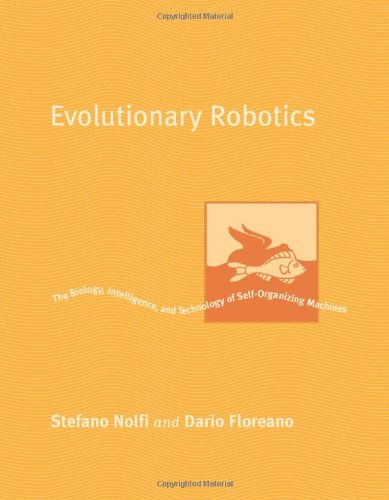
Evolutionary Robotics – The Biology, Intelligence & Technology of Self–Organizing Machines: The Biology, Intelligence and Technology of ... Robotics & Autonomous Agents Series) - Hardcover
Synopsis
Evolutionary robotics is a new technique for the automatic creation of autonomous robots. Inspired by the Darwinian principle of selective reproduction of the fittest, it views robots as autonomous artificial organisms that develop their own skills in close interaction with the environment and without human intervention. Drawing heavily on biology and ethology, it uses the tools of neural networks, genetic algorithms, dynamic systems, and biomorphic engineering. The resulting robots share with simple biological systems the characteristics of robustness, simplicity, small size, flexibility, and modularity.
In evolutionary robotics, an initial population of artificial chromosomes, each encoding the control system of a robot, is randomly created and put into the environment. Each robot is then free to act (move, look around, manipulate) according to its genetically specified controller while its performance on various tasks is automatically evaluated. The fittest robots then "reproduce" by swapping parts of their genetic material with small random mutations. The process is repeated until the "birth" of a robot that satisfies the performance criteria.
This book describes the basic concepts and methodologies of evolutionary robotics and the results achieved so far. An important feature is the clear presentation of a set of empirical experiments of increasing complexity. Software with a graphic interface, freely available on a Web page, will allow the reader to replicate and vary (in simulation and on real robots) most of the experiments.
"synopsis" may belong to another edition of this title.
Review
"Highly recommended for all involved in the field of evolutionary robotics. It will be an important reference for experimental and theoretical studies in evolutionary robotics for quite some time." - Horatiu Voicu, AI Magazine; "An informative and inspiring book that provides a thorough examination of the subject." - Industrial Robot: An International Journal"
About the Author
Stefano Nolfi is research director at the Institute of Cognitive Science and Tecnology and head of the Laboratory of Artificial Life and Robotics. He coordinated the European project ECAgents (Embodied and Communicating Agents) and is team leader of the European Projects I-TALK (Transfer of Action and Language Knowledge in Robots) and Swarmanoid (Towards Humanoid Robotic Swarms Humanoids). Dario Floreano is Director of the Laboratory of Intelligent Systems at the Swiss Federal Institute of Technology in Lausanne (EPFL). He is the coauthor of Evolutionary Robotics: The Biology, Intelligence, and Technology of Self-Organizing Machines (MIT Press, 2000).
"About this title" may belong to another edition of this title.
Search results for Evolutionary Robotics – The Biology, Intelligence...

Stock Image
Evolutionary Robotics: The Biology, Intelligence, and Technology of Self-Organizing Machines (Intelligent Robotics and Autonomous Agents)
Published by
Bradford Books, 2001
ISBN 10: 0262140705
ISBN 13: 9780262140706
Used
Hardcover
First Edition
Seller: Jackson Street Booksellers, Omaha, NE, U.S.A.
Seller rating 5 out of 5 stars

Hardcover. Condition: Fine. 1st Edition. Fine copy in hardcover with fine jacket. Small 4to. Seller Inventory # 052014
Seller Image
Evolutionary Robotics: The Biology, Intelligence, and Technology of Self-Organizing Machines (Intelligent Robotics and Autonomous Agents)
Seller: Manitou Books, Manitou Springs, CO, U.S.A.
Seller rating 5 out of 5 stars
Hardcover. Condition: Very Good. Dust Jacket Condition: Good. Inside is clean and unmarked. Crease on book board at bottom of spine (see photo 6). Dust jacket has fading on spine and creasing at edges. See photos. Seller Inventory # ABE-1777778468571
Stock Image
Evolutionary Robotics The Biology, Intelligence & Technology of Self-Organizing Machines
Seller: Harry Alter, Sylva, NC, U.S.A.
Seller rating 5 out of 5 stars
hardcover, Condition: Very Good, MIT Press, c.2000, 1st., 7-1/4"x9-1/4", cloth, 320pp., NF/NF $. Seller Inventory # 92635
Stock Image
Evolutionary Robotics: The Biology, Intelligence, and Technology of Self-Organizing Machines (Intelligent Robotics and Autonomous Agents)
Seller: Mispah books, Redhill, SURRE, United Kingdom
Seller rating 4 out of 5 stars

Hardcover. Condition: Good. Good .Ships From Multiple Locations. book. Seller Inventory # ERICA79102621407055
Stock Image
Evolutionary Robotics: The Biology, Intelligence And Technology Of Self-Organizing Machines (Intelligent Robotics & Autonomous Agents)
Seller: SZ Global, Toronto, ON, Canada
Seller rating 5 out of 5 stars
Hardcover. Condition: New. Evolutionary robotics is a new technique for the automatic creation of autonomous robots. Inspired by the Darwinian principle of selective reproduction of the fittest, it views robots as autonomous artificial organisms that develop their own skills in close interaction with the environment and without human intervention. Drawing heavily on biology and ethology, it uses the tools of neural networks, genetic algorithms, dynamic systems, and biomorphic engineering. The resulting robots share with simple biological systems the characteristics of robustness, simplicity, small size, flexibility, and modularity.In evolutionary robotics, an initial population of artificial chromosomes, each encoding the control system of a robot, is randomly created and put into the environment. Each robot is then free to act (move, look around, manipulate) according to its genetically specified controller while its performance on various tasks is automatically evaluated. The fittest robots then 'reproduce' by swapping parts of their genetic material with small random mutations. The process is repeated until the 'birth' of a robot that satisfies the performance criteria.This book describes the basic concepts and methodologies of evolutionary robotics and the results achieved so far. An important feature is the clear presentation of a set of empirical experiments of increasing complexity. Software with a graphic interface, freely available on a Web page, will allow the reader to replicate and vary (in simulation and on real robots) most of the experiments. Seller Inventory # 9780262140706