
Items related to Ditital Ground – Architecture, Pervasive Computing...
Synopsis
A theory of place for interaction design.
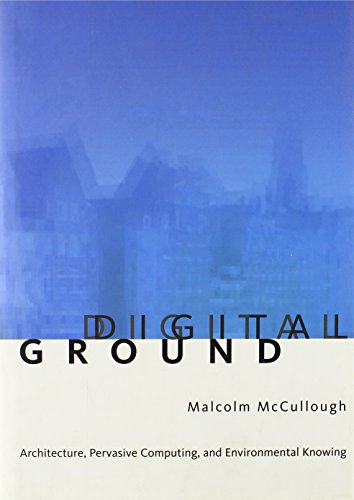
Digital Ground is an architect's response to the design challenge posed by pervasive computing. One century into the electronic age, people have become accustomed to interacting indirectly, mediated through networks. But now as digital technology becomes invisibly embedded in everyday things, even more activities become mediated, and networks extend rather than replace architecture. The young field of interaction design reflects not only how people deal with machine interfaces but also how people deal with each other in situations where interactivity has become ambient. It shifts previously utilitarian digital design concerns to a cultural level, adding notions of premise, appropriateness, and appreciation.
Malcolm McCullough offers an account of the intersections of architecture and interaction design, arguing that the ubiquitous technology does not obviate the human need for place. His concept of "digital ground" expresses an alternative to anytime-anyplace sameness in computing; he shows that context not only shapes usability but ideally becomes the subject matter of interaction design and that "environmental knowing" is a process that technology may serve and not erode.
Drawing on arguments from architecture, psychology, software engineering, and geography, writing for practicing interaction designers, pervasive computing researchers, architects, and the general reader on digital culture, McCullough gives us a theory of place for interaction design. Part I, "Expectations," explores our technological predispositions—many of which ("situated interactions") arise from our embodiment in architectural settings. Part II, "Technologies," discusses hardware, software, and applications, including embedded technology ("bashing the desktop"), and building technology genres around life situations. Part III, "Practices," argues for design as a liberal art, seeing interactivity as a cultural—not only technological—challenge and a practical notion of place as essential. Part IV, "Epilogue," acknowledges the epochal changes occurring today, and argues for the role of "digital ground" in the necessary adaptation.
"synopsis" may belong to another edition of this title.
About the Author
Malcolm McCullough is Professor of Architecture at Taubman College, the University of Michigan. He is the author of Abstracting Craft: The Practiced Digital Hand and Digital Ground: Architecture, Pervasive Computing, and Environmental Knowing, both published by the MIT Press.
"About this title" may belong to another edition of this title.
Search results for Ditital Ground – Architecture, Pervasive Computing...

Stock Image
Ditital Ground â" Architecture, Pervasive Computing and Environmental Knowing
Seller: WorldofBooks, Goring-By-Sea, WS, United Kingdom
Seller rating 5 out of 5 stars

Hardback. Condition: Very Good. The book has been read, but is in excellent condition. Pages are intact and not marred by notes or highlighting. The spine remains undamaged. Seller Inventory # GOR006689519
Buy Used
£ 3.42
£ 5.60 shipping
Ships from United Kingdom to U.S.A.
Ships from United Kingdom to U.S.A.
Quantity: 2 available
Stock Image
Digital Ground : Architecture, Pervasive Computing, and Environmental Knowing
Seller: Better World Books: West, Reno, NV, U.S.A.
Seller rating 5 out of 5 stars
Condition: Very Good. Former library copy. Pages intact with possible writing/highlighting. Binding strong with minor wear. Dust jackets/supplements may not be included. Includes library markings. Stock photo provided. Product includes identifying sticker. Better World Books: Buy Books. Do Good. Seller Inventory # GRP98518385
Stock Image
Digital Ground : Architecture, Pervasive Computing, and Environmental Knowing
Seller: Better World Books Ltd, Dunfermline, United Kingdom
Seller rating 5 out of 5 stars
Condition: Good. Former library copy. Pages intact with minimal writing/highlighting. The binding may be loose and creased. Dust jackets/supplements are not included. Includes library markings. Stock photo provided. Product includes identifying sticker. Better World Books: Buy Books. Do Good. Seller Inventory # GRP21075553
Buy Used
£ 6.45
£ 5 shipping
Ships from United Kingdom to U.S.A.
Ships from United Kingdom to U.S.A.
Quantity: 2 available
Stock Image
Digital Ground: Architecture, Pervasive Computing, and Environmental Knowing
Published by
MIT Press, Cambridge, (2004), 2004
ISBN 10: 0262134357
ISBN 13: 9780262134354
Used
Hardcover
Seller: Heartwood Books, A.B.A.A., Charlottesville, VA, U.S.A.
Seller rating 5 out of 5 stars
Cloth. Condition: Fine. Dust Jacket Condition: Near Fine. Fine, internally clean, solid hardback in a Near Fine dust jacket with a few stray ink marks on the spine. #. Seller Inventory # 7863
Stock Image
Digital Ground: Architecture, Pervasive Computing, and Environmental Knowing
Seller: Roundabout Books, Greenfield, MA, U.S.A.
Seller rating 4 out of 5 stars

hardcover. Condition: Near Fine. Condition Notes: Excellent, unmarked copy with little wear and tight binding. We ship in recyclable American-made mailers. 100% money-back guarantee on all orders. Seller Inventory # 1608011
Stock Image
Digital Ground: Architecture, Pervasive Computing, and Environmental Knowing
Seller: ThriftBooks-Atlanta, AUSTELL, GA, U.S.A.
Seller rating 5 out of 5 stars
Hardcover. Condition: As New. No Jacket. Pages are clean and are not marred by notes or folds of any kind. ~ ThriftBooks: Read More, Spend Less. Seller Inventory # G0262134357I2N00
Seller Image
Digital Ground: Architecture, Pervasive Computing, and Environmental Knowing
Seller: Shakespeare Book House, Rockford, IL, U.S.A.
Seller rating 5 out of 5 stars
Condition: new. Seller Inventory # EBBV.0262134357.N
Stock Image
Ditital Ground - Architecture, Pervasive Computing and Environmental Knowing
Seller: Ammareal, Morangis, France
Seller rating 5 out of 5 stars
Hardcover. Condition: Bon. Ancien livre de bibliothèque avec équipements. Couverture différente. Edition 2004. Ammareal reverse jusqu'à 15% du prix net de cet article à des organisations caritatives. ENGLISH DESCRIPTION Book Condition: Used, Good. Former library book. Different cover. Edition 2004. Ammareal gives back up to 15% of this item's net price to charity organizations. Seller Inventory # G-317-357
Stock Image
Digital Ground: Architecture, Pervasive Computing, and Environmental Knowing
Seller: Boswell's Books, Shelburne Falls, MA, U.S.A.
Seller rating 4 out of 5 stars
hardcover. Condition: Near Fine. Condition Notes: Excellent, unmarked copy with little wear and tight binding. We ship in recyclable American-made mailers. 100% money-back guarantee on all orders. Seller Inventory # 1608011
Stock Image
Digital Ground. Architecture, Pervasive Computing, and Environmental Knowing
Seller: Barksdale Books, Almere, Netherlands
Seller rating 5 out of 5 stars
Condition: Good. A theory of place for interaction design. Digital Ground is an architect's response to the design challenge posed by pervasive computing. One century into the electronic age, people have become accustomed to interacting indirectly, mediated through networks. But now as digital technology becomes invisibly embedded in everyday things, even more activities become mediated, and networks extend rather than replace architecture. The young field of interaction design reflects not only how people deal with machine interfaces but also how people deal with each other in situations where interactivity has become ambient. It shifts previously utilitarian digital design concerns to a cultural level, adding notions of premise, appropriateness, and appreciation. Malcolm McCullough offers an account of the intersections of architecture and interaction design, arguing that the ubiquitous technology does not obviate the human need for place. His concept of digital ground expresses an alternative to anytime-anyplace sameness in computing; he shows that context not only shapes usability but ideally becomes the subject matter of interaction design and that environmental knowing is a process that technology may serve and not erode. Drawing on arguments from architecture, psychology, software engineering, and geography, writing for practicing interaction designers, pervasive computing researchers, architects, and the general reader on digital culture, McCullough gives us a theory of place for interaction design. Part I, Expectations, explores our technological predispositions-many of which ( situated interactions ) arise from our embodiment in architectural settings. Part II, Technologies, discusses hardware, software, and applications, including embedded technology ( bashing the desktop ), and building technology genres around life situations. Part III, Practices, argues for design as a liberal art, seeing interactivity as a cultural-not only technological-challenge and a practical notion of place as essential. Part IV, Epilogue, acknowledges the epochal changes occurring today, and argues for the role of digital ground in the necessary adaptation.; Boek schoon, fris & gaaf; losse stofomslag met verwaarloosbare gebruikssporen. Seller Inventory # 928293
Buy Used
£ 8.83
£ 17.14 shipping
Ships from Netherlands to U.S.A.
Ships from Netherlands to U.S.A.
Quantity: 1 available