
Items related to The Plenitude – Creativity, Innovation and Making...
The Plenitude – Creativity, Innovation and Making Stuff (Simplicity: Design, Technology, Business, Life) - Hardcover
Synopsis
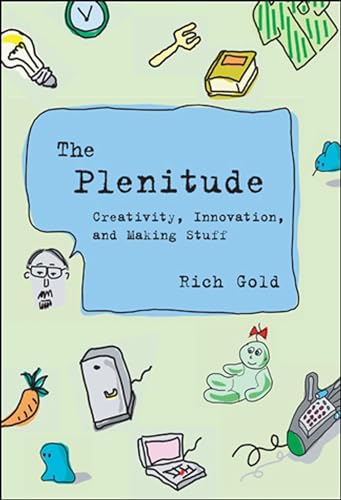
Lessons from and for the creative professions of art, science, design, and engineering: how to live in and with the Plenitude, that dense, knotted ecology of human-made stuff that creates the need for more of itself.
We live with a lot of stuff. The average kitchen, for example, is home to stuff galore, and every appliance, every utensil, every thing, is compound―composed of tens, hundreds, even thousands of other things. Although each piece of stuff satisfies some desire, it also creates the need for even more stuff: cereal demands a spoon; a television demands a remote. Rich Gold calls this dense, knotted ecology of human-made stuff the "Plenitude." And in this book―at once cartoon treatise, autobiographical reflection, and practical essay in moral philosophy―he tells us how to understand and live with it.
Gold writes about the Plenitude from the seemingly contradictory (but in his view, complementary) perspectives of artist, scientist, designer, and engineer―all professions pursued by him, sometimes simultaneously, in the course of his career. "I have spent my life making more stuff for the Plenitude," he writes, acknowledging that the Plenitude grows not only because it creates a desire for more of itself but also because it is extraordinary and pleasurable to create.
Gold illustrates these creative expressions with witty cartoons. He describes "seven patterns of innovation"―including "The Big Kahuna," "Colonization" (which is illustrated by a drawing of "The real history of baseball," beginning with "Play for free in the backyard" and ending with "Pay to play interactive baseball at home"), and "Stuff Desires to Be Better Stuff" (and its corollary, "Technology Desires to Be Product"). Finally, he meditates on the Plenitude itself and its moral contradictions. How can we in good conscience accept the pleasures of creating stuff that only creates the need for more stuff? He quotes a friend: "We should be careful to make the world we actually want to live in."
"synopsis" may belong to another edition of this title.
About the Authors
Rich Gold (1950-2003) was an artist, composer, designer, inventor, lecturer, and writer. Equally at home in the worlds of avant-garde art, academia, and business, he worked at various times for Sega, Mattel, and Xerox PARC.
An internationally recognized leader at the intersection of design and technology, John Maeda is Executive Vice President/Chief Experience Officer at Publicis Sapient. He was the 16th President of the Rhode Island School of Design (RISD). He is the author of Design by Numbers, The Laws of Simplicity, and Redesigning Leadership, all published by The MIT Press.
"About this title" may belong to another edition of this title.
Search results for The Plenitude – Creativity, Innovation and Making...

Stock Image
The Plenitude: Creativity, Innovation, and Making Stuff
Seller: World of Books (was SecondSale), Montgomery, IL, U.S.A.
Seller rating 5 out of 5 stars

Hardback. Condition: Good. Lessons from and for the creative professions of art, science, design, and engineering: how to live in and with the Plenitude, that dense, knotted ecology of human-made stuff that creates the need for more of itself.We live with a lot of stuff. The average kitchen, for example, is home to stuff galore, and every appliance, every utensil, every thing, is compound--composed of tens, hundreds, even thousands of other things. Although each piece of stuff satisfies some desire, it also creates the need for even more stuff: cereal demands a spoon; a television demands a remote. Rich Gold calls this dense, knotted ecology of human-made stuff the Plenitude. And in this book--at once cartoon treatise, autobiographical reflection, and practical essay in moral philosophy--he tells us how to understand and live with it.Gold writes about the Plenitude from the seemingly contradictory (but in his view, complementary) perspectives of artist, scientist, designer, and engineer--all professions pursued by him, sometimes simultaneously, in the course of his career. I have spent my life making more stuff for the Plenitude, he writes, acknowledging that the Plenitude grows not only because it creates a desire for more of itself but also because it is extraordinary and pleasurable to create.Gold illustrates these creative expressions with witty cartoons. He describes seven patterns of innovation--including The Big Kahuna, Colonization (which is illustrated by a drawing of The real history of baseball, beginning with Play for free in the backyard and ending with Pay to play interactive baseball at home), and Stuff Desires to Be Better Stuff (and its corollary, Technology Desires to Be Product). Finally, he meditates on the Plenitude itself and its moral contradictions. How can we in good conscience accept the pleasures of creating stuff that only creates the need for more stuff? He quotes a friend: We should be careful to make the world we actually want to live in. Seller Inventory # 00097655265
Seller Image
The Plenitude: Creativity, Innovation, and Making Stuff (Simplicity: Design, Technology, Business, Life)
Seller: Greenworld Books, Arlington, TX, U.S.A.
Seller rating 5 out of 5 stars
Condition: very_good. Fast Free Shipping â" Very Good condition book with a firm cover and clean pages. Shows normal use and some light wear or limited notes markings. A solid, nice copy to enjoy. Seller Inventory # GWV.0262072890.VG
Stock Image
The Plenitude: Creativity, Innovation, and Making Stuff (Simplicity: Design, Technology, Business, Life)
Seller: Evergreen Goodwill, Seattle, WA, U.S.A.
Seller rating 5 out of 5 stars
hardcover. Condition: Good. Seller Inventory # mon0000555283
Stock Image
The Plenitude: Creativity, Innovation, and Making Stuff (Simplicity: Design, Technology, Business, Life)
Seller: BRT Resales, DeLand, FL, U.S.A.
Seller rating 5 out of 5 stars
Hardcover. Condition: Very Good. Very Good hardcover 9780262072892. Seller Inventory # ABE-1780626426424
Stock Image
The Plenitude: Creativity, Innovation, and Making Stuff
Seller: World of Books Inc, Montgomery, IL, U.S.A.
Seller rating 4 out of 5 stars

Hardback. Condition: Good. Lessons from and for the creative professions of art, science, design, and engineering: how to live in and with the Plenitude, that dense, knotted ecology of human-made stuff that creates the need for more of itself.We live with a lot of stuff. The average kitchen, for example, is home to stuff galore, and every appliance, every utensil, every thing, is compound--composed of tens, hundreds, even thousands of other things. Although each piece of stuff satisfies some desire, it also creates the need for even more stuff: cereal demands a spoon; a television demands a remote. Rich Gold calls this dense, knotted ecology of human-made stuff the Plenitude. And in this book--at once cartoon treatise, autobiographical reflection, and practical essay in moral philosophy--he tells us how to understand and live with it.Gold writes about the Plenitude from the seemingly contradictory (but in his view, complementary) perspectives of artist, scientist, designer, and engineer--all professions pursued by him, sometimes simultaneously, in the course of his career. I have spent my life making more stuff for the Plenitude, he writes, acknowledging that the Plenitude grows not only because it creates a desire for more of itself but also because it is extraordinary and pleasurable to create.Gold illustrates these creative expressions with witty cartoons. He describes seven patterns of innovation--including The Big Kahuna, Colonization (which is illustrated by a drawing of The real history of baseball, beginning with Play for free in the backyard and ending with Pay to play interactive baseball at home), and Stuff Desires to Be Better Stuff (and its corollary, Technology Desires to Be Product). Finally, he meditates on the Plenitude itself and its moral contradictions. How can we in good conscience accept the pleasures of creating stuff that only creates the need for more stuff? He quotes a friend: We should be careful to make the world we actually want to live in. Seller Inventory # CIN0262072890G
Stock Image
The Plenitude : Creativity, Innovation, and Making Stuff
Seller: Better World Books, Mishawaka, IN, U.S.A.
Seller rating 5 out of 5 stars
Condition: Very Good. Pages intact with possible writing/highlighting. Binding strong with minor wear. Dust jackets/supplements may not be included. Stock photo provided. Product includes identifying sticker. Better World Books: Buy Books. Do Good. Seller Inventory # 9586870-6
Stock Image
The Plenitude : Creativity, Innovation, and Making Stuff
Seller: Better World Books: West, Reno, NV, U.S.A.
Seller rating 5 out of 5 stars
Condition: Very Good. Pages intact with possible writing/highlighting. Binding strong with minor wear. Dust jackets/supplements may not be included. Stock photo provided. Product includes identifying sticker. Better World Books: Buy Books. Do Good. Seller Inventory # 9586870-6
Stock Image
The Plenitude : Creativity, Innovation, and Making Stuff
Seller: Better World Books: West, Reno, NV, U.S.A.
Seller rating 5 out of 5 stars
Condition: Fine. Used book that is in almost brand-new condition. May contain a remainder mark. Better World Books: Buy Books. Do Good. Seller Inventory # 14243763-75
Stock Image
The Plenitude: Creativity, Innovation, and Making Stuff
Seller: ThriftBooks-Phoenix, Phoenix, AZ, U.S.A.
Seller rating 5 out of 5 stars
Hardcover. Condition: Very Good. No Jacket. May have limited writing in cover pages. Pages are unmarked. ~ ThriftBooks: Read More, Spend Less. Seller Inventory # G0262072890I4N00
Stock Image
The Plenitude: Creativity, Innovation, and Making Stuff
Seller: ThriftBooks-Dallas, Dallas, TX, U.S.A.
Seller rating 5 out of 5 stars
Hardcover. Condition: Good. No Jacket. Former library book; Pages can have notes/highlighting. Spine may show signs of wear. ~ ThriftBooks: Read More, Spend Less. Seller Inventory # G0262072890I3N10