
Items related to Memory Practices in the Sciences (Inside Technology)
Synopsis
Winner, 2007 Ludwig Fleck Prize given by the Society for Social Studies of Science (4S). and Awarded "Best Information Science Book 2006" by the American Society for Information Science and Technology (ASIS&T).
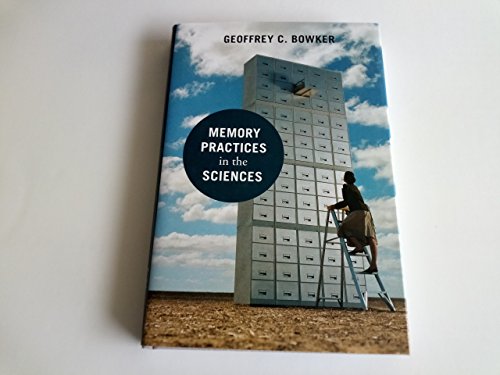
The way we record knowledge, and the web of technical, formal, and social practices that surrounds it, inevitably affects the knowledge that we record. The ways we hold knowledge about the past—in handwritten manuscripts, in printed books, in file folders, in databases—shape the kind of stories we tell about that past. In this lively and erudite look at the relation of our information infrastructures to our information, Geoffrey Bowker examines how, over the past two hundred years, information technology has converged with the nature and production of scientific knowledge. His story weaves a path between the social and political work of creating an explicit, indexical memory for science—the making of infrastructures—and the variety of ways we continually reconfigure, lose, and regain the past.
At a time when memory is so cheap and its recording is so protean, Bowker reminds us of the centrality of what and how we choose to forget. In Memory Practices in the Sciences he looks at three "memory epochs" of the nineteenth, twentieth, and twenty-first centuries and their particular reconstructions and reconfigurations of scientific knowledge. The nineteenth century's central science, geology, mapped both the social and the natural world into a single time package (despite apparent discontinuities), as, in a different way, did mid-twentieth-century cybernetics. Both, Bowker argues, packaged time in ways indexed by their information technologies to permit traffic between the social and natural worlds. Today's sciences of biodiversity, meanwhile, "database the world" in a way that excludes certain spaces, entities, and times. We use the tools of the present to look at the past, says Bowker; we project onto nature our modes of organizing our own affairs.
"synopsis" may belong to another edition of this title.
Review
--Howard S. Becker, author of "Art Worlds" and "Outsiders" --John Leslie King, Dean and Professor, School of Information, University of Michigan " With a sharp new perspective grounded firmly in a deep knowledge of both the natural and social sciences, Bowker reimagines the ancient topic of memory, showing us how our physical and social practices shape what we remember and thus what we know." --Howard S. Becker, author of "Art Worlds" and "Outsiders" " A brilliant and subtle analysis that uncovers and explains how conventions of naming, classifying, recording, and remembering create and preserve human knowledge. This book is required reading for all who do science or want to understand it--a real tour de force." --John Leslie King, Dean and Professor, School of Information, University of Michigan & quot; With a sharp new perspective grounded firmly in a deep knowledge of both the natural and social sciences, Bowker reimagines the ancient topic of memory, showing us how our physical and social practices shape what we remember and thus what we know.& quot; --Howard S. Becker, author of Art Worlds and Outsiders & quot; A brilliant and subtle analysis that uncovers and explains how conventions of naming, classifying, recording, and remembering create and preserve human knowledge. This book is required reading for all who do science or want to understand it--a real tour de force.& quot; --John Leslie King, Dean and Professor, School of Information, University of Michigan "With a sharp new perspective grounded firmly in a deep knowledge of both the natural and social sciences, Bowker reimagines the ancient topic of memory, showing us how our physical and social practices shape what we remember and thus what we know."--Howard S. Becker, author of "Art Worlds" and "Outsiders" "A brilliant and subtle analysis that uncovers and explains how conventions of naming, classifying, recording, and remembering create and preserve human knowledge. This book is required reading for all who do science or want to understand it--a real tour de force."--John Leslie King, Dean and Professor, School of Information, University of Michigan
About the Author
Geoffrey C. Bowker is Regis and Dianne McKenna Chair and Executive Director of the Center for Science, Technology, and Society at Santa Clara University.
"About this title" may belong to another edition of this title.
Search results for Memory Practices in the Sciences (Inside Technology)

Stock Image
Memory Practices in the Sciences
Seller: Better World Books, Mishawaka, IN, U.S.A.
Seller rating 5 out of 5 stars

Condition: Very Good. Pages intact with possible writing/highlighting. Binding strong with minor wear. Dust jackets/supplements may not be included. Stock photo provided. Product includes identifying sticker. Better World Books: Buy Books. Do Good. Seller Inventory # 57682327-6
Seller Image
Memory Practices in the Sciences (Inside Technology)
Seller: -OnTimeBooks-, Phoenix, AZ, U.S.A.
Seller rating 5 out of 5 stars
Condition: good. A copy that has been read, remains in good condition. All pages are intact, and the cover is intact. The spine and cover show signs of wear. Pages can include notes and highlighting and show signs of wear, and the copy can include "From the library of" labels or previous owner inscriptions. 100% GUARANTEE! Shipped with delivery confirmation, if you're not satisfied with purchase please return item! Ships via media mail. Seller Inventory # OTV.0262025892.G
Stock Image
Memory Practices in the Sciences
Published by
MIT Press, Massachusetts, 2005
ISBN 10: 0262025892
ISBN 13: 9780262025898
Used
Hardcover
First Edition
Seller: Webbooks, Wigtown, Wigtown, United Kingdom
Seller rating 5 out of 5 stars
Hard Cover. Condition: Good. No Jacket. First Edition. From an academic library with the usual stamps etc. OX3236. Seller Inventory # OX3236
Seller Image
Memory practices in the sciences
Published by
The MIT Press, Cambridge, Mass., 2005
ISBN 10: 0262025892
ISBN 13: 9780262025898
Used
Hardcover
First Edition
Seller: RightWayUp Books, Woodbridge, SUFFO, United Kingdom
Seller rating 5 out of 5 stars
Hardcover. Condition: Near Fine. Dust Jacket Condition: Very Good. 1st Edition. Bowker, Geoffrey C. Memory practices in the sciences. First edition. Cambridge, Mass.: The MIT Press, 2005. Hardback, near fine, in unclipped dustjacket, slightly bumped to top corners. Grey cloth with silver lettering to spine. Binding strong. xi, 261pp., contents clean and bright. How the way we hold knowledge about the past?in books, in file folders, in databases?affects the kind of stories we tell about the past. Geoffrey Bowker examines how, over the past two hundred years, information technology has converged with the nature and production of scientific knowledge. His story weaves a path between the social and political work of creating an explicit, indexical memory for science?the making of infrastructures?and the variety of ways we continually reconfigure, lose, and regain the past. RightWayUp Books aims to provide accurate and detailed descriptions. We do not use AI and all images are of the actual book for sale - no stock images are ever used. Thank you for looking at this listing. Seller Inventory # ABE-1784300329384
Buy Used
£ 20
£ 31.50 shipping
Ships from United Kingdom to U.S.A.
Ships from United Kingdom to U.S.A.
Quantity: 1 available
Seller Image
Memory Practices in the Sciences.
Published by
The MIT Press, Cambridge, 2005
ISBN 10: 0262025892
ISBN 13: 9780262025898
Used
Hardcover
Seller: Der Buchfreund, Wien, Austria
Seller rating 4 out of 5 stars

Original-Leinenband. Condition: Sehr gut. Dust Jacket Condition: Gut. gr8 Original-Leinenband en XI pp., 261 pp. Schutzumschlag: Gut. Seller Inventory # 2003278