
Items related to Autonomous Robots – From Biological Inspiration...
Autonomous Robots – From Biological Inspiration to Implemental and Control (Intelligent Robotics and Autonomous Agents series) - Hardcover
Synopsis
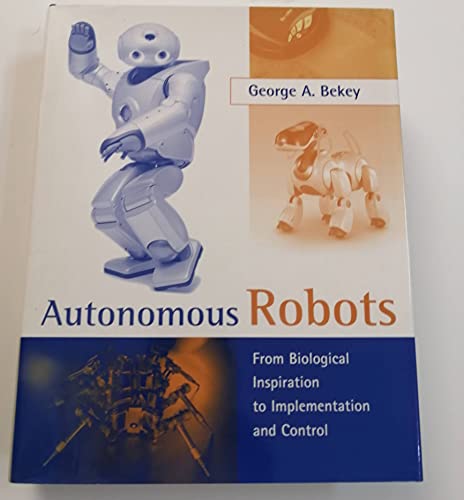
Autonomous robots are intelligent machines capable of performing tasks in the world by themselves, without explicit human control. Examples range from autonomous helicopters to Roomba, the robot vacuum cleaner. In this book, George Bekey offers an introduction to the science and practice of autonomous robots that can be used both in the classroom and as a reference for industry professionals. He surveys the hardware implementations of more than 300 current systems, reviews some of their application areas, and examines the underlying technology, including control, architectures, learning, manipulation, grasping, navigation, and mapping. Living systems can be considered the prototypes of autonomous systems, and Bekey explores the biological inspiration that forms the basis of many recent developments in robotics. He also discusses robot control issues and the design of control architectures. After an overview of the field that introduces some of its fundamental concepts, the book presents background material on hardware, control (from both biological and engineering perspectives), software architecture, and robot intelligence. It then examines a broad range of implementations and applications, including locomotion (wheeled, legged, flying, swimming, and crawling robots), manipulation (both arms and hands), localization, navigation, and mapping. The many case studies and specific applications include robots built for research, industry, and the military, among them underwater robotic vehicles, walking machines with four, six, and eight legs, and the famous humanoid robots "Cog," "Kismet," "Asimo," and "QRIO." The book concludes with reflections on the future of robotics - the potential benefits as well as the possible dangers that may arise from large numbers of increasingly intelligent and autonomous robots.
"synopsis" may belong to another edition of this title.
About the Author
George A. Bekey is Professor Emeritus in Computer Science at University of Southern California and Distinguished Professor of Engineering at California Polytechnic State University.
"About this title" may belong to another edition of this title.
Search results for Autonomous Robots – From Biological Inspiration...

Stock Image
Autonomous Robots: From Biological Inspiration to Implementation and Control (Intelligent Robotics and Autonomous Agents series)
Seller: KAKBooks, Duarte, CA, U.S.A.
Seller rating 5 out of 5 stars

Hardcover. Condition: Very Good. Hardcover edition, as pictured. ISBN #0262025787. Missing dust jacket. Binding is upside down. Some markings/highlighting. Seller Inventory # 2022-7-29 tor81
Seller Image
Autonomous Robots: From Biological Inspiration to Implementation and Control (Intelligent Robotics )
Seller: Fleur Fine Books, Port Neches, TX, U.S.A.
Seller rating 5 out of 5 stars
HARDCOVER. Condition: Used; Very Good. Used; Very Good. Autonomous robots are intelligent machines capable of performing tasks in the world by themselves, without explicit human control. Examples range from autonomous helicopters to Roomba, the robot vacuum cleaner. In this book, George Bekey offers an introduction to the science and practice of autonomous robots that can be used both in the classroom and as a reference for industry professionals. He surveys the hardware implementations of more than 300 current systems, reviews some of their application areas, and examines the underlying technology, including control, architectures, learning, manipulation, grasping, navigation, and mapping. Living systems can be considered the prototypes of autonomous systems, and Bekey explores the biological inspiration that forms the basis of many recent developments in robotics. He also discusses robot control issues and the design of control architectures.After an overview of the field that introduces some of its fundamental concepts, the book presents background material on hardware, control (from both biological and engineering perspectives), software architecture, and robot intelligence. It then examines a broad range of implementations and applications, including locomotion (wheeled, legged, flying, swimming, and crawling robots), manipulation (both arms and hands), localization, navigation, and mapping. The many case studies and specific applications include robots built for research, industry, and the military, among them underwater robotic vehicles, walking machines with four, six, and eight legs, and the famous humanoid robots Cog, Kismet, ASIMO,"and QRIO. The book concludes with reflections on the future of robotics -- the potential benefits as well as the possible dangers that may arise from large numbers of increasingly intelligent and autonomous robots . 0. HARDCOVER. Seller Inventory # 9780262025782
Stock Image
AUTONOMOUS ROBOTS: FROM BIOLOGICAL INSPIRATION TO IMPLEMENTATION AND CONTROL (INTELLIGENT ROBOTICS AND AUTONOMOUS AGENTS
Seller: lottabooks, ORANGE, CA, U.S.A.
Seller rating 5 out of 5 stars
HARDCOVER. Condition: NEW. Dust Jacket Condition: NEW. STILL IN THE ORIGINAL PUBLISHERS SHRINKWRAP. Seller Inventory # 54666
Stock Image
Autonomous Robots - From Biological Inspiration To Implementation And Control
Published by
First edition, published by The MIT Press, Cambridge, Massachusetts, 2005., 2005
ISBN 10: 0262025787
ISBN 13: 9780262025782
Used
Hardcover
First Edition
Seller: Jerry Merkel, XENIA, OH, U.S.A.
Seller rating 5 out of 5 stars
Hardcover. Condition: Near Fine. Dust Jacket Condition: Near Fine. 1st Edition. Very good to fine with very good to fine dust jacket. Dust jacket is lightly bumped at spine tips and corners. Book is bumped at bottom back corner. 577 pages with two indexes and many illustrations. Wide 8vo size. Seller Inventory # 16173
Stock Image
Autonomous Robots: From Biological Inspiration to Implementation and Control (Intelligent Robotics and Autonomous Agents series)
Seller: HPB-Red, Dallas, TX, U.S.A.
Seller rating 5 out of 5 stars
hardcover. Condition: Good. Connecting readers with great books since 1972! Used textbooks may not include companion materials such as access codes, etc. May have some wear or writing/highlighting. We ship orders daily and Customer Service is our top priority! Seller Inventory # S_438637728
Stock Image
Autonomous Robots â" From Biological Inspiration to Implemental and Control
Seller: WorldofBooks, Goring-By-Sea, WS, United Kingdom
Seller rating 5 out of 5 stars
Hardback. Condition: Very Good. The book has been read, but is in excellent condition. Pages are intact and not marred by notes or highlighting. The spine remains undamaged. Seller Inventory # GOR008729560
Buy Used
£ 57.08
£ 5.60 shipping
Ships from United Kingdom to U.S.A.
Ships from United Kingdom to U.S.A.
Quantity: 1 available