
Items related to How to Catch a Robot Rat – When Biology Inspires...
Synopsis
How biology has inspired technology -- from a watch with an alarm modeled on a cricket's noisemaking to a robot that can dance.
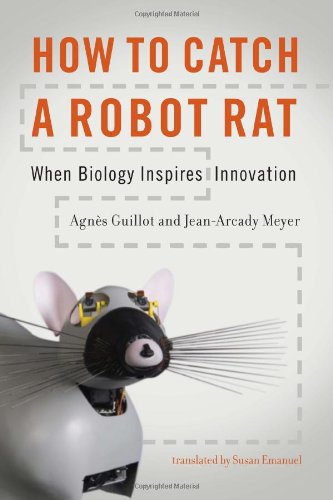
Humans have modeled their technology on nature for centuries. The inventor of paper was inspired by a wasp's nest; Brunelleschi demonstrated the principles of his famous dome with an egg; a Swiss company produced a wristwatch with an alarm modeled on the sound-producing capabilities of a cricket. Today, in the era of the "new bionics," engineers aim to reproduce the speed and maneuverability of the red tuna in a submarine; cochlear implants send sound signals to the auditory nerve of a hearing-impaired person; and robots replicate a baby's cognitive development. How to Catch a Robot Rat examines past, present, and future attempts to apply the methods and systems found in nature to the design of objects and devices.
The authors look at "natural technology transfers": how the study of nature inspired technological breakthroughs -- including the cricket-inspired watch; Velcro, which duplicates the prickly burrs of a burdock flower; and self-sharpening blades that are modeled on rats' self-sharpening teeth. They examine autonomous robots that imitate animals and their behaviors -- for example, the development of an unmanned microdrone that could fly like an albatross. And they describe hybrids of natural and artificial systems: neuroprostheses translating the thought of quadriplegics; and a nanorobot controlled by muscle cells. Some of the ideas described have outstripped technology's capacity to realize them; nature has had more than three billion years to perfect its designs, humankind not quite so long.
"synopsis" may belong to another edition of this title.
About the Authors
Agnès Guillot is Assistant Professor in Psychophysiology at the University of Paris X and a researcher at the Institute of Intelligent Systems and Robotics, University Pierre and Marie Curie, Paris.
Jean-Arcady Meyer is Emeritus Research Director at CNRS (Centre National de la Recherche Scientifique) and a researcher at the Institute of Intelligent Systems and Robotics, University Pierre and Marie Curie, Paris.
"About this title" may belong to another edition of this title.
Search results for How to Catch a Robot Rat – When Biology Inspires...

Stock Image
How to Catch a Robot Rat: When Biology Inspires Innovation
Seller: Bellwetherbooks, McKeesport, PA, U.S.A.
Seller rating 4 out of 5 stars

hardcover. Condition: Good. Crease/tear to cover. Seller Inventory # mon0000057183
Stock Image
How to Catch a Robot Rat : When Biology Inspires Innovation
Seller: Better World Books: West, Reno, NV, U.S.A.
Seller rating 5 out of 5 stars

Condition: Good. 0th Edition. Former library copy. Pages intact with minimal writing/highlighting. The binding may be loose and creased. Dust jackets/supplements are not included. Includes library markings. Stock photo provided. Product includes identifying sticker. Better World Books: Buy Books. Do Good. Seller Inventory # 2248151-6
Stock Image
How to Catch a Robot Rat : When Biology Inspires Innovation
Seller: Better World Books, Mishawaka, IN, U.S.A.
Seller rating 5 out of 5 stars
Condition: Good. 0th Edition. Former library copy. Pages intact with minimal writing/highlighting. The binding may be loose and creased. Dust jackets/supplements are not included. Includes library markings. Stock photo provided. Product includes identifying sticker. Better World Books: Buy Books. Do Good. Seller Inventory # 2248151-6
Stock Image
How to Catch a Robot Rat : When Biology Inspires Innovation
Seller: Better World Books, Mishawaka, IN, U.S.A.
Seller rating 5 out of 5 stars
Condition: Fine. 0th Edition. Used book that is in almost brand-new condition. May contain a remainder mark. Better World Books: Buy Books. Do Good. Seller Inventory # 18184625-6
Stock Image
How To Catch A Robot Rat When Biology Inspires Innovation
Published by
MIT Press, Cambridge, 2010
ISBN 10: 0262014521
ISBN 13: 9780262014526
New
Hardcover
First Edition
Seller: Nilbog Books, Portland, ME, U.S.A.
Seller rating 5 out of 5 stars
Hardcover. Condition: New. Dust Jacket Condition: New. 1st Edition. This is a New and Unread copy of the first edition (1st printing). Seller Inventory # 036782
Seller Image
How to Catch a Robot Rat when Biology inspires Innovation
Published by
Massachusetts Institute of Technology, 2010
ISBN 10: 0262014521
ISBN 13: 9780262014526
Used
Hardcover
First Edition
Seller: Book Souk, Porstoy, United Kingdom
Seller rating 5 out of 5 stars
Hardcover. Condition: As New. Dust Jacket Condition: Fine. 1st Edition. Seller Inventory # 000070