
Items related to Opera Quae Supersunt, Vol. 1: Excussis Exemplaribus...
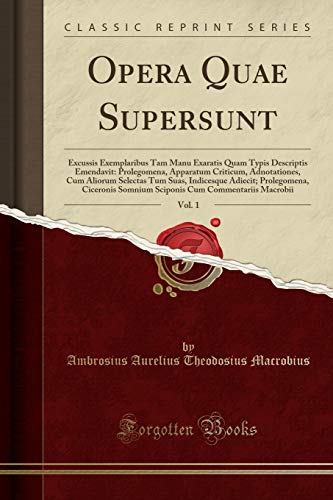
Opera Quae Supersunt, Vol. 1: Excussis Exemplaribus Tam Manu Exaratis Quam Typis Descriptis Emendavit: Prolegomena, Apparatum Criticum, Adnotationes, ... Ciceronis Somnium Sciponis Cum Commentari - Softcover
Synopsis
Excerpt from Opera Quae Supersunt, Vol. 1: Excussis Exemplaribus Tam Manu Exaratis Quam Typis Descriptis Emendavit: Prolegomena, Apparatum Criticum, Adnotationes, Cum Aliorum Selectas Tum Suas, Indicesque Adiecit; Prolegomena, Ciceronis Somnium Sciponis Cum Commentariis Macrobii
Cf. Bulletin der kunigl. Ha; er. Akademie d. W. 1844. N. 37. Ge lehrte Anzeigen, 1844. N. 172. P. 339 sqq. Ueber die ursprunghche Gestalt der Saturnalien des Macrobius.
About the Publisher
Forgotten Books publishes hundreds of thousands of rare and classic books. Find more at www.forgottenbooks.com
This book is a reproduction of an important historical work. Forgotten Books uses state-of-the-art technology to digitally reconstruct the work, preserving the original format whilst repairing imperfections present in the aged copy. In rare cases, an imperfection in the original, such as a blemish or missing page, may be replicated in our edition. We do, however, repair the vast majority of imperfections successfully; any imperfections that remain are intentionally left to preserve the state of such historical works.
"synopsis" may belong to another edition of this title.
Search results for Opera Quae Supersunt, Vol. 1: Excussis Exemplaribus...

Seller Image
Opera Quae Supersunt, Vol (Classic Reprint)
Print on DemandSeller: Forgotten Books, London, United Kingdom
Seller rating 5 out of 5 stars

Paperback. Condition: New. Print on Demand. This book analyzes the works of Macrobius, a philosopher and public figure of late antiquity. The book begins by discussing Macrobius's life, name, reputation, and writings. The author argues that Macrobius was born in North Africa in the late 4th century C.E. Although he eventually wrote mostly in Latin, Macrobius was highly educated in Greek language and literature and was familiar with the philosophical and rhetorical traditions of both the Greek and Roman worlds. Macrobius's most famous work, the Saturnalia, consists of a series of imaginary discussions on a wide range of topics, including religion, philosophy, literature, and history. The discussions are framed as taking place at a dinner party hosted by a wealthy Roman named Vettius Praetextatus. The participants in the discussions include some of the most famous intellectuals of Macrobius's time, such as the philosopher Symmachus and the poet Avianus. The author argues that the Saturnalia is an important source of information about the intellectual and cultural life of late antiquity. It is also a valuable resource for understanding Macrobius's own views on a variety of topics. The book includes a detailed analysis of Macrobius's philosophical and religious beliefs. The author argues that Macrobius was a Neoplatonist who believed in the existence of a single, transcendent God. He also argues that Macrobius was influenced by Christianity, but that he did not convert to the new religion. In addition to the Saturnalia, Macrobius also wrote a commentary on Cicero's Somnium Scipionis. This commentary is an important source of information about Cicero's philosophical views, and it also contains valuable insights into Macrobius's own philosophical thought. The author argues that Macrobius's commentary on the Somnium Scipionis is a significant contribution to the history of philosophy and that it deserves to be studied alongside the works of the great philosophers of antiquity. This book is a reproduction of an important historical work, digitally reconstructed using state-of-the-art technology to preserve the original format. In rare cases, an imperfection in the original, such as a blemish or missing page, may be replicated in the book. print-on-demand item. Seller Inventory # 9780243864782_0
Buy New
£ 18.98
Free Shipping
Ships from United Kingdom to U.S.A.
Ships from United Kingdom to U.S.A.
Quantity: Over 20 available
Stock Image
Opera Quae Supersunt, Vol. 1: Excussis Exemplaribus Tam Manu Exaratis Quam Typis Descriptis Emendavit: Prolegomena, Apparatum Criticum, Adnotationes, Cum Aliorum Selectas Tum Suas, Indicesque Adiecit; Prolegomena, Ciceronis Somnium Sciponis Cum Commentari
Seller: PBShop.store US, Wood Dale, IL, U.S.A.
Seller rating 5 out of 5 stars
PAP. Condition: New. New Book. Shipped from UK. Established seller since 2000. Seller Inventory # LW-9780243864782
Stock Image
Opera Quae Supersunt, Vol. 1: Excussis Exemplaribus Tam Manu Exaratis Quam Typis Descriptis Emendavit: Prolegomena, Apparatum Criticum, Adnotationes, Cum Aliorum Selectas Tum Suas, Indicesque Adiecit; Prolegomena, Ciceronis Somnium Sciponis Cum Commentari
Seller: PBShop.store UK, Fairford, GLOS, United Kingdom
Seller rating 5 out of 5 stars
PAP. Condition: New. New Book. Shipped from UK. Established seller since 2000. Seller Inventory # LW-9780243864782
Buy New
£ 25.76
£ 5.02 shipping
Ships from United Kingdom to U.S.A.
Ships from United Kingdom to U.S.A.
Quantity: 15 available