
Items related to "The Good War": An Oral History of World War...
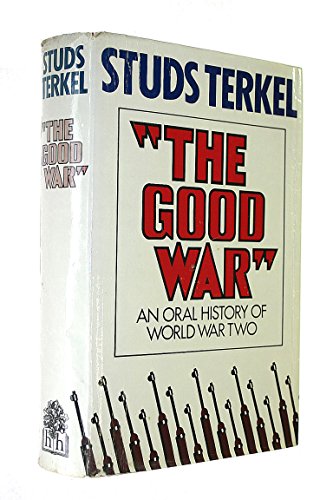
Synopsis
The dean of oral history evokes the innocent idealism, as well as the terror and horror, of ordinary Americans at home and abroad during World War II
"synopsis" may belong to another edition of this title.
Review
In World War II memories, Terkel has found a great, untold story - with fore-shadowings of Vietnam and aftershocks of atomic warfare. Terkel explains the title, matter-of-factly, as the Vietnam, nuclear-war contrast; the testimony - even from those whose lives peaked in WW II - exposes the irony of the phrase. First witness is "Hawaiian"-Californian John Garcia: in December 1941, as a pipefitter apprentice at Pearl Harbor, he retrieved live and dead bodies from the water and hulls; his girlfriend was killed by misfired American shells, he petitioned FDR to get into service, then was asked his race (great-grandparents?) and, as "Caucasian," separated from "the other Hawaiians"; on Okinawa, "I'd get up each day and start drinking. . . . They would show us movies. Japanese women didn't cry. They accepted the ashes stoically. I knew different. They went home and cried." In that same lead-off section appear the Nisei, uprooted and interned; a child-witness to, and a-participant in, the hysteria; an American-born Japanese, trapped in Japan on a visit. One of the last sections has to do with the Bomb. In an Indiana farm kitchen, Terkel talks with Bill Harney, radar operator on the plane that bombed Nagasaki. In a New York hotel lobby, he talks to Marnie Seymour who, with her husband, worked at Oak Ridge. "Out of the eighteen couples at the motel we lived in, most have never been able to have children. We are rather fortunate. We have four children. Two have birth defects." (Later, living in "very swish" New Canaan, she'd see the Hiroshima Maidens, brought over by Norman Cousins, at the supermarket.) There are several things to be said about Terkel, and his material. He has sought out people with real, unpredictable, history-brushing (sometimes history-revising) stories - but also persons whose experiences could be called typical, who become archetypal (like Chicago business executive Robert Ramos, "the skinny nineteen-year-old kid who's gonna prove that he can measure up"). He has a light intermix, too, of onlookers and leaders - yielding comments from both Pauline Kael and a retired admiral on the vacuousness of WW II films (but contrast, as well, between Kael's approval of The Clock and a war bride's contempt). He doesn't, however, construct his groupings mechanically, to make obvious points: blacks, for instance, turn up everywhere; under the rubric "Boogie Woogie Bugle Boy" we hear only from Marine Andrews; pronouncements on Vietnam differ, one after another Pacific veteran attests to gratitude for the Bomb. What is inescapable, though, is the recognition of war as brutal, and brutalizing; the reservations about "the Good War" utterable only in Vietnam-and-after retrospect. (Kirkus Reviews)
From the Publisher
Simon Schama explains why this is one of his favourites...
Terkel’s riveting books are history raw (rather than cooked) the spoken voices, sharp and unsentimental, quite unclouded by the vapours of epic self-aggrandisement or the bitters of cynicism.
This one is the perfect antidote to military heroics. "World War II for me is a sore asshole" says Eddie Costello the seaplane pilot and bomber "four years of nervous diarrhoea".
Terkel is in no doubt of the ultimate goodness of this particular war but he’s equally undeluded by nostalgia. Reading the book is like wandering into the reunion from hell - but you’re glad you’ve come all the same. Otherwise you’d never have met E.B. "Sledgehammer" Sledge, who owns up to knocking off wounded Japanese to knock out their gold teeth, but who reads Wilfred Owen in the foxholes of Okinawa, or Ray Wax, infantryman and showman, part Mailer, part Minderbinder, who builds Patton’s Third a movie theatre "I went to my drunken colonel who was marvellous and asked him for a two and a half ton truck. The army always said, Never volunteer. F**k ‘em. I always volunteered. He gave me the truck and I carried these six sections of prefabricated flooring. Everywhere I went I could drop down and I had a stage. I put that stage all across France. I put on Dinah Shore. I put on Bing Crosby.."
"About this title" may belong to another edition of this title.
Search results for "The Good War": An Oral History of World War...

Stock Image
"The Good War": An Oral History of World War Two
Seller: WorldofBooks, Goring-By-Sea, WS, United Kingdom
Seller rating 5 out of 5 stars

Hardback. Condition: Very Good. The book has been read, but is in excellent condition. Pages are intact and not marred by notes or highlighting. The spine remains undamaged. Seller Inventory # GOR001244268
Buy Used
£ 4.50
£ 5.60 shipping
Ships from United Kingdom to U.S.A.
Ships from United Kingdom to U.S.A.
Quantity: 3 available
Seller Image
"The Good War": An Oral History of World War Two
Seller: WeBuyBooks, Rossendale, LANCS, United Kingdom
Seller rating 5 out of 5 stars
hardcover. Condition: Good. Most items will be dispatched the same or the next working day. A copy that has been read but remains in clean condition. All of the pages are intact and the cover is intact and the spine may show signs of wear. The book may have minor markings which are not specifically mentioned. Seller Inventory # rev5219805121
Buy Used
£ 4.73
£ 9.33 shipping
Ships from United Kingdom to U.S.A.
Ships from United Kingdom to U.S.A.
Quantity: 1 available
Stock Image
THE GOOD WAR: AN ORAL HISTORY OF WORLD WAR TWO
Seller: Military History Books, Weymouth, DORSE, United Kingdom
Seller rating 2 out of 5 stars

(Subject: World War II - General) Gift dedication on endpaper. Pages browning. Signs of use. Good in marked d/w "Studs" Terkel was an American author, historian, actor, and broadcaster. He received the Pulitzer Prize for this book in 1985 which is essentially a collection of the memories of those who experienced World War II whilst serving in the US forces and the Home Front. It is wide ranging from the the front line soldier to senior officers, the famous and those who stayed at home and made money. It also includes the memories of fear, romance, racial battles and those who were the first to liberate the concentration camps. (Published: 1985) (Publisher: Hamish Hamilton) (ISBN: 0241114934) (Pagination: xv + 589pp) (Condition: ) UL-XXXXXX. Seller Inventory # 21543-01
Buy Used
£ 9.20
£ 8.45 shipping
Ships from United Kingdom to U.S.A.
Ships from United Kingdom to U.S.A.
Quantity: 1 available
Stock Image
'The Good War': An Oral History of World War Two
Seller: ThriftBooks-Dallas, Dallas, TX, U.S.A.
Seller rating 5 out of 5 stars
Hardcover. Condition: Fair. No Jacket. Readable copy. Pages may have considerable notes/highlighting. ~ ThriftBooks: Read More, Spend Less. Seller Inventory # G0241114934I5N00
Seller Image
"The Good War". An Oral History of World War Two
Published by
Hamish Hamilton, 1985
ISBN 10: 0241114934
ISBN 13: 9780241114933
Used
Hardcover
First Edition
Seller: H4o Books, Market Rasen, LINCS, United Kingdom
Seller rating 5 out of 5 stars
Hardcover. Condition: Very Good. Dust Jacket Condition: Very Good. 1st Edition. Red cloth. Gilt titles . Size: 8vo - over 7¾ - 9¾" tall. 589 pages. Item Type: Book. Binding is tight, covers and spine fully intact. Dust Jacket is in very good condition, without tears or chips or other damage, but with some minor edge wear. Dust Jacket price-clipped. No inscriptions. Some browning to page edges. Jacket protected with clear plastic cover. Shipped Weight: Under 1 kilogram. Category: Military & Warfare; . ISBN: 0241114934. ISBN/EAN: 9780241114933. Please contact H4o Books if you require images or further information. Inventory No: 027120. Seller Inventory # 027120