
Items related to Why Not Parties?: Party Effects in the United States...
Synopsis
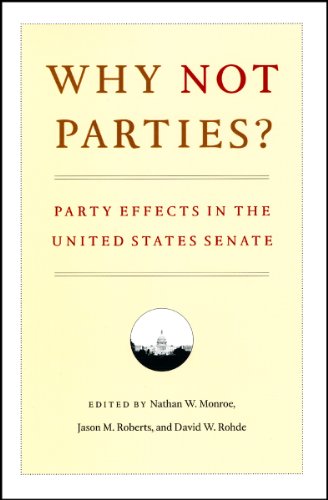
Recent research on the U.S. House of Representatives largely focuses on the effects of partisanship, but the strikingly less frequent studies of the Senate still tend to treat parties as secondary considerations in a chamber that gives its members far more individual leverage than congressmen have. In response to the recent increase in senatorial partisanship, Why Not Parties? corrects this imbalance with a series of original essays that focus exclusively on the effects of parties in the workings of the upper chamber.
Illuminating the growing significance of these effects, the contributors explore three major areas, including the electoral foundations of parties, partisan procedural advantage, and partisan implications for policy. In the process, they investigate such issues as whether party discipline can overcome Senate mechanisms that invest the most power in individuals and small groups; how parties influence the making of legislation and the distribution of pork; and whether voters punish senators for not toeing party lines. The result is a timely corrective to the notion that parties don’t matter in the Senate—which the contributors reveal is far more similar to the lower chamber than conventional wisdom suggests.
"synopsis" may belong to another edition of this title.
About the Author
Nathan W. Monroe is assistant professor of political science at the University of California, Merced. Jason M. Roberts is assistant professor of political science at the University of Minnesota. David W. Rohde is the Ernestine Friedl Professor of Political Science at Duke University.
"About this title" may belong to another edition of this title.
Search results for Why Not Parties?: Party Effects in the United States...

Stock Image
Why Not Parties?: Party Effects in the United States Senate
Published by
University of Chicago Press, 2008
ISBN 10: 0226534898
ISBN 13: 9780226534893
Used
Paperback
Seller: Midtown Scholar Bookstore, Harrisburg, PA, U.S.A.
Seller rating 5 out of 5 stars

Paperback. Condition: Good. Good - Bumped and creased book with tears to the extremities, but not affecting the text block, may have remainder mark or previous owner's name - GOOD Standard-sized. Seller Inventory # M0226534898Z3
Stock Image
Why Not Parties? Party Effects in the United States Senate
Published by
University of Chicago Press, 2008
ISBN 10: 0226534898
ISBN 13: 9780226534893
Used
Paperback
Seller: Mahler Books, PFLUGERVILLE, TX, U.S.A.
Seller rating 5 out of 5 stars
Paperback. Condition: Very Good. This book is in very good condition; no remainder marks. It does have some cover shelfwear. Inside pages are clean. ; 0.9 x 8.9 x 5.9 Inches; 282 pages. Seller Inventory # 080711-202-172
Stock Image
Why Not Parties? : Party Effects in the United States Senate
Published by
University of Chicago Press, 2008
ISBN 10: 0226534898
ISBN 13: 9780226534893
New
Softcover
Seller: GreatBookPrices, Columbia, MD, U.S.A.
Seller rating 5 out of 5 stars
Condition: New. Seller Inventory # 5695391-n
Stock Image
Why Not Parties? Format: Paperback
Published by
University of Chicago press, 2008
ISBN 10: 0226534898
ISBN 13: 9780226534893
New
Softcover
Seller: INDOO, Avenel, NJ, U.S.A.
Seller rating 5 out of 5 stars
Condition: New. Brand New. Seller Inventory # 9780226534893
Stock Image
Why Not Parties?: Party Effects in the United States Senate
Published by
University of Chicago Press, 2008
ISBN 10: 0226534898
ISBN 13: 9780226534893
New
Paperback
Seller: GoldBooks, Denver, CO, U.S.A.
Seller rating 5 out of 5 stars
Paperback. Condition: new. New Copy. Customer Service Guaranteed. Seller Inventory # 4S67_57_0226534898
Stock Image
Why Not Parties?: Party Effects in the United States Senate
Published by
University of Chicago Press, 2008
ISBN 10: 0226534898
ISBN 13: 9780226534893
New
Softcover
Seller: Brook Bookstore On Demand, Napoli, NA, Italy
Seller rating 5 out of 5 stars
Condition: new. Seller Inventory # 49610d05bb5ac46b15f91c3b60b9d51c
Buy New
£ 28.27
£ 4.62 shipping
Ships from Italy to U.S.A.
Ships from Italy to U.S.A.
Quantity: Over 20 available
Stock Image
Why Not Parties?: Party Effects In The United States Senate
Published by
University of Chicago Press 2008-10-01, 2008
ISBN 10: 0226534898
ISBN 13: 9780226534893
New
Paperback
Seller: Chiron Media, Wallingford, United Kingdom
Seller rating 5 out of 5 stars
Paperback. Condition: New. Brand new book, sourced directly from publisher. Dispatch time is 3-4 days from our warehouse. Book will be sent in robust, secure packaging to ensure it reaches you securely. Seller Inventory # 6666-WLY-9780226534893
Buy New
£ 28.16
£ 4.99 shipping
Ships from United Kingdom to U.S.A.
Ships from United Kingdom to U.S.A.
Quantity: 20 available
Stock Image
Why Not Parties?
Published by
The University of Chicago Press, 2008
ISBN 10: 0226534898
ISBN 13: 9780226534893
New
PAP
Seller: PBShop.store US, Wood Dale, IL, U.S.A.
Seller rating 5 out of 5 stars
PAP. Condition: New. New Book. Shipped from UK. Established seller since 2000. Seller Inventory # FW-9780226534893
Seller Image
Why Not Parties? : Party Effects in the United States Senate
Published by
University of Chicago Press, 2008
ISBN 10: 0226534898
ISBN 13: 9780226534893
Used
Softcover
Seller: GreatBookPrices, Columbia, MD, U.S.A.
Seller rating 5 out of 5 stars
Condition: As New. Unread book in perfect condition. Seller Inventory # 5695391
Seller Image
Why Not Parties?
Published by
The University of Chicago Press, US, 2008
ISBN 10: 0226534898
ISBN 13: 9780226534893
New
Paperback
Seller: Rarewaves.com USA, London, LONDO, United Kingdom
Seller rating 5 out of 5 stars
Paperback. Condition: New. Current research on the U.S. House of Representatives largely focuses on the effects of partisanship, but the strikingly less frequent studies of the Senate still tend to treat parties as secondary considerations in a chamber that gives its members far more individual leverage than congressmen have. In response to the recent increase in senatorial partisanship, "Why Not Parties?" corrects this imbalance with a series of original essays that focus exclusively on the effects of parties in the workings of the upper chamber.Illuminating the growing significance of these effects, the contributors explore three major areas, including the electoral foundations of parties, partisan procedural advantage, and partisan implications for policy. In the process, they investigate such issues as whether party discipline can overcome Senate mechanisms that invest the most power in individuals and small groups; how parties influence the making of legislation and the distribution of pork; and whether voters punish senators for not toeing party lines.The result is a timely corrective to the notion that parties don't matter in the Senate - which the contributors reveal is far more similar to the lower chamber than conventional wisdom suggests. Seller Inventory # LU-9780226534893
Buy New
£ 35.36
Free Shipping
Ships from United Kingdom to U.S.A.
Ships from United Kingdom to U.S.A.
Quantity: 1 available