
Items related to From Dissertation to Book, Second Edition (Chicago...
From Dissertation to Book, Second Edition (Chicago Guides to Writing, Editing, and Publishing) - Softcover
Book 48 of 93: Chicago Guides to Writing, Editing, and Publishing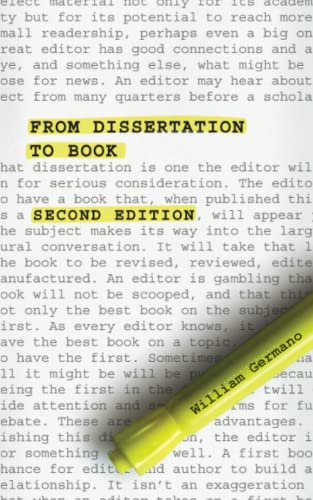
Synopsis
When a dissertation crosses my desk, I usually want to grab it by its metaphorical lapels and give it a good shake. “You know something!” I would say if it could hear me. “Now tell it to us in language we can understand!”
Since its publication in 2005, From Dissertation to Book has helped thousands of young academic authors get their books beyond the thesis committee and into the hands of interested publishers and general readers. Now revised and updated to reflect the evolution of scholarly publishing, this edition includes a new chapter arguing that the future of academic writing is in the hands of young scholars who must create work that meets the broader expectations of readers rather than the narrow requirements of academic committees.
At the heart of From Dissertation to Book is the idea that revising the dissertation is fundamentally a process of shifting its focus from the concerns of a narrow audience—a committee or advisors—to those of a broader scholarly audience that wants writing to be both informative and engaging. William Germano offers clear guidance on how to do this, with advice on such topics as rethinking the table of contents, taming runaway footnotes, shaping chapter length, and confronting the limitations of jargon, alongside helpful timetables for light or heavy revision.
Germano draws on his years of experience in both academia and publishing to show writers how to turn a dissertation into a book that an audience will actually enjoy, whether reading on a page or a screen. Germano also acknowledges that not all dissertations can or even should become books and explores other, often overlooked, options, such as turning them into journal articles or chapters in an edited work.
With clear directions, engaging examples, and an eye for the idiosyncrasies of academic writing, From Dissertation to Book reveals to recent PhDs the secrets of careful and thoughtful revision—a skill that will be truly invaluable as they add “author” to their curriculum vitae.
"synopsis" may belong to another edition of this title.
About the Author
William Germano is dean of the faculty of humanities and social sciences and professor of English literature at the Cooper Union for the Advancement of Science and Art. Previously, he served as editor in chief at Columbia University Press and vice president and publishing director at Routledge.
Excerpt. © Reprinted by permission. All rights reserved.
From Dissertation to Book
By William GermanoTHE UNIVERSITY OF CHICAGO PRESS
Copyright © 2013 William Germano
All rights reserved.
ISBN: 978-0-226-06204-4All rights reserved.
Contents
| Acknowledgments............................................................ | ix |
| 1 Why This Book............................................................ | 1 |
| 2 Getting Started, Again................................................... | 16 |
| 3 Nagging Doubts........................................................... | 37 |
| 4 The Basic Options........................................................ | 44 |
| 5 Reading with an Editor's Eyes............................................ | 60 |
| 6 Planning and Doing....................................................... | 77 |
| 7 Getting into Shape....................................................... | 91 |
| 8 Making Prose Speak....................................................... | 117 |
| 9 The Snow Globe and the Machine........................................... | 137 |
| 10 What Happens Next....................................................... | 149 |
| Three Checklists........................................................... | 157 |
| For Further Reading........................................................ | 159 |
| Index...................................................................... | 163 |
CHAPTER 1
Why This Book
The morning after defending the doctoral thesis is the first dayof a scholar's brave new world. But aside from recommendingthat you publish, graduate schools rarely take the time to explainjust what you should do with your dissertation. There'san expectation that the student is on the brink, or that thisexcellent piece of new scholarship will naturally find its placein the academic firmament. But how to get it there? And inwhat form?
Senior professors are often too far from the process to giveuseful advice. Junior faculty are usually just as puzzled asgraduate students by the mechanics of scholarly publication.But each year, many dissertations are written, and some arepublished. Among those, a few become widely read works thattransform not only what but how we think.
To the new PhD's eager question—"What do I do now thatI'm done?"—this book offers answers rather than an answer.There can't be just one. The key to any of them, though, is revision.
Revision can mean a lot of different things, maybe especiallyfor scholars. Young academics talk about revising their dissertationswhen they mean they will do hardly anything at all, orrewrite every sentence, or settle for something in between. Thisbook is in part about what can be done with a doctoral dissertation,choosing among your options, and moving forward. Whereveryou begin, and whatever investment of time and energyyou plan to make, your goal is to take something already writtenand make it more.
Taking that dissertation and making it "more" isn't a straightpath. It's a curving route with loops and off-ramps. Yet onceyou know where you want to go, there are more and less efficientways of getting there. From Dissertation to Book is itselfmeant to be a map, charting out your possibilities and givingyou driving instructions.
In more than twenty-five years as an editor of scholarlybooks, I saw hundreds of books through to publication. As anyeditor knows, you whittle down thousands of proposals to getto those chosen hundreds. My job also gave me the chance towork with other editors on the books that they were consideringfor publication. Sometimes I learned most from reviewinga thick stack of proposals other editors were keen to put forward.This part of the job is what I've described as editing fromten thousand feet up. An editor-in-chief has a few minutes tostudy how an editor presents a rationale, a marketing strategy,and a financial analysis, as well as what outside reviewershave to say, and what the author's own words tell about clarityand purpose. In ways I could hardly articulate, this bookis a product of my engagements with all those manuscriptsand proposals. When I formally left publishing for academia,I found that publishing hadn't quite left me. I've continued togive workshops and lead seminars on scholarly publishing andhave been fortunate to be invited to speak at institutions of differentscale and with different missions. But however diversethose colleges and universities may be, they have one thingin common: all are inhabited by scholars with ideas and thedesire to see those ideas brought to light for the use of others.
The difficult academic market has dispersed ambitious andtalented young scholars more thoroughly than ever before. Toland a tenure-track job at an institution one has never visited—orperhaps even heard of—before the on-campus interviewis no longer strange. The consequence of the shortage in fulltimejobs is that highly desirable candidates are being takenup by institutions that might never have had a crack at thema long generation ago. In recent years I have had more thanone conversation with a university administrator expressingdelight (bordering on disbelief) that the upside of the terriblejob market has been that that institution landed its first hiringchoices—a privilege very few colleges and universities can enjoyand none can take for granted.
For readers of From Dissertation to Book this state of affairshas two consequences.
First, we—scholars, their advisors, hiring committees, andpublishers—need to be reminded that there are talented, productiveteacher-scholars across a broad compass of institutions.There have always been fine teachers at every level ofacademia, but this market is now sending them into every cornerof the scholarly world. New PhDs will go into think tanksand research libraries and other organizations affiliated withcolleges and universities. Some will take positions at collegesand universities that are not teaching slots—as student advisors,foreign program directors, registrars, fundraisers, communicationsspecialists. Into those nonteaching positions will goscholars eager to see their research interests turn into scholarlypublications.
Second, the rising tide of adjunct faculty is a direct consequenceof the paucity of full-time slots. As the percentage ofpart-time faculty increases, so there will necessarily be an increasein the sheer number of part-time faculty with scholarlyprojects in search of publishers. One of the unresolved politicalissues within the modern academy is the conflict between institutionalmission and a reliance on part-time appointments.From Dissertation to Book aims to function as a sort of writingcoach. This book can't resolve the larger structural conflictswithin the academy. But it's important to recognize that asdoctoral students earn their degrees and face a market thatoffers even fewer full-time positions than it did an academicgeneration ago, there will be more scholarly labor in danger ofdisappearing off the academic face of the earth.
At exactly the same time that the academic labor force isstruggling to determine what opportunities lie ahead, scholarlypublishing struggles with its own survival issues as it facesquestions of technology and dissemination, declining institutionalsupport and shifting outlets, changes in reading habitsand access, and the clamor for free open access.
It's hard to write a dissertation, a challenge to transform itinto a publishable manuscript, and a matter of skill and luck toget it published. In the second decade of the twenty-first centuryit's also a challenge for scholarly publishers to make spacewithin their publishing programs for first books.
Both the professoriate and the scholarly publishing worldseem always to be operating in crisis mode. It would be funnyif it weren't true. The process of transforming dissertationsinto books involves more than accommodating the needs ofyoung professionals and assessing the realities of the marketplace.It's also part of a larger effort to identify and preserveadvances in knowledge. Not every dissertation moves forwardour knowledge of a subject, but it's impossible to know twentyyears in advance which early works in a scholar's career willopen doors for the big breakthroughs.
The mechanisms by which publishers select first books forpublication are closely bound up with the ways in which dissertationsare rethought and reshaped. In making their selections,publishers are not only choosing what projects best fitthe market. They're also quietly making bets on what new constructionsof ideas will become foundational for the work infields we know well and fields we can't even name yet.
* * *
Publishers and academic authors view books in ways that overlap,but that are hardly identical. Academics, like all writers,tend to think that a great book idea is its own justification.Publishers want something that can stand as a book, not justa good idea indifferently presented. That means getting somekey things right—shape, length, voice—so that the audiencethe author believes is out there will want the result enough tobuy it.
It can be a shock to hear that your wonderful thesis nowneeds to be entirely rethought. A young scholar's writing life beginswith an apparent contradiction: a dissertation needs to bewritten, yet no publisher has to want it when it's done. I meeta lot of scholars frustrated that academic publishers seem tobrush off what graduate schools oblige their students to produce.But scholarly publishers look for at least two things in aproposal beyond a great idea and dandy prose. One is the author'scredentials—how an academic's training and appointmentenabled him or her to write the book in the first place. Thesecond is what we call the author's platform. By that we meanthe reputation and visibility the author has already established,and how, acting together, they will help get the intended bookto its audience. You don't have much of a platform comingstraight out of graduate school, but during a career of writingand publishing and lecturing, you can build a wider base andon it build broader ideas for broader audiences. Revising yourdissertation, as unglamorous an activity as it may be, is the firststep in creating a structure to climb.
Scholars know that our appetite for knowledge, right alongsideour ignorance, grows daily. But what we call "the market"continues to undergo radical changes, making access toideas increasingly challenging. The appeal of digital formatsand the highly complex issue of open access put greater andgreater pressure on traditional scholarly publishers. Librariesbuy books (the things with paper pages) ever more cautiously.Readers read differently. We look for answers or information,preferring a short ride on a search engine to the slower andmore complex demands of a book. Independent bookstores,once a haven for scholarly works, are an endangered speciesof commercial life. Neither campus stores nor the chain giants(often the same thing) can provide all that the academic communitywould like to see on the shelf. It's much harder for ascholarly book to be published today than it was thirty—oreven five—years ago, and increasingly unlikely that, once published,it will appear on a bookstore shelf.
Faculty members now approaching retirement came of agewhen it was possible to have highly specialized work publishedby a leading university press. These days, young scholars are oftenthinking about the second book before tenure—even thoughthere are senior faculty in their departments who were tenuredon a handful of articles and never went on to write a book at all.Buddhist calm might be the best response to this inequity; bitternessand resentment certainly won't help. The best advice Ican offer is to be pragmatic: take your own strengths and makethem stronger.
These are hard times for scholars and for their publishers.Yet even in hard times, it's important to remember that manydissertations can become manuscripts strong enough to beconsidered for publication, and a good number of them canbecome books. It's possible to revise a dissertation and to turnit into something more, but to do this well means first takingstock of what one has and what it might become. Turning adissertation into a book manuscript is one option facing therecent PhD. But it isn't the only one. A dissertation can becomemany things—a single scholarly article, a handful of them, aspecialized monograph, a broader scholarly work, a trade book,even the seeds of two or more distinct projects that could occupythe author for decades.
Some dissertations do get turned into books that attract asizeable readership. Those dissertations keep on speaking yearsafter publication. Martin Jay's Dialectical Imagination and KateMillett's Sexual Politics began as doctoral theses. So did DanielGoldhagen's Hitler's Willing Executioners, Mitchell Duneier'sSlim's Table, and Jill Lepore's The Name of War.
Each year scholarly publishers present the reading publicwith first books that may become essential reading in theirfields. A few recent titles by authors who began with dissertationsand finished with successful books: Leor Halevi's Muhammad'sGrave: Death Rites and the Making of Islamic Society(New York: Columbia University Press, 2007), Isaac WilliamMartin's The Permanent Tax Revolt: How the Property Tax TransformedAmerican Politics (Stanford: Stanford University Press,2008), Karen Ho's Liquidated: An Ethnography of Wall Street (Durham:Duke University Press, 2009), and Alondra Nelson's Bodyand Soul: The Black Panther Party and the Fight against Medical Discrimination(Minneapolis: University of Minnesota Press, 2011).
However much publishers may complain about the surfeitof PhD theses, however much editors may say they rarelyconsider them, there are always hunter-gatherers at scholarlyhouses who want the exceptional dissertation. Of course, editorspay particular attention to award-winning dissertationsin their commissioning fields. But word of mouth is still theeditor's secret weapon. Every successful scholarly editor relieson a network. Trusted faculty advisors can identify the mostpromising dissertations being written in the discipline, andif you're writing one of them an energetic editor may be intouch with you before you've hammered out chapter 3. Whatto do if an editor approaches you while you're still writing yourthesis? Listen, discuss, and be appreciative, but don't be distractedby even the most persistent editor's enthusiasms. Gettingyour dissertation written, approved, and filed is your firstand most important responsibility. After that comes the set ofquestions this book will address. Yes, the academic market isa harsh place, but if you're working on a dissertation aboutwhich you're genuinely excited, don't panic. If you have writtenan outstanding doctoral thesis, chances are still very good thatat least one publisher would like to talk to you about it.
But what makes a dissertation outstanding to a publisherisn't exactly the same thing that makes it outstanding to thescholarly community. The winner of the prize for the year'soutstanding thesis in the field of Kwakiutl grammar may havemade a signal contribution to the study of linguistics. A publisher,however, will see the prize only as a validation of the dissertation'sacademic quality. That might be enough to get a footin the door. An outstanding book would be something more, aswell as something different.
Perhaps the author has explained a feature of this languagein such a way that those of us who haven't studied Kwakiutlcan understand something new about the way speech expressesnotions of space and time. Maybe the author has gonefurther and posited something that shifts, if only by a few degrees,how we understand language acquisition. In that readjustmentcould lie a revolution in a discipline's thought. In orderto accomplish this, though, an author would have to thinkin terms of more than the usual two dimensions of academicwriting—page length and density of footnotes.
The dissertation is usually the longest work the youngscholar has ever written, an exhausting trek across the scholarlytundra. At some level, it's natural for that young scholarto see the dissertation's length itself as in some way symbolicof her achievement. After all, every book any of us picks uphas a heft in our hands: whether it's a physical book in physicalhands or a digital book in our metaphorical hands, a bookis a substantial thing. All writers want their books to be substantial,to have the weight capable of conveying the richnessof the author's thoughts. But—and it's the biggest but a first-timeacademic author must grapple with—the length of a bookmanuscript must be the result of the thought working insideit, not the thought's precondition. Nobody should set out towrite a 350-page dissertation, even if that turns out to be exactlywhat the writer produces. In the early nineteenth centurya German scholar published a dissertation in biblical studiesthat changed thinking about the composition of Deuteronomy.It was some eighteen pages long. In our day a dissertation onMichelangelo by the art historian James Elkins ran to six volumes(three for text, two for illustrations, and one for notes).The length of a dissertation, however, has nothing to do withreaching a broader academic readership; real books are different.
* * *
Getting length right is only part of revising the dissertation.Moving from dissertation manuscript to book manuscript involvesfinding within the thesis what can be of value to abroader readership. It also means finding what will interestyou, the author. This process is neither magical nor mysterious.It involves taking that interesting material you wrote andshaping it, lopping off the boring bits required to demonstratehow well you know your subject, and assessing the utility of allthose different scenarios in which you apply your particularinsight. It also involves stretching your interesting material inways you may not have originally foreseen. Remember howSilly Putty, that venerable semisolid entertainment, lifted a cartoonimage from the newspaper so you could stretch the figureinto new and unintended shapes? The stretching was the funpart. In rethinking your dissertation, imagine your subject interms of its plasticity. Revision offers a kind of freedom. Try tohave some fun with it.
(Continues...)
Excerpted from From Dissertation to Book by William Germano. Copyright © 2013 William Germano. Excerpted by permission of THE UNIVERSITY OF CHICAGO PRESS.
All rights reserved. No part of this excerpt may be reproduced or reprinted without permission in writing from the publisher.
Excerpts are provided by Dial-A-Book Inc. solely for the personal use of visitors to this web site.
"About this title" may belong to another edition of this title.
Search results for From Dissertation to Book, Second Edition (Chicago...

Stock Image
From Dissertation to Book, Second Edition (Chicago Guides to Writing, Editing, and Publishing)
Published by
University Of Chicago Press, 2013
ISBN 10: 022606204X
ISBN 13: 9780226062044
Used
Paperback
Seller: HPB-Emerald, Dallas, TX, U.S.A.
Seller rating 5 out of 5 stars

Paperback. Condition: Very Good. Connecting readers with great books since 1972! Used books may not include companion materials, and may have some shelf wear or limited writing. We ship orders daily and Customer Service is our top priority! Seller Inventory # S_481857370
Stock Image
From Dissertation to Book, Second Edition (Chicago Guides to Writing, Editing, and Publishing)
Published by
University of Chicago Press, 2013
ISBN 10: 022606204X
ISBN 13: 9780226062044
Used
Paperback
Seller: HPB-Red, Dallas, TX, U.S.A.
Seller rating 5 out of 5 stars
Paperback. Condition: Good. Connecting readers with great books since 1972! Used textbooks may not include companion materials such as access codes, etc. May have some wear or writing/highlighting. We ship orders daily and Customer Service is our top priority! Seller Inventory # S_481639507
Stock Image
From Dissertation to Book, Second Edition
Published by
The University of Chicago Press, 2013
ISBN 10: 022606204X
ISBN 13: 9780226062044
Used
Paperback
Seller: World of Books (was SecondSale), Montgomery, IL, U.S.A.
Seller rating 5 out of 5 stars
Paperback. Condition: Fair. Includes a chapter arguing that the future of academic writing is in the hands of young scholars who meet the broader expectations of readers rather than the narrow requirements of academic committees. This title reveals to PhDs the secrets of careful and thoughtful revision. Seller Inventory # 00109749238
Stock Image
From Dissertation to Book, Second Edition (Chicago Guides to Writing, Editing, and Publishing)
Published by
University Of Chicago Press, 2013
ISBN 10: 022606204X
ISBN 13: 9780226062044
Used
Paperback
Seller: Half Price Books Inc., Dallas, TX, U.S.A.
Seller rating 5 out of 5 stars
Paperback. Condition: Very Good. Connecting readers with great books since 1972! Used books may not include companion materials, and may have some shelf wear or limited writing. We ship orders daily and Customer Service is our top priority! Seller Inventory # S_480237510
Seller Image
From Dissertation to Book, Second Edition (Chicago Guides to Writing, Editing, and Publishing)
Published by
University of Chicago Press, 2013
ISBN 10: 022606204X
ISBN 13: 9780226062044
Used
Softcover
Seller: Goodwill of Greater Milwaukee and Chicago, Racine, WI, U.S.A.
Seller rating 5 out of 5 stars
Condition: good. Book is considered to be in good or better condition. The actual cover image may not match the stock photo. Hard cover books may show signs of wear on the spine, cover or dust jacket. Paperback book may show signs of wear on spine or cover as well as having a slight bend, curve or creasing to it. Book should have minimal to no writing inside and no highlighting. Pages should be free of tears or creasing. Stickers should not be present on cover or elsewhere, and any CD or DVD expected with the book is included. Book is not a former library copy. Seller Inventory # SEWV.022606204X.G
Stock Image
From Dissertation to Book, Second Edition
Published by
The University of Chicago Press, 2013
ISBN 10: 022606204X
ISBN 13: 9780226062044
Used
Paperback
Seller: World of Books Inc, Montgomery, IL, U.S.A.
Seller rating 4 out of 5 stars

Paperback. Condition: Fair. Includes a chapter arguing that the future of academic writing is in the hands of young scholars who meet the broader expectations of readers rather than the narrow requirements of academic committees. This title reveals to PhDs the secrets of careful and thoughtful revision. Seller Inventory # CIN022606204XA
Stock Image
From Dissertation to Book, Second Edition (Chicago Guides to Writing, Editing, and Publishing)
Published by
University of Chicago Press, 2013
ISBN 10: 022606204X
ISBN 13: 9780226062044
Used
paperback
Seller: Facetextbooks, LITTLE ROCK, AR, U.S.A.
Seller rating 5 out of 5 stars
paperback. Condition: Good. May contain some writing/highlighting. Cover shows wear from normal use. Supplemental materials such as CDs or access codes are not included unless otherwise noted. Seller Inventory # mon0000023055
Stock Image
From Dissertation to Book, Second Edition Format: Paperback
Published by
University of Chicago press, 2013
ISBN 10: 022606204X
ISBN 13: 9780226062044
New
Softcover
Seller: INDOO, Avenel, NJ, U.S.A.
Seller rating 5 out of 5 stars
Condition: New. Brand New. Seller Inventory # 9780226062044
Stock Image
From Dissertation to Book, Second Edition (Chicago Guides to Writing, Editing, and Publishing)
Published by
University of Chicago Press, 2013
ISBN 10: 022606204X
ISBN 13: 9780226062044
New
paperback
Seller: Chiron Media, Wallingford, United Kingdom
Seller rating 5 out of 5 stars
paperback. Condition: New. Brand new book, sourced directly from publisher. Dispatch time is 24-48 hours from our warehouse. Book will be sent in robust, secure packaging to ensure it reaches you securely. Seller Inventory # 6666-GRD-9780226062044
Buy New
£ 16.42
£ 4.49 shipping
Ships from United Kingdom to U.S.A.
Ships from United Kingdom to U.S.A.
Quantity: 4 available
Seller Image
From Dissertation to Book
Published by
University of Chicago Press, 2013
ISBN 10: 022606204X
ISBN 13: 9780226062044
Used
Softcover
Seller: GreatBookPrices, Columbia, MD, U.S.A.
Seller rating 5 out of 5 stars
Condition: As New. Unread book in perfect condition. Seller Inventory # 19743029