
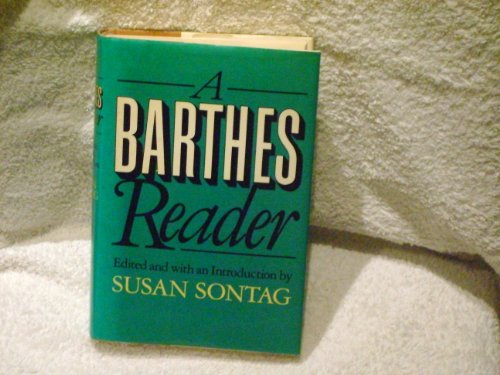
Synopsis
ROLAND BARTHES
"synopsis" may belong to another edition of this title.
Review
"Roland Barthes must be counted the most characteristic and important French intellectual of the structuralist generation that gained worldwide attention in the 1960s. Yet as an intellectual authority--"maitre a penser," as the French tend to say--he cut a curious figure. He detested all forms of authority, worried about the power wielded by the teacher, and called his main subject, literature, 'a grand imposture.' He could be assertive, but always in the mode of counterstatement, affirming the inverse of society's accepted dogmas and myths. . . .
"A Barthes Reader" gives one the image of Barthes as one of the great public teachers of our time, someone who thought out, argued for, and made available several steps in a penetrating reflection on language sign systems, texts--and what they have to tell us about the concept of being human. His work is always partial, passionate underneath its cool, and preliminary, ready to be superseded or contradicted, yet its pedagogical power is durable. . . . Susan Sontag's prefatory essay is one of her finest acts of criticism, informed by intellectual sympathy and a sure sense of the contours of the mind she is describing."--Peter Brooks, Yale University
Roland Barthes must be counted the most characteristic and important French intellectual of the structuralist generation that gained worldwide attention in the 1960s. Yet as an intellectual authority--maitre a penser, as the French tend to say--he cut a curious figure. He detested all forms of authority, worried about the power wielded by the teacher, and called his main subject, literature, 'a grand imposture.' He could be assertive, but always in the mode of counterstatement, affirming the inverse of society's accepted dogmas and myths. . . .
A Barthes Reader gives one the image of Barthes as one of the great public teachers of our time, someone who thought out, argued for, and made available several steps in a penetrating reflection on language sign systems, texts--and what they have to tell us about the concept of being human. His work is always partial, passionate underneath its cool, and preliminary, ready to be superseded or contradicted, yet its pedagogical power is durable. . . . Susan Sontag's prefatory essay is one of her finest acts of criticism, informed by intellectual sympathy and a sure sense of the contours of the mind she is describing.--Peter Brooks, Yale University"
Roland Barthes must be counted the most characteristic and important French intellectual of the structuralist generation that gained worldwide attention in the 1960s. Yet as an intellectual authority--maitre a penser, as the French tend to say--he cut a curious figure. He detested all forms of authority, worried about the power wielded by the teacher, and called his main subject, literature, 'a grand imposture.' He could be assertive, but always in the mode of counterstatement, affirming the inverse of society's accepted dogmas and myths. . . .
A Barthes Reader gives one the image of Barthes as one of the great public teachers of our time, someone who thought out, argued for, and made available several steps in a penetrating reflection on language sign systems, texts--and what they have to tell us about the concept of being human. His work is always partial, passionate underneath its cool, and preliminary, ready to be superseded or contradicted, yet its pedagogical power is durable. . . . Susan Sontag's prefatory essay is one of her finest acts of criticism, informed by intellectual sympathy and a sure sense of the contours of the mind she is describing. Peter Brooks, Yale University
"A Barthes Reader" gives one the image of Barthes as one of the great public teachers of our time, someone who thought out, argued for, and made available several steps in a penetrating reflection on language sign systems, texts--and what they have to tell us about the concept of being human. His work is always partial, passionate underneath its cool, and preliminary, ready to be superseded or contradicted, yet its pedagogical power is durable. . . . Susan Sontag's prefatory essay is one of her finest acts of criticism, informed by intellectual sympathy and a sure sense of the contours of the mind she is describing. "Peter Brooks, Yale University""
"Roland Barthes must be counted the most characteristic and important French intellectual of the structuralist generation that gained worldwide attention in the 1960s. Yet as an intellectual authority--maitre a penser, as the French tend to say--he cut a curious figure. He detested all forms of authority, worried about the power wielded by the teacher, and called his main subject, literature, 'a grand imposture.' He could be assertive, but always in the mode of counterstatement, affirming the inverse of society's accepted dogmas and myths. . . .
A Barthes Reader gives one the image of Barthes as one of the great public teachers of our time, someone who thought out, argued for, and made available several steps in a penetrating reflection on language sign systems, texts--and what they have to tell us about the concept of being human. His work is always partial, passionate underneath its cool, and preliminary, ready to be superseded or contradicted, yet its pedagogical power is durable. . . . Susan Sontag's prefatory essay is one of her finest acts of criticism, informed by intellectual sympathy and a sure sense of the contours of the mind she is describing." --Peter Brooks, Yale University
"A Barthes Reader gives one the image of Barthes as one of the great public teachers of our time, someone who thought out, argued for, and made available several steps in a penetrating reflection on language sign systems, texts--and what they have to tell us about the concept of being human. His work is always partial, passionate underneath its cool, and preliminary, ready to be superseded or contradicted, yet its pedagogical power is durable. . . . Susan Sontag's prefatory essay is one of her finest acts of criticism, informed by intellectual sympathy and a sure sense of the contours of the mind she is describing." --Peter Brooks, Yale University
From the Back Cover
'A Barthes Reader' gives one the image of Barthes as one of the great public teachers of our time, someone who thought out, argued for, and made available several steps in a penetrating reflection on language sign systems, texts- and what they have to tell us about the concept of being human. Susan Sontag's prefatory essay is one of her finest acts of criticism, informed by intellectual sympathy and a sure sense of the contours of the mind she is describing'.
"About this title" may belong to another edition of this title.
Other Popular Editions of the Same Title

Search results for A Roland Barthes Reader

Stock Image
A Barthes Reader
Seller: Better World Books, Mishawaka, IN, U.S.A.
Seller rating 5 out of 5 stars

Condition: Good. Former library copy. Pages intact with minimal writing/highlighting. The binding may be loose and creased. Dust jackets/supplements are not included. Includes library markings. Stock photo provided. Product includes identifying sticker. Better World Books: Buy Books. Do Good. Seller Inventory # 42726259-20
Seller Image
A Barthes Reader
Published by
Vintage/Ebury (A Division of Random House Group), 1982
ISBN 10: 0224019449
ISBN 13: 9780224019446
Used
Hardcover
Seller: Goodwill of Colorado, COLORADO SPRINGS, CO, U.S.A.
Seller rating 5 out of 5 stars
Condition: very_good. Item may have minor cosmetic defects marks, wears, cuts, bends, crushes on the cover, spine, pages or dust cover. Shrink wrap, dust covers, or boxed set case may be missing. Item may contain remainder marks on outside edges, which should be noted in Product Details. Item may be missing bundled media. Seller Inventory # COLV.0224019449.VG
Stock Image
A Barthes Reader
Published by
Vintage/Ebury (A Division of Random House Group), 1982
ISBN 10: 0224019449
ISBN 13: 9780224019446
New
Hardcover
Seller: BennettBooksLtd, Los Angeles, CA, U.S.A.
Seller rating 5 out of 5 stars
Hardcover. Condition: New. In shrink wrap. Looks like an interesting title! Seller Inventory # Q-0224019449