
Items related to The Pleasure of the Text
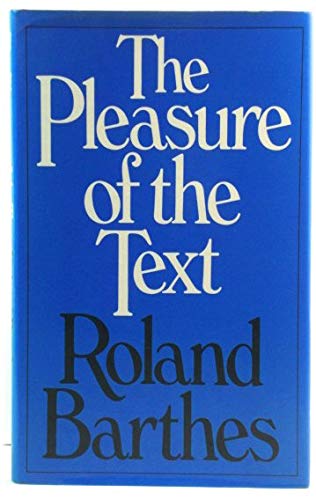
Synopsis
What is it that we do when we enjoy a text? What is the pleasure of reading? The French critic and theorist Roland Barthes's answers to these questions constitute "perhaps for the first time in the history of criticism . . . not only a poetics of reading . . . but a much more difficult achievement, an erotics of reading . . . . Like filings which gather to form a figure in a magnetic field, the parts and pieces here do come together, determined to affirm the pleasure we must take in our reading as against the indifference of (mere) knowledge." --Richard Howard
"synopsis" may belong to another edition of this title.
Review
"Barthes repeatedly compared teaching to play, reading to eros, writing to seduction. His voice became more and more personal, more full of grain, as he called it; his intellectual art more openly a performance, like that of the other great anti-systematizers . . . All of Barthes work is an exploration the histrionic or ludic; in many ingenious modes, a plea for savor, for a festive (rather than dogmatic or credulous) relation to ideas. For Barthes, the point is to make us bold, agile, subtle, intelligent, detached. And to give pleasure." --Susan Sontag
Barthes repeatedly compared teaching to play, reading to eros, writing to seduction. His voice became more and more personal, more full of grain, as he called it; his intellectual art more openly a performance, like that of the other great anti-systematizers . . . All of Barthes work is an exploration the histrionic or ludic; in many ingenious modes, a plea for savor, for a festive (rather than dogmatic or credulous) relation to ideas. For Barthes, the point is to make us bold, agile, subtle, intelligent, detached. And to give pleasure. "Susan Sontag""
"Barthes repeatedly compared teaching to play, reading to eros, writing to seduction. His voice became more and more personal, more full of grain, as he called it; his intellectual art more openly a performance, like that of the other great anti-systematizers . . . All of Barthes work is an exploration the histrionic or ludic; in many ingenious modes, a plea for savor, for a festive (rather than dogmatic or credulous) relation to ideas. For Barthes, the point is to make us bold, agile, subtle, intelligent, detached. And to give pleasure." --Susan Sontag
About the Author
Roland Barthes was born in 1915 and studied French literature and the classics at the University of Paris. After teaching French at universities in Romania and Egypt, he joined the Centre National de Recherche Scientifique, where he devoted himself to research in sociology and lexicology. He was a professor at the College de France until his death in 1980.
"About this title" may belong to another edition of this title.
Search results for The Pleasure of the Text

Stock Image
The Pleasure of the Text
Seller: Aardvark Rare Books, Presteigne, HEREF, United Kingdom
Seller rating 5 out of 5 stars

Hardcover. Condition: Fine. First Edition. Hardbound. 1st UK Edition of Barthes' classic analysis of pleasure in reading. Very Good plus unclipped and unsunned dustwrapper . 8vo 68pp . Very Good plus in Very Good plus dustwrapper. Seller Inventory # mon0000375759
Seller Image
The Pleasure of the Text 1st UK Edition
Published by
Jonathan Cape, London, 1976
ISBN 10: 0224011871
ISBN 13: 9780224011877
Used
Hardcover
First Edition
Seller: Gotcha By The Books, Brisbane, QLD, Australia
Seller rating 5 out of 5 stars
hardbound. 1st UK Edition of Barthes' classic analysis of pleasure in reading, discussing what and how we enjoy when we read, with focus on literary texts; translated by Richard Miller, with a note on the text by Richard Howard; front endpaper clipped (a little clumsily), minor foxing to endpapers, prelims and text block, o.w. Very Good throughout; dustwrapper very lightly rubbed, o.w. Very Good. Dustwrapper. 67pp. 8vo. Very Good in Very Good dustwrapper (front endpaper clipped) Very Good in Very Good dustwrapper (front endpaper clipped). Seller Inventory # 20010
Buy Used
£ 81.27
£ 14.99 shipping
Ships from Australia to U.S.A.
Ships from Australia to U.S.A.
Quantity: 1 available