
Items related to Artificial Intelligence: Structures and Strategies...
Synopsis
Artificial intelligence (AI) began as the quest to create machines that could think for themselves and (perhaps) out-think humans: the holy grail of computing! Over the years, while still exploring the mechanisms that enable thought, AI has evolved into a more pragmatic discipline. AI uses different strategies to solve the complex practical problems that present themselves wherever computing technology is applied. And intelligence itself is now known to be too complex to be described by any single theory - instead, a constellation of theories characterize the subject from different levels of abstraction. At the lowest levels, neural networks, genetic algorithms and other forms of computation aid understanding of adaptation, perception, embodiment, and interaction with the physical world. On a more abstract level, designers of expert systems, intelligent agents, stochastic models, and natural language understanding programs reflect the role of knowledge and social processes in creating, transmitting and sustaining knowledge. Further, logicians propose deduction, abduction, induction, truth-maintenance, and other models and modes for reasoning. In this fourth edition, George Luger touches on all these levels of structures and strategies for complex problem solving, as well as conveying excitement for the study of intelligence itself. He shows how to use many different software tools and techniques for addressing the complex problems that challenge the modern computer scientist.
"synopsis" may belong to another edition of this title.
From the Back Cover
Shelving category- Artificial intelligence
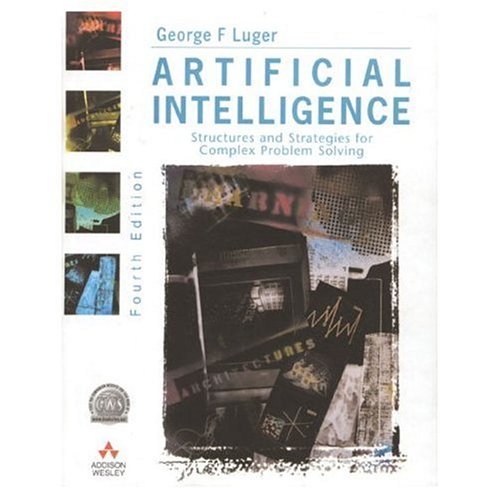
Artificial Intelligence
Structures and Strategies for Complex Problem Solving
Fourth Edition
George Luger
Artificial intelligence (AI) began as the quest to create machines that could think for themselves and (perhaps) out-think humans- the holy grail of computing! Over the years, while still exploring the mechanisms that enable thought, AI has evolved into a more pragmatic discipline. AI uses different strategies to solve the complex practical problems that present themselves wherever computing technology is applied. And intelligence itself is now known to be too complex to be described by any single theory - instead, a constellation of theories characterize the subject from different levels of abstraction. At the lowest levels, neural networks, genetic algorithms and other forms of computation aid understanding of adaptation, perception, embodiment, and interaction with the physical world. On a more abstract level, designers of expert systems, intelligent agents, stochastic models, and natural language understanding programs reflect the role of knowledge and social processes in creating, transmitting and sustaining knowledge. Further, logicians propose deduction, abduction, induction, truth-maintenance, and other models and modes for reasoning.
In this fourth edition, George Luger touches on all these levels of structures and strategies for complex problem solving, as well as conveying excitement for the study of intelligence itself. He shows how to use many different software tools and techniques for addressing the complex problems that challenge the modern computer scientist.
The trademark features of this best-selling text are-
· a thorough and balanced treatment of the foundations of AI;
· the combination of theoretical foundations of intelligent problem solving with the data structures and algorithms needed for implementation;
· example programs written in LISP and PROLOG;
· putting practical applications of AI into context; and
· a unique discussion of the social and philosophical issues of AI.
In addition, this thoroughly updated fourth edition includes-
· the incorporation of more "agent-based" problem solving;
· new material on reinforcement learning;
· improved chapters on Bayesian based inference techniques, including belief networks;
· model-based reasoning and planning examples from the NASA space program;
· updated material on Natural Language Processing; and
· comments on the AI endeavor from the perspectives of philosophy, psychology and neuro-physiology.
Artificial Intelligence- Structures and Strategies for Complex Problem Solving is ideal for a one or two semester university course on AI, as well as an invaluable reference for researchers in the field or practitioners wishing to understand and employ the power of current AI techniques in their work.
George Luger received his PhD from the University of Pennsylvania in 1973. He spent the next five years as a Postdoctoral Research Fellow at the Department of Artificial Intelligence of the University of Edinburgh. He is currently a Professor of Computer Science, Linguistics, and Psychology at the University of New Mexico in Albuquerque.
"About this title" may belong to another edition of this title.
Search results for Artificial Intelligence: Structures and Strategies...

Stock Image
Artificial Intelligence: Structures and Strategies for Complex Problem Solving (4th Edition)
Seller: WorldofBooks, Goring-By-Sea, WS, United Kingdom
Seller rating 5 out of 5 stars

Hardback. Condition: Very Good. The book has been read, but is in excellent condition. Pages are intact and not marred by notes or highlighting. The spine remains undamaged. Seller Inventory # GOR001345964
Buy Used
£ 3.26
£ 5.60 shipping
Ships from United Kingdom to U.S.A.
Ships from United Kingdom to U.S.A.
Quantity: 2 available
Stock Image
Artificial Intelligence: Structures and Strategies for Complex Problem Solving (4th Edition)
Seller: Wonder Book, Frederick, MD, U.S.A.
Seller rating 5 out of 5 stars
Condition: Good. Good condition. 4th edition. A copy that has been read but remains intact. May contain markings such as bookplates, stamps, limited notes and highlighting, or a few light stains. NOT AVAILABLE FOR SHIPMENT OUTSIDE OF THE UNITED STATES. Seller Inventory # D05M-00821
Stock Image
Artificial Intelligence : Structures and Strategies for Complex Problem Solving
Published by
Addison-Wesley Longman, Incorporated, 2001
ISBN 10: 0201648660
ISBN 13: 9780201648669
Used
Hardcover
Seller: Better World Books, Mishawaka, IN, U.S.A.
Seller rating 5 out of 5 stars
Condition: Good. 4th. Former library copy. Pages intact with minimal writing/highlighting. The binding may be loose and creased. Dust jackets/supplements are not included. Includes library markings. Stock photo provided. Product includes identifying sticker. Better World Books: Buy Books. Do Good. Seller Inventory # GRP9359649
Stock Image
Artificial Intelligence : Structures and Strategies for Complex Problem Solving
Published by
Addison-Wesley Longman, Incorporated, 2001
ISBN 10: 0201648660
ISBN 13: 9780201648669
Used
Hardcover
Seller: Better World Books: West, Reno, NV, U.S.A.
Seller rating 5 out of 5 stars
Condition: Good. 4th. Former library copy. Pages intact with minimal writing/highlighting. The binding may be loose and creased. Dust jackets/supplements are not included. Includes library markings. Stock photo provided. Product includes identifying sticker. Better World Books: Buy Books. Do Good. Seller Inventory # GRP9359649
Stock Image
Artificial Intelligence: Structures and Strategies for Complex Problem Solving (4th Edition)
Seller: Wonder Book, Frederick, MD, U.S.A.
Seller rating 5 out of 5 stars
Condition: Very Good. Very Good condition. 4th edition. A copy that may have a few cosmetic defects. May also contain light spine creasing or a few markings such as an owner's name, short gifter's inscription or light stamp. NOT AVAILABLE FOR SHIPMENT OUTSIDE OF THE UNITED STATES. Seller Inventory # N23O-01007
Stock Image
Artificial Intelligence: Structures and Strategies for Complex Problem Solving (4th Edition)
Seller: HPB-Red, Dallas, TX, U.S.A.
Seller rating 5 out of 5 stars
hardcover. Condition: Good. Connecting readers with great books since 1972! Used textbooks may not include companion materials such as access codes, etc. May have some wear or writing/highlighting. We ship orders daily and Customer Service is our top priority! Seller Inventory # S_480335417
Stock Image
Artificial Intelligence : Structures and Strategies for Complex Problem Solving
Published by
Addison-Wesley Longman, Incorporated, 2001
ISBN 10: 0201648660
ISBN 13: 9780201648669
Used
Hardcover
Seller: Better World Books Ltd, Dunfermline, United Kingdom
Seller rating 5 out of 5 stars
Condition: Very Good. 4th. Former library copy. Pages intact with possible writing/highlighting. Binding strong with minor wear. Dust jackets/supplements may not be included. Includes library markings. Stock photo provided. Product includes identifying sticker. Better World Books: Buy Books. Do Good. Seller Inventory # 13438095-6
Buy Used
£ 5.75
£ 5 shipping
Ships from United Kingdom to U.S.A.
Ships from United Kingdom to U.S.A.
Quantity: 2 available
Stock Image
Artificial Intelligence: Structures and Strategies for Complex Problem Solving
Seller: Anybook.com, Lincoln, United Kingdom
Seller rating 5 out of 5 stars
Condition: Fair. This is an ex-library book and may have the usual library/used-book markings inside.This book has hardback covers. Clean from markings. In fair condition, suitable as a study copy. Please note the Image in this listing is a stock photo and may not match the covers of the actual item,1750grams, ISBN:9780201648669. Seller Inventory # 9715446
Buy Used
£ 2.50
£ 15.76 shipping
Ships from United Kingdom to U.S.A.
Ships from United Kingdom to U.S.A.
Quantity: 1 available
Stock Image
Artificial Intelligence: Structures and Strategies for Complex Problem Solving, 4th
Published by
Addison Wesley, Boston, MA, 2001
ISBN 10: 0201648660
ISBN 13: 9780201648669
Used
Hardcover
Seller: a2zbooks, Burgin, KY, U.S.A.
Seller rating 5 out of 5 stars
Hardcover. Condition: Very Good. 4th Edition. all pages clean and crisp Multiple copies available this title. Quantity Available: 6. ISBN: 0201648660. ISBN/EAN: 9780201648669. Pictures of this item not already displayed here available upon request. Inventory No: ABE351939332. Seller Inventory # ABE351939332
Stock Image
Artificial Intelligence: Structures and Strategies for Complex Problem Solving, 4th
Published by
Addison Wesley, Boston, MA, 2001
ISBN 10: 0201648660
ISBN 13: 9780201648669
Used
Hardcover
Seller: a2zbooks, Burgin, KY, U.S.A.
Seller rating 5 out of 5 stars
Hardcover. Condition: As New. 4th Edition. all pages clean and crisp, Brand new with dusty cover with minor shelf wear, Used sticker on binding and back cover, cover does not look new but pages are obviously new Multiple copies available this title. Quantity Available: 6. ISBN: 0201648660. ISBN/EAN: 9780201648669. Pictures of this item not already displayed here available upon request. Inventory No: 1560803095. Seller Inventory # 1560803095