
Items related to Insurance Against Poverty (WIDER Studies in Development...
Insurance Against Poverty (WIDER Studies in Development Economics) - Hardcover
Book 14 of 45: WIDER Studies in Development Economics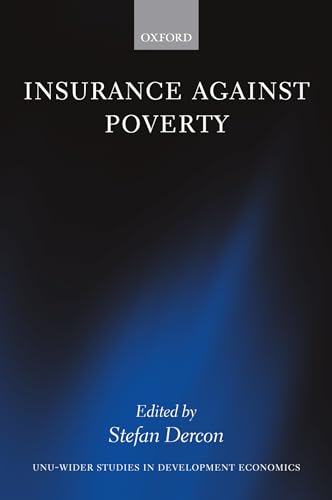
Synopsis
Proposes new forms of insurance for developing economies
"synopsis" may belong to another edition of this title.
About the Author
Stefan Dercon is a University Lecturer at the University of Oxford, and has been Professor in Development Economics at the Katholieke Universiteit Leuven, Belgium, a Research Officer at the centre of the Study of African Economies, a Research Fellow at Nuffield College, Oxford, and a Visiting Professor at the University of Addis Ababa, Ethiopia.
"About this title" may belong to another edition of this title.
Search results for Insurance Against Poverty (WIDER Studies in Development...

Stock Image
Insurance Against Poverty
Published by
Oxford University Press, Incorporated, 2005
ISBN 10: 0199276838
ISBN 13: 9780199276837
Used
Hardcover
Seller: Better World Books Ltd, Dunfermline, United Kingdom
Seller rating 5 out of 5 stars

Condition: Good. Former library copy. Pages intact with minimal writing/highlighting. The binding may be loose and creased. Dust jackets/supplements are not included. Includes library markings. Stock photo provided. Product includes identifying sticker. Better World Books: Buy Books. Do Good. Seller Inventory # 67840711-20
Buy Used
£ 33.41
£ 5 shipping
Ships from United Kingdom to U.S.A.
Ships from United Kingdom to U.S.A.
Quantity: 1 available
Stock Image
Insurance against Poverty (WIDER Studies in Development Economics)
Published by
Oxford University Press, 2005
ISBN 10: 0199276838
ISBN 13: 9780199276837
Used
Hardcover
Seller: Phatpocket Limited, Waltham Abbey, HERTS, United Kingdom
Seller rating 5 out of 5 stars
Condition: Good. Your purchase helps support Sri Lankan Children's Charity 'The Rainbow Centre'. Ex-library, so some stamps and wear, but in good overall condition. Our donations to The Rainbow Centre have helped provide an education and a safe haven to hundreds of children who live in appalling conditions. Seller Inventory # Z1-S-016-03593
Buy Used
£ 49.84
£ 10.64 shipping
Ships from United Kingdom to U.S.A.
Ships from United Kingdom to U.S.A.
Quantity: 1 available
Stock Image
Insurance Against Poverty (WIDER Studies in Development Economics)
Seller: Vashon Island Books, Vashon, WA, U.S.A.
Seller rating 5 out of 5 stars
Hardcover. Condition: Near Fine. Dust Jacket Condition: Near Fine. Second Printing. Size: 8vo - over 7¾" - 9¾". Book. Seller Inventory # 0843546
Seller Image
Insurance Against Poverty (Hardcover)
Published by
Oxford University Press, Oxford, 2004
ISBN 10: 0199276838
ISBN 13: 9780199276837
New
Hardcover
Seller: AussieBookSeller, Truganina, VIC, Australia
Seller rating 5 out of 5 stars
Hardcover. Condition: new. Hardcover. Poor people in developing countries are often affected by droughts, floods, illness, crop failure, job loss, and economic downturns. Much of their energy goes into coping with these shocks and into day-to-day survival. While insurance and credit markets, combined with widespread social security, provide an important cushion against poverty in rich countries, the need for immediate survival may lock the poor into persistent poverty in developingcountries.The poor in developing countries do have informal mechanisms to cope with risk and misfortune. These are based on income diversification, risk avoidance, self-insurance by saving togetherwith family, and community-based mutual assistance. Nevertheless, the scope of these mechanisms remains limited. Repeated individual-specific shocks such as illness or pests, or covariate risks associated with drought, flood, or recession, undermine the ability of individuals and their families to cope with risk.We now know much more about vulnerability to risk and how poor people cope. Even more importantly, we have learned much about the large long-term consequences ofthese risks, which condemns many to persistent poverty and excludes them from economic growth. But there is much that can be done. The micro-level studies that underpin this book offer new insights onhow effective public action could be more effective in protecting the vulnerable against persistent poverty. Policy should focus on providing a comprehensive menu of ex-ante and post-crisis protection mechanisms, including new forms of insurance, savings, safety nets, and the means to strengthen the poor's asset base. Local communities have a big role to play: public funds should not be used to replace indigenous community-based support networks; rather they should be used to build on thestrengths of these networks to ensure broader and more effective protection.With numerous thematic chapters and case studies of both best practice and of failure, from a mix oflow-income and middle-income countries across the developing world, this book evaluates alternatives in widening insurance and protection provision, and makes an important contribution to the topical field of insurance and risk. Poor people in developing countries are often affected by droughts, floods, illness, crop failure, job loss, and economic downturns. This book evaluates alternatives in widening insurance and social protection provision, including sustainability and poverty effects, in thematic papers and case studies, development assessments, and policy analyses. This item is printed on demand. Shipping may be from our Sydney, NSW warehouse or from our UK or US warehouse, depending on stock availability. Seller Inventory # 9780199276837
Buy New
£ 130.15
£ 27.31 shipping
Ships from Australia to U.S.A.
Ships from Australia to U.S.A.
Quantity: 1 available
Stock Image
Insurance Against Poverty (eng)
Print on DemandSeller: Brook Bookstore On Demand, Napoli, NA, Italy
Seller rating 5 out of 5 stars
Condition: new. Questo è un articolo print on demand. Seller Inventory # 9f5ed2ab0f347f5f5c2750a5fb33d74d
Buy New
£ 206.73
£ 6.87 shipping
Ships from Italy to U.S.A.
Ships from Italy to U.S.A.
Quantity: Over 20 available
Seller Image
Insurance Against Poverty
Seller: GreatBookPrices, Columbia, MD, U.S.A.
Seller rating 5 out of 5 stars
Condition: New. Seller Inventory # 3184907-n
Stock Image
Insurance Against Poverty
Seller: GreatBookPricesUK, Woodford Green, United Kingdom
Seller rating 5 out of 5 stars
Condition: New. Seller Inventory # 3184907-n
Buy New
£ 208.50
£ 15 shipping
Ships from United Kingdom to U.S.A.
Ships from United Kingdom to U.S.A.
Quantity: Over 20 available
Stock Image
Insurance Against Poverty
Print on DemandSeller: PBShop.store UK, Fairford, GLOS, United Kingdom
Seller rating 5 out of 5 stars
HRD. Condition: New. New Book. Delivered from our UK warehouse in 4 to 14 business days. THIS BOOK IS PRINTED ON DEMAND. Established seller since 2000. Seller Inventory # IG-9780199276837
Buy New
£ 221.84
£ 5.87 shipping
Ships from United Kingdom to U.S.A.
Ships from United Kingdom to U.S.A.
Quantity: 15 available
Stock Image
Insurance against Poverty (WIDER Studies in Development Economics)
Seller: Ria Christie Collections, Uxbridge, United Kingdom
Seller rating 5 out of 5 stars
Condition: New. In. Seller Inventory # ria9780199276837_new
Buy New
£ 229.37
£ 11.29 shipping
Ships from United Kingdom to U.S.A.
Ships from United Kingdom to U.S.A.
Quantity: Over 20 available
Seller Image
Insurance Against Poverty
Published by
Oxford University Press, 2005
ISBN 10: 0199276838
ISBN 13: 9780199276837
Used
Hardcover
Seller: GreatBookPrices, Columbia, MD, U.S.A.
Seller rating 5 out of 5 stars
Condition: As New. Unread book in perfect condition. Seller Inventory # 3184907