
Items related to Europe after Rome: A New Cultural History 500-1000
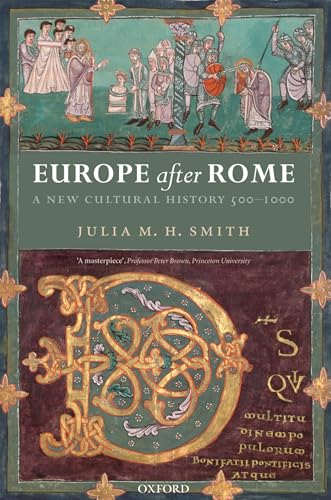
Synopsis
This is the first single-author study in over fifty years to offer an integrated appraisal of the early Middle Ages as a dynamic and formative period in European history. Written in an attractive and accessible style, it makes extensive use of original sources to introduce early medieval men and women at all levels of society from slave to emperor, and allows them to speak to the reader in their own words. It overturns traditional narratives and instead offers an entirely fresh approach to the centuries from c.500 to c.1000. Rejecting any notion of a dominant, uniform early medieval culture, it argues that the fundamental characteristic of the early middle ages is diversity of experience. To explain how the men and women who lived in this period ordered their world in cultural, social, and political terms, it employs an innovative methodology combining cultural history, regional studies, and gender history. Ranging comparatively from Ireland to Hungary and from Scotland and Scandinavia to Spain and Italy, the analysis highlights three themes: regional variation, power, and the legacy of Rome.
The book's eight chapters examine the following subjects: Speaking and Writing; Living and Dying; Friends and Relations; Men and Women; Labour and Lordship; Getting and Giving; Kingship and Christianity; Rome and the Peoples of Europe. Collectively, they establish the complex cultural realities which distinguished Europe in the period between the end of the central institutions of the western Roman empire in the fifth century and the emergence of a Rome-centred papal monarchy from the late eleventh century onwards. In the context of debates about the social, religious and cultural meaning of 'Europe' in the early twenty-first century, this books seeks the origins of European cultural pluralism and diversity in the early Middle Ages.
"synopsis" may belong to another edition of this title.
About the Authors
Julia Smith is a specialist on gender, religion, and politics in early medieval Europe. She holds the Edwards Chair in Medieval History at the University of Glasgow, having taught in the USA from 1986 to 1995 and at the University of St Andrews from 1995 to 2005. She is a Fellow of the Royal
Historical Society and has recently held research fellowships at the Netherlands Institute for Advanced Studies and the Shelby Cullom Davis Center at Princeton University.
Julia Smith is a specialist on gender, religion, and politics in early medieval Europe. She holds the Edwards Chair in Medieval History at the University of Glasgow, having taught in the USA from 1986 to 1995 and at the University of St Andrews from 1995 to 2005. She is a Fellow of the Royal Historical Society and has recently held research fellowships at the Netherlands Institute for Advanced Studies and the Shelby Cullom Davis Center at Princeton University.
"About this title" may belong to another edition of this title.
Search results for Europe after Rome: A New Cultural History 500-1000

Stock Image
Europe after Rome: A New Cultural History 500-1000
Published by
Oxford University Press, 2005
ISBN 10: 0199244278
ISBN 13: 9780199244270
Used
Hardcover
Seller: WorldofBooks, Goring-By-Sea, WS, United Kingdom
Seller rating 5 out of 5 stars

Hardback. Condition: Very Good. The book has been read, but is in excellent condition. Pages are intact and not marred by notes or highlighting. The spine remains undamaged. Seller Inventory # GOR004078571
Buy Used
£ 5.82
£ 5.60 shipping
Ships from United Kingdom to U.S.A.
Ships from United Kingdom to U.S.A.
Quantity: 3 available
Seller Image
Europe after Rome: A New Cultural History 500-1000
Seller: WeBuyBooks, Rossendale, LANCS, United Kingdom
Seller rating 5 out of 5 stars
hardcover. Condition: Very Good. Most items will be dispatched the same or the next working day. A copy that has been read, but is in excellent condition. Pages are intact and not marred by notes or highlighting. The spine remains undamaged. Seller Inventory # rev9056851913
Buy Used
£ 5.98
£ 8.19 shipping
Ships from United Kingdom to U.S.A.
Ships from United Kingdom to U.S.A.
Quantity: 1 available
Seller Image
Europe After Rome: A New Cultural History 500-1000
Published by
Oxford University Press, Oxford, England, 2007
ISBN 10: 0199244278
ISBN 13: 9780199244270
Used
Hardcover
Seller: Bay Used Books, Sudbury, ON, Canada
Seller rating 5 out of 5 stars
hardcover no dust jacket. Condition: Very Good. Very good condition. Light wear. Binding tight, pages clean. No dust jacket. Pictures available upon request. dw. Seller Inventory # 133262
Seller Image
Europe After Rome: A New Cultural History, 500-1000
Published by
Oxford University Press, 2005
ISBN 10: 0199244278
ISBN 13: 9780199244270
Used
Hardcover
First Edition
Seller: City Lights Bookshop, London, ON, Canada
Seller rating 5 out of 5 stars
Hardcover. Condition: Very Good. Dust Jacket Condition: Good. 1st Edition. Third printing. Light wear to edges of jacket with a small, barely perceptible slit to right side front. Light rubbing/bumping to edges of boards. Previous owner's stamp to front endpaper, interior otherwise clean and unmarked. Seller Inventory # ABE-1776196608969
Stock Image
Europe after Rome: A New Cultural History 500-1000
Published by
Oxford University Press, Oxford, 2005
ISBN 10: 0199244278
ISBN 13: 9780199244270
Used
Hardcover
First Edition
Seller: Salsus Books (P.B.F.A.), Kidderminster, United Kingdom
Seller rating 5 out of 5 stars
Hardcover. Condition: Very Good. Dust Jacket Condition: Very Good. 1st Edition. 398pp hardack, black boards gilt in wrapper, private bookplate. Seller Inventory # 077892
Stock Image
Europe after Rome: A New Cultural History 500-1000 (eng)
Print on DemandSeller: Brook Bookstore On Demand, Napoli, NA, Italy
Seller rating 5 out of 5 stars
Condition: new. Questo è un articolo print on demand. Seller Inventory # 5b31efb613fe9a0bf35d2552568de727
Buy New
£ 29.41
£ 6.77 shipping
Ships from Italy to U.S.A.
Ships from Italy to U.S.A.
Quantity: Over 20 available
Stock Image
Europe After Rome : A New Cultural History 500-1000
Seller: GreatBookPrices, Columbia, MD, U.S.A.
Seller rating 5 out of 5 stars
Condition: New. Seller Inventory # 3390869-n
Stock Image
Europe After Rome : A New Cultural History 500-1000
Published by
Oxford University Press, 2005
ISBN 10: 0199244278
ISBN 13: 9780199244270
Used
Hardcover
Seller: GreatBookPrices, Columbia, MD, U.S.A.
Seller rating 5 out of 5 stars
Condition: As New. Unread book in perfect condition. Seller Inventory # 3390869
Seller Image
Europe After Rome: A New Cultural History 500-1000
Published by
Oxford University Press, 2005
ISBN 10: 0199244278
ISBN 13: 9780199244270
Used
Hardcover
Seller: BBBooks, Poulton-Le-Fylde, United Kingdom
Seller rating 5 out of 5 stars
Hardcover. Condition: Near Fine. Bright and unmarked beneath printed pictorial boards. Minor redge wear only. (Please note: this is a 2007 OUP digital reprint, issued without a dust jacket.) Appears unread. Frontis, xiii, 384pp. Illustrated. Seller Inventory # 4863
Buy Used
£ 22
£ 18.50 shipping
Ships from United Kingdom to U.S.A.
Ships from United Kingdom to U.S.A.
Quantity: 1 available
Seller Image
Europe after Rome
Published by
Oxford University Press, GB, 2005
ISBN 10: 0199244278
ISBN 13: 9780199244270
New
Hardcover
Seller: Rarewaves.com USA, London, LONDO, United Kingdom
Seller rating 5 out of 5 stars
Hardback. Condition: New. This is the first single-author study in over fifty years to offer an integrated appraisal of the early Middle Ages as a dynamic and formative period in European history. Written in an attractive and accessible style, it makes extensive use of original sources to introduce early medieval men and women at all levels of society from slave to emperor, and allows them to speak to the reader in their own words. It overturns traditional narratives and instead offers an entirely fresh approach to the centuries from c.500 to c.1000. Rejecting any notion of a dominant, uniform early medieval culture, it argues that the fundamental characteristic of the early middle ages is diversity of experience. To explain how the men and women who lived in this period ordered their world in cultural, social, and political terms, it employs an innovative methodology combining cultural history, regional studies, and gender history. Ranging comparatively from Ireland to Hungary and from Scotland and Scandinavia to Spain and Italy, the analysis highlights three themes: regional variation, power, and the legacy of Rome. The book's eight chapters examine the following subjects: Speaking and Writing; Living and Dying; Friends and Relations; Men and Women; Labour and Lordship; Getting and Giving; Kingship and Christianity; Rome and the Peoples of Europe. Collectively, they establish the complex cultural realities which distinguished Europe in the period between the end of the central institutions of the western Roman empire in the fifth century and the emergence of a Rome-centred papal monarchy from the late eleventh century onwards. In the context of debates about the social, religious and cultural meaning of 'Europe' in the early twenty-first century, this books seeks the origins of European cultural pluralism and diversity in the early Middle Ages. Seller Inventory # LU-9780199244270
Buy New
£ 41.18
Free Shipping
Ships from United Kingdom to U.S.A.
Ships from United Kingdom to U.S.A.
Quantity: Over 20 available