
Items related to Partnerships In Birds: The Study of Monogamy (Oxford...
Synopsis
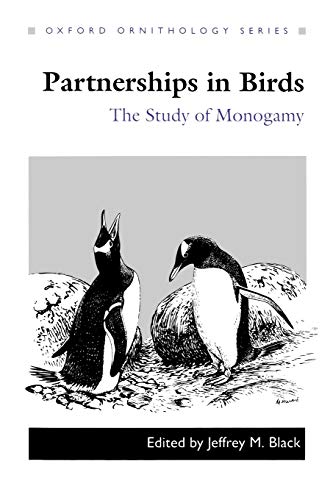
In pairs, male and female birds appear to work as a team, competing for food, defending nests, and protecting predators, but in fact, because each individual strives to maximize its own reproductive potential, conflicts can occur if one finds a better partner. So while some birds choose one mate for life, others have many partners. In this book, fourteen classic studies of bird behavior are brought together to compare the different partnership patterns from ecological and evolutionary perspectives. Particular attention is paid to the availability of mates, the selection process and the consequences of choosing one mate over another. By comparing between and within species, each chapter outlines the features that influence a pair's reproductive performance and how this interacts with ecological and environmental constraints. Introductory and concluding chapters review the latest thinking on this fascinating subject. The book is aimed at students and researchers in behavioral ecology but can also foster new insights for bird watchers and ornithologists.
"synopsis" may belong to another edition of this title.
From the Back Cover
Some birds mate for life, while others have many partners. Why? In this book, fourteen classic studies are brought together to compare different partnership patterns from ecological and evolutionary perspectives. The subjects have been chosen to include the same species living in different habitats (Sparrowhawks) and at different population densities (Great Tits). There are comparisons between closely related species (Mute Swans and Bewick's Swans; Florida Scrub Jays and Pinyon Jays). The studies span the globe and the behavioural gradient, from Iceland's strictly monogamous Whooper Swans to Australia's sexually promiscuous Splendid Fairy-wrens. In all cases, sexual and social relationships strongly influence a bird's survival and breeding success. Recent research has revealed an astonishing diversity in avian male-female relationships. Social monogamy and sexual fidelity are not necessarily the same thing, and birds have been shown to adopt many variations on this theme.
"About this title" may belong to another edition of this title.
Search results for Partnerships In Birds: The Study of Monogamy (Oxford...

Seller Image
Partnerships in Birds: The Study of Monogamy (Oxford Ornithology Series)
Published by
Oxford University Press, 1996
ISBN 10: 0198548605
ISBN 13: 9780198548607
Used
Softcover
Seller: -OnTimeBooks-, Phoenix, AZ, U.S.A.
Seller rating 5 out of 5 stars

Condition: good. Hulme, Mark (illustrator). A copy that has been read, remains in good condition. All pages are intact, and the cover is intact. The spine and cover show signs of wear. Pages can include notes and highlighting and show signs of wear, and the copy can include "From the library of" labels or previous owner inscriptions. 100% GUARANTEE! Shipped with delivery confirmation, if you're not satisfied with purchase please return item! Ships via media mail. Seller Inventory # OTV.0198548605.G
Seller Image
Partnerships in Birds: The Study of Monogamy (Oxford Ornithology Series)
Published by
Oxford University Press, 1996
ISBN 10: 0198548605
ISBN 13: 9780198548607
Used
Softcover
Seller: Solr Books, Lincolnwood, IL, U.S.A.
Seller rating 5 out of 5 stars
Condition: good. Hulme, Mark (illustrator). This book is in Good condition. There may be some notes and highligting but otherwise the book is in overall good condition. Seller Inventory # BCV.0198548605.G
Stock Image
Partnerships In Birds: The Study of Monogamy (Oxford Ornithology Series): 6
Published by
Oxford University Press, U.S.A., 2004
ISBN 10: 0198548605
ISBN 13: 9780198548607
Used
Soft cover
Seller: Hard To Find Editions, Bristol, AVON, United Kingdom
Seller rating 5 out of 5 stars
Soft cover. Condition: Good. Hulme, Mark (illustrator). This book has been read. Front cover creased to its top corner. Bottom edges of first few pages a little crumpled. Rear cover has slight creasing. However all pages intact with no highlighting or writing contained within. The spine remains undamaged with tight binding and the book is generally in good condition. Fast dispatch within and from the UK. 100% money back guarantee. Seller Inventory # ABE-1689329735056
Buy Used
£ 22.87
£ 48 shipping
Ships from United Kingdom to U.S.A.
Ships from United Kingdom to U.S.A.
Quantity: 1 available
Stock Image
Partnerships in Birds: The Study of Monogamy (Oxford Ornithology Series)
Seller: BennettBooksLtd, Los Angeles, CA, U.S.A.
Seller rating 5 out of 5 stars
paperback. Condition: New. Hulme, Mark (illustrator). In shrink wrap. Looks like an interesting title! Seller Inventory # Q-0198548605
Stock Image
Partnerships in Birds: The Study of Monogamy (eng)
Print on DemandSeller: Brook Bookstore On Demand, Napoli, NA, Italy
Seller rating 5 out of 5 stars
Condition: new. Hulme, Mark (illustrator). Questo è un articolo print on demand. Seller Inventory # a9978ca60dab70ab3354aa1d39fcfe80
Seller Image
Partnerships in Birds : The Ecology of Monogamy
Seller: GreatBookPrices, Columbia, MD, U.S.A.
Seller rating 5 out of 5 stars
Condition: New. Hulme, Mark (illustrator). Seller Inventory # 79749-n
Stock Image
Partnerships in Birds: The Study of Monogamy (Oxford Ornithology Series)
Seller: SHIMEDIA, Brooklyn, NY, U.S.A.
Seller rating 4 out of 5 stars

Condition: New. Hulme, Mark (illustrator). Satisfaction Guaranteed or your money back. Seller Inventory # 0198548605
Stock Image
Partnerships in Birds
Print on DemandSeller: PBShop.store UK, Fairford, GLOS, United Kingdom
Seller rating 5 out of 5 stars
PAP. Condition: New. Hulme, Mark (illustrator). New Book. Delivered from our UK warehouse in 4 to 14 business days. THIS BOOK IS PRINTED ON DEMAND. Established seller since 2000. Seller Inventory # L0-9780198548607
Buy New
£ 99.60
£ 5.87 shipping
Ships from United Kingdom to U.S.A.
Ships from United Kingdom to U.S.A.
Quantity: Over 20 available
Seller Image
Partnerships in Birds : The Ecology of Monogamy
Seller: GreatBookPricesUK, Woodford Green, United Kingdom
Seller rating 5 out of 5 stars
Condition: New. Hulme, Mark (illustrator). Seller Inventory # 79749-n
Buy New
£ 91.32
£ 15 shipping
Ships from United Kingdom to U.S.A.
Ships from United Kingdom to U.S.A.
Quantity: Over 20 available
Seller Image
Partnerships in Birds : The Ecology of Monogamy
Published by
Oxford University Press, 1996
ISBN 10: 0198548605
ISBN 13: 9780198548607
Used
Softcover
Seller: GreatBookPrices, Columbia, MD, U.S.A.
Seller rating 5 out of 5 stars
Condition: As New. Hulme, Mark (illustrator). Unread book in perfect condition. Seller Inventory # 79749