
Items related to The Argument from Injustice: A Reply to Legal Positivism...
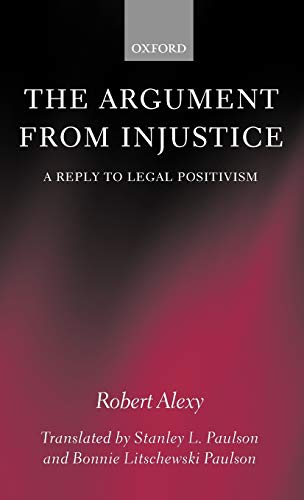
Synopsis
At the heart of this book is the age-old question of how law and morality are related. The legal positivist, insisting on the separation of the two, explicates the concept of law independently of morality. The author challenges this view, arguing that there are, first, conceptually necessary connections between law and morality and, second, normative reasons for including moral elements in the concept of law. While the conceptual argument alone is too limited to establish a sufficiently strong connection between law and morality, and the normative argument alone fails to address the nature of law, the two arguments together support a nonpositivistic concept of law, toppling legal positivism qua comprehensive theory of law.
The author makes his case within a conceptual framework of five distinctions that can be variously combined to represent a multiplicity of presuppositions or perspectives underlying the enquiry into the relationship of law and morality. In this context, it can indeed be shown that there are perspectives that bespeak solely a positivistic concept of law. The decisive point, however, is that there is a perspective, necessary to the law, that necessarily presupposes a nonpositivistic concept of law. This is the perspective of a participant in the legal system, asking for the correct answer to a legal question in this legal system. The participant-thesis is demonstrated by appeal to Gustav Radbruch's formula (extreme injustice is not law) and to the judge's balancing of principles in deciding a concrete case. The author arrives at a concept of law that systematically links classical elements of legal positivism - authoritative issuance and social efficacy - with the desideratum of nonpositivistic legal theory, correctness of content.
"synopsis" may belong to another edition of this title.
About the Author
Robert Alexy has been Professor of Law, Christian Albrechts University Kiel, since 1986. He was Dean of the Faculty of Law, Kiel, 1998-2000. He was President from1994 until 1998, of the German Section of the International Association for Philosophy of Law and Social Philosophy (IVR).
"About this title" may belong to another edition of this title.
Search results for The Argument from Injustice: A Reply to Legal Positivism...

Stock Image
The Argument from Injustice : A Reply to Legal Positivism
Published by
Oxford University Press, Incorporated, 2003
ISBN 10: 0198259875
ISBN 13: 9780198259879
Used
Hardcover
Seller: Better World Books Ltd, Dunfermline, United Kingdom
Seller rating 5 out of 5 stars

Condition: Good. Pages intact with minimal writing/highlighting. The binding may be loose and creased. Dust jackets/supplements are not included. Stock photo provided. Product includes identifying sticker. Better World Books: Buy Books. Do Good. Seller Inventory # 56105728-20
Buy Used
£ 41.62
£ 5 shipping
Ships from United Kingdom to U.S.A.
Ships from United Kingdom to U.S.A.
Quantity: 1 available
Seller Image
The Argument from Injustice (Hardcover)
Published by
Oxford University Press, Oxford, 2002
ISBN 10: 0198259875
ISBN 13: 9780198259879
New
Hardcover
Seller: AussieBookSeller, Truganina, VIC, Australia
Seller rating 5 out of 5 stars
Hardcover. Condition: new. Hardcover. At the heart of this book is the age-old question of how law and morality are related. The legal positivist, insisting on the separation of the two, explicates the concept of law independently of morality. The author challenges this view, arguing that there are, first, conceptually necessary connections between law and morality and, second, normative reasons for including moral elements in the concept of law. While the conceptual argument alone is too limited toestablish a sufficiently strong connection between law and morality, and the normative argument alone fails to address the nature of law, the two arguments together support a nonpositivistic concept oflaw, toppling legal positivism qua comprehensive theory of law.The author makes his case within a conceptual framework of five distinctions that can be variously combined to represent a multiplicity of presuppositions or perspectives underlying the enquiry into the relationship of law and morality. In this context, it can indeed be shown that there are perspectives that bespeak solely a positivistic concept of law. The decisive point, however, is that there is aperspective, necessary to the law, that necessarily presupposes a nonpositivistic concept of law. This is the perspective of a participant in the legal system, asking for the correct answer to a legalquestion in this legal system. The participant-thesis is demonstrated by appeal to Gustav Radbruch's formula (extreme injustice is not law) and to the judge's balancing of principles in deciding a concrete case. The author arrives at a concept of law that systematically links classical elements of legal positivism - authoritative issuance and social efficacy - with the desideratum of nonpositivistic legal theory, correctness of content. At the heart of this book is the age-old question of how law and morality are related. The author challenges this view, arguing that there are, first, conceptually necessary connections between law and morality and, second, normative reasons for including moral elements in the concept of law. This item is printed on demand. Shipping may be from our Sydney, NSW warehouse or from our UK or US warehouse, depending on stock availability. Seller Inventory # 9780198259879
Stock Image
The Argument from Injustice: A Reply to Legal Positivism (eng)
Print on DemandSeller: Brook Bookstore On Demand, Napoli, NA, Italy
Seller rating 5 out of 5 stars
Condition: new. Questo è un articolo print on demand. Seller Inventory # 827960fe0bb73e2b4d9f90b84e44ab5e
Buy New
£ 162.31
£ 4.64 shipping
Ships from Italy to U.S.A.
Ships from Italy to U.S.A.
Quantity: Over 20 available
Seller Image
Argument from Injustice : A Reply to Legal Positivism
Seller: GreatBookPrices, Columbia, MD, U.S.A.
Seller rating 5 out of 5 stars
Condition: New. Seller Inventory # 1385365-n
Seller Image
Argument from Injustice : A Reply to Legal Positivism
Seller: GreatBookPricesUK, Woodford Green, United Kingdom
Seller rating 5 out of 5 stars
Condition: New. Seller Inventory # 1385365-n
Buy New
£ 164.62
£ 15 shipping
Ships from United Kingdom to U.S.A.
Ships from United Kingdom to U.S.A.
Quantity: Over 20 available
Stock Image
The Argument from Injustice
Print on DemandSeller: PBShop.store UK, Fairford, GLOS, United Kingdom
Seller rating 5 out of 5 stars
HRD. Condition: New. New Book. Delivered from our UK warehouse in 4 to 14 business days. THIS BOOK IS PRINTED ON DEMAND. Established seller since 2000. Seller Inventory # L1-9780198259879
Buy New
£ 183.66
£ 4.16 shipping
Ships from United Kingdom to U.S.A.
Ships from United Kingdom to U.S.A.
Quantity: Over 20 available
Seller Image
Argument from Injustice : A Reply to Legal Positivism
Published by
Oxford University Press, 2003
ISBN 10: 0198259875
ISBN 13: 9780198259879
Used
Hardcover
Seller: GreatBookPrices, Columbia, MD, U.S.A.
Seller rating 5 out of 5 stars
Condition: As New. Unread book in perfect condition. Seller Inventory # 1385365
Stock Image
The Argument from Injustice
Print on DemandSeller: PBShop.store US, Wood Dale, IL, U.S.A.
Seller rating 5 out of 5 stars
HRD. Condition: New. New Book. Shipped from UK. THIS BOOK IS PRINTED ON DEMAND. Established seller since 2000. Seller Inventory # L1-9780198259879
Seller Image
The Argument from Injustice (Hardcover)
Published by
Oxford University Press, Oxford, 2002
ISBN 10: 0198259875
ISBN 13: 9780198259879
New
Hardcover
Seller: Grand Eagle Retail, Bensenville, IL, U.S.A.
Seller rating 5 out of 5 stars
Hardcover. Condition: new. Hardcover. At the heart of this book is the age-old question of how law and morality are related. The legal positivist, insisting on the separation of the two, explicates the concept of law independently of morality. The author challenges this view, arguing that there are, first, conceptually necessary connections between law and morality and, second, normative reasons for including moral elements in the concept of law. While the conceptual argument alone is too limited toestablish a sufficiently strong connection between law and morality, and the normative argument alone fails to address the nature of law, the two arguments together support a nonpositivistic concept oflaw, toppling legal positivism qua comprehensive theory of law.The author makes his case within a conceptual framework of five distinctions that can be variously combined to represent a multiplicity of presuppositions or perspectives underlying the enquiry into the relationship of law and morality. In this context, it can indeed be shown that there are perspectives that bespeak solely a positivistic concept of law. The decisive point, however, is that there is aperspective, necessary to the law, that necessarily presupposes a nonpositivistic concept of law. This is the perspective of a participant in the legal system, asking for the correct answer to a legalquestion in this legal system. The participant-thesis is demonstrated by appeal to Gustav Radbruch's formula (extreme injustice is not law) and to the judge's balancing of principles in deciding a concrete case. The author arrives at a concept of law that systematically links classical elements of legal positivism - authoritative issuance and social efficacy - with the desideratum of nonpositivistic legal theory, correctness of content. At the heart of this book is the age-old question of how law and morality are related. The author challenges this view, arguing that there are, first, conceptually necessary connections between law and morality and, second, normative reasons for including moral elements in the concept of law. This item is printed on demand. Shipping may be from multiple locations in the US or from the UK, depending on stock availability. Seller Inventory # 9780198259879
Seller Image
Argument from Injustice : A Reply to Legal Positivism
Published by
Oxford University Press, 2003
ISBN 10: 0198259875
ISBN 13: 9780198259879
Used
Hardcover
Seller: GreatBookPricesUK, Woodford Green, United Kingdom
Seller rating 5 out of 5 stars
Condition: As New. Unread book in perfect condition. Seller Inventory # 1385365
Buy Used
£ 190.34
£ 15 shipping
Ships from United Kingdom to U.S.A.
Ships from United Kingdom to U.S.A.
Quantity: Over 20 available