
Items related to Preaching in the Last Days: The Theme of `Two Witnesses'...
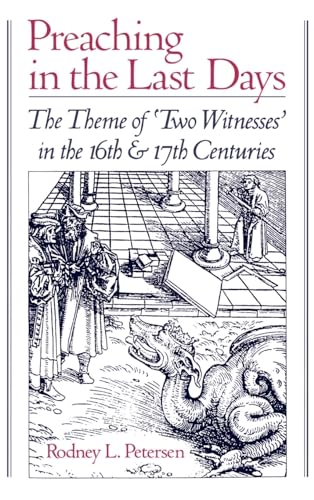
Preaching in the Last Days: The Theme of `Two Witnesses' in the Sixteenth and Seventeenth Centuries - Hardcover
Synopsis
Among the enigmatic prophecies of the Book of Revelation is a passage (11.3-13) concerning `two witnesses' who will appear in the dark days of the church to preach or prophesy with powers like those of the prophets of ancient Israel. In this book Rodney Petersen presents an exhaustive examination of the treatment of this passage by interpreters from medieval times to the Protestant Reformation.
Petersen demonstrates that speculation on the identity and theological meaning of the two witnesss has abounded since the days of the early church. They have been linked to a time of culminating evil, the final proclamation of hope, and the end of history associated with divine judgement. Such speculation found ample expression in medieval literature, art and drama. In the writings of the reformers, however, the witnesses acquired increased social implications. The sixteenth and seventeenth centuries saw a proliferation of commentaries on the Apocalypse, in which reformist exegetes appropriated the image of the witnesses to their own movement, often identifying them with specific contemporary figures or using them to predict a future in tune with their hopes for the Protestant movement. Finally, Petersen shows, the theme of the two witnesses inspired and sustained those who carried the Puritan message into the New World, and features in the writings of such leading New England divines as Cotton Mather and Jonathan Edwards.
"synopsis" may belong to another edition of this title.
About the Author
Rodney L. Petersen is Executive Director of the Boston Theological Institute (BTI), Adjunct Professor of Church History at several BTI member schools, and Adjunct Professor in the Department of Management and Human Resource Development at Webster University in Geneva, Switzerland.
From the Back Cover
Reform-minded movements have long appealed to the Apocalypse, for it served to whet the visionary appetite. Early in the church's history speculation grew up around the text - Revelation 11:3-13 - depicting two witnesses, or prophets, who preach at the end of history against the beast from the abyss, the epitome of evil, called Antichrist. Different interpretive methodologies have discovered different meanings in the text, and a symbolic value for political or ecclesial reform has been identified with it throughout the history of its use. The witnesses have been linked to a time of culminating evil, to the final proclamation of hope, and to the end of history associated with divine judgment. Such speculation found ample expression in medieval literature, art, and drama. In the writings of reformers, however, the story acquired increased social implications. The text of the Apocalypse came to lend visionary strength to Protestant piety, polity, and political activity, and the adventual witnesses became increasingly visible in Protestant polemics. Anglo-American commentators, in particular, have used the text both for self-identity and as part of a formula for plotting the onset of Christ's millennial reign. Tracing the history of how the Apocalypse was read, Preaching in the Last Days sheds light on how social groups are formed through ideas occasioned by texts. Petersen's study provides a fascinating look at the theological significance of how we read biblical texts and offers new insights on the development of culture, the Christian movement, and its churches. The book has added importance for understanding the assumptions behind the ways in which the book of Revelation is read andused in our own day.
"About this title" may belong to another edition of this title.
Search results for Preaching in the Last Days: The Theme of `Two Witnesses'...

Seller Image
Preaching in the Last Days: The Theme of "Two Witnesses" in the 16th and 17th Centuries
Published by
Oxford University Press, 1993
ISBN 10: 0195073746
ISBN 13: 9780195073744
Used
Hardcover
Seller: -OnTimeBooks-, Phoenix, AZ, U.S.A.
Seller rating 5 out of 5 stars

Condition: good. A copy that has been read, remains in good condition. All pages are intact, and the cover is intact. The spine and cover show signs of wear. Pages can include notes and highlighting and show signs of wear, and the copy can include "From the library of" labels or previous owner inscriptions. 100% GUARANTEE! Shipped with delivery confirmation, if you're not satisfied with purchase please return item! Ships via media mail. Seller Inventory # OTV.0195073746.G
Stock Image
Preaching in the Last Days: The Theme of "Two Witnesses" in the 16th and 17th Centuries
Published by
Oxford University Press, 1993
ISBN 10: 0195073746
ISBN 13: 9780195073744
Used
Hardcover
Seller: MyLibraryMarket, Waynesville, OH, U.S.A.
Seller rating 5 out of 5 stars
Hardcover. Condition: Very Good. ***Please Read*** Light wear to DJ - No marks on text - My shelf location 18-e-8*. Seller Inventory # 231031025
Stock Image
Preaching in the Last Days: The Theme of 'Two Witnesses' in the Sixteenth and Seventeenth Centuries
Published by
Oxford University Press, 1993
ISBN 10: 0195073746
ISBN 13: 9780195073744
Used
Hardcover
Seller: Anybook.com, Lincoln, United Kingdom
Seller rating 5 out of 5 stars
Condition: Good. This is an ex-library book and may have the usual library/used-book markings inside.This book has hardback covers. In good all round condition. Dust jacket in good condition. Please note the Image in this listing is a stock photo and may not match the covers of the actual item,850grams, ISBN:9780195073744. Seller Inventory # 8696515
Buy Used
£ 62.20
£ 13.60 shipping
Ships from United Kingdom to U.S.A.
Ships from United Kingdom to U.S.A.
Quantity: 1 available
Seller Image
Preaching in the Last Days _ The Theme of 'Two Witnesses' in the 16th & 17th Centuries
Published by
Oxford University Press, New York, 1993
ISBN 10: 0195073746
ISBN 13: 9780195073744
Used
Hardcover
Seller: San Francisco Book Company, Paris, France
Seller rating 4 out of 5 stars

Hardcover. Condition: Very good. Dust Jacket Condition: very good. Cloth/dust jacket Octavo. gray cloth, black lettering, dust jacket, 318 pp. Seller Inventory # 113164
Stock Image
Preaching in the Last Days: The Theme of "Two Witnesses" in the 16th and 17th Centuries
Seller: BennettBooksLtd, Los Angeles, CA, U.S.A.
Seller rating 5 out of 5 stars
hardcover. Condition: New. In shrink wrap. Looks like an interesting title! Seller Inventory # Q-0195073746
Stock Image
Preaching in the Last Days: The Theme of `Two Witnesses' in the Sixteenth and Seventeenth Centuries (eng)
Print on DemandSeller: Brook Bookstore On Demand, Napoli, NA, Italy
Seller rating 5 out of 5 stars
Condition: new. Questo è un articolo print on demand. Seller Inventory # e922ae6cef3969a7cd98eb265374de41
Buy New
£ 118.33
£ 5.84 shipping
Ships from Italy to U.S.A.
Ships from Italy to U.S.A.
Quantity: Over 20 available
Stock Image
Preaching in the Last Days
Print on DemandSeller: PBShop.store UK, Fairford, GLOS, United Kingdom
Seller rating 5 out of 5 stars
HRD. Condition: New. New Book. Delivered from our UK warehouse in 4 to 14 business days. THIS BOOK IS PRINTED ON DEMAND. Established seller since 2000. Seller Inventory # L1-9780195073744
Buy New
£ 142.51
£ 5.87 shipping
Ships from United Kingdom to U.S.A.
Ships from United Kingdom to U.S.A.
Quantity: Over 20 available
Stock Image
Preaching in the Last Days: The Theme of "Two Witnesses" in the 16th and 17th Centuries
Seller: Ria Christie Collections, Uxbridge, United Kingdom
Seller rating 5 out of 5 stars
Condition: New. In. Seller Inventory # ria9780195073744_new
Buy New
£ 140.09
£ 11.98 shipping
Ships from United Kingdom to U.S.A.
Ships from United Kingdom to U.S.A.
Quantity: Over 20 available
Seller Image
Preaching in the Last Days : The Theme of 'Two Witnesses' in the Sixteenth and Seventeenth Centuries
Seller: GreatBookPrices, Columbia, MD, U.S.A.
Seller rating 5 out of 5 stars
Condition: New. Seller Inventory # 64946-n
Stock Image
Preaching in the Last Days
Print on DemandSeller: PBShop.store US, Wood Dale, IL, U.S.A.
Seller rating 5 out of 5 stars
HRD. Condition: New. New Book. Shipped from UK. THIS BOOK IS PRINTED ON DEMAND. Established seller since 2000. Seller Inventory # L1-9780195073744