
Items related to Meaning Of Meaning: A Study of the Influence of Language...
Meaning Of Meaning: A Study of the Influence of Language upon Thought and of the Science of Symbolism - Softcover
Synopsis
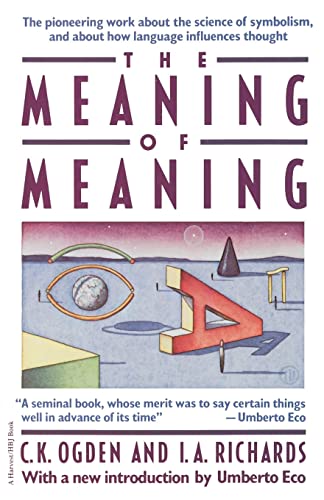
"Language is the most important of all the instruments of civilization." The authors state this premise boldly in their preface to "The Meaning of Meaning," a classic work whose significance--and challenge--to the study of language, literature, and philosophy has remained undiminished since its original publication.
Much about language continues to be only hazily understood, distorted by our habitual attitude--often one of indifference--toward words, or by lingering assumptions based on discredited theories. What IS the relationship between words and what the words refer to? Between words and the way we think? Can understanding such matters lead to greater precision in communication? Readers considering these questions find themselves at the crossroads of linguistics and communications theory, of literary criticism and philosophy--an interdisciplinary nexus claimed by the increasingly influential field of semiotics--and "The Meaning of Meaning" will prove, as it has over the last six decades, an essential resource.
In his introduction Umberto Eco, emininent novelist and, not coincidentally, semiotician, provides a fascinating perspective on this pioneering work that continues to disturb intellectual complacency and provoke thought and discussion.
"synopsis" may belong to another edition of this title.
From the Back Cover
"Language is the most important of all the instruments of civilization." The authors state this premise boldly in their preface to "The Meaning of Meaning," a classic work whose significance--and challenge--to the study of language, literature, and philosophy has remained undiminished since its original publication.
Much about language continues to be only hazily understood, distorted by our habitual attitude--often one of indifference--toward words, or by lingering assumptions based on discredited theories. What IS the relationship between words and what the words refer to? Between words and the way we think? Can understanding such matters lead to greater precision in communication? Readers considering these questions find themselves at the crossroads of linguistics and communications theory, of literary criticism and philosophy--an interdisciplinary nexus claimed by the increasingly influential field of semiotics--and "The Meaning of Meaning" will prove, as it has over the last six decades, an essential resource.
In his introduction Umberto Eco, emininent novelist and, not coincidentally, semiotician, provides a fascinating perspective on this pioneering work that continues to disturb intellectual complacency and provoke thought and discussion.
"About this title" may belong to another edition of this title.
Search results for Meaning Of Meaning: A Study of the Influence of Language...

Stock Image
Meaning Of Meaning
Seller: HPB Inc., Dallas, TX, U.S.A.
Seller rating 5 out of 5 stars

Paperback. Condition: Very Good. Connecting readers with great books since 1972! Used books may not include companion materials, and may have some shelf wear or limited writing. We ship orders daily and Customer Service is our top priority! Seller Inventory # S_472239158
Stock Image
Meaning of Meaning
Seller: World of Books (was SecondSale), Montgomery, IL, U.S.A.
Seller rating 5 out of 5 stars
Paperback. Condition: Fair. Language is the most important of all the instruments of civilization. This is the premise of a work whose significance to the study of language, literature, and philosophy has remained undiminished since its original publication in 1923. New Introduction by Umberto Eco; Indices. Seller Inventory # 00106808889
Stock Image
Meaning of Meaning
Seller: World of Books (was SecondSale), Montgomery, IL, U.S.A.
Seller rating 5 out of 5 stars
Paperback. Condition: Good. Language is the most important of all the instruments of civilization. This is the premise of a work whose significance to the study of language, literature, and philosophy has remained undiminished since its original publication in 1923. New Introduction by Umberto Eco; Indices. Seller Inventory # 00105491533
Stock Image
Meaning Of Meaning
Seller: HPB-Emerald, Dallas, TX, U.S.A.
Seller rating 5 out of 5 stars
Paperback. Condition: Very Good. Connecting readers with great books since 1972! Used books may not include companion materials, and may have some shelf wear or limited writing. We ship orders daily and Customer Service is our top priority! Seller Inventory # S_478978836
Stock Image
Meaning of Meaning
Seller: World of Books Inc, Montgomery, IL, U.S.A.
Seller rating 4 out of 5 stars

Paperback. Condition: Good. Language is the most important of all the instruments of civilization. This is the premise of a work whose significance to the study of language, literature, and philosophy has remained undiminished since its original publication in 1923. New Introduction by Umberto Eco; Indices. Seller Inventory # CIN0156584468G
Stock Image
Meaning of Meaning
Seller: World of Books Inc, Montgomery, IL, U.S.A.
Seller rating 4 out of 5 stars
Paperback. Condition: Fair. Language is the most important of all the instruments of civilization. This is the premise of a work whose significance to the study of language, literature, and philosophy has remained undiminished since its original publication in 1923. New Introduction by Umberto Eco; Indices. Seller Inventory # CIN0156584468A
Stock Image
Meaning Of Meaning
Seller: HPB-Ruby, Dallas, TX, U.S.A.
Seller rating 5 out of 5 stars
Paperback. Condition: Very Good. Connecting readers with great books since 1972! Used books may not include companion materials, and may have some shelf wear or limited writing. We ship orders daily and Customer Service is our top priority! Seller Inventory # S_484420496
Stock Image
Meaning Of Meaning
Seller: Midtown Scholar Bookstore, Harrisburg, PA, U.S.A.
Seller rating 5 out of 5 stars
Paperback. Condition: Very Good. Very Good paperback with light shelfwear - NICE! Standard-sized. Seller Inventory # mon0000352586
Stock Image
Meaning Of Meaning
Seller: Lakeside Books, Benton Harbor, MI, U.S.A.
Seller rating 5 out of 5 stars
Condition: New. Brand New! Not Overstocks or Low Quality Book Club Editions! Direct From the Publisher! We're not a giant, faceless warehouse organization! We're a small town bookstore that loves books and loves it's customers! Buy from Lakeside Books! Seller Inventory # OTF-S-9780156584463
Seller Image
Meaning of Meaning : A Study of the Influence of Language upon Thought and of the Science of Symbolism
Seller: GreatBookPrices, Columbia, MD, U.S.A.
Seller rating 5 out of 5 stars
Condition: New. Seller Inventory # 639565-n